To write a bass line, put the root of each chord on the beat where that chord starts, give each bar one or two notes, fill the gaps with the root's octave or the fifth, and save stepping notes for the moment before a chord change. In Song Cage's count of 880 professionally arranged pop songs from the POP909 dataset, the bass landed on the root at 88.6% of chord changes.
Most advice on bass lines is a list of things you could do: passing notes, chromatic approaches, inversions, syncopation. All true, and none of it tells you how often any of it happens. So we counted. We took a public set of 909 pop songs arranged by professional musicians, read the lowest note of each piano arrangement at every chord change, and tallied what it was. The answer is plainer than most lessons suggest, and that's useful, because a plain bass line is the one that makes your chords sound like themselves.
What the bass does in 880 pop arrangements
Song Cage counted 101,746 chord changes and 29,621 one-chord bars in the POP909 dataset.
What is a bass line?
A bass line is the lowest part in a piece of music: the line, usually one note at a time, that tells the ear which chord is playing and where the beat falls. In pop it's played on a bass guitar, a synth or a piano's left hand, and it mostly plays the root of each chord.
Wikipedia's definition covers every style at once: the "low-pitched instrumental part or line" played by an electric bass, double bass, cello, tuba or keyboard. It notes that bass lines usually emphasize chord tones (the root, third or fifth), that they "align or syncopate with the drums", and that they sit roughly "at least an octave and a half below middle C".
That gives a bass line two jobs. The first is harmonic: the bass note is the one the ear uses to name the chord, which is why a C chord with E in the bass sounds like a different chord from the same notes with C underneath (more on that in chord inversions). The second is rhythmic: the bass and the kick drum share the low end, so where the bass notes fall decides how the groove feels. A good bass line does both jobs without drawing attention to itself, and the numbers below show how little it takes.
How did we measure what a bass line plays?
We used POP909, a dataset released at the ISMIR 2020 conference by researchers at NYU Shanghai and other universities. According to the paper, it holds piano arrangements of 909 popular songs by 462 artists, released from the 1950s to around 2010. The songs are Chinese-language pop, so read the numbers as one big tradition of pop arranging, not a census of every style. The arrangements were written by hired professional musicians and checked by a second team of reviewers before a version was accepted.
How the count works
Each song has a piano accompaniment track, lined up with the original recording, plus beat and chord labels. We took the lowest note of the piano track at each moment as the bass, kept the 880 songs in 4/4, and compared that note with the chord above it.
Limits worth knowing: the songs are Chinese-language pop; the bass here is a pianist's left hand, not a bass guitar track; the set has no drums; and the chord labels were extracted by software from the arrangements, not written by hand.
Those limits matter. A bass player on a record may add slides, ghost notes and fills that a piano left hand rarely plays. What the count does show is the skeleton: which note goes under which chord, and when, in arrangements written by people paid to make songs sound finished.
How do you write a bass line, step by step?
Write the bass line after the chords and before anything fancy. The steps below run in the order a bass player would think about them, and each one comes with what the 880 arrangements did.
Step 1: Know the chords before you write the bass
A bass line describes a chord progression, so you need the progression first, with the beat each chord starts on. If you've got chord symbols, the bass note is already written into them: the root of C is C, the root of Am is A, and a slash chord like G/B tells you to play B. If you've got a melody but no chords yet, harmonize it first (how to harmonize a melody walks through it), or build the progression from scratch with how to write a chord progression.
Mark where each chord starts. In a lot of pop that's beat one of every bar, or beats one and three when the chords move twice a bar. Those are the moments the bass line has to get right. Everything between them is decoration, and as the next steps show, pop arrangements use far less decoration than you might expect.
Step 2: What note should the bass play on each chord change?
On each chord change, play the chord's root. In Song Cage's count of 101,746 chord changes in the POP909 pop arrangements, the bass landed on the root 88.6% of the time. The third came next at 4.3%, then the fifth at 3.3%, the seventh at 2.0% and any other note at 1.8%.
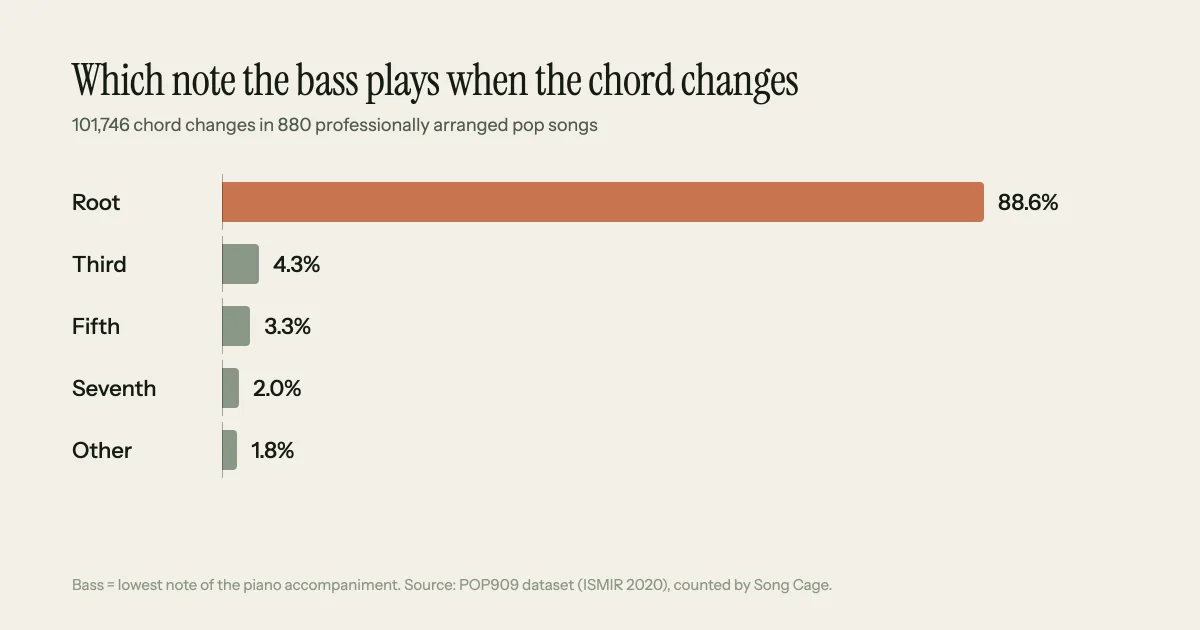
When the chord changes, the ear wants to hear its name, and the root is its name. Playing it on the change is what makes a progression sound like that progression instead of a blur of notes.
It holds even when the root is a long way off. Where the new root was a leap from the previous chord's bass note and the new chord's third or fifth sat just a step away, the arrangers still took the root 76% of the time. A smooth line is a choice they made now and then, not the default. So the first draft of any bass line is simple: one root on the downbeat of every chord. Play it against the song before you add anything, because often that's most of the part.
Step 3: How many notes should the bass play in a bar?
Fewer than you think: a pop bass line usually plays one or two notes a bar. In Song Cage's POP909 count, under chords lasting a bar or more, 28.6% got one bass note per bar and 31.1% got two, and four notes or fewer covered 91%. Busy eighth-note lines exist, but they're the exception in pop.
The rhythms were just as plain. Of the 29,621 bars that stayed on one chord, these were the most common:
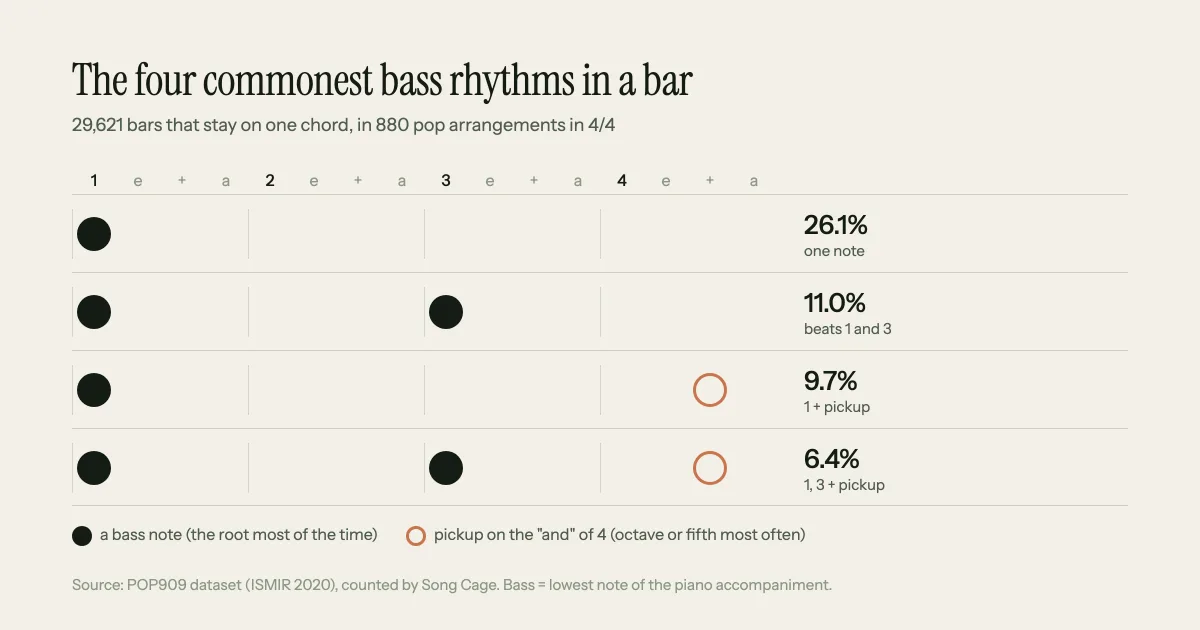
| Bass rhythm in one bar of 4/4 | Share of bars |
|---|---|
| One note on beat 1 | 26.1% |
| Beats 1 and 3 | 11.0% |
| Beat 1, then the "and" of 4 | 9.7% |
| Beats 1 and 3, then the "and" of 4 | 6.4% |
Bars that stay on one chord in 880 POP909 songs in 4/4. The rest spread across hundreds of rarer rhythms.
The note on the "and" of four is the pickup: a short note just before the next bar that pushes the line forward. It turns a held root into something that sounds like a part. If your bass line feels static, try adding that one note before you add anything else.
Step 4: Which notes go between the chord changes?
Once the chord has started, the bass has more freedom, and the arrangers used it in a clear order. Of the 112,735 notes the bass played after the first note of a chord, 58.9% were the root again, 21.1% were the fifth and 11.5% were the third. The seventh and notes outside the chord took 3.4% each.
When the bass came back to the root it started the chord on, it often jumped an octave: 44.1% of those repeats were the root an octave away rather than the same note. Root, octave and fifth are the bass player's safe notes because they stay the same whether the chord is major or minor: the fifth of C major and C minor is the same G, and only the third tells major from minor. So if you want movement inside a bar without risking a clash with the chords or the melody, go to the octave or the fifth first.
Outside notes are rare but real. A note that steps between two chord tones is a passing note, and the non-chord tones post covers when a note outside the chord still sounds right. In a bass line, keep them short and off the beat, and let them move on straight away.
Step 5: How does the bass move into the next chord?
In pop, the bass rarely steps into the next chord. In Song Cage's POP909 count, at 51.2% of chord changes the bass struck no new note in the final beat before the change, and at 42.0% it played a note from the old chord. Only 4.8% of changes were approached by a step, a half or whole step, into the new bass note.
That's low for a move walking-bass lessons build on: the approach note, a half step below or above the next root, is the signature of a jazz walking line (below). In these pop arrangements, stepping into the change at all is rare.
What the arrangers did instead was pick up with a note from the chord they were leaving. When the pickup before a new chord was the root, it jumped up an octave from the note before it 53.9% of the time. Otherwise it was usually the fifth (25.3% of all pickups before a change) or the third (16.4%). So the classic pop move is root on one, maybe root on three, then the octave or the fifth on the "and" of four, then the next root. If you want a lead-in, use it as a spice at the end of a phrase, not on every change.
Step 6: When should the bass leave the root?
Put the third or fifth in the bass when you want the line to move by step. That's an inversion, written as a slash chord: C/E means a C chord over an E bass. In our count, 4.3% of changes put the third in the bass and 3.3% the fifth. When the arrangers left the root on a change, the most common shape (23.1% of those changes) stepped in from the previous chord's bass note and stepped out to the next chord's. The textbook case is C to G/B to Am: a bass that walks C, B, A while the chords above barely move.
Procol Harum's "A Whiter Shade of Pale" is built on that idea. Gary Brooker has said he started out trying to play Bach's Air on the G String, and in his words, "The bass line I had just kept going down." As Ethan Hein describes it, the song is in C and the bass walks down the C major scale. The chord inversions post shows how to build a stepwise bass like this from any progression.
Step 7: Fit the rhythm to the drums
POP909 has no drum tracks, so this step comes from practice rather than our count. Ableton's Learning Music puts it simply: bass lines reinforce the chords "while also using interesting rhythmic patterns that relate to or contrast with the drums." MasterClass names syncing with the kick drum as part of what a good bass line does. A practical way in: put bass notes where the kick hits, so the two sound like one low instrument, then decide where the bass should play against the kick instead.
The piano left hands we measured already lean off the beat. Of the notes after a chord's first one, 42.9% fell on an "and" and 34.3% on a beat. The "and" is where a bass line gets its push. If you're working in a DAW, how tightly you lock those offbeat notes to the grid changes the feel as much as the notes do; what is quantize covers how much of the grid a part wants, and syncopation covers playing across the beat on purpose.
Which bass line fits which style?
The pop numbers above are one style. Other styles lean on different patterns, and the rhythm is usually what changes most.
| Style | What the bass usually plays | Source |
|---|---|---|
| Pop (piano arrangements) | Root on each change, one or two notes a bar, octave or fifth as a pickup | Our POP909 count |
| Bluegrass and traditional country | The root and fifth of each chord | Wikipedia, Bassline |
| Swing jazz and jump blues | A walking line of steady quarter notes, mostly stepwise or arpeggios | Wikipedia, Bassline |
| Latin, salsa, reggae, jazz fusion, electronica, some rock and metal | Rhythmically complex, syncopated figures | Wikipedia, Bassline |
Pop row from our count; the others from Wikipedia's Bassline article.
Root and fifth is the easiest of these to try on any song: root on beat one, fifth on beat three, and you've got a country-style bass part. It works for the same reason the octave does: the fifth belongs to the chord whether it's major or minor.
What is a walking bass line?
A walking bass line plays one note on every beat, usually quarter notes in 4/4, and moves by step or through the chord's notes from one root to the next. It's the standard bass sound of swing jazz and jump blues, and the note on beat four often leads into the next chord from a half step away.
Bassist John Goldsby gives the recipe in Bass Magazine: play the chord's root on the downbeat, chord tones or scale tones on beats two and three, "and then a chromatic tone on beat four leading to the next root." Over a bar of C going to F, that could be C, E, G, then F sharp on beat four (a half step above F) before landing on F.
Here the pop numbers and the jazz lesson part ways, and both are right for their style. A step into the new bass note happened at under 5% of pop chord changes in our count; in a walking line it's the whole point. If your song is pop, a walking bass will sound like a style change, so save it for a bridge or a breakdown where you want that shift. If your song swings, start with the walking line and simplify from there.
How do you write a bass line from a melody you sang?
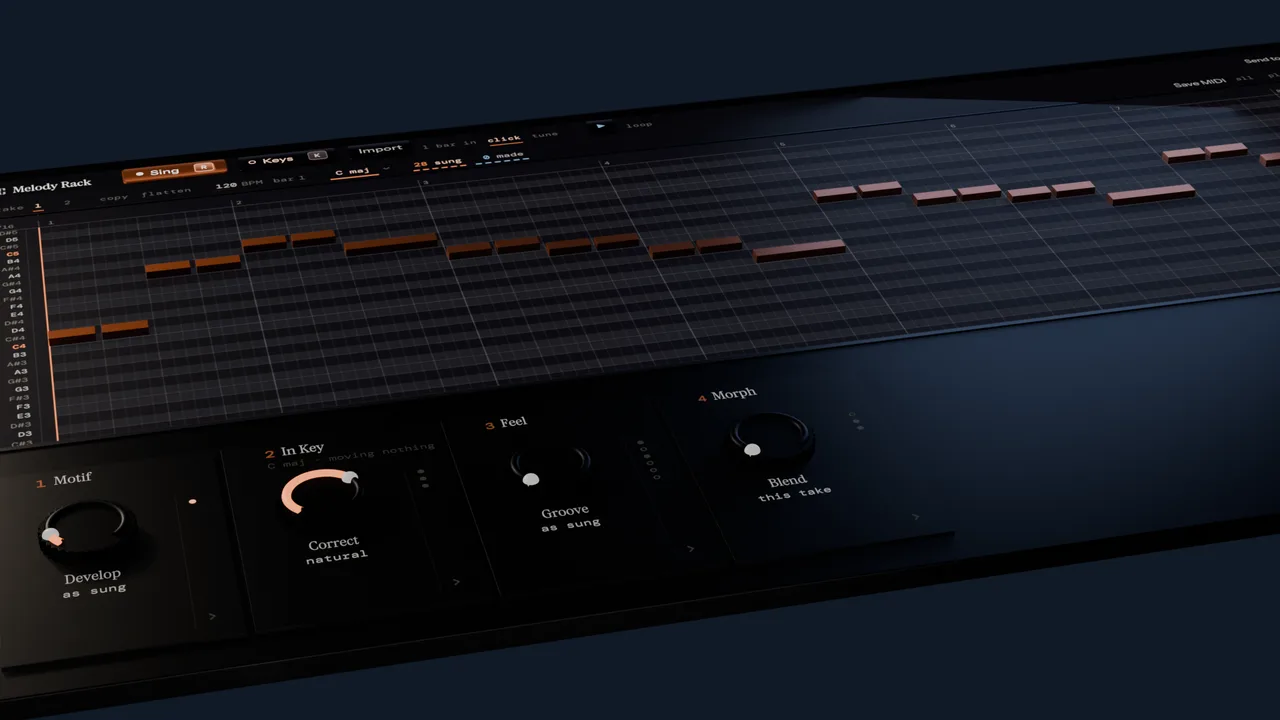
Most songwriters have the tune before they have the chords, let alone the bass. Melody Rack is a MIDI effect plugin for your DAW (AU and VST3 on Mac, VST3 on Windows) that starts from a sung or played melody: its Chords module writes a progression from your tune, and since version 1.0.9 its Bass module writes a bass line under those chords. Melody Rack is its own product, separate from the Song Cage app.
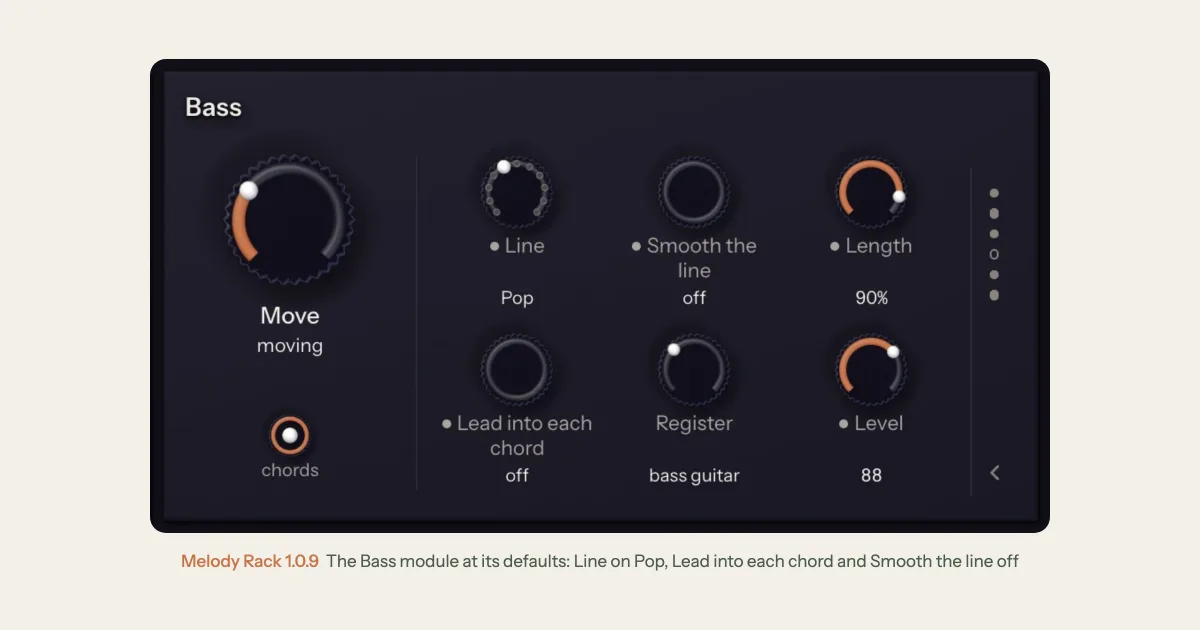
The Bass module's defaults come from the same POP909 count in this post. Every new chord starts on its root (or on the note a slash chord is written over), nothing rings into the next chord, and the default line, Pop, plays the root on one and three with the octave on the "and" of four. Leading into each chord from a half step below and smoothing the line with inversions are two switches, both off until you want them, because that's how rarely the arrangers used them. One knob, Move, takes the line from a held root through pushed and running lines to a walking bass. The full list of lines is in the Bass section of the docs.
The bass is its own part, so you can drag it out as a separate MIDI clip for a bass instrument, or give your bass track a second Melody Rack that follows it.
Frequently Asked Questions
What notes should a bass line play?
Start with the root of each chord, played where the chord begins. Between changes, use the root's octave, the fifth and the third, in that order of safety. In 880 pop arrangements, 98.4% of the bass notes on chord changes were notes of the chord above them, and 88.6% were the root.
Should a bass line always play the root note?
On the chord change, nearly always in pop. Inside the bar, no: the fifth, the octave and sometimes the third keep the part moving. Leave the root on purpose when an inversion lets the bass walk by step, as in C, G/B, Am.
How do you write a bass line if you don't know music theory?
Read the letter at the start of each chord symbol, with any sharp or flat after it, and play that note: C for C, A for Am, B flat for Bb, F sharp for F#m. For a slash chord like D/F#, play the note after the slash. Play it once per chord on the beat where the chord starts, then add the same note an octave up just before the next chord.
How many notes should a bass line have per bar?
One or two is the most common in pop: 60% of bars in our count. Beat one alone, or beats one and three, cover the basics, and a pickup on the "and" of four adds movement. A note on every beat is a walking line.
Can you write a bass line on a keyboard or in a piano roll?
Yes. Every number in this post comes from piano parts, not bass guitars. Write the notes in your DAW's piano roll, send them to a bass instrument, and keep the roots low: on a bass guitar, the lowest open string in standard tuning is E1, two octaves and a sixth below middle C.
What is the difference between a bass line and a walking bass line?
Any lowest part is a bass line. A walking bass line is a particular kind: one note per beat, moving by step or through chord tones, with the last beat leading into the next chord. It belongs to swing jazz and blues; pop bass lines play far fewer notes.

Sing the tune. Get the bass line under it.
Melody Rack writes chords from the melody you sing, then a bass line under those chords that starts from what pop arrangers actually play: the root on every change, with a pickup into the next bar.