Table of Contents
- What does quantize mean in music?
- Where did quantize come from?
- Is quantize the same as quantization in digital audio?
- How much does quantize move a note?
- What is quantize range, or "exclude within"?
- Should you quantize the note ends too?
- Should you quantize while you record?
- How much grid does your part want?
- Does quantizing kill the feel?
- Should you quantize a sung melody?
- Why does my part sound robotic after quantizing?
- Why did some notes jump to the wrong beat?
- What is swing in music?
- Is swing always a triplet?
- What is a shuffle rhythm?
- Swung eighths or swung sixteenths?
- Where does swing live in your DAW?
- What swing percentage should you use?
- Why doesn't 60% swing mean the same thing in every app?
- Do all your parts need the same swing?
- Quantize, groove or humanize: which one does a part need?
- Is humanize the same as swing?
- What is groove quantize?
- How do you quantize a part you sang or played?
- How does Melody Rack's Feel do this?
- Frequently Asked Questions
Quantize moves recorded notes toward a timing grid. In every major DAW it does that by an amount you choose, from 0% (untouched) to 100% (every note exactly on the line). Swing is a setting on the same grid that delays every second line. The useful question is how much grid each part wants.
Most explanations stop at "it snaps your notes to the grid", which is how people end up with a vocal melody that sounds typed. This guide covers what the grid is, what the strength, range and swing numbers in your DAW actually do, what the timing research says about quantized versus human parts, and how to set each part of a song, with a sung melody treated as its own case.
Quick summary
Quantize is a dial. Swing is a setting on that dial. A part you sang wants far less of it than a part you programmed.
What does quantize mean in music?
Quantize means moving the notes you recorded so they start closer to an even rhythmic grid, such as every sixteenth note. A note that landed a little early or late gets pulled toward the nearest grid line. How far it moves depends on the strength setting, and which grid it moves to depends on the note value you pick.
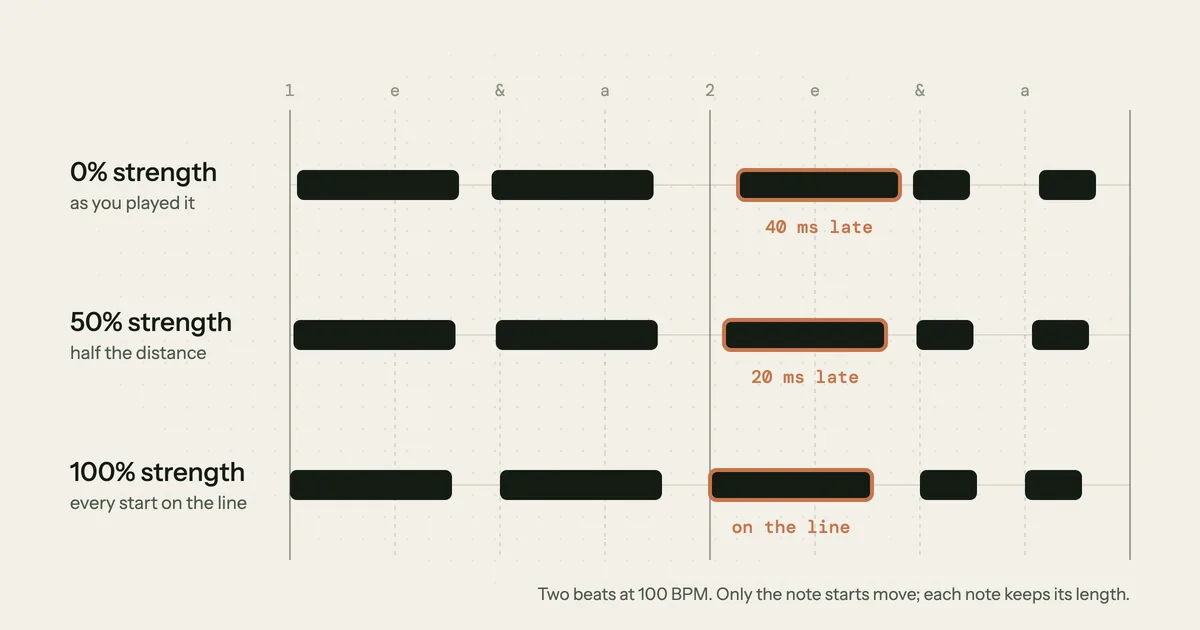
The grid is just the beat divided evenly. At 100 BPM a quarter note lasts 600 milliseconds, an eighth note 300 ms and a sixteenth note 150 ms, so a sixteenth grid has a line every 150 ms. If you played a note 40 ms after one of those lines, a full quantize puts it on the line.
Pick the grid from the shortest note you meant to play. A part built on eighth notes quantized to a quarter-note grid will have its off-beats dragged onto the beats, and a part with sixteenths quantized to eighths will lose half its notes to the wrong place. If the part has triplets in it, it needs a triplet grid, because no straight grid has a line where a triplet falls.
Quantize applies to MIDI notes. Audio can be quantized too, but that requires the DAW to cut or stretch the recording at each note, which is a different job with different side effects.
Where did quantize come from?
From a drum machine trying to save memory. Roger Linn told Attack Magazine that memory chips were expensive while he was building the LM-1, so his prototypes stored drum hits only at sixteenth-note positions, and that pulled his playing onto the grid. He called it "timing correct", and other manufacturers later called it quantize. He built swing the same way, by delaying alternate sixteenths. Roger Linn Design credits the LM-1 Drum Computer, announced in 1979, with introducing both.
That origin explains a lot about the feature. It was designed for drum hits programmed into a machine, and DAWs inherited it from there. Nobody designed it with a sung melody in mind, which is why the default behaviour suits drums much better than voices.
Is quantize the same as quantization in digital audio?
No. Quantization in music production means moving notes onto a timing grid, and the shared word causes confusion. In digital audio, quantization means rounding each sample of a waveform to the nearest value the bit depth allows. That happens inside the converter whenever you record, and it has nothing to do with rhythm.
There's also pitch quantizing, where a plugin moves notes to the nearest note in a scale. Some tools call that quantize as well. When a producer says "quantize the bass" they mean timing, and that's the meaning in the rest of this post.
How much does quantize move a note?
Quantize moves each note as far as the strength setting says. At 100% strength a note moves all the way to the grid line. At 50% it moves half the distance, so a note 40 ms late ends up 20 ms late. At 0% it stays where you played it. Every major DAW has this control, under different names.
Apple's Logic Pro guide defines Q-Strength as the percentage of the distance each note moves toward the grid. Because a partially quantized note keeps part of its original offset, the shape of your timing survives: notes you played early stay a little early, and notes you laid back stay a little behind. They all just sit closer to the beat.
Here is what the strength and swing controls are called in eight DAWs, from each one's own manual.
| DAW | Strength control | Leave some notes alone | Swing | Record quantize |
|---|---|---|---|---|
| Logic Pro | Q-Strength | Q-Range | Q-Swing, 50% straight | Region defaults apply to new recordings |
| Ableton Live 12 | Amount (Quantize MIDI Tool) | None documented | Groove Pool grooves | Record Quantization |
| FL Studio | Start time and Duration blend knobs | Sensitivity | Global Swing (Channel Rack) | Global Snap |
| Cubase Pro 15 | Quantize Strength (Soft Quantize) | Catch Range, Safe Range | Quantize Swing | Auto Quantize |
| Pro Tools | Strength | Include Within, Exclude Within | Swing, 0–300% | Input Quantize |
| Studio One | Start | Range | Swing, 0–100% | Input Quantize |
| REAPER | Strength | Only quantize range | Swing grid | Per-track recording settings |
| Bitwig Studio | Start Amount | None documented | Shuffle | Record Quantization |
Control names from each vendor's current manual. GarageBand has a Strength slider in the Piano Roll that works on whole regions.
What is quantize range, or "exclude within"?
A range setting decides which notes get moved at all. Logic's Q-Range is 0 by default, which moves every note. A positive value moves only notes far from the grid and leaves the near-misses alone, and Apple's own example pairs a 20-tick range with 50% strength. Pro Tools has the same idea as Include Within and Exclude Within, and Cubase calls it Catch Range and Safe Range.
Range matters most for played and sung parts. For scale, Fujii and colleagues (2011) found 15 professional drummers playing to a click at 60 and 120 BPM averaged about 10 ms early on snare and kick. A note 8 ms off is almost certainly fine and is part of how you played it. A note 70 ms off is probably the one you meant to fix. Excluding the small misses and correcting the big ones gets you a tight part that still sounds played.
Avid's Pro Tools Reference Guide gives a concrete starting point for keeping the original feel: Exclude Within at 10–15% and Strength at 70–80%.
Should you quantize the note ends too?
Usually not for a melody. Most DAWs quantize note starts by default and treat ends as a separate option: Ableton's Quantize MIDI Tool can do starts, ends or both, Pro Tools quantizes Note On and Note Off separately, and Cubase has its own commands for event ends.
Snapping the end of a sung or bowed note to the grid shortens or stretches it to a length you never chose. That's how a legato phrase picks up little gaps, or two notes start to overlap. Quantize the ends when the length is part of the rhythm, such as a staccato synth stab, chopped chords or a bass line that has to stop with the kick. Leave them alone when the length is part of the phrasing.
Should you quantize while you record?
Most DAWs offer record quantize (Logic's region defaults, Ableton's Record Quantization, Cubase's Auto Quantize, input quantize in Pro Tools, Studio One and REAPER). It can save time on a drum part you already know you'll quantize hard.
For anything with feel, record it raw and quantize afterwards. Logic's quantize is non-destructive and can be reverted to the original timing, Studio One has Restore Timing, Pro Tools has Restore Performance and REAPER can unquantize. But it's easier to keep the original take than to depend on getting it back.
How much grid does your part want?
How much quantize a part wants depends on its job. Drums usually want a lot of grid, since everything else locks to them. Bass, chords and arpeggios want a fair amount. A sung lead melody wants the least, because its timing is phrasing. Start low on anything you sang and stop once the obvious mistakes go away.
That's a practical rule rather than a law, and the research below explains why it holds. Treat these as starting points to adjust by ear.
| Part | Where to start | Why |
|---|---|---|
| Programmed drums and percussion | High strength, starts only | The rest of the track locks to them; feel comes from swing and accents |
| Bass | High strength on starts; ends if it must stop with the kick | Kick and bass drifting apart sounds like a mistake |
| Strummed or comped chords | Medium strength, ends off | Keeps the strum spread and the ring of each chord |
| Arpeggios, hi-hats, sequenced figures | High strength plus swing | Evenness is the point; swing gives the motion |
| Sung lead melody | Low strength (0–40%), starts only, with a range | Pushing and laying back on syllables is phrasing |
| Harmony or double of the lead | Match the lead, not the grid | A harmony on the grid against a phrased lead sounds like two singers disagreeing |
Does quantizing kill the feel?
Less often than people say. When researchers have taken real performances and removed the timing deviations, listeners mostly didn't miss them. In Senn, Kilchenmann, von Georgi and Bullerjahn (2016), quantized and original versions of swing and funk bass-and-drums recordings were rated equally high for groove, and exaggerated deviations lowered the ratings. In Datseris and colleagues (2019), 160 listeners rated twelve jazz piano performances: a version quantized to the piece's own average swing grid was rated slightly more swinging than the original, and a version with the deviations doubled was rated clearly less swinging (an odds ratio of 0.23).
Frühauf, Kopiez and Platz (2013) found the same with a simple rock drum pattern: the quantized version scored highest, and early shifts hurt more than late ones. The finer result is from Kilchenmann and Senn (2015). Expert listeners moved their heads more to versions with 40% of the original deviation left in than to fully quantized ones, a small-to-moderate effect that didn't appear in non-experts. That's partial quantize, measured.
Should you quantize a sung melody?
Lightly, if at all, because a singer's timing against the beat carries meaning. Friberg and Sundström's study of jazz recordings (Music Perception, 2002) found that at slow tempos, soloists played behind the drummer's ride cymbal on the downbeats while meeting it on the off-beats. That's a systematic placement, and a full quantize erases it.
Nelias and colleagues (2022) tested the same pattern: delaying a jazz soloist's downbeats by about 30 ms while keeping the off-beats together made professional and semi-professional jazz musicians rate it as swinging more. Delaying every note by the same amount made no significant difference. The study used jazz piano, not singing, but the point carries: where a line sits against the beat matters more than how tightly it's played.
A melody with words has a second reason to move. A stressed syllable can land late for weight, and a run of short words can rush. Quantizing those notes fixes the rhythm and breaks the fit between the words and the melody. If you converted a sung take to MIDI, audio to MIDI covers what else to clean up first.
Why does my part sound robotic after quantizing?
Usually because everything got the same treatment. When every part is at 100% on the same grid, nothing pushes or pulls against anything else, and the velocities often all match too. Bring the strength down on the parts a person would phrase, leave note ends alone, and let the velocity carry the accents.
Random humanize doesn't fix it. Hennig and colleagues (PLOS ONE, 2011) found that real human timing drifts in a correlated way, where one early note makes the next one more likely to be early, and listeners preferred that kind of variation to independent random jitter at the same 15 ms spread. They compared two humanize methods, not humanize against a quantized part, and four of the authors later disclosed patents on their method. Roger Linn's view is blunter: "Personally, I don't think anything significant is gained by randomising playing timing."
Why did some notes jump to the wrong beat?
Because they were closer to the wrong grid line. Quantize moves each note to the nearest line, so a note played more than halfway late gets pulled forward to the next line, not back to the one you meant. BandLab's beginner guide warns about exactly this.
There are three fixes. Use a finer grid so the correct line is nearer, use a range setting so the far-off notes are left for you to drag by hand, or switch to a triplet grid if those notes were triplets all along. Logic's Smart Quantize also keeps notes in their original order.
What is swing in music?
Swing, or swing rhythm, is an uneven split of the beat: of each pair of eighth notes (or sixteenths), the first is held longer and the second is played late. Written swung eighth notes look straight on the page but are played long-short. A full triplet swing gives the first note two-thirds of the pair and the second note one-third.
Open Music Theory describes swing eighths as notated straight and performed in a "quasi-triplet rhythm where the first note is twice as long as the second", and says the ratio varies with tempo. At 100 BPM, straight eighths start every 300 ms. In triplet swing the off-beat moves from 300 ms after the beat to 400 ms, so the long note gets 400 ms and the short one 200 ms.
Swing also names a feel and a genre, which is why "swing" searches turn up big-band history as often as rhythm lessons. For a songwriter, the rhythm sense is the one that matters: a long-short pulse under the melody. Syncopation is a different thing, accents placed off the beat, and the two often appear together.
Is swing always a triplet?
No. Swing gets taught as a triplet, but measured players rarely sit exactly on one. Friberg and Sundström measured jazz drummers' ride cymbal swing ratios moving smoothly with tempo, from about 3.5:1 at slow tempos down to 1:1 at fast ones, with 2:1 appearing only at around 200 BPM. Above about 150 BPM, the short note stayed near 100 ms whatever the tempo.
Soloists swing less than drummers. Benadon (2006, Ethnomusicology) found jazz soloists' long-to-short ratios "seldom exceed 1.5 and most often lie between 0.9 and 1.4." Corcoran and Frieler (2021, Music Perception) analysed 456 solos in the Weimar Jazz Database and found most soloists swinging lightly, at about 1.3:1, calling a stable 2:1 swing for solos "a conceptual myth."
In practice, the right swing amount for a song goes down as the tempo goes up. A ballad can take a heavy lilt, and a fast tune with a full triplet swing will sound like it's limping.
What is a shuffle rhythm?
A shuffle is a swung feel that sits close to a strict triplet, usually with a heavy snare backbeat on 2 and 4, and it belongs to electric blues and early rock and roll. Jazz swing sits lower and moves around more, with the backbeat carried by the hi-hat.
The half-time shuffle puts the backbeat on beat 3 only, with soft ghost notes on the snare in between. It's usually credited to Bernard Purdie, who played it on Steely Dan's "Home at Last" (Aja, 1977). Purdie told MusicRadar the band first said they didn't want a shuffle, so he offered to play it for them to hear, and they loved it.
Jeff Porcaro credited Purdie's shuffles and John Bonham's "Fool in the Rain" (1979) as the sources for his groove on Toto's "Rosanna" (1982). "Fool in the Rain" is also a lesson in contrast: midway through, the shuffle drops into a straight samba feel, then comes back.
Swung eighths or swung sixteenths?
Jazz swings eighth notes. Funk, R&B and hip-hop mostly swing sixteenths, which is a lighter, faster lilt sitting inside a straighter beat. A lot of DAW and drum-machine swing works on sixteenths by default, as Linn's always has: his swing delays the second sixteenth in each eighth-note pair.
Stevie Wonder's "Superstition" (1972) is the textbook swung-sixteenth record: a four-on-the-floor kick under a hi-hat that drummer Todd Bishop describes as "almost with a sixtuplet feel, but not quite." Teddy Riley's New Jack Swing is built on the same idea. In his Red Bull Music Academy lecture, Riley said Bobby Brown's "My Prerogative" (1988) was first made on an Alesis machine, and he ended up replaying much of it because the machine lacked the "off-and-on swing" he wanted, swung in places and straight in others.
Where does swing live in your DAW?
Swing lives in a DAW's quantize settings, as a percentage that delays every second grid line. In Roger Linn's system, used by Logic and the MPC, 50% is straight and 66% is a full triplet. Other DAWs count from zero instead, so the same number can mean a different amount of swing in different software.
Roger Linn explains the number as the share of the pair the first note gets: at 66%, "the first 16th note of each pair gets 2/3 of the time, and the second 16th note gets 1/3." Logic's 1/16 Swing presets A through F are 50, 54, 58, 62, 66 and 71%.
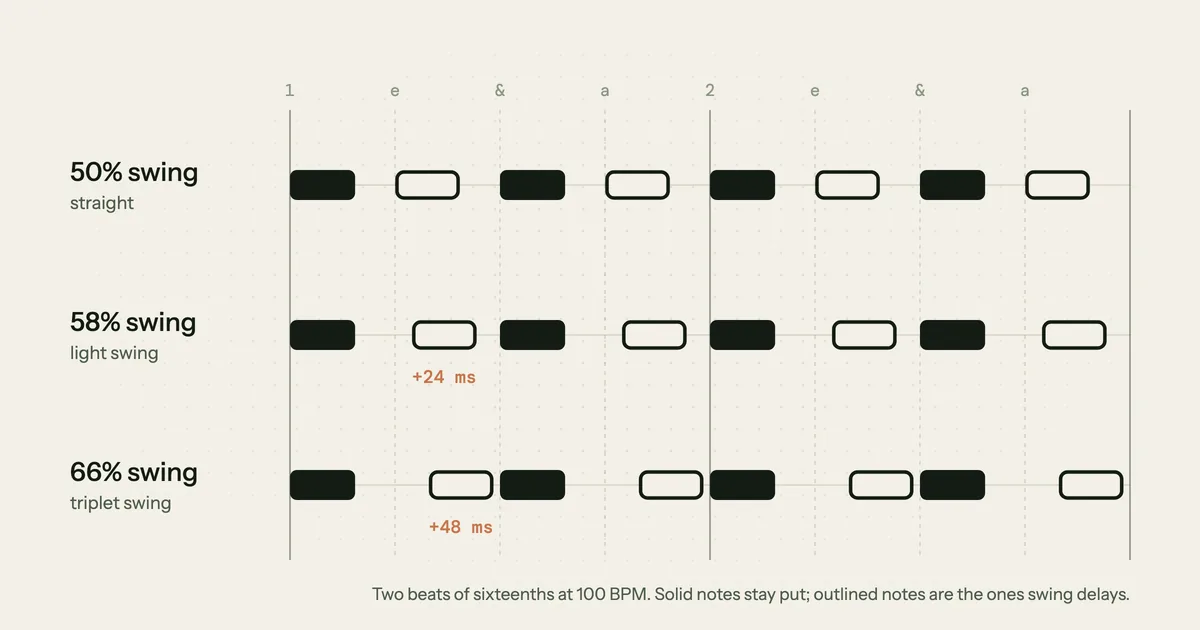
Because the setting is a percentage of the note pair, its effect in milliseconds depends on the tempo and the grid. At 100 BPM with sixteenth-note swing, each pair lasts 300 ms, and the second note moves by this much:
| Swing setting | Second sixteenth delayed by (100 BPM) | What you hear |
|---|---|---|
| 50% | 0 ms | Straight |
| 54% | 12 ms | Looser, but not swung |
| 58% | 24 ms | Light swing |
| 62% | 36 ms | Clear swing |
| 66% | 48 ms | Close to a full triplet |
| 75% | 75 ms | A 3:1 split, very hard |
Delay = (setting − 50%) × 2 × the sixteenth length. At other tempos, scale by 100 ÷ your BPM.
What swing percentage should you use?
Start at 50% and come up a few points at a time while the track plays. Linn's own advice is tempo-dependent: "a 90 BPM swing groove will feel looser at 62% than at a perfect swing setting of 66%," and "for straight 16th-note beats (no swing), a swing setting of 54% will loosen up the feel without it sounding like swing." He says the range between 50% and around 70% is where the "wonderful little settings" are.
That matches the measurements above. Soloists swing less than a triplet, and drummers and soloists alike swing less as the tempo rises. If you can hear the swing as a limp rather than a lilt, go down.
Why doesn't 60% swing mean the same thing in every app?
Because there are two counting systems. Logic and the MPC use Linn's numbering, where 50% is straight. In Cubase and FL Studio 0% is straight and 100% is a triplet. Studio One's swing runs 0–100%, with 100% equal to a full 2:1. Pro Tools runs 0–300%, with 100% as the triplet feel. Ableton's Groove Pool has grooves named in both systems.
So "60% swing" means a light swing in Logic and something past halfway to a triplet in Cubase. When you copy a setting from a tutorial, check which app it came from, or convert it to milliseconds at your tempo.
Do all your parts need the same swing?
No, and some of the best-known grooves depend on them being different. In John Hiatt's "Thing Called Love" (1987), Ry Cooder's guitar riff shuffles while Jim Keltner's drums stay straight, an example musicologist Anne Danielsen uses for straight and swung time running at once. She makes the same point about Destiny's Child's "Nasty Girl" (2001), where the programmed track sits mostly on a straight grid and the vocal sits between straight and triplet.
J Dilla made that clash a signature. Dan Charnas, in Dilla Time (2022), argues it's an oversimplification to say Dilla "didn't quantize": on the MPC3000 he swung some tracks and kept others straight, so straight and swung parts run against each other in the same beat. On D'Angelo's Voodoo (2000), Questlove was asked to play straight while D'Angelo and bassist Pino Palladino played behind him.
The deliberate versions work because one part holds steady. Two parts that play the same rhythm at slightly different swing amounts usually just sound loose.
Quantize, groove or humanize: which one does a part need?
Quantize pulls notes toward a fixed grid. Swing bends that grid the same way every bar. Groove quantize replaces the grid with the timing of a real performance. Humanize adds random variation. A part that's sloppy wants quantize. A part that's stiff wants swing or a groove. Random humanize rarely helps either.
Is humanize the same as swing?
No. Swing is a systematic delay: every second grid line moves by the same amount, every bar, so you hear a pulse. Humanize nudges each note a random amount earlier or later, so nothing repeats. Bitwig applies Humanize last in its Quantize dialog, and Logic's Humanize preset randomizes position, velocity and length together.
The research so far favours systematic placement over randomness. Datseris and colleagues found doubled timing deviations made jazz performances sound much less swinging, and Nelias and colleagues found a consistent downbeat delay worked where a uniform shift didn't. If you want looser, try a little swing (Linn's 54%) or partial strength before reaching for random humanize.
What is groove quantize?
Groove quantize uses a real performance as the grid. You take a part with timing you like, extract its groove, and quantize other parts to it, so the bass lands where the drummer actually played rather than where the clock says. Ableton has Extract Groove and a Groove Pool with Base, Quantize, Timing, Random and Velocity controls. Logic has Make Groove Template, Studio One has Groove Extraction, and Pro Tools has groove templates made with Beat Detective.
Records were doing this before the software existed. For Toto's "Africa" (1982), Jeff Porcaro and Lenny Castro played percussion for about five minutes without a click, picked the best two bars and made a one-bar tape loop, choosing it over a Linn drum machine because the machine didn't feel the same.
How do you quantize a part you sang or played?
Quantize a sung or played part with starts only, a low strength and a range that leaves near-misses alone, then raise the strength until the obvious mistakes are gone and stop. Set swing for that part on its own, at the song's tempo, and compare the result against the untouched take.
Start with the raw take and a copy of it, so you can always compare. Set the grid to the shortest note you meant to sing or play, and use a triplet grid if the line is in triplets. If the quantized version sounds more correct but less like you, back off.
How does Melody Rack's Feel do this?
Feel does this in Melody Rack, our MIDI effect plugin for turning a sung take into MIDI and new melodic ideas. Feel treats quantize as a dial: Tighten runs from 0% (your timing, untouched) to 100% (every start on the grid), and its defaults leave the timing exactly as you sang it. Our own starting point for a sung take is about 40%.
Swing runs from 50% to 75% on whatever grid you set, Loosen adds random spread, Push moves the whole part ahead of or behind the beat, and each note keeps its length unless you also tighten the ends. The Feel section of the Melody Rack docs lists every control.
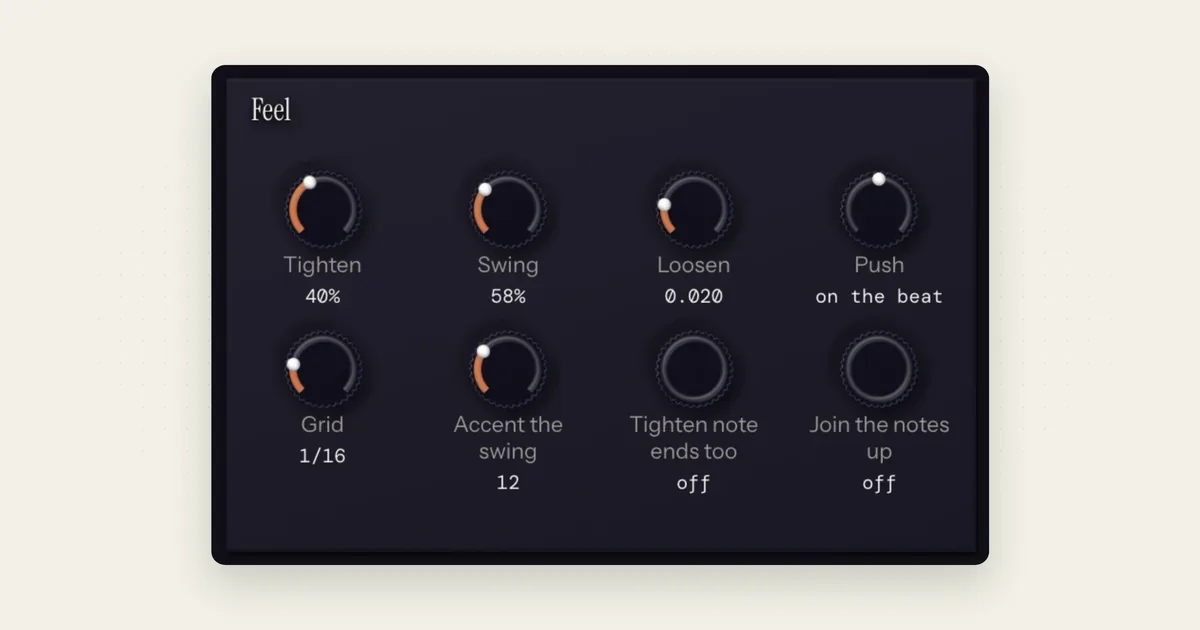
It also works the other way. Turn on Follow my feel on the Arp or Euclid effect and, when there's enough steady singing to measure, it works out how far behind or ahead of the beat you sang and how much you swung your eighths. It prints the result on the strip in the form "30 ms behind · 58% swing" and plays its generated figures with your timing instead of the clock's.
Frequently Asked Questions
What does quantize mean in simple terms?
It means tidying the timing of recorded notes by moving them toward an even grid, such as every sixteenth note. A note that was a little early or late gets pulled toward the nearest grid line. The strength setting decides how far it moves, so you can tidy a part without making it perfectly mechanical.
What quantize strength should I use?
High for programmed drums and bass, medium for chords, and low (0–40%) for a sung or played lead line. Avid suggests Strength at 70–80% with Exclude Within at 10–15% when you want to keep a performance's feel. Whatever you pick, compare the result against the raw take.
Is quantizing cheating?
No. Drum machines have quantized since Roger Linn's LM-1 in 1979, and listening studies have mostly found quantized versions of real performances rated as grooving as well as the originals. What sounds wrong is quantizing everything to 100%, including parts whose timing was phrasing.
What does 66% swing mean?
In Logic, on an MPC and in other software using Roger Linn's numbering, 66% swing gives the first note of each pair two-thirds of the time and the second note one-third, which is a full triplet feel. In Cubase or FL Studio the same feel is 100%, because those count straight time as 0%.
Is swing the same as triplets?
Not exactly. Swing is taught as a triplet with the middle note left out, but measured swing moves with the tempo and rarely sits exactly on a triplet. Jazz drummers ranged from about 3.5:1 at slow tempos to 1:1 at fast ones in Friberg and Sundström's study, and a 2021 analysis of 456 jazz solos found most soloists swinging at about 1.3:1.
Can you undo quantize?
Often, yes. Logic's quantize is non-destructive and can be set back to the original timing, Studio One has Restore Timing, Pro Tools has Restore Performance and REAPER can unquantize. Record quantize works differently from one DAW to the next (in Ableton, when you record into the Arrangement, it's a separate step in Undo), so it's safer to record raw and quantize afterwards.
Sing it rough. Keep your timing.
Melody Rack turns a hummed take into MIDI in your DAW and grows new melodic ideas out of it. Feel tightens the timing by as much or as little as you want, so the line still sounds like you sang it.