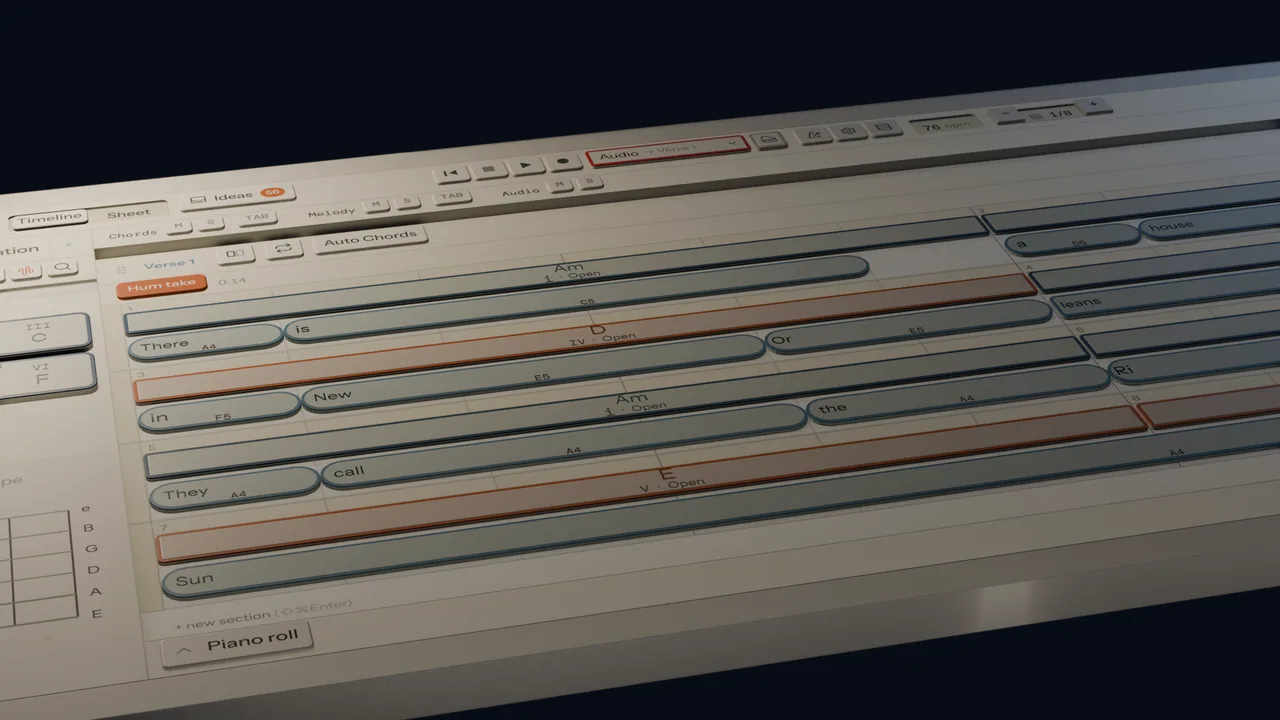
The easiest piano songs for beginners use a handful of chords that sit on the white keys, and they change chord slowly. We checked every chord in 737 Billboard Hot 100 hits. Only 31 can be played on white keys alone in the key of the record. Move each song to its easiest key and 195 fit, and a digital piano's Transpose button keeps them sounding in the record's key.
This page lists 26 easy songs to play on piano, in two tables. The first is songs you can play along with the record without touching a black key. The second is songs that land on the white keys once you change the key, with the Transpose setting that keeps them sounding like the record.
The short version
Start with El Condor Pasa (If I Could) or Ain't No Sunshine: four chords, all on the white keys, in the record's own key. For three chords, play Lay Down Sally as C, F and G with Transpose set to −3. Most easy songs come down to the same six chords: C, Dm, Em, F, G and Am.
What are the easiest songs to play on piano?
The easiest piano songs in our count are El Condor Pasa (If I Could), The Night Chicago Died, Ain't No Sunshine and Chain of Fools. Every chord sits on the white keys in the key of the record (play Chain of Fools' C7♯9 as a plain C), so you can play along without a black key. The table ranks 13 such hits by chord count, then by how often the chords change.
| Song | Chords on the record | Chords | Changes a minute | Hot 100 peak |
|---|---|---|---|---|
| 1. Chain of Fools, Aretha Franklin | C7♯9 (play C)* | 1 | 0 | 2 |
| 2. The Night Chicago Died, Paper Lace | C, Dm, G | 3 | 13.5 | 1 |
| 3. I'll Take You There, The Staple Singers | C, F, G9sus4 | 3 | 35.2 | 1 |
| 4. Ain't Too Proud to Beg, The Temptations | C, F, G | 3 | 38.2 | 13 |
| 5. El Condor Pasa (If I Could), Simon & Garfunkel | G, Em, C6, Am | 4 | 6.4 | 18 |
| 6. The Long Run, Eagles | F, C, Am7, G | 4 | 13.8 | 8 |
| 7. Hello Stranger, Barbara Lewis | Dm7, Cmaj9, Em7, G7 | 4 | 16.4 | 3 |
| 8. Just a Friend, Biz Markie | Dm, C, F, G7 | 4 | 21.6 | 9 |
| 9. Hot in the City, Billy Idol | C, Am, G, F | 4 | 24.5 | 23 |
| 10. Ain't No Sunshine, Bill Withers | Am7, Em7, G7, Dm7 | 4 | 24.8 | 3 |
| 11. Sweet Soul Music, Arthur Conley | C, F, Am, G | 4 | 26.1 | 2 |
| 12. I Love a Rainy Night, Eddie Rabbitt | C, F6, G7, Am | 4 | 30.6 | 1 |
| 13. D'yer Mak'er, Led Zeppelin | Am, G, F, C | 4 | 31.7 | 20 |
Chords and changes are counted from the McGill Billboard transcription of each record. A chord and its 7th, 6th or 9th count as one chord; a sus chord counts on its own. Changes a minute is every chord change on the record divided by its length from the first chord. Hot 100 peak is from the dataset's index. *Chain of Fools' C7♯9 adds B♭ and D♯; play a plain C (C, E, G) under it.
Every chord in this table uses white keys only, extensions included, apart from the C7♯9 in Chain of Fools. The order is fewest chords first, then fewest changes a minute.
The Night Chicago Died is the gentlest three-chord song in this table: C, Dm and G, changing 13.5 times a minute. El Condor Pasa (If I Could) is the slowest of the songs that change chord, at 6.4 changes a minute. Ain't No Sunshine has four white-key 7th chords, but in most lines Em7 and G7 get one beat each on the way back to Am7, so drill that move before you play it with the record.
Which hit songs become white-key songs in another key?
Lay Down Sally, I Got You (I Feel Good), The Twist, Love Me Do and Bad Moon Rising all become C, F and G when you move them to C. With or Without You becomes Let It Be's C, G, Am, F, with a sus4 on the G. The table gives the white-key chords for 13 hits and the Transpose setting that makes each one sound like the record.
| Song | Chords on the record | White-key chords | Transpose | Chords | Changes a minute | Hot 100 peak |
|---|---|---|---|---|---|---|
| 1. Lay Down Sally, Eric Clapton | A, A7, D, E | C, F, G | −3 | 3 | 10.2 | 3 |
| 2. I Got You (I Feel Good), James Brown | D7, G7, A7 | C, F, G7 | +2 | 3 | 14.6 | 3 |
| 3. The Twist, Chubby Checker | E, A, B | C, F, G | +4 | 3 | 16.1 | 1 |
| 4. Old Time Rock & Roll, Bob Seger & the Silver Bullet Band | F♯, B, C♯ | C, F, G | +6 | 3 | 16.7 | 28 |
| 5. Rock'n Me, Steve Miller Band | B, E, A | G, C, F | +4 | 3 | 17.2 | 1 |
| 6. Love Me Do, The Beatles | G, C, D | C, F, G | −5 | 3 | 25.3 | 1 |
| 7. Beat It, Michael Jackson | E♭m, D♭, B | Am, G, F | +6 | 3 | 27.7 | 1 |
| 8. Bad Moon Rising, Creedence Clearwater Revival | D, G, A | C, F, G | +2 | 3 | 31.7 | 2 |
| 9. Runaround Sue, Dion | D, Bm, G, A | C, Am, F, G | +2 | 4 | 17.3 | 1 |
| 10. Running Up That Hill, Kate Bush | Cm, A♭, B♭, Fm7 | Am, F, G, Dm7 | +3 | 4 | 22.1 | 30 (1985), 3 (2022) |
| 11. With or Without You, U2 | D, A7sus4, Bm7, Gmaj9 | C, G7sus4, Am7, Fmaj9 | +2 | 4 | 23.9 | 1 |
| 12. Red Red Wine, UB40 | D♭, G♭, A♭, A♭sus4 | C, F, G, Gsus4 | +1 | 4 | 33.9 | 1 |
| 13. The Joker, Steve Miller Band | F, B♭, C, Csus4 | C, F, G, Gsus4 | +5 | 4 | 39.2 | 1 |
Same count and rules as the first table. Running Up That Hill peaked at 30 in 1985 and at 3 in 2022. "White-key chords" is each song moved to the key where every chord needs only white keys. "Transpose" is the setting on a digital piano that makes those keys sound in the record's key: at +2 you press C and hear D. Where a 7th adds a black key after the move (Lay Down Sally's A7 becomes C7, which has a B♭), play the plain chord.
Lay Down Sally is the place to start. No chord on the record lasts less than two bars, and in C it's C, F and G. I Got You (I Feel Good) has a verse that's a 12-bar blues on the same three chords. Beat It is the odd one: on the record it's E♭ minor, whose chord is three black keys (E♭, G♭, B♭), and moved to A minor it becomes Am, G and F.
Why do so few hit songs fit on the white keys?
The white keys hold seven chords: C, Dm, Em, F, G, Am and the rarely used Bdim. They are the chords of C major, and of A minor, which uses the same notes. A song stays on the white keys only when every chord is one of these, or a 7th or sus chord built from the same notes.
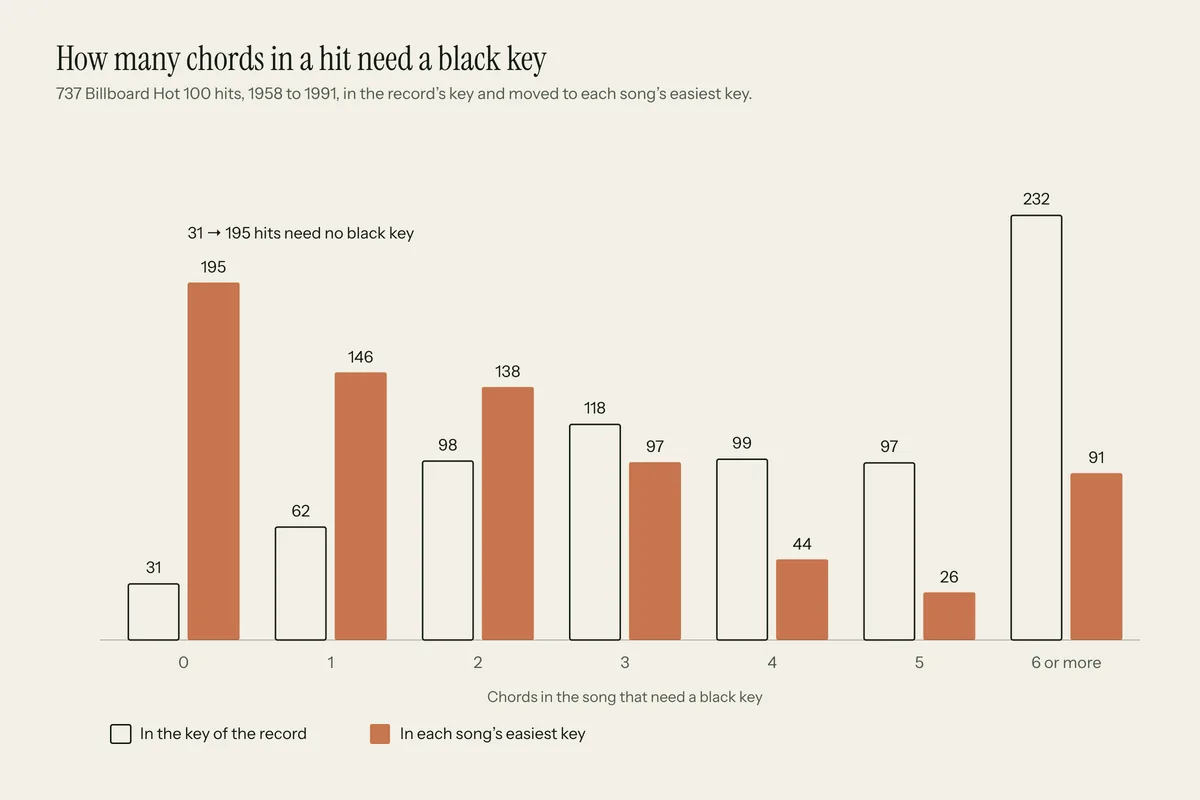
Most records aren't in C or A minor. The median hit in our count uses seven chords, and in the record's key the median hit has four chords that need a black key. Only 31 of the 737 hits (4.2%) need none.
Changing the key fixes most of that. Move each song to the key with the fewest black-key chords and 195 hits (26.5%) need no black key at all, more than six times as many. Of the 181 hits with four chords or fewer, 132 (73%) fit the white keys in some key. The rule is simple: if a song's chords are the 1, 4 and 5 of a major key, they become C, F and G in C. Of the 68 three-chord hits in our count, 46 are exactly that.
Some songs land somewhere else. Rock'n Me is B, E and A, which isn't the 1, 4 and 5 of B. Moved to G it becomes G, C and F, all white, because the song uses the flat 7th of the key the way the Mixolydian mode does, and G Mixolydian is the white keys from G to G.
How do you play a song in C when the record is in another key?
Use the Transpose function on a digital piano or keyboard. It shifts every key up or down by half steps, so you can play in C while the piano sounds in the record's key. Yamaha's P-45 transposes from −6 to +6, and six half steps either way reach every key.
Yamaha's owner's manuals give the example of +5: you press C and hear F, so a song in F plays as if it were in C. Yamaha's spec page for the P-45 lists its Transpose range as −6 to +6. The button combination differs between models, so check your own keyboard's manual.
To work out the setting for any song, count the half steps from the white-key version's home chord to the record's, whichever way is shorter. Up is plus and down is minus. Lay Down Sally is in A, three half steps below C, so the setting is −3. Bad Moon Rising is in D, two above C, so it's +2. Love Me Do is in G, seven half steps up from C or five down, so −5.
An acoustic piano has no Transpose button. Play the white-key version anyway and sing in the new key. You lose the play-along, but the song still works, and a key that suits your voice is often a better choice than the record's. The guitar's version of this trick is a capo, which does the same job on six strings.
Which chords do you need for easy piano songs?
Six chords cover almost every song on this page: C, Dm, Em, F, G and Am. Each is three white keys, built by playing one white key, skipping one, playing one, skipping one and playing one. Learn these six in your right hand and play each chord's first letter as a single note in your left.
| Chord | Keys (letters) | White-key 7th | Songs on this page |
|---|---|---|---|
| C | C, E, G | Cmaj7: C, E, G, B | Most of them |
| Dm | D, F, A | Dm7: D, F, A, C | The Night Chicago Died, Just a Friend, Running Up That Hill |
| Em | E, G, B | Em7: E, G, B, D | El Condor Pasa, Hello Stranger, Ain't No Sunshine |
| F | F, A, C | Fmaj7: F, A, C, E | Lay Down Sally, Love Me Do, The Joker |
| G | G, B, D | G7: G, B, D, F | Nearly every song here |
| Am | A, C, E | Am7: A, C, E, G | Ain't No Sunshine, D'yer Mak'er, Runaround Sue |
One sus chord turns up in the white-key columns: Gsus4 (G, C, D), in I'll Take You There, With or Without You, Red Red Wine and The Joker.
That's what makes white-key songs easy. Every chord is the same hand shape moved along the keyboard, with no black key changing the feel under your fingers.
The 7th column matters for the first table. Ain't No Sunshine's Am7, Em7, G7 and Dm7 are four white keys each. If four notes are too many at first, play the three-note chord and leave the 7th out. It still sounds like the song.
How do you change piano chords without moving your hand?
Play the next chord in the inversion closest to the one you're on. From C (C, E, G), play F as C, F, A and G as B, D, G. Your hand stays in one place. From C, each change moves one or two fingers, and F to G moves all three by a key or two, instead of jumping the whole hand.
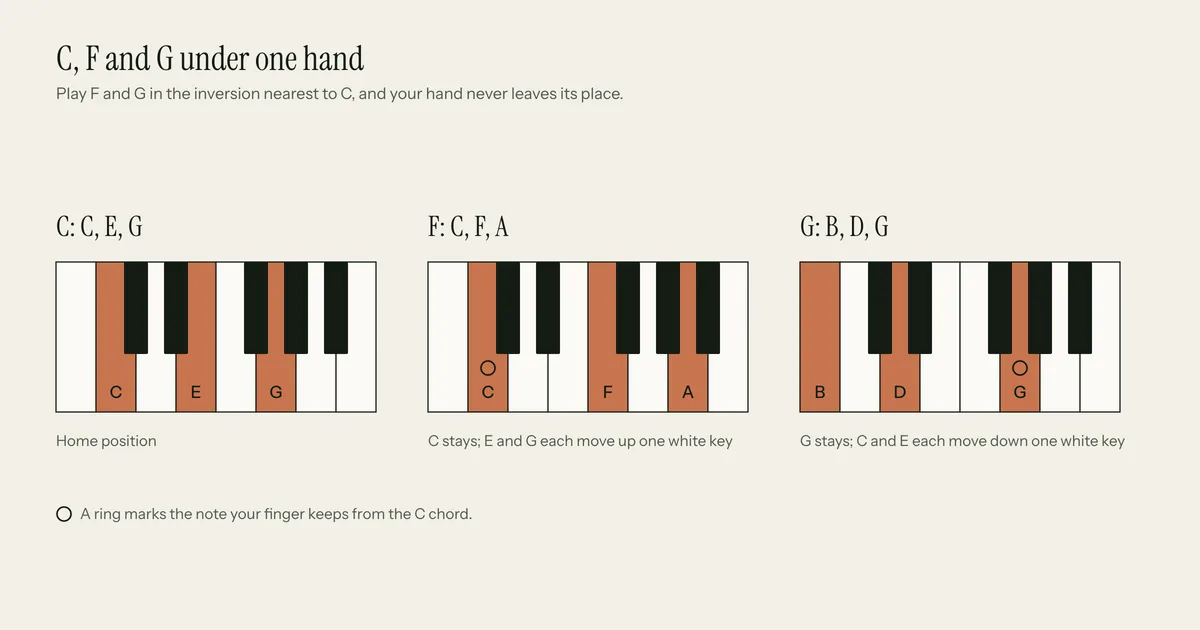
An inversion is the same three notes stacked in a different order, and chord inversions covers how they work. For C, F and G, the only chords in 8 of the songs here (and in 3 more with a Gsus4), it means C stays under your thumb for C and F, and only drops to B for G.
Am works the same way. From C (C, E, G), play Am as C, E, A: only your little finger moves, up one key. So C, F, G and Am, the four chords of Hot in the City and Sweet Soul Music, all fit under one hand position.
Speed is the other half. Across all 737 hits the median song changes chord 23.7 times a minute. For the songs with four chords or fewer, it's 17.4. Songs below that line, like Lay Down Sally at 10.2 and The Long Run at 13.8, give you a bar or more to find each chord.
What about Let It Be, Lean on Me and Heart and Soul?
These three aren't in the McGill sample, but the chords beginners learn for each are white-key chords. Let It Be is in C, and its verse is C, G, Am and F. Lean on Me is in C. The Heart and Soul duet loops C, Am, F and G.
The McGill sample is a random draw of Hot 100 chart slots, so it misses plenty of famous songs, these three included.
Let It Be by The Beatles is in C major, and its verse moves C, G, Am, F, per the Pianote lesson and Hooktheory's analysis. Its ending walks down through a B♭, the one black key you'll meet. Moved to C, With or Without You follows the same order, with G7sus4 in place of G.
Lean on Me is in C, per Hooktheory. Bill Withers told Songfacts in 2004 that he wrote it on a Wurlitzer electric piano: "That's often the first song that children learn to play because they don't have to change fingers."
Heart and Soul was written in 1938 by Hoagy Carmichael with lyrics by Frank Loesser. The duet most people learn loops C, Am, F and G, per Piano With Jonny. Runaround Sue, moved to C, uses those four chords in that order.
How do you see any song's chords on a keyboard in Song Cage?
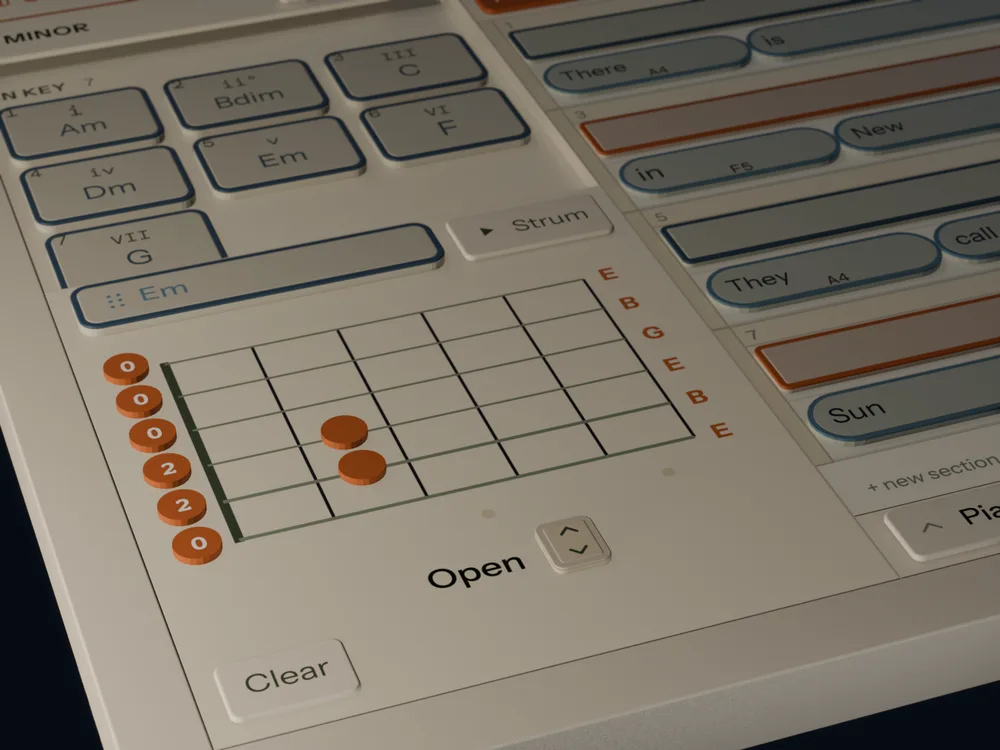
Switch Song Cage to Piano and the keyboard panel lights the keys of whichever chord you pick. To move a song to C, choose C from the key chip and pick Move song: every chord moves with it, so a song in A becomes a white-key song in C.
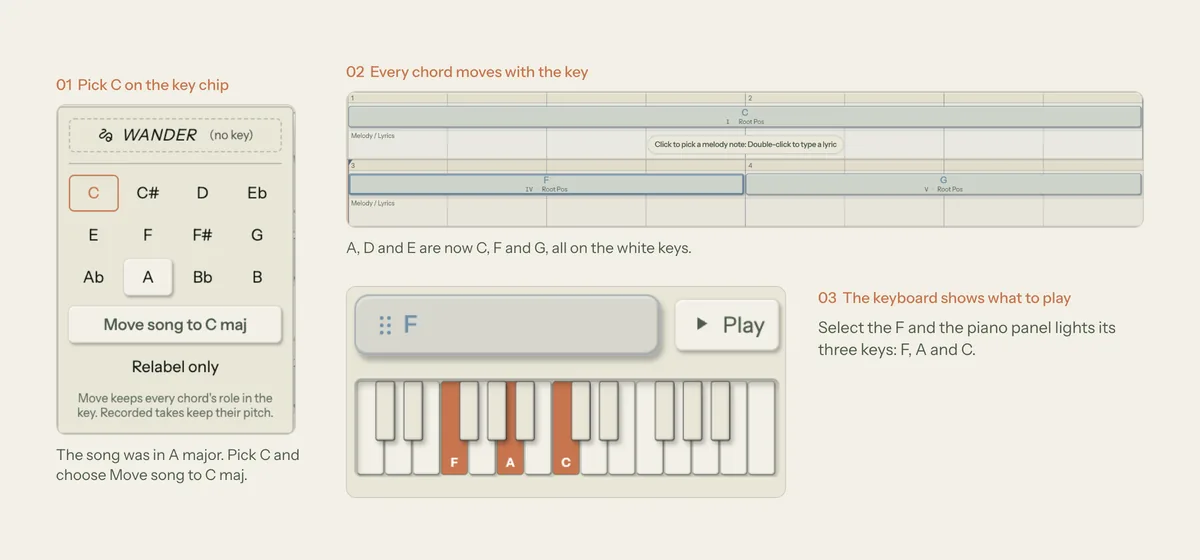
On a computer, paste a chord chart with the chords in square brackets into a song's Sheet view and it becomes sections with the chords over the words. Open Settings and switch the instrument to Piano. The panel under the chord palette shows a keyboard with the chord's keys lit, and Play sounds it on a grand piano. The guitar and piano chapter covers the panel, voicings and inversions.
Then open the key chip. If the song has no key yet, set it to the record's key first (A for Lay Down Sally). Now pick C, and Song Cage asks whether to Move song to C maj or Relabel only. Move song carries every chord over, so A, D and E become C, F and G, and any melody notes move too. The changing keys chapter explains the difference.
The web app is free for one song. PDF export, to print the moved chart, comes with the Song Cage licence.
Play any song on the keys you know
Paste in a chord chart, move it to C, and Song Cage lights every chord on a keyboard.
Frequently Asked Questions
What is the easiest song to play on piano?
Of the 26 hits here, El Condor Pasa (If I Could) is the gentlest to play along with: four white-key chords (G, Em, C6 and Am) changing 6.4 times a minute, in the record's own key. For three chords, Lay Down Sally becomes C, F and G with Transpose set to −3. Outside our sample, the Heart and Soul duet (C, Am, F, G) and the verse of Let It Be (C, G, Am, F) are white-key songs too.
What songs can you play on piano with only the white keys?
In the record's own key: The Night Chicago Died, Ain't Too Proud to Beg, El Condor Pasa (If I Could), The Long Run, Ain't No Sunshine, Sweet Soul Music, I Love a Rainy Night and D'yer Mak'er, among others. Only 31 of 737 hits in our count fit as recorded. Let It Be's verse and chorus chords (C, G, Am and F) fit too.
Can I play a song in a different key from the recording?
Yes. On a digital piano, set Transpose to the gap between C (or A, for a minor song) and the record's key and play the white-key version: the piano sounds in the record's key. On an acoustic piano, play the white-key version and sing in the new key.
What chords are in most easy piano songs?
C, F and G, often with Am. Of the 68 three-chord hits in our count, 46 use the major 1, 4 and 5 chords of their key, which are C, F and G once the song is in C.
Why doesn't this page print the melody notes or words?
The 26 hits here first charted between 1960 and 1990, and even Heart and Soul (1938) is still under copyright, so the page lists their chords only. For songs old enough to print in full, the easy Christmas songs page has ten carols with every chord over the words.
Where can I find easy piano songs with letter notes?
This page gives chords, not melody notes, because its songs are under copyright. For songs you can print in full, the Happy Birthday chords page has the tune as piano letter notes, and lullabies on guitar and piano writes out right-hand letter notes in C.
Why are there no songs after 1991 here?
The McGill Billboard sample covers Hot 100 chart slots from 1958 to 1991, and every count here comes from it. The same check works on any newer song: count its chords, see which need a black key, and try it in C or A minor.