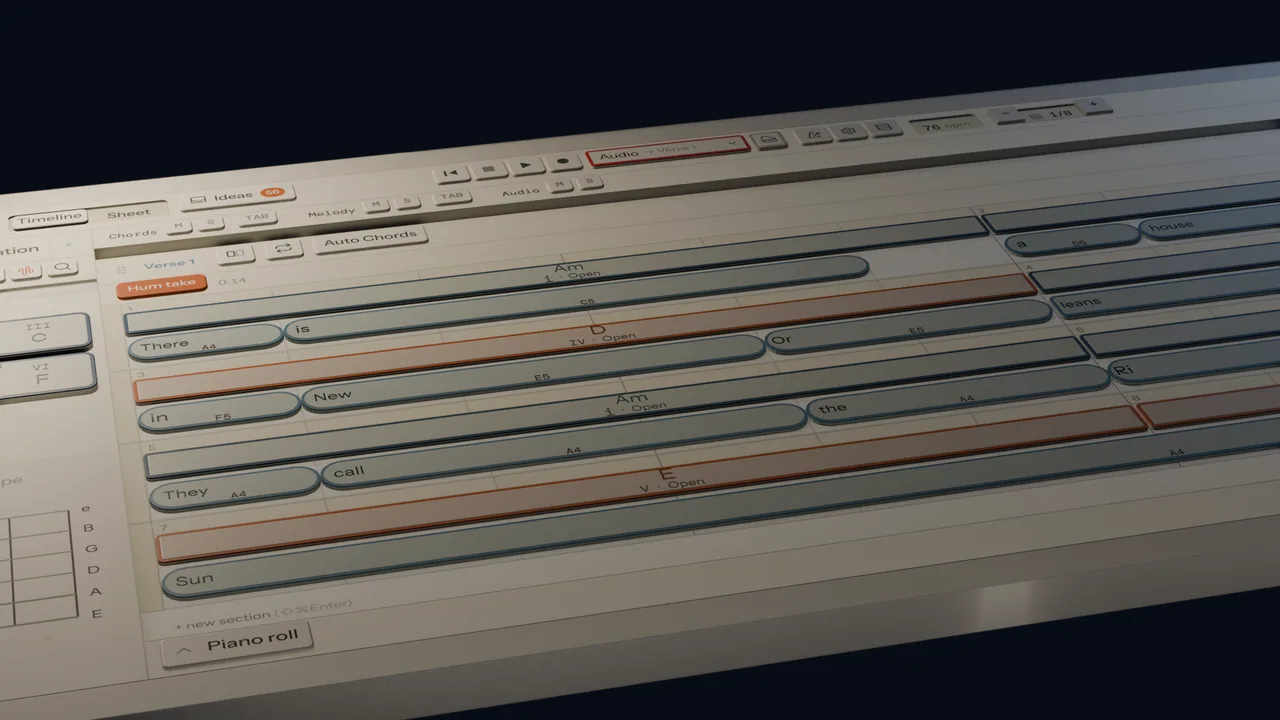
The O Come, O Come, Emmanuel chords in E minor are Em, G, Am, Bm, C and D, with D7, B7 and A7 for color, and the same chart works on guitar, piano and ukulele. Below are the chords over the words, the piano notes for the tune, the song in every common key, and the story of a melody whose origin stayed a mystery for 110 years.
The chart follows the four-part harmony in the Lutheran Common Service Book of 1917, simplified to one chord per syllable. E minor is the key most current hymnals print, and on guitar it's nearly all open shapes.
The short version
Nine chords in E minor: Em, G, Am, Bm, C, D, D7, B7, A7. Bm is the only barre chord; G can stand in for it. The tune is in 4/4, starts with a pickup on "O," and spans one octave, from the D above middle C to the D above that. Its only black key on the piano is F sharp.
What chords are in O Come, O Come, Emmanuel?
O Come, O Come, Emmanuel uses the chords of E minor: Em, G, Am, Bm, C and D, plus D7, and two chords from outside the key, B7 and A7, once each. Em and G carry most of the song, Am and D7 come under "Emmanuel," and Bm comes on "O" and "Israel."
The song spends its time between E minor and G major, its relative major, which uses the same seven notes. The first line ends on G ("Emmanuel"), the second comes back to Em ("Israel"), and the refrain ends in E minor, where it started.
| Chord | In E minor | Piano notes | Where it comes |
|---|---|---|---|
| Em | 1 (home) | E, G, B | "O come," "Israel," the last "Emmanuel" |
| G | ♭3 | G, B, D | "come," "ransom," "appear" |
| Am | 4 | A, C, E | "man-," "That mourns," "Is-" |
| Bm | 5 | B, D, F♯ | "O," "-ra-," the second "Rejoice!" |
| C | ♭6 | C, E, G | "captive," "thee" |
| D / D7 | ♭7 | D, F♯, A (C) | "And," "here," "-u-" (as D7) |
| B7 | 5 (major, 7th) | B, D♯, F♯, A | "lonely" |
| A7 | 4 (major, 7th) | A, C♯, E, G | "exile" |
The same chords work on guitar, piano and ukulele. B7 and A7 each borrow one note from outside E minor (D sharp and C sharp).
O Come, O Come, Emmanuel lyrics and chords
These are the words from the 1917 Common Service Book, with chords in E minor. Each chord sits on the syllable where it changes and rings until the next one. Every verse and every refrain uses the same chords.
Verse 1 and refrain (4/4, key of E minor)
[Em]O come, [Bm]O [G]come, Em[Am]man[D7]u[G]el,
[D]And [G]ransom [C]cap[G]tive [Am]Is[Bm]ra[Em]el,
[Am]That mourns in [Em]lone[B7]ly [Em]e[A7]xile [D]here
[Em]Un[D]til [Bm]the [G]Son of [Am]God [D7]ap[G]pear.
[G]Re[D]joice! [Em]Re[Bm]joice! [G]Em[Am]man[D7]u[Em]el
[D]Shall [G]come to [C]thee, [G]O [Am]Is[Bm]ra[Em]el.
Verses 2 to 5 (sing the refrain after each)
O come, Thou Wisdom from on high,
Who orderest all things mightily;
To us the path of knowledge show,
And teach us in her ways to go.
O come, Thou Rod of Jesse, free
Thine own from Satan's tyranny;
From depths of hell Thy people save,
And give them vict'ry o'er the grave.
O come, Thou Day-spring, come and cheer
Our spirits by Thine advent here;
Disperse the gloomy clouds of night,
And death's dark shadows put to flight.
O come, Thou Key of David, come,
And open wide our heavenly home;
Make safe the way that leads on high,
And close the path to misery.
Many hymnals add "O come, O come, Thou Lord of might, / Who to Thy tribes on Sinai's height / In ancient times didst give the law / In cloud and majesty and awe," and a verse that begins "O come, Desire of nations." Glory to God (2013), the Presbyterian hymnal, prints seven verses and suggests singing one on each day from December 17 to 23.
How do you play O Come, O Come, Emmanuel on guitar?
The O Come, O Come, Emmanuel guitar chords in E minor are Em (022000), G (320003), Am (x02210), Bm (x24432), C (x32010), D (xx0232), D7 (xx0212), B7 (x21202) and A7 (x02020), counting strings from the low E. Start on "O," the beat before the first full bar.
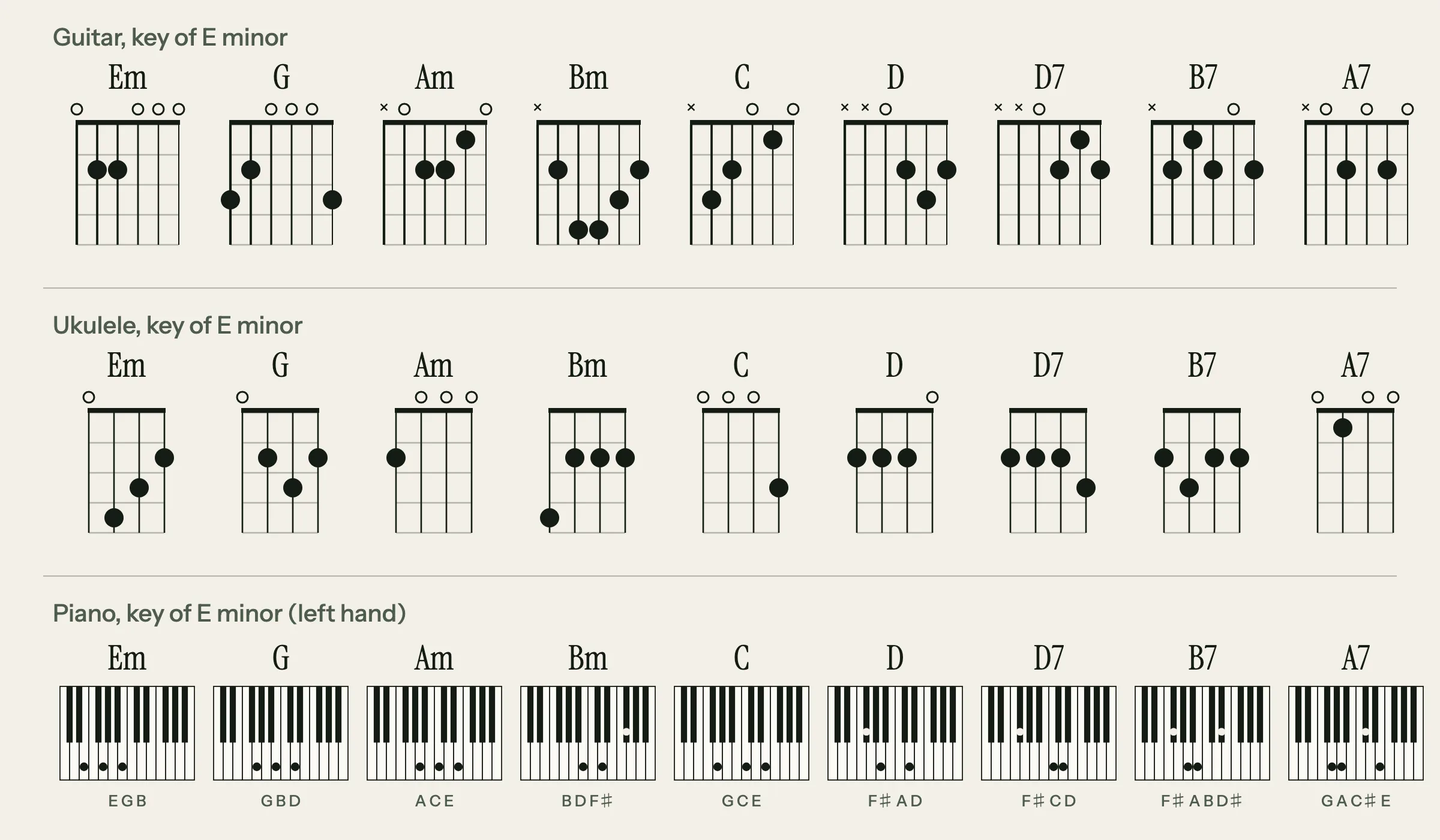
Bm is the one barre chord. Two easier options: Bm7 (x20202), or G, which works everywhere Bm comes, because the tune only sings B or D over it and G has both. B7 and A7 last one beat each, on "lone-ly e-xile," so practice that half line on its own: Em, B7, Em, A7, D.
Count "four" on the first "O" and land on beat 1 with "come." Strum slowly, one down-stroke per beat, and let the long notes ring: "-el" at the end of the first line holds for three beats. The verses work well picked and quiet, with fuller strumming for "Rejoice!" To sing higher, a capo on the second fret turns the same shapes into F sharp minor; the guitar capo chart has every fret. If your strumming hand stops whenever you start singing, how to sing and play guitar at the same time covers why and how to fix it.
What are the piano notes for O Come, O Come, Emmanuel?
The O Come, O Come, Emmanuel piano notes in E minor start on the E above middle C: E G B B B A C B A G, "O come, O come, Emmanuel." F sharp is the only black key the tune uses. The left hand plays the chords from the table above.
O Come, O Come, Emmanuel: piano notes (right hand, key of E minor)
O come, O come, Emmanuel: E G B B B A C B A G
And ransom captive Israel: A B G E G A F♯ E D E
That mourns in lonely exile here: A A E E F♯ G F♯ E D
Until the Son of God appear: G A B B B A C B A G
Rejoice! Rejoice! Emmanuel: D D B B B A C B A G
Shall come to thee, O Israel: A B G E G A F♯ E D E
The D's on "Rejoice!" are the D an octave above the low D on "-ra-" and "here," and they're the highest notes in the song. "Man-" and "Is-" each carry three notes (A C B and A F♯ E), so a line can have more notes than syllables. The first line, the fourth line and the first line of the refrain all end on the same eight notes, B B B A C B A G, and the second line and the refrain's last line are identical. Learn two lines and you have most of the song.
For the left hand, keep it simple: one chord per syllable from the chart, or just the bass note of each chord in octaves. Besides F sharp, the chords bring in two more black keys, once each: D sharp in B7 and C sharp in A7.
What are the ukulele chords for O Come, O Come, Emmanuel?
The O Come, O Come, Emmanuel ukulele chords in E minor are Em (0432), G (0232), Am (2000), Bm (4222), C (0003), D (2220), D7 (2223), B7 (2322) and A7 (0100), where the numbers are frets on the G, C, E and A strings in that order.
Em on the ukulele is a stretch for some hands. 0402, with the E string open, is an easier version with the same three notes. Bm (4222) is a small barre across the second fret; as on guitar, G (0232) is an easy stand-in. A7 (0100) is one finger.
For lower voices, D minor works on the ukulele too: Dm (2210), F (2010), Gm (0231), Am (2000), B♭ (3211), C (0003), C7 (0001), A7 (0100) and G7 (0212). It sits a step lower than E minor, from middle C up to the C above it.
O Come, O Come, Emmanuel chords in every key
O Come, O Come, Emmanuel works in any minor key with the same nine chords. Its lowest note is a whole step below the key note and its highest is that same note an octave up, so pick the key whose range fits your voice and read the chords across.
| Key | Chords, in the same order as E minor | Lowest and highest note (middle C is C4) | Guitar shapes |
|---|---|---|---|
| A minor | Am, C, Dm, Em, F, G, E7, D7 | G3 up to G4 | Open (F is a barre) |
| B minor | Bm, D, Em, F♯m, G, A, F♯7, E7 | A3 up to A4 | A minor shapes, capo 2 |
| C minor | Cm, E♭, Fm, Gm, A♭, B♭, G7, F7 | B♭3 up to B♭4 | A minor shapes, capo 3 |
| D minor | Dm, F, Gm, Am, B♭, C, A7, G7 | C4 up to C5 | A minor shapes, capo 5 |
| E minor | Em, G, Am, Bm, C, D, B7, A7 | D4 up to D5 | Open (Bm is a barre) |
| F♯ minor | F♯m, A, Bm, C♯m, D, E, C♯7, B7 | E4 up to E5 | E minor shapes, capo 2 |
| G minor | Gm, B♭, Cm, Dm, E♭, F, D7, C7 | F4 up to F5 | E minor shapes, capo 3 |
The ♭7 chord also appears as a 7th (D7 in E minor). Men singing the tune sing it an octave lower than written.
In Nashville numbers, a minor-key song is usually charted from its relative major, so in E minor G is 1 and Em is 6-. The first line reads 6-, 3-, 1, 2-, 5⁷, 1. The Nashville Number System post explains the minor-key convention.
What key should a group sing O Come, O Come, Emmanuel in?
E minor is the key most current hymnals use, and it fits most groups: the tune runs from the D above middle C up to the D an octave higher, D4 to D5. D minor (C4 to C5) is a step lower and easier for deep voices.
Evangelical Lutheran Worship (2006), the Lutheran Service Book (2006) and the Baptist Hymnal (2008) all print it in E minor. So does the 1917 Common Service Book this chart comes from.
The whole range shows up early. The lowest note, D, comes on "-ra-" in the second line, and the highest, the D an octave up, comes on "Rejoice!" So the opening verse and the first refrain test the key completely. If "Rejoice!" strains, drop to D minor; if "Israel" is too low to hear, go up to F sharp minor.
If you're leading and want to check your own range first, the free vocal range test finds your lowest and highest notes and suggests keys that fit, with guitar capo frets.
Why does O Come, O Come, Emmanuel sound so old?
The melody uses only the seven notes of E natural minor. It never sings a D sharp, the raised seventh of harmonic minor, and the "-man-" of "Emmanuel" climbs to C, the flat sixth. That plain minor comes from a 15th-century chant book, which is why it sounds older than the hymns around it.
The Psalter Hymnal Handbook, quoted on Hymnary.org, calls the tune Dorian. But Dorian minor has a raised sixth (C sharp in E), and this tune sings a C natural on "-man-" and on "God," so as hymnals print it, it's Aeolian, the natural minor scale. The Dorian mode post shows what that one raised note would change.
The harmony adds the D sharp the tune leaves out, once, in the B7 under "lonely." That's the raised seventh of harmonic minor, and it makes the next Em land harder.
The 1917 harmony also sets the same melody note two ways. "-el" at the end of the first line is G and harmonized with a G chord, ending the line in the relative major. In the refrain, the same G on "-el" is harmonized with Em, which pulls the song home to E minor. How to tell what key a song is in explains why a song can sit on G for a line and still be in E minor.
Who wrote O Come, O Come, Emmanuel?
The words come from the O Antiphons, seven short Latin chants for the last evenings before Christmas Eve, probably from the 8th century. A rhyming Latin hymn based on them was printed in Germany by 1693, and John Mason Neale translated it in 1851. Nobody knows who wrote either Latin text.
Each antiphon calls Christ by a different title: Wisdom, Lord (Adonai), Root of Jesse, Key of David, Dayspring, King of Nations and Emmanuel, which means "God with us." According to the Hymnology Archive, the first letters of the Latin titles, read backward, spell ero cras, Latin for "I will be [there] tomorrow," though scholars have long debated whether that was deliberate.
The Hymnology Archive lists two early printings from the same region of Germany: Triplex Horologium Juventutis Studiosae (Westphalia, 1693) and the Psalteriolum Cantionum Catholicarum (Cologne, 1710), the date Wikipedia gives as the first. The rhyming hymn, "Veni, veni, Emmanuel," kept only five of the seven titles and added the refrain. Neale's 1851 translation began "Draw nigh, draw nigh, Emmanuel." Hymns Ancient and Modern altered Neale's text in 1861 into the words most churches sing, changing "Draw nigh" to "O come" and the refrain's "shall be born for thee" to "shall come to thee." The Hymnology Archive says those changes are generally credited to Henry W. Baker. English verses for the two missing titles came later; the most widely sung are by the American minister Henry Sloane Coffin, from 1916.
Where does the O Come, O Come, Emmanuel tune come from?
The tune, called VENI EMMANUEL, was first printed with these words in The Hymnal Noted, whose music editor was Thomas Helmore. The book said it came "From a French Missal in the National Library, Lisbon." No one could find it there. In 1966 the musicologist Mary Berry found it in a 15th-century processional in Paris.
The source stayed missing for more than a century, and many scholars came to believe Helmore had made the tune up. The editors of a 1901 hymnal companion wrote that the missals at Lisbon had been checked and the melody wasn't in them. In December 1965, the young musicologist Nicholas Temperley wrote in The Cambridge News that it was "now established beyond reasonable doubt that he wrote it himself, using fragments of plainsong."
Nine months later, Berry, then known as Mother Thomas More, reported in The Musical Times what she had found at the Bibliothèque nationale de France: a processional that had belonged to French Franciscan nuns, in which the melody carries a different Latin text, "Bone Jesu dulcis cunctis," a trope added to the funeral chant "Libera me." So the oldest known form of the Advent tune is burial music. The words and the tune are both in the public domain.
How do you put O Come, O Come, Emmanuel into Song Cage?
Song Cage shows a song as chords over the words, like a printed chord sheet, and moves the whole song to a new key in one step. Type the words into a song in Sheet view, set the key to E minor, put the chords on, then pick a new key from the key chip and choose Move song.
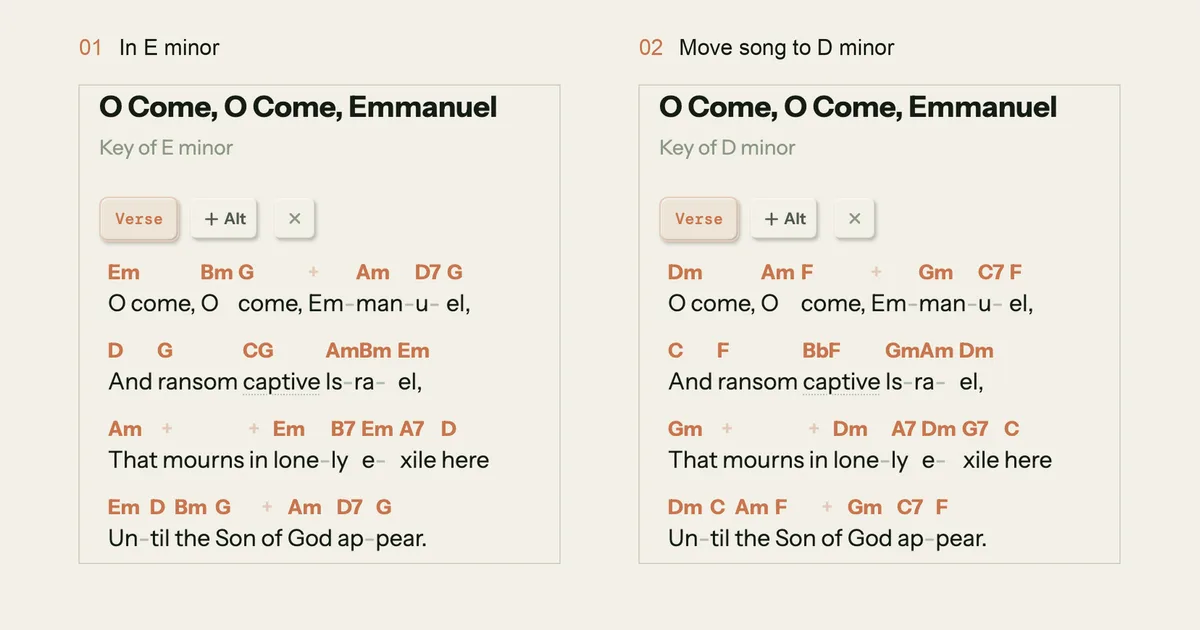
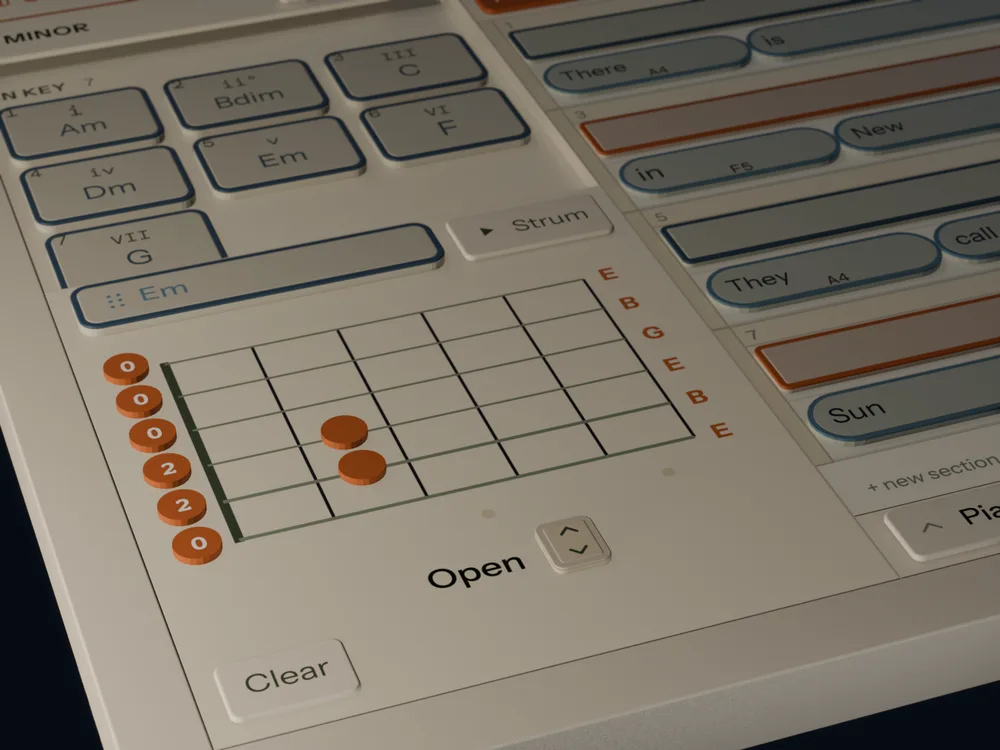
Move song is how the chart in E minor becomes D minor for a lower group: every chord moves together and stays on its word. View > Nashville Numbers shows the chart counted from G, the relative major, so Em reads 6-, and View > Roman Numerals counts from E instead, so Em reads i. Clicking a chord shows its guitar shape or piano keys, with a capo if you set one. The changing keys chapter covers Move song and Relabel.
To hear the words on the tune, add the melody by singing it in or entering the notes, and the Singer voice sings each syllable on its note. It sounds like an 80s talking computer played off an old cassette, rough but clear enough to hear how the words sit. For more carols in the same format, see O Come All Ye Faithful chords, Hark the Herald Angels Sing chords and Silent Night chords.
Play O Come, O Come, Emmanuel in your key
Put the chords over the words in Song Cage, move the song from E minor to D minor or any other key, and see every chord as a guitar shape or as piano keys.
Frequently Asked Questions
What are the chords for O Come, O Come, Emmanuel?
In E minor: Em, G, Am, Bm, C and D, with D7, B7 and A7. Em and G carry most of the song, Am and D7 come under "Emmanuel," and B7 and A7 come once each, on "lonely exile." Play G in place of Bm if you'd rather skip the barre chord.
What key is O Come, O Come, Emmanuel in?
E minor in most current hymnals, including Evangelical Lutheran Worship (2006), the Lutheran Service Book (2006) and the Baptist Hymnal (2008). The tune spans D4 to D5 in E minor. D minor is a step lower for deep voices.
Is O Come, O Come, Emmanuel a Christmas carol?
It's an Advent hymn, sung in the weeks before Christmas, though carol books often include it. Its verses come from the O Antiphons, chants for the seven evenings before Christmas Eve, December 17 to 23.
What does Emmanuel mean?
"God with us." The name comes from Isaiah 7:14 and is quoted in Matthew 1:23. It's the last of the seven titles in the O Antiphons, and the Latin hymn moved it to the first verse.
Who wrote the music for O Come, O Come, Emmanuel?
Nobody knows. Thomas Helmore published the tune with these words in The Hymnal Noted in the 1850s, and in 1966 Mary Berry found the melody in a 15th-century French processional in Paris, set to a funeral chant text.
Is O Come, O Come, Emmanuel in the public domain?
Yes. The Latin text was printed by 1693, Neale's translation dates from 1851 and its revision from 1861, and the tune is from the 15th century. Some newer verse translations in current hymnals, and modern arrangements and recordings, can still be under copyright.