The easiest guitar songs use three or four chords that you can play as open shapes, and they change chord slowly. We counted every chord in 737 Billboard Hot 100 hits. Of the well-known ones, Lay Down Sally, I Got You (I Feel Good) and These Boots Are Made for Walkin' lead the table: three chords, changing 9 to 15 times a minute. Chain of Fools uses only one.
A chord count tells you how many shapes to learn. This list also counts how often the chords change across the whole record, because that's what your hands feel. Bad Moon Rising and Lay Down Sally both use three chords, but Bad Moon Rising changes three times as often.
The short version
The two easy songs to learn on guitar first are Lay Down Sally (A, D and E) and I Got You (I Feel Good) (D7, G7 and A7). Neither needs a capo or a barre chord, and both hold each chord for at least a bar. A capo is the other trick: it puts more than three times as many hits within reach of open chords.
What are the easiest songs to learn on guitar?
The easiest songs to learn on guitar are Chain of Fools (one chord), These Boots Are Made for Walkin', Lay Down Sally and I Got You (I Feel Good). Each of the three-chord songs changes chord fewer than 15 times a minute. The table ranks 18 easy guitar songs for beginners, all well-known hits with four chords or fewer, by chord count and then by how often the chords change.
| Song | Chords on the record | What to play | Chords | Changes a minute | Hot 100 peak |
|---|---|---|---|---|---|
| 1. Chain of Fools, Aretha Franklin | C7♯9 | C or C7, no capo | 1 | 0 | 2 |
| 2. These Boots Are Made for Walkin', Nancy Sinatra | E, G, A* | No capo | 3 | 9.4 | 1 |
| 3. Lay Down Sally, Eric Clapton | A, A7, D, E | No capo | 3 | 10.2 | 3 |
| 4. I Got You (I Feel Good), James Brown | D7, G7, A7 | No capo | 3 | 14.6 | 3 |
| 5. The Twist, Chubby Checker | E, A, B | Capo 2: D, G, A | 3 | 16.1 | 1 |
| 6. Love Me Do, The Beatles | G, C, D | No capo | 3 | 25.3 | 1 |
| 7. Bad Moon Rising, Creedence Clearwater Revival | D, A, G | No capo | 3 | 31.7 | 2 |
| 8. Cecilia, Simon & Garfunkel | B, E, F♯ | Capo 2: A, D, E | 3 | 34.0 | 4 |
| 9. I'll Take You There, The Staple Singers | C, F, G9sus4 | Capo 3: A, D, Esus4 | 3 | 35.2 | 1 |
| 10. El Condor Pasa (If I Could), Simon & Garfunkel | Em, G, C6, Am | No capo | 4 | 6.4 | 18 |
| 11. Get Together, The Youngbloods | A, G, D, E | No capo | 4 | 15.2 | 5 |
| 12. Born to Be Wild, Steppenwolf | E, D, G, A | No capo | 4 | 17.2 | 2 |
| 13. Teach Your Children, Crosby, Stills, Nash & Young | D, G, A, Bm | No capo, or capo 7: G, C, D, Em | 4 | 19.3 | 16 |
| 14. With or Without You, U2 | D, A7sus4, Bm7, Gmaj9 | Capo 7: G, D7sus4, Em7, C | 4 | 23.9 | 1 |
| 15. Ain't No Sunshine, Bill Withers | Am7, Em7, G7, Dm7 | No capo | 4 | 24.8 | 3 |
| 16. Red Red Wine, UB40 | D♭, G♭, A♭, A♭sus4 | Capo 4: A, D, E, Esus4 | 4 | 33.9 | 1 |
| 17. Sweet Home Alabama, Lynyrd Skynyrd | D, C, G, F | No capo (F is a one-beat passing chord) | 4 | 40.8 | 8 |
| 18. Come and Get Your Love, Redbone | Em7, A, D, Bm | Capo 2: Dm7, G, C, Am | 4 | 47.4 | 5 |
Chords and changes are counted from the McGill Billboard transcription of each record. A chord and its 7th, 6th or 9th count as one chord (A and A7 are one); a sus chord counts on its own. Changes a minute is every chord change on the record divided by its length from the first chord. Hot 100 peak is from the dataset's index. *Chord charts put These Boots Are Made for Walkin' in E; the McGill transcription has it a half step higher, in F (F, A♭, B♭), where a capo on fret 1 gives the same shapes.
The order is fewest chords first, then fewest changes a minute. Two songs with the same count can feel very different, which the next section explains.
What makes a guitar song easy to play?
Three things make a guitar song easy: how many chord shapes it uses, whether any of them is a barre chord, and how often the chords change. Chord count misleads on its own. In our count, 21 of the 68 three-chord hits change chord faster than the median hit, which uses seven chords and changes 23.7 times a minute.
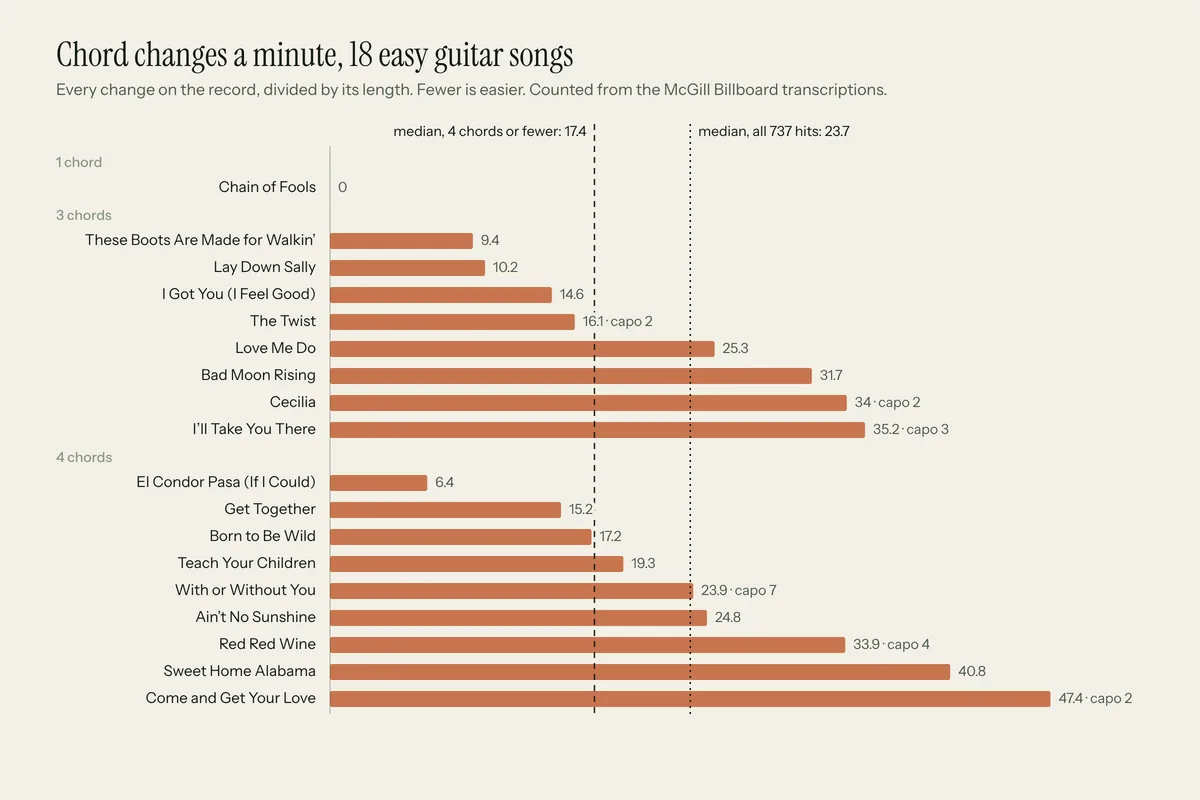
Changes a minute is the number that the usual lists leave out. With a capo on fret 2, Cecilia uses the same three shapes as Lay Down Sally (A, D and E), but Cecilia changes 34 times a minute to Lay Down Sally's 10. Across all 737 songs the median is 23.7 changes a minute. For the songs with four chords or fewer, it's 17.4.
Barre chords are the second wall. B, F, Bm, F♯m and C♯m all need one finger pressed across the strings, and they show up in hits all the time. Only 64 of the 737 songs can be played with open shapes alone (C, D, E, G, A, Am, Dm and Em, with their 7ths and sus chords). Allow a capo anywhere from the first fret to the seventh and that rises to 216, more than three times as many.
Tempo matters as well. A slow song gives your fretting hand more time per change, which is why El Condor Pasa (If I Could), at 6.4 changes a minute, plays easier than its four chords suggest.
How many chords does a hit song use?
The median hit in our count uses seven chords. Of 737 Billboard Hot 100 hits from 1958 to 1991, 86 (11.7%) use three chords or fewer and 181 (24.6%) use four or fewer. Eighteen use one or two. Most three-chord hits are the 1, 4 and 5 chords of their key.
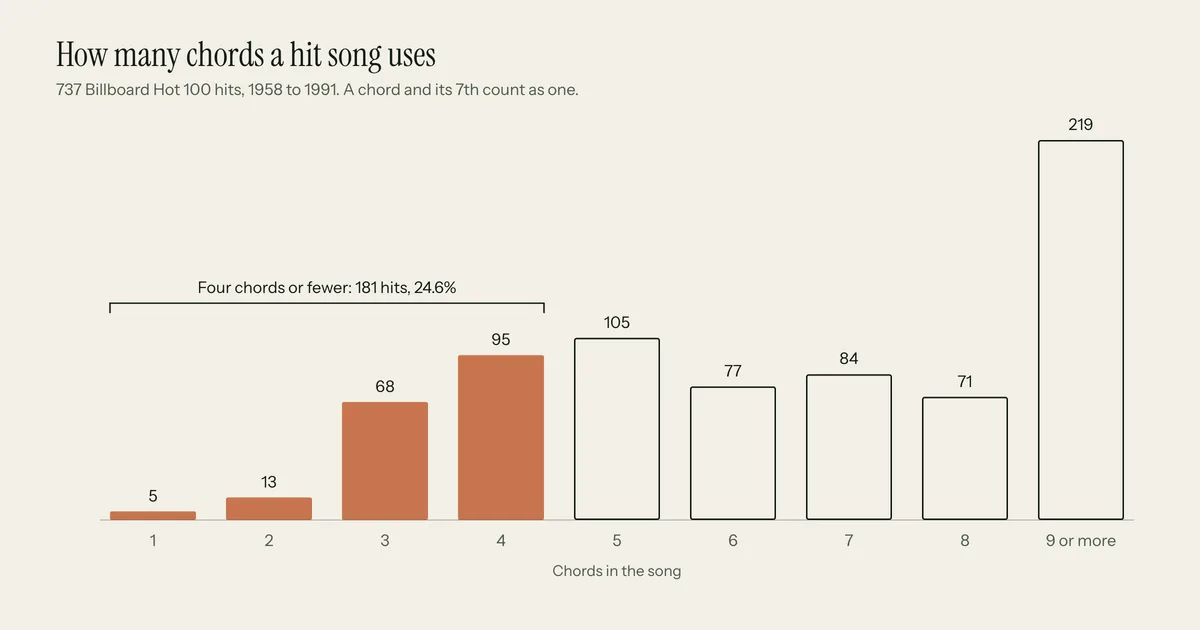
The songs come from the McGill Billboard Project, a random sample of Hot 100 chart slots from 1958 to 1991 that a team of trained jazz musicians transcribed chord by chord from the records. The project released it free for anyone to use. The released set has 890 annotated slots, and some songs were drawn more than once, so we counted each song once: 737 songs with chords.
Of the 68 songs with exactly three chords, 46 use the major 1, 4 and 5 chords of their key: G, C and D in G, or A, D and E in A. That's 68%. Love Me Do is G, C and D. Lay Down Sally is A, D and E. The rest add a minor chord, a sus chord (like the G9sus4 in I'll Take You There) or a chord from outside the key.
| Chords in the song | Hits | Share | Running total |
|---|---|---|---|
| 1 or 2 | 18 | 2.4% | 2.4% |
| 3 | 68 | 9.2% | 11.7% |
| 4 | 95 | 12.9% | 24.6% |
| 5 | 105 | 14.2% | 38.8% |
| 6 | 77 | 10.4% | 49.3% |
| 7 or 8 | 155 | 21.0% | 70.3% |
| 9 or more | 219 | 29.7% | 100% |
737 songs from the McGill Billboard sample, each counted once. A chord and its 7th, 9th or 6th count as one chord.
Which songs use only one or two chords?
Chain of Fools by Aretha Franklin uses one chord the whole way through: C, played on the record as C7♯9. Eighteen of the 737 hits use one or two chords. They are easy on the fretting hand and hard on the strumming hand, because the groove carries the song.
On Chain of Fools, the C7♯9 takes 272 of the song's 318 beats and a plain C takes the rest. A beginner can strum an open C or C7 under it and sound right. What makes it Chain of Fools is the rhythm, so play along with the record and copy the strum rather than counting chords.
Two-chord songs work the same way. It's Your Thing by The Isley Brothers (No. 2) swings between F and B♭, which a capo on fret 1 turns into E and A. Smoking Gun by The Robert Cray Band moves between Em and Am. Your hand learns one move and then repeats it. If one-chord songs bore you, they are still the best place to practise strumming while you sing, which is a separate skill from fretting. How to sing and play guitar at the same time covers why your strumming hand stops when you start to sing.
Which easy guitar songs use only three chords?
Lay Down Sally, I Got You (I Feel Good), The Twist, Love Me Do and Bad Moon Rising are the best-known three-chord songs in the sample. Lay Down Sally and I Got You need no capo and no barre. The Twist and Cecilia need a capo on the second fret to come off the barre chords.
Lay Down Sally (A, D, E) is the easiest of the lot. No chord on the record lasts less than two bars, and the chorus spends two bars on A before moving to D. I Got You (I Feel Good) uses D7, G7 and A7, all open shapes, and its verse is a 12-bar blues: four bars of D7, two of G7, two of D7, then A7, G7 and two more bars of D7.
The Twist is E, A and B on the record. Play B7 (x21202) in place of B, or put a capo on fret 2 and play D, G and A. These Boots Are Made for Walkin' sits on its first chord for most of the song. Chord charts put it in E, so it's E, G and A with no capo. The McGill transcription hears it a half step higher, in F, where a capo on fret 1 gives the same shapes.
Love Me Do alternates G and C a bar at a time and saves D for the middle section. Bad Moon Rising is the quick one: each verse line moves D, then A and G two beats each, then D. Drill that A-to-G move on its own before you play it with the record.
Which beginner guitar songs use four chords?
El Condor Pasa (If I Could) and Get Together change chord the least of the four-chord songs in the table, 6.4 and 15.2 times a minute, all on open shapes. Born to Be Wild and Teach Your Children come next. With or Without You needs a capo or a Bm7 shape.
El Condor Pasa (If I Could) sits on G and Em for long stretches and changes 6.4 times a minute, the slowest of the four-chord songs. Get Together stays on A for three bars of each verse line before dropping to G. Born to Be Wild swings between E and D through its chorus and adds G and A in the bridge.
Teach Your Children is D, G and A plus a Bm that lasts only four bars of the whole song. Learn the other three first and fake the Bm until you can play it. Ain't No Sunshine has four open chords, but in most lines Em7 and G7 get one beat each on the way back to Am7. That's 28 chords lasting a single beat in a two-minute song.
With or Without You loops the same four bars (D, A7sus4, Bm7, Gmaj9) through its verses and choruses. With a capo on fret 7, those become G, D7sus4, Em7 and C shapes. Without a capo, play Bm7 as x20202, which needs no barre. Come and Get Your Love is the hardest here: four chords, but it changes 47 times a minute.
How does a capo make a song easier to play?
A capo raises every string by one half step per fret, so a shape played behind it sounds higher than its name. To find the shape, count down from the chord on the record by the capo's fret number. With a capo on fret 2, a G shape sounds as A, and a D shape sounds as E.
That's how a song full of barre chords turns into open shapes. The Twist is E, A and B, and B is a barre chord. Count each down two half steps and you get D, G and A, all open. Red Red Wine is D♭, G♭ and A♭. Count down four and you get A, D and E.
A capo doesn't change what the audience hears, only what your fingers do. That is why the table lists the record's chords and the shapes separately. The guitar capo chart has every chord at every fret, if you want to work one out yourself. On a keyboard, a digital piano's Transpose button does the same job, and easy piano songs gives the setting for 26 hits.
Finding the capo for any song
- Write down the song's chords as they sound on the record.
- Count each one down by one half step, then two, and so on up to seven.
- Stop at the first fret where every chord lands on an open shape: C, D, E, G, A, Am, Dm or Em.
We stopped counting at the seventh fret. A capo that high makes the guitar sound small and bright next to the record, and With or Without You at capo 7 already does.
How do you get faster at changing chords?
Practise the chord change on its own, away from the song. JustinGuitar's One Minute Changes is a simple drill: pick two chords, switch back and forth for one minute, and write down how many changes you made. The lesson says six to nine is a typical first try and sets 60 a minute as the target.
Each song in the table gives you the pairs to drill. For Lay Down Sally, that's A to D and A to E. For Bad Moon Rising, it's D to A and A to G, and the A to G move is the one that has to happen in two beats. Start with the pair you fumble most.
The One Minute Changes video is free. The chords don't have to ring clean while you drill, since the point is getting your fingers to move. Clean the shapes up once the speed is there. If you need diagrams for any of these shapes, free guitar chord charts online lists the free sites with fingerings and sound.
How can you tell if a song is easy before you learn it?
Count three things from any chord chart: how many different chords it has, whether any is a barre chord, and how often the chords change. Four or fewer chords, no barre (or one a capo removes), and around 15 to 20 changes a minute or fewer makes a beginner-friendly song.
To estimate changes a minute, count the chord changes in one verse and chorus, time that stretch on the record, and divide. Compare your number with 17.4, the median for hits with four chords or fewer in our count, and 23.7, the median for every hit.
Watch for 7th and sus chords in a chart. A 7th looks like an extra chord but isn't an extra shape to learn: A7 is an A shape with one finger lifted. The table counts a 7th with its parent chord and a sus chord on its own, though Dsus4 and Asus4 are only one finger away from D and A.
Chord charts online disagree, and a simplified chart may leave chords out. The counts here come from transcriptions of the records themselves, so they include passing chords like the one-beat F in Sweet Home Alabama.
How do you see any song as capo shapes in Song Cage?
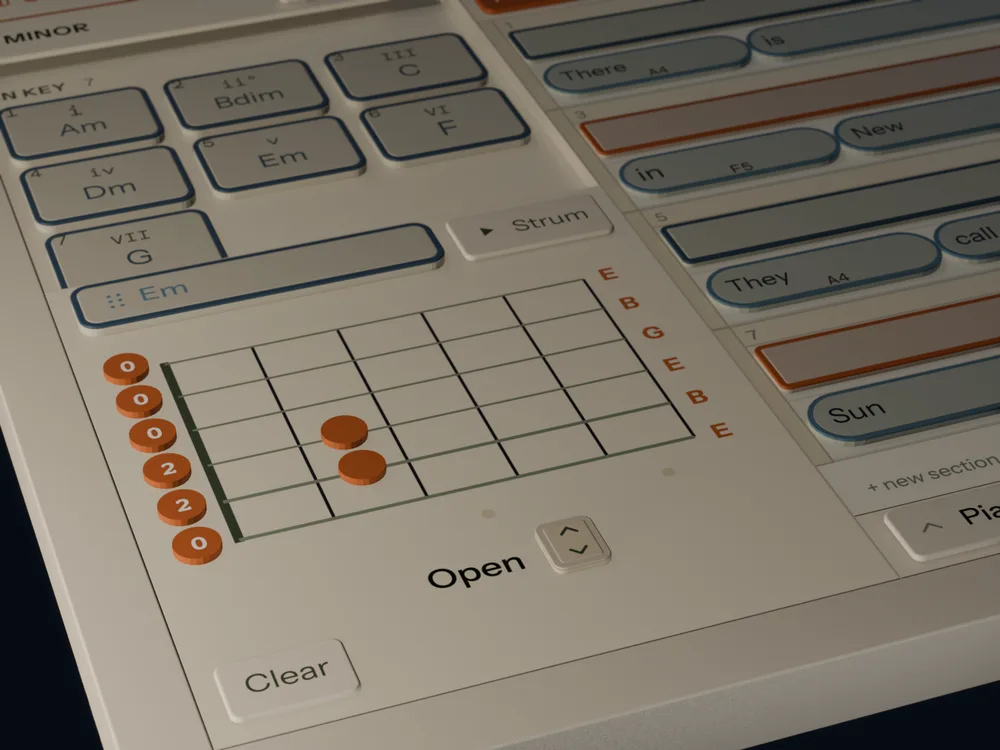
Song Cage shows each chord as the shape you play behind a capo, with the real key kept beside it. On a computer, set the capo in Settings and the fretboard panel shows the shape for each chord. On the phone app, set a capo on an idea and every chord reads as a shape.
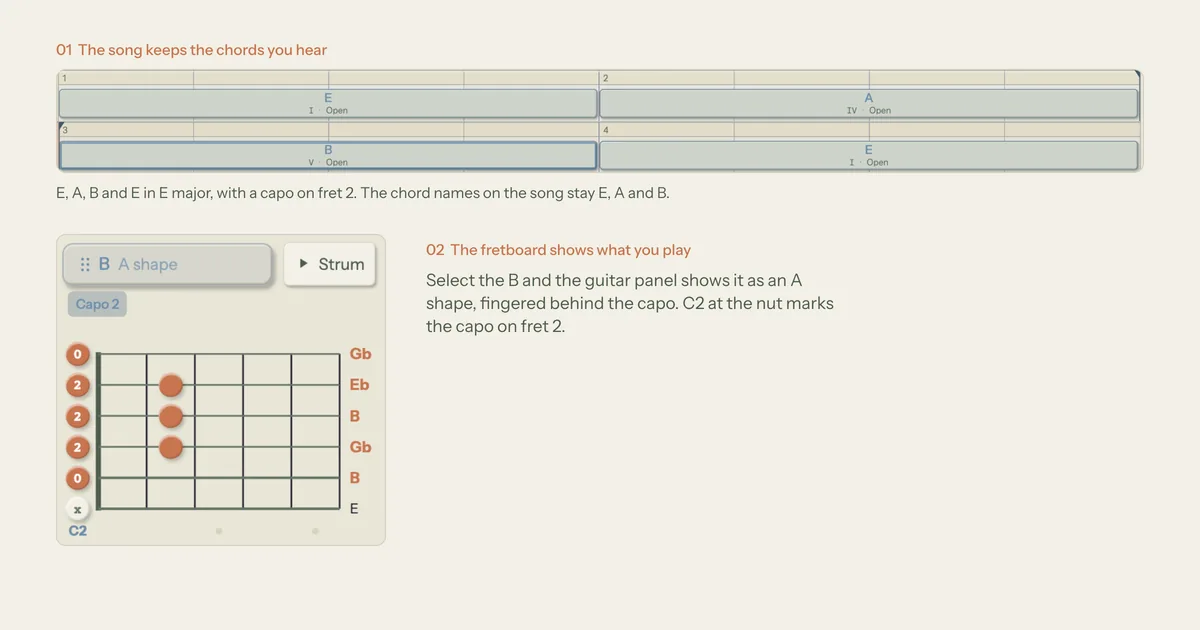
On a computer, paste a chord chart with the chords in square brackets into a song's Sheet view and it becomes sections with the chords over the words. Then open Settings, switch to Guitar, and pick a fret from the Capo menu. The chord names on the song stay the sounding chords, and the fretboard panel shows the shape behind the capo with a capo marker at the nut. The guitar and piano chapter covers it.
Export PDF prints the shape chords and the capo fret, which is how a guitarist reads a chart. The web app is free for one song, and PDF export comes with the Song Cage licence.
On the phone, a capo never changes the sound or the key. The idea keeps its real key, the capo's shape key shows beside it (Capo 2 (G) next to A maj), and with Guitar picked as the instrument every chord reads as the shape you play. How to make a chord chart covers writing the chords over the words from scratch.
Play any song on shapes you know
Paste in a chord chart, set a capo, and Song Cage shows every chord as the shape you play while the song keeps its key.
Frequently Asked Questions
What is the easiest song to play on guitar?
Of the 18 songs in the table, Lay Down Sally by Eric Clapton is the easiest to start with: three open chords (A, D and E), no capo, and about 10 chord changes a minute. Chain of Fools uses only one chord, C, but its rhythm is harder to copy than Lay Down Sally's changes.
What songs can you play with G, C and D?
Love Me Do by The Beatles uses only G, C and D. So do Treat Her Right by Roy Head, Sweet Nothin's by Brenda Lee and If I Were a Carpenter by Bobby Darin. Sweet Home Alabama is D, C and G with a one-beat passing F.
What are the three chords in most three-chord songs?
The 1, 4 and 5 chords of the key: G, C and D in G, or A, D and E in A. Of the 68 three-chord hits in our count, 46 use exactly those three major chords.
Do I need a capo for easy guitar songs?
Not for all of them. Lay Down Sally, I Got You (I Feel Good), Love Me Do and Bad Moon Rising need none. A capo matters for songs in keys like B, F or D♭: only 64 of 737 hits fit open chords without one, and 216 fit once you allow a capo anywhere up to the seventh fret.
Why doesn't this page print the words?
The songs here are from 1958 onward and still under copyright, so the page lists their chords, not their lyrics. For songs old enough to print in full, the easy Christmas songs page has ten carols with every chord over the words.
Why are there no songs after 1991 here?
The McGill Billboard sample covers Hot 100 chart slots from 1958 to 1991, and every count here comes from it. The way of checking a song works on anything newer: count its chords, look for barre chords, and count how often the chords change.