Happy Birthday needs three chords: C, F and G7 in the key of C, or G, C and D7 in G. The tune spans exactly one octave, and it starts on its lowest note, so the note you pick for the first "Hap-" decides whether anyone can reach the top note on "birth-day dear."
Below you'll find the chords with the words, the piano letter notes, guitar tab, ukulele chords, the notes for band instruments, and a table of all 12 keys. Then why the song is hard to sing, and how to choose a key a room full of people can manage.
The short version
Happy Birthday uses the 1, 4 and 5 chords of its key: C, F and G7 in C; G, C and D7 in G; F, B flat and C7 in F. It's in 3/4 time and starts with two pickup notes on "Hap-py." The tune runs from the first note up one octave, and the top note arrives on "birth-" in the third line, just before the name. Start low and sing it slowly, and most of the room can hit it.
What are the chords to Happy Birthday?
Happy Birthday uses three chords: the 1, 4 and 5 of the key. In C they're C, F and G7. The song starts on C, moves to G7 at the end of the first line, comes home to C at the end of the second, goes to F on the name, and finishes G7 to C.
Here it is in C, with each chord placed on the syllable where it changes:
Happy Birthday (3/4): C, F, G7
Happy [C]birthday to [G7]you,
Happy [G7]birthday to [C]you,
Happy [C]birthday dear [F](Name),
Happy [C]birthday [G7]to [C]you.
Guitar in G: G, C and D7 in the same places. In F: F, B flat and C7.
The first "Happy" of each line is a pickup, so the first full chord lands on "birth-." If you want something under the very first "Hap-py," play G7 (Hoffman Academy's piano lesson suggests the same), then go to C on "birth-." The name gets a hold, called a fermata in written music, so stay on F until the singers have finished the name, however many syllables it has.
For a stronger pull into the name, play C7 on "dear" before the F. C7 is the 5 chord of F, a secondary dominant, and it makes the F sound like an arrival. The chords work by number, which is the idea behind the Nashville Number System: 1, 5, 5, 1, 1, 4, then 1, 5, 1 to finish, in any key.
What are the Happy Birthday guitar chords?
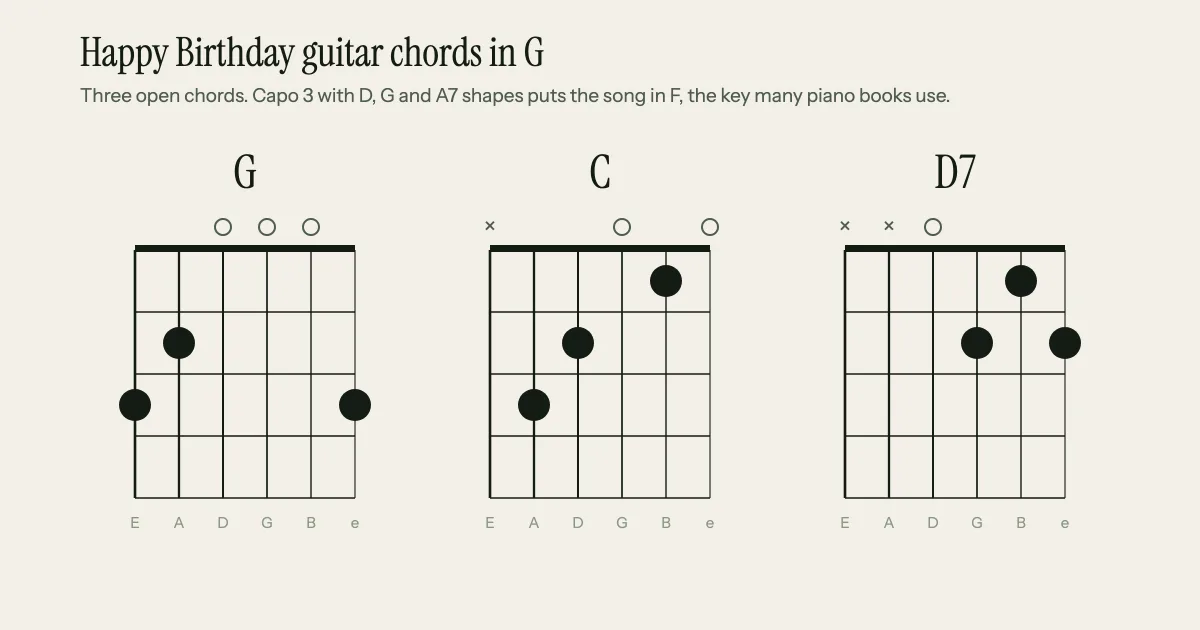
The Happy Birthday guitar chords are G, C and D7 in G, or C, F and G7 in C; G avoids the F chord. Count three beats to the bar: bass note on beat 1, then brush the chord on beats 2 and 3. To sing in F, play D shapes with a capo on the third fret.
Happy Birthday is a waltz, three beats to the bar, so a four-beat strum feels wrong against it. Bass on 1, chord on 2 and 3 fits the song and leaves a gap for the singers to breathe. Time signatures explains how 3/4 counts if waltz time is new to you.
A capo lets you keep easy shapes and still sing in the key the room needs. Each fret raises the song a half step: D shapes with a capo on fret 3 sound in F, and G shapes on fret 3 sound in B flat. The guitar capo chart has every fret and shape. If you're leading a group and you're not sure where they'll sing, start with D shapes and a capo on fret 3 (the key of F), then move the capo down a fret if the top note strains, or up a fret if the first note is too low to sing.
Happy Birthday guitar tab
The melody in C sits in open position on the top three strings, frets 0 to 3, so it pairs with the C, F and G7 chords above. The number is the fret; 0 is the open string.
Happy birthday to you
e|-----------------|
B|---------1--0----|
G|-0-0-2-0---------|
D|-----------------|
A|-----------------|
E|-----------------|

Happy birthday to you
e|-----------------|
B|---------3--1----|
G|-0-0-2-0---------|
D|-----------------|
A|-----------------|
E|-----------------|

Happy birthday dear (Name)
e|-----3--0----------|
B|----------1--0-----|
G|-0-0----------2----|
D|-------------------|
A|-------------------|
E|-------------------|

Happy birthday to you
e|-1-1-0-----------|
B|-------1--3--1---|
G|-----------------|
D|-----------------|
A|-----------------|
E|-----------------|
The jump from the open G string to the third fret of the high E string in the third line is the octave leap, the same jump that catches singers.
What are the piano notes for Happy Birthday?
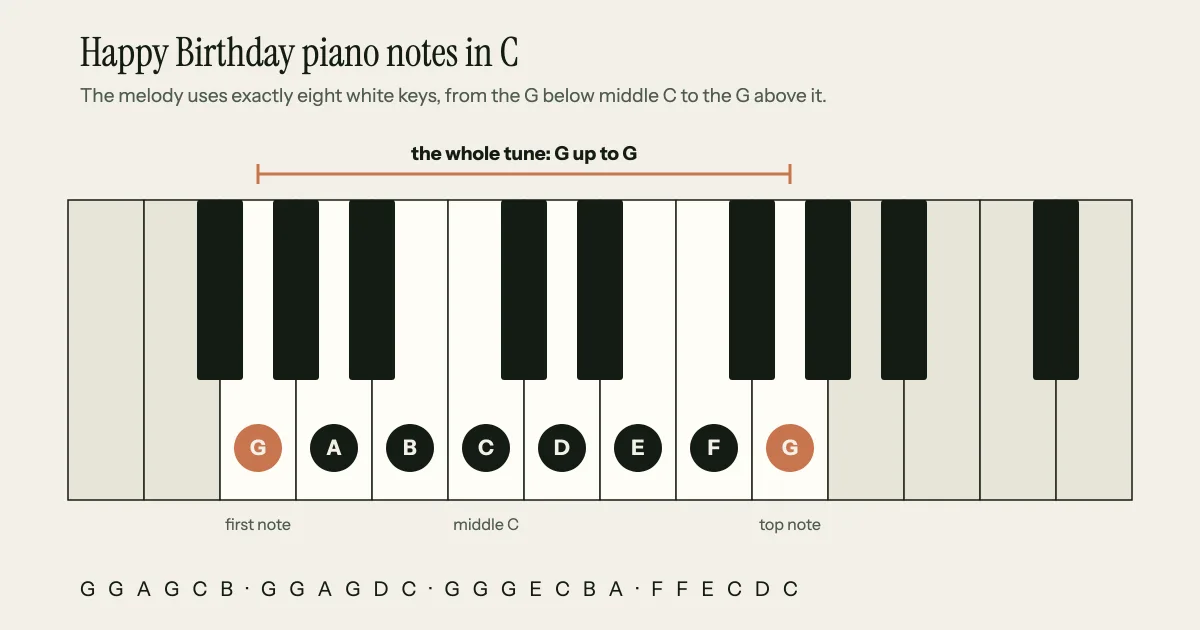
In C, starting on the G below middle C, the right-hand notes are: G G A G C B, G G A G D C, G G G E C B A, F F E C D C. The third G in the third line is the G above middle C, an octave higher than the first.
Happy Birthday piano notes (right hand, key of C)
Hap-py birth-day to you: G G A G C B
Hap-py birth-day to you: G G A G D C
Hap-py birth-day dear (Name): G G G E C B A (the third G is an octave up)
Hap-py birth-day to you: F F E C D C
Happy Birthday piano notes (right hand, key of F)
Hap-py birth-day to you: C C D C F E
Hap-py birth-day to you: C C D C G F
Hap-py birth-day dear (Name): C C C A F E D (the third C is an octave up)
Hap-py birth-day to you: B♭ B♭ A F G F
In C the tune uses exactly eight keys, the white keys from G up to G, and no black keys at all. The F version starts on middle C, which makes it easy to find. Many piano arrangements use F. Music Theory Academy chose it because the melody then sits "at a pitch range that most people (male and female) can sing."
For the left hand in C, three shapes cover the whole song with almost no movement. C is C, E and G. For F, keep the C and move the other two fingers up to F and A. For G7, play B, F and G: C slips down to B, E slips up to F, and G stays, so no finger moves more than a half step. Play the chord on beat 1 and let it ring, or play it on beats 1, 2 and 3 for a fuller sound. If both hands at once is too much, play the tune alone and let the room carry it.
Happy Birthday ukulele chords
The ukulele plays Happy Birthday in C with three easy shapes: C (0003), F (2010) and G7 (0212), reading the strings G, C, E, A from the top. They go in the same places as the C chord sheet above. For a lower key, play it in G with G (0232), C (0003) and D7 (2020).
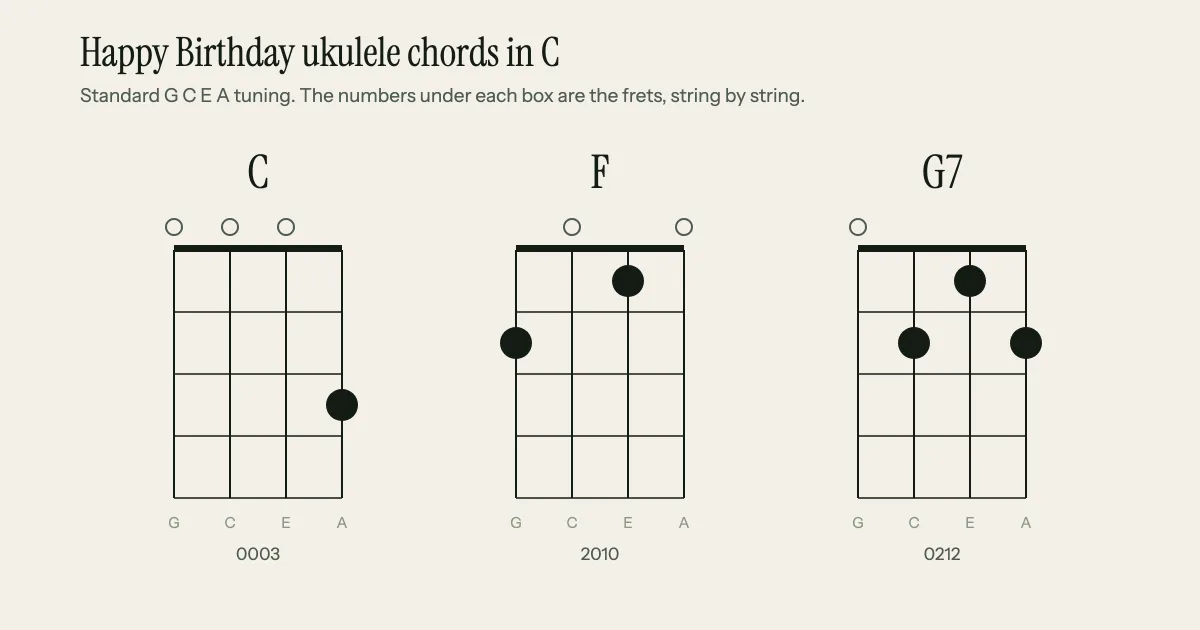
Strum down on beat 1 and lightly on 2 and 3, the same waltz feel as the guitar. On the name, strum F once and let it ring until the singers are ready, then pick the beat up again on the last "Hap-py." If C sits too low for the group, a capo moves the same three shapes up; if it sits too high, play it in G.
What are the notes for violin, flute, trumpet, clarinet and saxophone?
Violin, flute, recorder, oboe, piano, guitar and ukulele read the notes as written. B flat trumpet and B flat clarinet read a whole step higher (tenor saxophone a whole step plus an octave), and E flat alto saxophone reads a major sixth higher, so each needs its own key to play along with a piano.
That's because trumpet, clarinet and saxophone are transposing instruments: a written C on a B flat clarinet sounds as a B flat on the piano. If the piano or guitar is playing Happy Birthday in F, the key many piano arrangements use, here's what each player should read:
| Instrument | Read in | Notes |
|---|---|---|
| Piano, violin, flute, recorder, oboe, guitar, ukulele | F | C C D C F E, C C D C G F, C C C A F E D, B♭ B♭ A F G F |
| B♭ trumpet, B♭ clarinet, tenor sax, soprano sax | G | D D E D G F♯, D D E D A G, D D D B G F♯ E, C C B G A G |
| E♭ alto sax, baritone sax | D | A A B A D C♯, A A B A E D, A A A F♯ D C♯ B, G G F♯ D E D |
| French horn in F | C | G G A G C B, G G A G D C, G G G E C B A, F F E C D C |
The concert key is F. In the third group of each row, the third note is an octave above the first.
On recorder, the C version (G G A G C B...) has no sharps or flats at all. Flute and violin can play any of the versions, as long as everyone agrees on the key before the candles are lit.
Why is Happy Birthday so hard to sing?
Happy Birthday covers a full octave, and its highest note comes late, on "birth-" in the third line. People pick the first note without thinking, so if they start too high, the top note is out of reach. Groups also tend to rush, and studies of occasional singers find they're more accurate when they sing it slowly.
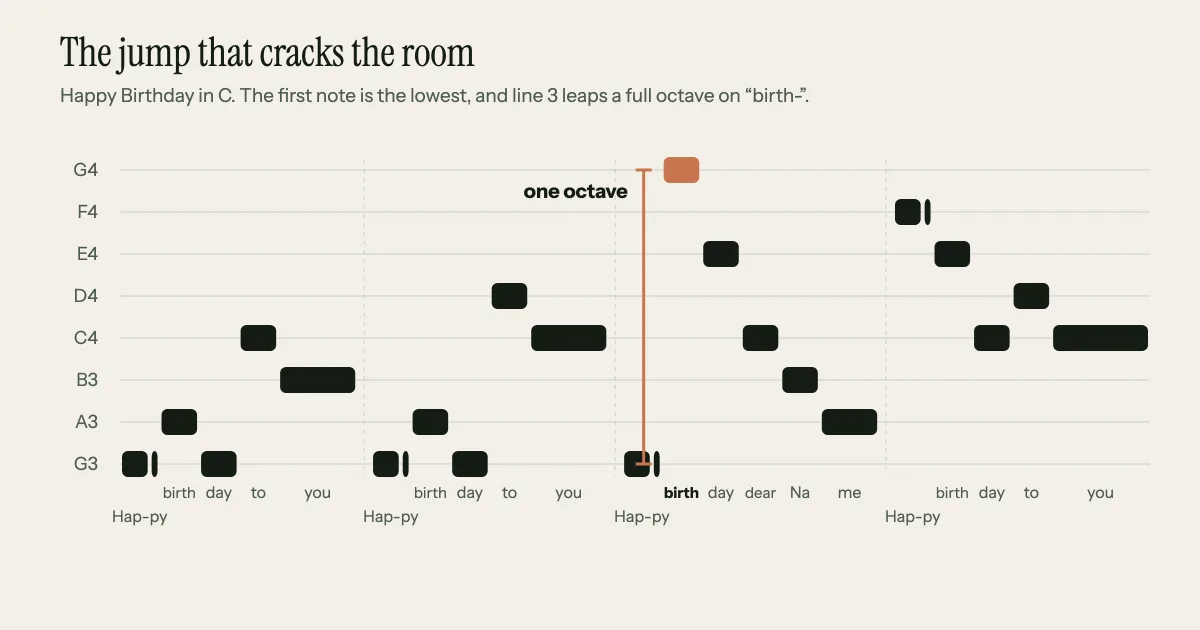
The first note is the lowest note in the song, and the top note is the same note an octave higher. Nothing in the first two lines warns you: they only climb a fourth and a fifth above the start. Then, after the pickup on "Hap-py," the third line leaps the whole octave in one go. Start comfortably, and that leap lands on a note you can sing. Start at a pitch that already feels high, and there's nowhere left to go.
Singing researchers often use Happy Birthday as a test song because everybody knows it. Pauline Larrouy-Maestri and colleagues recorded 166 occasional singers singing it and had 18 singing and music experts rate them. The experts' marks went down for two things: wrong intervals, and "tonality modulations," drifting into a different key partway through. In a second study that recorded 63 occasional and 14 professional singers, the occasional singers were more accurate the slower they sang.
Simone Dalla Bella and Magdalena Berkowska summarised the same finding in 2009: when nonmusicians sing a well-known song such as Happy Birthday at a slow tempo, they're as accurate as professional singers. An earlier study in Montreal asked 62 occasional singers to sing "Gens du pays," the song Quebecers sing at birthdays. They sang it faster than professionals and made more pitch errors. When 15 of them sang it again at a slow tempo, 13 matched the professionals.
So the fix is simple. Start low, start slowly, and take your time on the name. If you play guitar or piano, you control both: play a full bar before anyone sings, at the speed you want, and the room will follow.
What key should you sing Happy Birthday in?
Choose the key from the first note. Sing "Hap-" on the lowest note you can sing comfortably at party volume, find that note in the table below, and play in the key beside it. The highest note will be the same note an octave up. For a mixed group, F and G are good starting points.
The first note of Happy Birthday is the fifth note of the scale, so the key is always five notes below it (or four above). Start on G and you're in C; start on C and you're in F. You don't need to work that out: find your first note in the left column.
| First note (lowest) | Key | Chords (1, 4, 5) | Easy guitar route |
|---|---|---|---|
| G | C | C, F, G7 | Open C shapes |
| A♭ | D♭ | D♭, G♭, A♭7 | C shapes, capo 1 |
| A | D | D, G, A7 | Open D shapes |
| B♭ | E♭ | E♭, A♭, B♭7 | D shapes, capo 1 |
| B | E | E, A, B7 | Open E shapes |
| C | F | F, B♭, C7 | D shapes, capo 3 (or E shapes, capo 1) |
| C♯ | F♯ | F♯, B, C♯7 | D shapes, capo 4 (or E shapes, capo 2) |
| D | G | G, C, D7 | Open G shapes |
| E♭ | A♭ | A♭, D♭, E♭7 | G shapes, capo 1 |
| E | A | A, D, E7 | Open A shapes |
| F | B♭ | B♭, E♭, F7 | G shapes, capo 3 (or A shapes, capo 1) |
| F♯ | B | B, E, F♯7 | G shapes, capo 4 (or A shapes, capo 2) |
Find the note you start on, play the key beside it. The highest note in the song is the first note, an octave higher.
If you don't know what note you're singing, the free pitch detector shows its name as you sing: hold "Hap-" for a second and read it off. For your own voice, the vocal range test finds your lowest and highest notes and suggests the keys that suit you, with the capo fret. Your song is in the wrong key for your voice explains the same idea for any song.
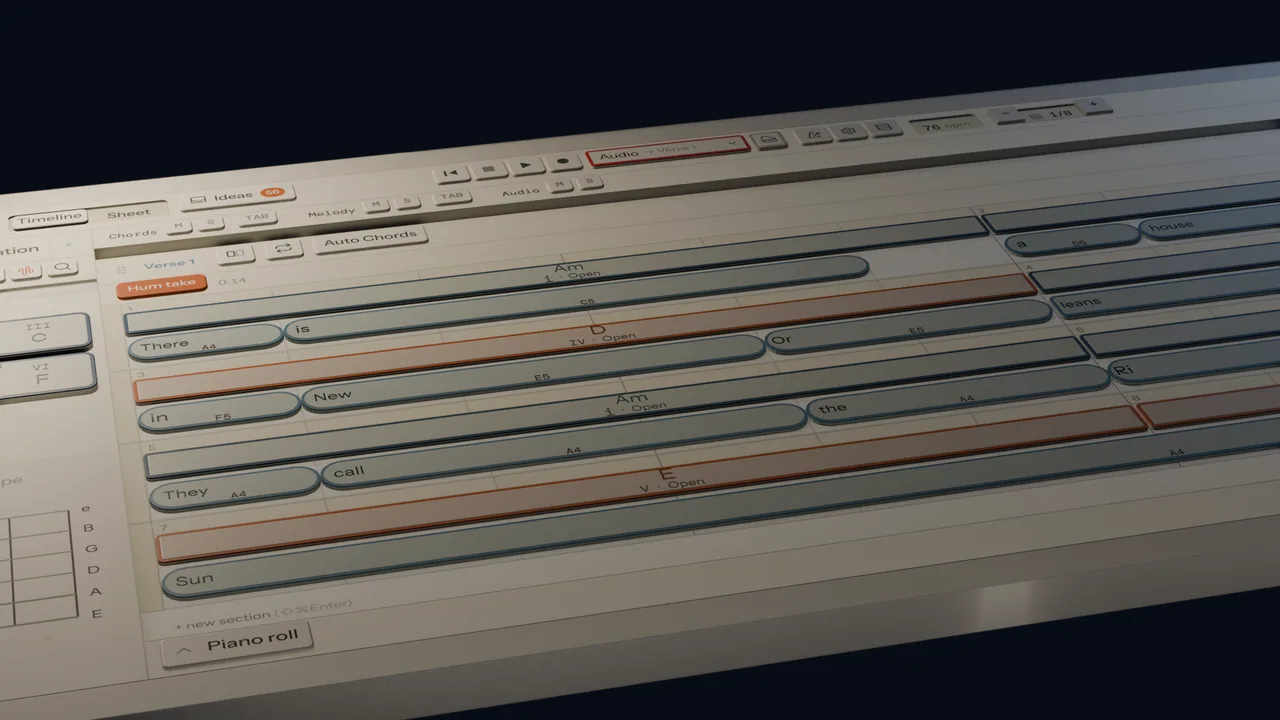
If you write chord charts in Song Cage, you can type the words, put the chords on them, and move the whole song with the key chip's Move song, which changes every chord at once. With a capo set, the guitar view shows the shapes to play while the sheet keeps the chords everyone hears.
Who wrote Happy Birthday?
The tune comes from "Good Morning to All," credited to the Kentucky sisters Mildred J. Hill and Patty Smith Hill, and published in 1893 in their book Song Stories for the Kindergarten. The birthday words were in print by 1911, without credit, in a book that said they were sung to that tune.
Patty Hill was a kindergarten principal in Louisville and Mildred a pianist and composer. They used "Good Morning to All" as a song young children would find easy to sing, according to the song's Wikipedia history. Their authorship isn't settled: the scholar Kembrew McLeod has argued that the sisters likely borrowed from similar 19th-century songs such as "Happy Greetings to All" (1858), while the law professor Robert Brauneis, whose study of the song's copyright concluded it was "almost certainly no longer under copyright," points out that those earlier songs have quite different melodies.
The court that later ruled on the copyright found that the full birthday words were first published in 1911, in a book called The Elementary Worker and His Work, which named no author and noted that they were sung to the tune of "Good Morning to All." A 1901 school-primer poem, "Roy's Birthday," ends with the same four lines, with nothing to say they were sung. Over the following decades the birthday verse took over. According to the 1998 Guinness World Records, it's the most recognised song in the English language.
Is Happy Birthday copyrighted?
No. Happy Birthday is in the public domain in the United States and the European Union. A US federal judge ruled in September 2015 that Warner/Chappell's copyright claim was invalid, and in June 2016 the court approved a $14 million settlement and declared the song public domain. In the EU the copyright expired on January 1, 2017.
The claim went back to 1935, when the Summy Company, the Hill sisters' publisher, registered copyrights on piano arrangements of the song. Warner/Chappell bought the company that owned them in 1988 and claimed the song was under copyright until 2030. By 2008 it was collecting about $2 million a year in licence fees; the makers of the 1994 documentary Hoop Dreams paid $5,000 to use it.
In 2013 the documentary maker Jennifer Nelson, who had paid $1,500 to use the song, sued. On September 22, 2015, Judge George H. King ruled that Warner/Chappell did not own a valid copyright in the words: the Hill sisters had given the Summy Company the melody and piano arrangements of it, never the lyrics. The melody's own copyright, through Song Stories for the Kindergarten, had already run out in 1949. Warner/Chappell settled in February 2016 for $14 million, paid back to people who had licensed the song, and the court declared it public domain on June 30, 2016. That's why the full words and chords can be printed on this page.
How do you write someone their own birthday song?
Start with their name and one true thing about them, and hum a short line that fits it. Keep it in a small range and sing it slowly, the two things that trip groups up on Happy Birthday. Repeat the line with a change at the end, and put it over the same three chords: 1, 4 and 5.
Happy Birthday is a good model for the shape: two lines that are nearly the same, a third that jumps up for the name, and a fourth that comes home. Copy that plan and keep your top note lower than the octave, and a group should find it easier to sing than the original. The lullabies post uses the same three chords if you want more songs that fit them.
If the tune comes to you in the car, sing it into your phone before it's gone. Song Cage's capture app for iPhone and Android is free and needs no account. On a computer, Song Cage writes a hummed tune down as notes under your words and suggests chords that fit it, and its Singer voice can sing the words back to you on those notes. It's free for one song in the web app. If you have nothing yet, the Song starter on a blank song gives you a title, a character and a feeling to begin with.
Write them a song of their own
Hum the tune before it's gone. Song Cage turns the hum into notes under your words and shows you chords that fit, in any key you need.
Frequently Asked Questions
How many chords are in Happy Birthday?
Three: the 1, 4 and 5 chords of the key, with the 5 usually played as a seventh chord. In C that's C, F and G7; in G it's G, C and D7; in F it's F, B flat and C7. The order is 1, 5, 5, 1, 1, 4, 1, 5, 1.
What key is Happy Birthday in?
It has no fixed key, because everyone starts it on a different note. Piano arrangements are often in F, starting on middle C, and guitar charts are commonly in G, C or D. Choose the key from the first note: the song starts on the fifth note of the scale, so starting on C puts you in F and starting on D puts you in G.
What are the letter notes for Happy Birthday on piano?
In C: G G A G C B, G G A G D C, G G G E C B A, F F E C D C, with the third G of the third line an octave higher than the first. In F, starting on middle C: C C D C F E, C C D C G F, C C C A F E D, B flat B flat A F G F.
What is the time signature of Happy Birthday?
3/4, three beats to the bar, like a waltz. It starts with a two-note pickup on "Hap-py," so the first full bar begins on "birth-." The bar with the name usually has a fermata, a hold, so the singers can fit in a name of any length.
Why does everyone sing Happy Birthday out of tune?
Mostly because they start too high and too fast. The tune climbs a full octave to its top note on "birth-" in the third line, and studies of occasional singers have found they're more accurate at a slower tempo. Start on a low, comfortable note and slow down, and most groups do much better.
Can I use Happy Birthday in a video or performance?
Yes, in the US and the EU. A federal court declared Happy Birthday to You public domain in June 2016, after ruling in 2015 that Warner/Chappell's copyright claim was invalid, and its EU copyright expired on January 1, 2017. A particular recording or arrangement can still be copyrighted, so record your own.