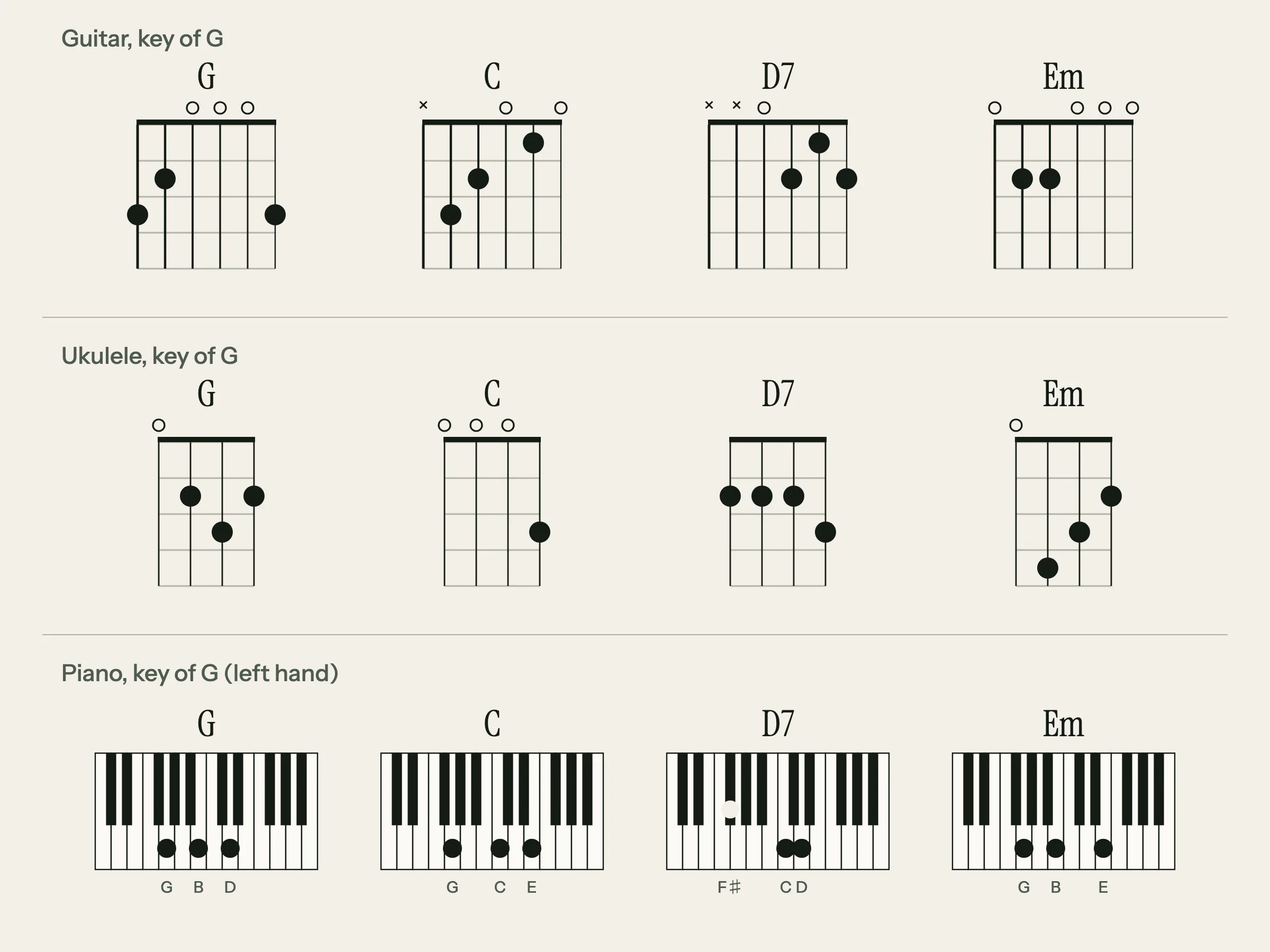
The Auld Lang Syne chords in G are G, C and D7, with Em for one change near the end of each half, and the same four chords work on guitar, piano and ukulele. Below are the chords over Robert Burns's words, what the Scots words mean, the piano notes for the tune, the song in every common key, and how a poem from 1788 ended up on a tune Burns never put it to.
The chart is in G, where every chord is an open shape on guitar and the tune is all white keys on piano. Hymnals usually print it in F; to match one, put a capo on the third fret and play the D-shape chords from the key table below.
The short version
Four chords in G: G, C, D7, Em. The tune is in 4/4, every line starts with a pickup ("Should," "For," "We'll"), and it spans nine notes, from the D above middle C up to the E an octave and a step higher. It uses only five different notes, so in G it's all white keys on a piano.
What chords are in Auld Lang Syne?
Auld Lang Syne uses the 1, 4 and 5 chords of its key, with the 5 as a seventh, plus the 6 minor once in each half. In G that's G, C, D7 and Em. G carries most of the song, D7 comes under "be forgot" and "kindness yet," C under "mind" and the chorus's second "syne," and Em under the last "auld" of each half.
The tune is four phrases of four bars, two lines of the words each, and every phrase starts the same way: G, then D7. The first and third go back to G and end on the C chord, which leaves the tune open, like a question. The second and fourth end on "auld lang syne," Em to D7 to G, which closes it.
| Number | Chord in G | Piano notes | Where it comes |
|---|---|---|---|
| 1 | G | G, B, D | "auld acquaintance," "never brought to," "For auld lang," "tak' a cup," the closing "syne" |
| 4 | C | C, E, G | "mind," the chorus's second "syne" |
| 5 (as a 7th) | D7 | D, F♯, A, C | "be forgot," "syne, my jo," "kindness yet," "lang" |
| 6 minor | Em | E, G, B | "auld" in "and auld lang syne" |
The same four chords work on guitar, piano and ukulele. Em is optional: play C there and the song still works.
Auld Lang Syne lyrics and chords
These are Burns's Scots words with the Auld Lang Syne chords in G. Each chord sits on the syllable where it changes and rings until the next one. Every verse uses the same chords as the first, and the chorus comes after each verse.
Verse 1 and chorus (4/4, key of G)
Should [G]auld acquaintance [D7]be forgot,
And [G]never brought to [C]mind?
Should [G]auld acquaintance [D7]be forgot,
And [Em]auld [D7]lang [G]syne?
For [G]auld lang [D7]syne, my jo,
For [G]auld lang [C]syne,
We'll [G]tak' a cup o' [D7]kindness yet,
For [Em]auld [D7]lang [G]syne.
Verses 2 to 5
And surely ye'll be your pint-stoup!
And surely I'll be mine!
And we'll tak' a cup o' kindness yet,
For auld lang syne.
We twa hae run about the braes,
And pou'd the gowans fine;
But we've wander'd mony a weary fit,
Sin' auld lang syne.
We twa hae paidl'd in the burn,
Frae morning sun till dine;
But seas between us braid hae roar'd
Sin' auld lang syne.
And there's a hand, my trusty fiere!
And gie's a hand o' thine!
And we'll tak' a right gude-willie waught,
For auld lang syne.
Burns wrote more than one version himself. In the copy he sent the editor George Thomson in 1793, the chorus has "my dear" instead of "my jo," and the fourth line reads "And days o' lang syne," close to the familiar "and days of auld lang syne." According to the University of Glasgow's Editing Robert Burns for the 21st Century project, six manuscripts of the song survive, all with differences.
What do the Auld Lang Syne lyrics mean?
"Auld lang syne" is Scots for "old long since," or "long ago," so "for auld lang syne" means roughly "for the sake of old times." The song asks whether old friends should be forgotten, and answers by raising a drink to them: "We'll tak' a cup o' kindness yet."
| Scots | English |
|---|---|
| auld lang syne | old long since, days gone by |
| my jo | my dear |
| ye'll be your pint-stoup | you'll buy your pint cup |
| we twa hae run about the braes | we two have run about the hills |
| pou'd the gowans fine | pulled the daisies fine |
| mony a weary fit | many a weary foot |
| paidl'd in the burn | paddled in the stream |
| frae morning sun till dine | from morning sun till dinner time |
| seas between us braid hae roar'd | seas between us broad have roared |
| my trusty fiere | my trusty friend |
| gie's a hand o' thine | give me a hand o' thine |
| a right gude-willie waught | a right good-will draught (drink) |
Translations follow Wikipedia's standard English version of Burns's text.
The last verse is where the arms cross. At Hogmanay in Scotland, people stand in a circle holding hands and cross their arms only when "And there's a hand, my trusty fiere!" begins, so the right hand reaches to the neighbor on the left. Outside Scotland, people often cross arms from the first line.
How do you play Auld Lang Syne on guitar?
The Auld Lang Syne guitar chords in G are G (320003), C (x32010), D7 (xx0212) and Em (022000), counting strings from the low E. It's a slow 4/4: strum once per beat, and start on "Should," which comes before the first full bar.
Every line begins with a pickup, one beat before the bar: "Should," "And," "For," "We'll." Count "four" on the pickup and land the chord on the next word. The rhythm inside each bar is long-short: "auld ac-" is a dotted note and a quick one, and the same snap comes on "be for-," "ne-ver" and "kind-ness." Strumming a steady down-stroke on every beat keeps a room together while it sings.
The quickest change is at the end of each half: Em on "auld," D7 on "lang," G on "syne," one change every two beats. Practice "and auld lang syne" on its own until the switch is automatic. Em to D7 is an easy move, since both shapes sit near the nut. To play with a songbook in F, put a capo on the third fret and play the D-key shapes: D, G, A7, Bm. The guitar capo chart has every fret.
What are the piano notes for Auld Lang Syne?
The Auld Lang Syne piano notes in G are all white keys. The tune starts on the D just above middle C and climbs to the high E on "mind": D G G G B A G A B G G B D E, "Should auld acquaintance be forgot, and never brought to mind?"
Auld Lang Syne: piano notes (right hand, key of G)
Should auld acquaintance be forgot, and never brought to mind: D G G G B A G A B G G B D E
Should auld acquaintance be forgot, and auld lang syne: E D B B G A G A B G E E D G
For auld lang syne, my jo, for auld lang syne: E D B B G A G A E D B B D E
We'll tak' a cup o' kindness yet, for auld lang syne: E D B B G A G A B G E E D G
The second line and the last line of the chorus are the same notes, so there are really three lines to learn. The high E on "mind" and the chorus's second "syne" is the top of the song; the D the tune starts on, which comes back on "lang" in the last line of each half, is the bottom. "Auld" and "lang" near the end of each half carry two notes each (G E, then E D).
The whole tune uses five notes: G, A, B, D and E, the G major pentatonic scale, with no C and no F sharp. Amazing Grace uses the same five-note scale, and the same trick works: in G flat the five notes are the five black keys, so you can play the tune on black keys alone. For the left hand, play G, C, D7 and Em where the chart puts them; play D7 as F sharp, C and D so the hand barely moves from G.
What are the ukulele chords for Auld Lang Syne?
The Auld Lang Syne ukulele chords in G are G (0232), C (0003), D7 (2223) and Em (0432), where the numbers are frets on the G, C, E and A strings in that order. The same chart as the guitar and piano works unchanged.
Strum down on every beat, or down on beat 1 and lightly on the rest for a softer singalong. The tune starts on a pickup, so hold the strum until "auld." The Em to D7 to G change at the end of each half is the only fast part; on the ukulele, Em (0432) to D7 (2223) is a short move.
For a lower key, C uses four of the easiest ukulele shapes: C (0003), F (2010), G7 (0212) and Am (2000). It sits a fifth lower than G, from the G below middle C up to the A above it. That suits low voices and a room of untrained ones.
Auld Lang Syne chords in every key
Auld Lang Syne works in any major key with the same four chords. Its lowest note is the 5 of the key, a fourth below the key note, and its highest is the 6, a sixth above the key note, so the range is a ninth. Pick the key whose range fits your voice and read the chords across.
| Key | 1, 4, 5 (7th), 6 minor | Lowest and highest note (middle C is C4) | Guitar shapes |
|---|---|---|---|
| C | C, F, G7, Am | G3 up to A4 | Open (F is a barre) |
| D | D, G, A7, Bm | A3 up to B4 | Open (Bm is a barre) |
| E | E, A, B7, C♯m | B3 up to C♯5 | D shapes, capo 2 |
| F | F, B♭, C7, Dm | C4 up to D5 | D shapes, capo 3 |
| G | G, C, D7, Em | D4 up to E5 | Open |
| A | A, D, E7, F♯m | E4 up to F♯5 | G shapes, capo 2 |
Men singing the tune sing it an octave lower than written.
In Nashville numbers, the first line is 1, 5⁷, 1, 4, and the second is 1, 5⁷, 6-, 5⁷, 1. The chorus repeats the same two lines. The Nashville Number System post explains how to read a chart like this, and how to harmonize a melody uses this song as its example of adding the 6 minor to three chords.
What key should a group sing Auld Lang Syne in?
F is a good key for a mixed group: the tune runs from middle C up to the D an octave and a step above it, C4 to D5. G (D4 to E5) is a step higher and easier on guitar. For a room of low or untrained voices, D (A3 to B4) or C (G3 to A4) is safer.
The range is nine notes, wider than an octave, which is why the high notes trip people up. They come early. "Mind," at the end of the second line, is the highest note in the song, and the chorus comes back to it on its first word, "For," and on its second "syne." The lowest note is the very first one, "Should." So the first two lines test the key: if "mind" strains, go down; if "Should" disappears, go up.
At midnight there's rarely time to check, so pick before the countdown. If you're leading and want to check your own range first, the free vocal range test finds your lowest and highest notes and suggests keys that fit, with guitar capo frets.
Who wrote Auld Lang Syne?
Robert Burns wrote Auld Lang Syne in 1788, building on an older Scottish song. He told his publisher James Johnson that only three of its verses were old and the other two were his own. It was first printed in Johnson's Scots Musical Museum in 1796, the year Burns died.
Burns first mentions the song in a letter to his friend Frances Dunlop on December 7, 1788, asking whether the Scots phrase "auld lang syne" isn't "exceedingly expressive." In 1793 he sent a copy to George Thomson with a note that it was "the old Song of the olden times, & which has never been in print, nor even in manuscript, untill I took it down from an old man's singing," according to the Morgan Library, which holds that manuscript. The Morgan calls the claim perhaps disingenuous, and Burns admitted to Johnson that two of the song's stanzas were his own.
The phrase is older than Burns. A ballad printed in James Watson's 1711 Choice Collection of Scots Poems begins "Should auld Acquaintance be forgot" and ends its first verse "On Old-long-syne," and the poet Allan Ramsay published his own song on the same opening line in 1720.
Where does the Auld Lang Syne tune come from?
The tune everyone sings is a traditional Scottish dance tune, first printed in 1759 in Robert Bremner's Scots Reels as "The Miller's Wedding." George Thomson put Burns's words to it in his Select Collection of Original Scottish Airs in 1799, three years after Burns died.
Burns's words first went to a different melody. The Scots Musical Museum printed his words to an older tune that goes back to Playford's Original Scotch Tunes (1700), and Burns told Thomson in 1793 that the air was "but mediocre." Thomson chose the dance tune instead and, as the University of Glasgow's Burns project notes, printed the words as "From an old MS. in the editor's possession," without Burns's name.
Guy Lombardo's radio broadcasts made it America's midnight song. On December 31, 1929, the bandleader and his Royal Canadians played it at midnight at the Roosevelt Hotel in New York, bridging the switch from one radio network to another, and they played it every New Year's Eve until 1976, according to The Canadian Encyclopedia. Lombardo's recording still plays in Times Square after the ball drops. The words and the tune are both in the public domain.
How do you put Auld Lang Syne into Song Cage?
Song Cage shows a song as chords over the words, like a printed chord sheet, and moves the whole song to a new key in one step. Type the words into a song in Sheet view, put the four chords on, then pick a key from the key chip and choose Move song.
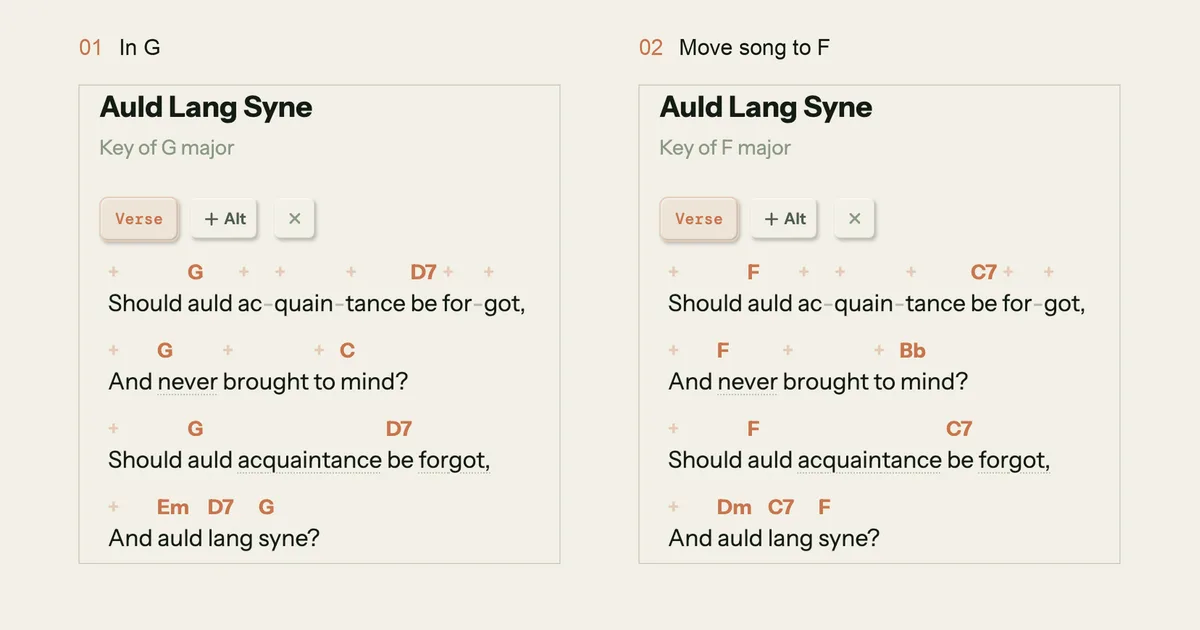
Move song is how the chart in G becomes the songbook's F, or D for a low room: the chords move together and land on the same words. View > Nashville Numbers shows the song as numbers in any key, and clicking a chord shows its guitar shape or piano keys, with a capo if you set one. The changing keys chapter covers Move song and Relabel.
To hear the words on the tune, add the melody by singing it in or entering the notes, and the Singer voice sings each syllable on its note. It sounds like an 80s talking computer played off an old cassette, rough but clear enough to hear how the Scots words sit on the tune. For another song everyone sings together, see Happy Birthday chords.
Play Auld Lang Syne in your key
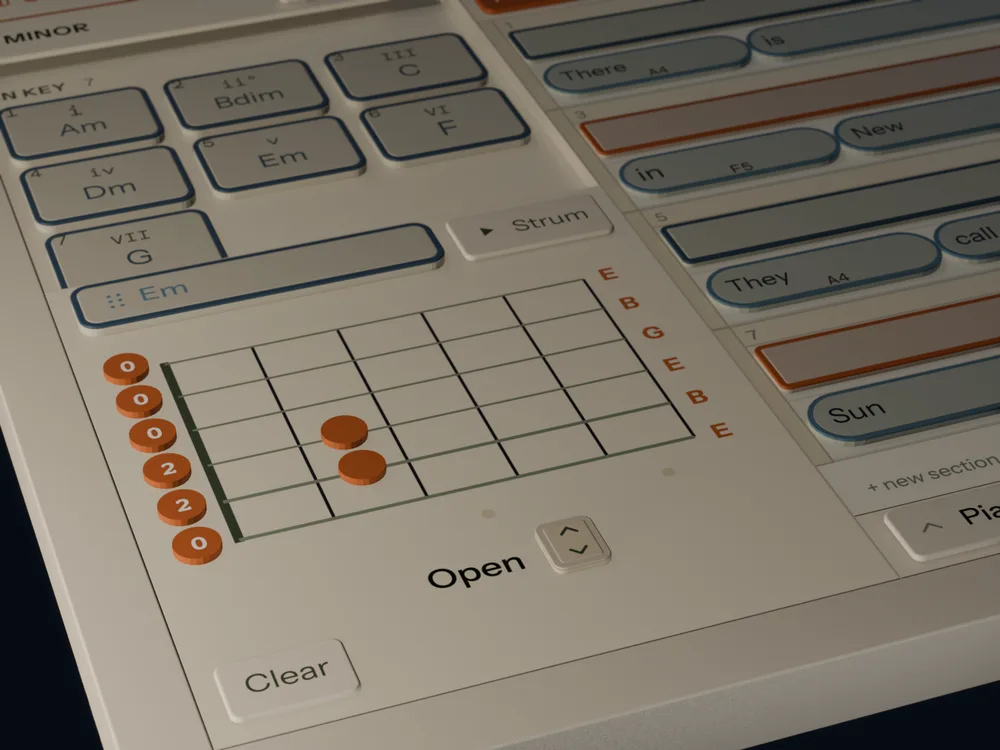
Put the chords over the words in Song Cage, move the song from G to F or any other key, and see every chord as a guitar shape or as piano keys.
Frequently Asked Questions
What are the chords for Auld Lang Syne?
In G: G, C and D7, with Em once near the end of each half. G carries most of the song, D7 comes under "be forgot" and "kindness yet," C under "mind," and Em under "auld" in "and auld lang syne." The same four chords work on guitar, piano and ukulele.
What does auld lang syne mean?
It's Scots for "old long since," or "long ago." "For auld lang syne" means roughly "for the sake of old times," and the song is about remembering old friends and drinking to them.
Why is Auld Lang Syne sung on New Year's Eve?
Singing it at Hogmanay, the Scottish New Year, spread with Scottish emigrants around the world. In the United States, Guy Lombardo and his Royal Canadians made it the midnight song with their New Year's Eve broadcasts from 1929 to 1976.
Is it "should old acquaintance" or "should auld acquaintance"?
Burns wrote "auld," Scots for "old," and many people sing "old." Both fit the tune. The same goes for "and days of auld lang syne," which is close to a line in one of Burns's own manuscripts, "And days o' lang syne," though most printed texts have "and auld lang syne."
What time signature is Auld Lang Syne in?
4/4, sung slowly, with each line starting on a pickup on beat 4. Count "four" on "Should" and land beat 1 on "auld."
Is Auld Lang Syne in the public domain?
Yes. Burns wrote the words in 1788, the tune was printed as "The Miller's Wedding" in 1759, and George Thomson first printed them together in 1799. Modern arrangements and recordings can still be under copyright.