Table of Contents
- How to Choose the Right Music Theory App
- 1. Song Cage
- 2. musictheory.net
- 3. Simply Piano
- 4. Yousician
- 5. Teoria
- 6. Tenuto
- 7. Chordify
- 8. MuseScore Studio
- 9. Perfect Ear
- 10. EarMaster
- Music Theory Basics: A Complete Beginner Guide
- What is music theory and why does it matter?
- What is the difference between major and minor keys?
- What are diatonic chords and how do I use them?
- What are the essential chord progressions for beginners?
- What are borrowed chords and when should I use them?
- What is a secondary dominant chord?
- How do I write chord progressions as a beginner with no theory?
- How do I modulate between keys in a song?
- Full Comparison: Best Music Theory Apps for Beginners 2026
- Frequently Asked Questions
Updated April 2026
Pricing and platform details verified against vendor sites and App Store listings in April 2026. Tenuto 5.0.1, Perfect Ear 1.5.6, MuseScore Studio 4.6.5, and Teoria's January 2026 content additions are all current as of publication. Rankings compiled from five weeks of hands-on testing with beginner musicians.
A music theory app is a piece of software that helps musicians understand why certain combinations of notes and chords sound the way they do, and apply that understanding to writing better songs, playing more fluently, or developing their ear. The best music theory apps for beginners sit on a spectrum: structured lesson curricula at one end, learn-by-doing composition tools at the other.
Quick Summary
We tested 20+ music theory apps across five weeks with musicians at complete beginner level, no prior theory knowledge. Here are the 10 best music theory apps for beginners in 2026, ranked by how effectively they teach music theory basics, how beginner-accessible they are from day one, and how well they connect theory to practical music-making.
This guide is specifically about music theory for songwriters and beginner musicians, not academic theorists or conservatory students. We tested every tool with that frame: how fast does a beginner understand what a diatonic chord is, what borrowed chords sound like, and how to write a chord progression that actually works?
How We Ranked These Apps
Every app was put through five weeks of testing by musicians with zero prior theory background. Our scoring weighted these criteria:
No app paid for placement. Song Cage is listed first because it ranked first across our beginner music theory criteria, and because this is the Song Cage blog. We are transparent about that.
How to Choose the Right Music Theory App
Music theory apps serve different learning styles and goals. Before jumping into the rankings, here's a quick framework for what type of learner you are.
You need music theory for songwriting: diatonic chords, borrowed chords, key modulation, learned by writing real songs rather than completing lessons. Song Cage.
You need music theory for guitarists with fretboard context: chord shapes, how keys relate on the neck, why certain progressions work on guitar. Song Cage, musictheory.net.
You need chord voicings on keys, note reading, and scale patterns. Simply Piano, Song Cage Piano mode.
You want a step-by-step curriculum with lessons, exercises, and progressive difficulty. musictheory.net, Yousician, EarMaster.
You want to hear music theory: interval recognition, chord quality by sound, relative pitch. Perfect Ear, Teoria, EarMaster.
You want the best completely free music theory education. musictheory.net, Teoria, Song Cage free tier (full chord palette, limited to one song).
The fastest way to learn music theory
The fastest path is not study. It's application. Apps that make you use theory to create music you can actually hear (chord progressions, real songs, your own compositions) produce faster and more lasting learning than apps that test you on abstract symbols. The best music theory apps for beginners put application before memorization.
1. Song Cage
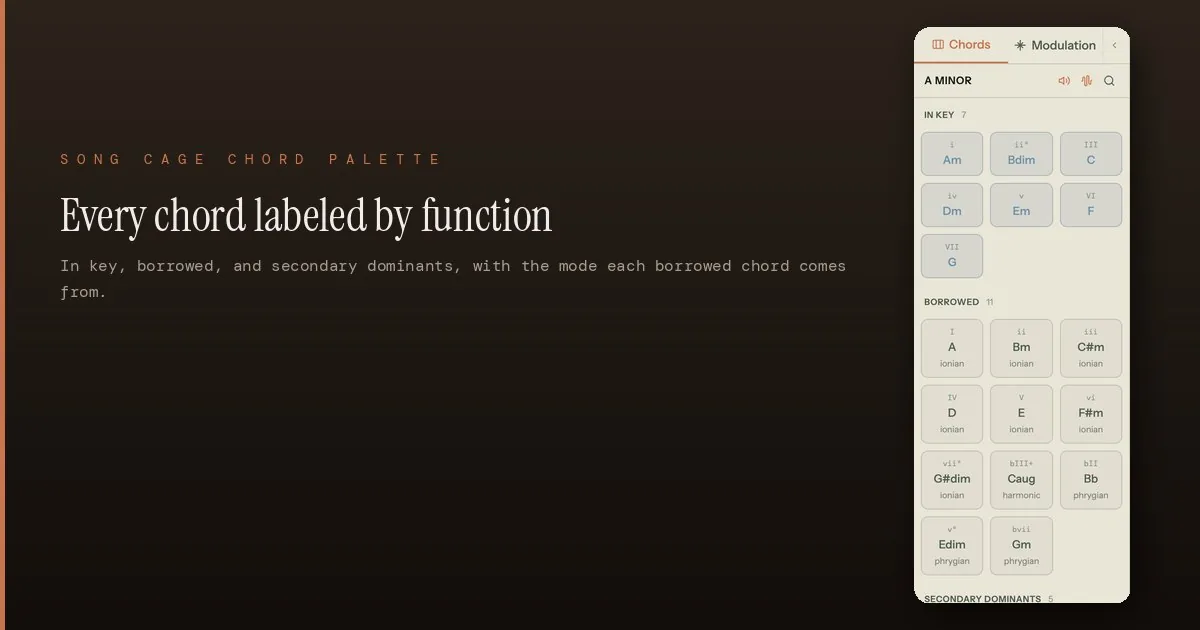

Song Cage is the best music theory app for beginners who want to learn through doing rather than studying. The distinction matters. Most music theory apps, including excellent ones like musictheory.net and EarMaster, present theory as a subject to understand before you apply it. Song Cage reverses that order: you write a song, and the theory reveals itself as you write.
The chord palette is the core of the learning experience. Pick any key (G major, D minor, Bb major) and Song Cage shows you all seven diatonic chords labeled with Roman numerals (I, ii, iii, IV, V, vi, vii°). This is foundational music theory: the seven chords that always work in your key, labeled with their harmonic function. You hear each one by tapping it. The I chord sounds like home. The V chord sounds like tension waiting to resolve. You internalize this relationship before you know the formal term for it, which is exactly how learning by ear is supposed to work.
The borrowed chord library extends this into intermediate territory. Song Cage shows chords drawn from parallel modes (Aeolian, Mixolydian, Dorian, Lydian, Phrygian in major keys; Ionian, harmonic minor, and Phrygian in minor keys), each labeled with its source mode. For a beginner, this is the moment when certain emotionally powerful chord moves in songs you've always loved suddenly become legible. You're learning modal interchange without knowing the term. The context-aware chord suggestion engine reinforces this: when you click an empty beat, Song Cage reads the chords before and after it and the melody notes at that beat, then ranks every chord by how well it fits, displaying live scores (e.g. "1/1 · 99%") alongside each option. You're not guessing. You're choosing from what the theory says actually works.
The modulation panel teaches key modulation more effectively than any textbook. Select any destination key and the panel surfaces every pivot chord (chords diatonic to both your current key and the target) ranked by harmonic strength. Below the pivot list, full cadential routes show the complete path: direct resolutions (V→I, V7→I, bVII→I), three-chord cadences (ii→V→I, and the tritone substitution ii7→bII7→Imaj7), and extended four- and five-chord routes with voice-led extensions. Return routes appear simultaneously, so you can plan a complete modulation arc in one view. Beginners navigate key changes that would otherwise require years of formal training to execute confidently.
Guitar and piano modes add instrument-specific context. Guitar mode shows a fretboard diagram for every chord with real chord shapes from a curated database and capo-aware transposition. Piano mode gives you four voicing types (Close, Open, Spread, Drop-2) with all inversions and an octave offset control. Music theory for guitarists and music theory piano beginners content are both built in: you see where the chord lives on your actual instrument, not just in Roman numeral abstraction.
The free tier is genuinely useful. It includes the full chord palette (diatonic, borrowed, and secondary dominant chords in every key), the modulation panel, guitar voicings, all word tools, playback and accompaniment, and audio recording. It needs no card, and it is limited to one song with no PDF or MIDI export. The license removes the cap and adds PDF chord sheet export, MIDI export, and collaboration with up to 5 editors per song, along with the native desktop app and the AU/VST3 plugin; signing in once in the desktop app or plugin starts a 14-day trial of everything.
Key Features
- Diatonic chord palette with Roman numeral function labels (I through vii°)
- Borrowed chord library organized by source mode (Aeolian, Dorian, Phrygian, and more)
- Secondary dominant chords with resolution targets
- Context-aware chord suggestions with live melody-fit scoring
- Modulation panel: pivot chords plus full cadential routes between any two keys
- Guitar fretboard diagrams with multiple voicings, capo-aware
- Piano chord voicings: Close, Open, Spread, Drop-2 with all inversions
- Lyric workspace with rhyme finder, slant rhyme, synonym, semantic drift
- Built-in audio recording
- Free tier: full chord palette and modulation panel (the free web app is limited to one song)
Pros & Cons
- Best learn-by-doing music theory experience available
- Zero prior theory knowledge needed to start
- Covers music theory for guitarists AND piano beginners in one app
- Context-aware suggestions teach harmonic function through use
- Free tier covers all theory features (the free web app is limited to one song)
- Theory depth grows with the musician
- Not a structured lesson curriculum (learning is incidental, and intentional)
- No ear training exercises (pair with Perfect Ear or Teoria for that)
- Full editor lives on web (any browser) and the Mac/Windows desktop app; the free iOS/Android apps are deliberately capture-only and sync into the editor
2. musictheory.net
musictheory.net has been the definitive free music theory resource on the internet for over two decades. Its lesson library covers everything from the very beginning (what a staff is, how notes are named, what intervals are) through intermediate topics like diatonic triads, Roman numeral analysis, seventh chords, and common chord progressions, and all the way through Neapolitan chords. Each lesson is clearly written, well-paced, and entirely free. The companion exercises (note trainer, interval trainer, chord trainer, scale trainer, keyboard trainer, and guitar trainer) are all available on the site at no cost. For music theory basics from absolute zero, it remains the best free structured curriculum available.
The Theory Lessons iOS app ($2.99) offers enhanced offline versions of the animated web lessons. Tenuto ($4.99, iPhone and iPad, version 5.0.1 released December 2025) is the dedicated exercise app: 24 highly customizable drills across note identification, interval recognition, chord identification, key signatures, and scale construction, all fully offline. At $4.99 it is among the best-value purchases in music education. Both apps require iOS 15.8 or later.
The limitation for most songwriters is the notation-first approach. musictheory.net teaches music through standard staff notation (reading notes on a staff), which is essential knowledge for formal musicians but not necessary for most songwriters who want to understand chord progressions and harmonic function. Beginners who want to learn how borrowed chords work or how to modulate between keys without reading notation will find it more abstract than necessary. Use it for the notation fundamentals it covers brilliantly, and pair it with Song Cage for the practical chord application side.
Pros
- Best completely free music theory curriculum, no account required
- Covers music theory basics from absolute beginner through advanced
- Includes Roman numeral analysis, diatonic chords, and chord progressions
- Guitar trainer and keyboard trainer built into the free web exercises
- Tenuto app ($4.99) is the best-value mobile theory drill tool available
Cons
- Notation-first approach: emphasizes reading music over harmonic application
- No chord palette or composition environment
- No borrowed chords, modulation panel, or guitar/piano voicings
- Web interface feels dated compared to modern apps
- Mobile apps (Theory Lessons and Tenuto) are iOS only
3. Simply Piano
Simply Piano by Simply Ltd (formerly JoyTunes) is the best app for music theory piano beginners who want to learn through playing rather than studying. The app listens to your acoustic piano or digital keyboard via microphone, tracks your accuracy in real time, and teaches music theory (note reading, rhythm, chord shapes, scale patterns) through progressively challenging songs from a library of over 5,000 titles. The theory is embedded in the playing, not separated into a textbook section. You understand what a chord inversion is because you play one before you read its name.
For piano chord voicings and understanding how chords sit on the keyboard, Simply Piano gives beginners excellent visual and audio feedback. It teaches major and minor chord shapes, basic inversions, and chord progressions in a piano-first context. The app requires a physical piano or keyboard (acoustic or digital): it listens to actual note output rather than screen-tapping. It's available on iOS and Android with 50 million+ downloads on Google Play, making it one of the most widely used piano learning apps worldwide. Pricing varies by region and promotion, but the annual plan commonly lands around $120/year; monthly billing is generally more expensive per month. A couple of free introductory courses let you try before paying.
The limitation is scope. Simply Piano teaches piano theory through playing, but the harmonic depth stops at basic major and minor chords. There's no borrowed chord library, no secondary dominant chords or modulation, and no lyric workspace. Once you've built your piano chord vocabulary here, move to Song Cage to deepen the harmonic theory and apply it to songwriting.
Pros
- Best music theory piano beginners app available
- Real-time listening, works with any piano or keyboard via mic
- Theory taught through songs, not abstract drills
- 5,000+ song library from classical to contemporary
- 50M+ downloads on Google Play
- Available on iOS and Android
Cons
- Requires physical piano or keyboard (no screen-only mode)
- No borrowed chords, secondary dominants, or modulation
- Chord theory limited to basic major/minor, no deeper harmony
- No lyric tools or songwriting integration
- Free tier limited to a couple of introductory courses
- Pricing varies by region and promo

4. Yousician
Yousician covers guitar, piano, ukulele, bass, and singing in a single platform with real-time listening that responds to your playing via microphone. Music theory content is embedded in instrument lessons rather than taught in isolation, so you learn music theory for guitarists and music theory for piano simultaneously through playing. The gamification layer (missions, stars, streaks) works well for building consistent practice habits, and the 7-day free trial lets you assess the content before committing. Cross-platform availability across iOS, Android, macOS, and Windows is strong.
Plans and pricing shift frequently; Yousician currently offers a Premium tier (around $19.99/mo, cheaper on annual) and a pricier Premium+ tier that unlocks all instruments at once. Check the membership page for current numbers and regional promotions before committing.
The music theory coverage within Yousician is good for absolute beginners (note reading, basic scales, chord shapes, simple chord progressions) but doesn't go deep. Borrowed chords, secondary dominant chords, key modulation, and the kind of music theory for songwriters that Song Cage covers are outside its scope. Yousician is an instrument learning app with theory built in, not a theory app with instruments supported. The free tier is genuinely limited: meaningful content requires a paid plan.
Pros
- Covers guitar, piano, bass, ukulele, and singing together
- Real-time listening and feedback on your playing
- Good gamification for daily habit building
- Cross-platform: iOS, Android, macOS, Windows
- 7-day free trial with full access
Cons
- Paid plan required for meaningful content, free tier very limited
- Yearly costs are high relative to alternatives at similar theory depth
- No borrowed chords, secondary dominants, or key modulation
- Instrument-learning focus rather than songwriter-focused theory
- No lyric tools or song composition environment
5. Teoria

Teoria (teoria.com) is one of the oldest and most respected free music theory resources on the web. It has been online since 1997, making it 29 years old as of 2026, and it remains actively maintained: new exercises were added as recently as January 2026 (secondary dominants in harmonic analysis) and December 2025 (harmonic progressions using patterns). It was peer-reviewed by MERLOT and won a MERLOT Classic Award in music in 2006. The site is developed by José Rodríguez Alvira, made on the Caribbean island of Puerto Rico.
The exercise library covers interval identification, chord identification (including inversions), scale identification, rhythm exercises, and harmonic analysis including secondary dominants. The tutorial section covers music theory basics from notation through advanced harmony. For a free companion to any primary learning tool, Teoria is hard to beat. It's more comprehensive than musictheory.net's exercise section and more rigorous than most free alternatives. The limitation is that it's exercises-only at the advanced level: the tutorials are solid but brief, and there's no composition environment or chord palette. Best used alongside Song Cage for the practical application layer.
Pros
- Completely free: no account, no download, no ads
- 29 years old and actively maintained with new exercises in 2026
- Peer-reviewed by MERLOT (academically rigorous)
- Best free interactive theory drill tool available
- Covers intervals, chords, scales, harmonic analysis, and ear training
Cons
- Browser-only (no mobile app)
- Exercises-only at advanced level; tutorials are brief
- No chord palette or composition environment
- Interface is functional but dated by modern standards
6. Tenuto
Tenuto is the mobile companion to musictheory.net and the best dedicated mobile music theory drill app available. At $4.99 as a one-time purchase, it's exceptional value. The exercise library contains 24 highly customizable drills covering note identification on treble and bass clef, interval recognition, chord identification, key signature identification, scale construction, and more, all customizable to your current level and specific weak areas. Six built-in calculators cover intervals, chords, scales, and key relationships. All exercises work fully offline. Version 5.0.1 was released December 2025 and requires iOS 15.8 or later on iPhone and iPad.
Like musictheory.net, Tenuto's focus is traditional notation-based theory. It's excellent for the fundamentals, particularly for beginners who also take instrument lessons and need to reinforce what their teacher covers between sessions. As a standalone music theory app for songwriters focused on practical chord application rather than notation drilling, pair it with Song Cage. As a pure drill companion at $4.99 one-time, nothing on iOS compares on value.
Pros
- Best mobile music theory drill app at $4.99 one-time (no subscription)
- 24 fully customizable exercises for targeted practice
- Six calculators: intervals, chords, scales, key relationships
- Fully offline (no internet required)
- Released December 2025 (v5.0.1)
Cons
- iPhone and iPad only (no Android)
- Notation-based: drills sheet-reading rather than chord application
- No chord palette, borrowed chords, or composition environment
- Best as a companion to a primary learning tool, not standalone
7. Chordify

Chordify teaches chord progressions the most intuitive way for ear learners: by extracting them from songs you already love. Paste a YouTube URL, upload an MP3, or search within the app, and Chordify returns a synchronized chord chart that scrolls with the playback, showing exactly which chord is playing at each moment across a library of over 36 million songs. For building pattern recognition, it's unmatched. You start to notice that the same I–V–vi–IV progression appears across dozens of songs you know, which is a more lasting way to understand why it works than reading about it in a theory book.
The free tier is limited to four songs per day with ads. Premium adds unlimited songs, transposition, PDF chord sheets, tempo adjustment, looping, and MIDI download. A Premium + Toolkit tier adds a Generate Lyrics feature, tuner, metronome, and chord detection for longer uploads. Pricing shifts by region and promotion; check chordify.net/premium for current numbers. Available on web, iOS, and Android with millions of downloads.
As a chord composition tool, Chordify has no generation capabilities; it only analyzes existing music. There's no music theory explanation alongside the chords: it shows you what chord is playing, not why it works or how it relates to the key. Pair it with Song Cage for the harmonic framework that explains the patterns you're seeing. Chordify shows you what; the others show you why.
Pros
- Best tool for learning from songs you already know
- Synchronized chord chart plays along with audio
- 36 million+ song library (almost anything is findable)
- Builds pattern recognition across real popular music
- Web, iOS, and Android
Cons
- Shows chords but doesn't explain the music theory behind them
- No Roman numeral labels, key context, or harmonic function
- Free tier limited to 4 songs/day with ads
- No chord composition workspace or borrowed chord tools
- Accuracy varies with complex or heavily produced audio
8. MuseScore Studio

MuseScore Studio (current version 4.6.5, with a 4.7 beta now available) is the most widely used free notation software in the world. It's completely free and open source, built by a large community of contributors on GitHub, with input via MIDI keyboard, computer keyboard, or mouse, and export to MusicXML, MIDI, PDF, or audio. Notes play back with high-quality Muse Sounds (free instrument samples available via the MuseHub app, including strings, woodwinds, brass, percussion, choirs, and keys). The community library on musescore.com hosts millions of user-shared scores for reference and learning.
For music theory basics in a notation context, MuseScore makes the connection between theory and sound viscerally immediate: input a borrowed chord and hear how it sounds within your score. The experience of seeing a chord labeled on a staff and hearing it played back simultaneously accelerates notation literacy. For guitar players, MuseScore handles both standard notation and guitar tablature, and VST3 plugin support in MuseScore Studio 4 lets you route playback through your own instruments.
As a music theory learning app in the songwriting sense, MuseScore is not the starting point: it's notation software. There's no chord palette organized by harmonic function, no borrowed chord library, no modulation panel. Its learning value for beginners is specifically in notation literacy and score-based thinking. (There's also a separate MuseScore mobile app for viewing scores from musescore.com, but it isn't an editor.) Pair MuseScore Studio with Song Cage for the harmonic theory and use MuseScore to notate what you've composed when you need to share it formally.
Pros
- Best free music notation software, completely free with no limits
- Hear compositions play back with realistic Muse Sounds
- Handles guitar tablature as well as standard notation
- Millions of community scores for reference learning
- VST3 plugin support (MuseScore Studio 4)
- MIDI keyboard input support
Cons
- Notation tool, not designed for chord theory learning
- No chord palette, borrowed chords, or modulation support
- Steep learning curve for notation beginners
- Desktop only (Windows, macOS, Linux); no mobile editor
- Full feature set is overkill for most beginner songwriters
9. Perfect Ear
Perfect Ear by Crazy Ootka Software AB is the most comprehensive ear training app available for mobile, covering intervals, chord identification (including inversions and chord progressions), scales, singing (solfège), rhythm, and sight reading. Ear training is the frequently overlooked dimension of music theory learning: the ability to hear the difference between a major and a minor chord, to identify intervals by ear, and to recognize chord progressions by sound is fundamental to becoming a confident musician, and it can only be developed through listening exercises, not notation drills.
The pricing model is noteworthy: Perfect Ear is free to download with a meaningful free tier, and the Full Exercise Pack unlocks through a one-time in-app purchase (not a subscription). This is rare in a landscape of subscription-heavy music apps, and it makes Perfect Ear exceptional value. Available on iOS (requires iOS 17.6+) and Android, with seven languages supported. The iOS version was updated to v1.5.6 in November 2025.
For the major vs minor key question that every beginner asks early on, Perfect Ear gives the most direct answer: you hear the difference across dozens of exercises until it becomes instinctive rather than recalled. Pair it with Song Cage for the harmonic framework, and use Perfect Ear to train your ear to recognize what you're learning conceptually. The two types of learning reinforce each other.
Pros
- Best mobile ear training app available for iOS and Android
- One-time purchase for Full Exercise Pack (no subscription)
- Covers intervals, chord quality, chord progressions, rhythm, and sight reading
- Teaches major vs minor distinction through listening, not memorization
- 7 languages; updated November 2025 (v1.5.6)
Cons
- Ear training only, no chord palette or composition environment
- No guitar fretboard or piano keyboard context
- Best used alongside a theory learning app, not as the primary tool
- iOS version requires iOS 17.6+ (excludes older devices)
10. EarMaster

EarMaster has been the reference standard for serious ear training since the mid-1990s and is the deepest pure music-theory-and-aural-skills app on this list. The library covers more than 4,000 exercises across intervals, chords, scales, melodic and rhythmic dictation, sight-singing, rhythm reading, and harmonic analysis, all built around a structured Beginner's Course (4 modules in the free version, 14 General Workshops and 9 Jazz Workshops in Pro), plus dedicated courses for ABRSM Aural exam preparation and RCM Voice. It runs on iOS, Android, Windows, macOS, and Chromebook with cloud sync of settings and results across devices.
What separates EarMaster for beginners willing to commit is the voice and MIDI input. Sight-singing exercises listen to your voice and give pitch and rhythm feedback in real time, which is rare on consumer mobile apps and effectively impossible in the free competitors on this list. The functional keyboard explains every chord and interval in harmonic context (tonic, subdominant, dominant) rather than abstract intervals alone, which builds a more useful internal model of how music actually works. Trusted by music schools and conservatories worldwide for both individual practice and classroom use.
The pricing model is unusually flexible. The free version has the 4-module Beginner's Course and limited customized exercises, which is more than enough to evaluate the app. From there, EarMaster Pro 7 is a one-time perpetual desktop license at $59.95 (or $99.95 for a Family Pack of 3 users), or a personal subscription from roughly $3.65/mo for full cross-platform access. Schools and choirs have separate cloud licenses. For a beginner who wants ear training and theory drilling at a more rigorous depth than the gamified mobile apps higher on this list, EarMaster is the ceiling of the category.
Pros
- 4,000+ exercises across ear training, sight-singing, rhythm, and theory
- Voice input for sight-singing with real-time pitch and rhythm feedback
- Structured Beginner's Course plus 14 General and 9 Jazz Workshops
- ABRSM Aural and RCM Voice exam preparation courses
- Cross-platform: iOS, Android, Windows, macOS, Chromebook with cloud sync
- Generous free version, plus perpetual desktop license option ($59.95)
Cons
- Steeper interface than gamified competitors; less casual-friendly
- No chord palette or composition workspace (it is a training app, not a writing app)
- No lyric tools or song timeline
- Some courses (Vocal Trainer, ABRSM, RCM) sold as additional in-app purchases
Music Theory Basics: A Complete Beginner Guide
Here is everything a beginner songwriter needs to understand, organized in the order it makes the most sense to learn it.
What is music theory and why does it matter?
Music theory is the language that explains why certain combinations of notes and chords sound the way they do. For songwriters, music theory basics reduce to a practical set: what key you're writing in, which chords are available in that key, why certain progressions create the emotional effects they do, and how to move between keys. You don't need to know everything. You need the concepts that directly affect your songs.
A practical example: roughly four chord progressions (I–IV–V, I–V–vi–IV, vi–IV–I–V, and ii–V–I) underpin the majority of popular songs released in the last fifty years. Knowing those four patterns and the seven chords that build them in any key is enough music theory to write almost any pop, rock, folk, country, or singer-songwriter song. Everything beyond that is refinement.
What is the difference between major and minor keys?
Every song orbits a tonal center called a key. The major vs minor key decision is the most fundamental harmonic choice in songwriting. Major keys feel brighter, more resolved, and emotionally uplifting. Minor keys feel darker, more melancholic, and emotionally complex. The musical reason: major keys have a major third (4 semitones above the root) while minor keys have a minor third (3 semitones). Concrete example: C major (C–E–G) and C minor (C–E♭–G) differ by exactly one note (E vs E♭), and that single semitone change flips the entire emotional character of the chord. In practice, the most emotionally resonant songs blur this divide, using borrowed chords from the parallel minor inside a major-key song to access a wider emotional range, or bringing in unexpected brightness from the parallel major within a minor-key framework.
What are diatonic chords and how do I use them?
Diatonic chords are the seven chords built naturally from any key; they share all the same scale notes, so they always sound harmonically correct together. What are diatonic chords in practice? In C major: C (I), Dm (ii), Em (iii), F (IV), G (V), Am (vi), Bdim (vii°). The Roman numeral tells you the function: the I chord is home, the V chord is tension, the vi is emotional depth, the IV is lift before return. Understanding chord function, not just chord names, is the core of music theory for songwriting. Song Cage labels every diatonic chord with its Roman numeral so you see the function as you write, internalizing the relationship between label and sound.
What are the essential chord progressions for beginners?
The most useful chord progressions for beginners to internalize are: I–IV–V (the foundation of blues, rock, and folk, in G major: G–C–D), I–V–vi–IV (the most common progression in contemporary pop, in G: G–D–Em–C), vi–IV–I–V (the relative minor variation, Em–C–G–D in G), and ii–V–I (the jazz foundation). These four patterns underpin the vast majority of popular music: I–V–vi–IV alone has been used in hundreds of well-known songs, from Pachelbel's Canon to modern pop hits, which is why it's sometimes called "the four-chord song" progression. Understanding why they work (the pull of V back to I, the melancholy of vi, the lift of IV) makes you an intentional songwriter rather than one who stumbles on progressions by trial and error.
What are borrowed chords and when should I use them?
Once diatonic chords feel natural, borrowed chords are the next level. They come from the parallel key, using chords from C minor while writing in C major. The most useful for songwriters: the ♭VII (adds rock energy or anthemic lift), the ♭VI (adds cinematic weight), the minor iv (adds deep melancholy), and the ♭III (adds unexpected brightness). Concrete example: in C major, swapping the IV chord (F major) for the minor iv (Fm) right before the I chord produces the emotional ache heard in countless ballad bridges. These create the emotional surprise that makes certain chord moves in songs feel powerful. In Song Cage, borrowed chords are labeled by source mode (Aeolian, Dorian, Phrygian): you don't need to know the theory to use them, and you absorb the terminology naturally through the labels.
What is a secondary dominant chord?
A secondary dominant chord is the V7 chord of any diatonic chord other than the tonic. In C major, G7 is the regular dominant (V7→I). E7 is the secondary dominant of Am (V7 of vi): it creates a pull toward Am that a plain Em would not produce. Secondary dominants make progressions feel purposeful rather than static; the harmonic tension is felt before it's analytically understood. They show up everywhere in popular music: a C–E7–Am progression (I–V7/vi–vi) instantly transforms a static C-to-Am move into a directed, almost cinematic pull. Other common secondary dominants in C major are A7 (V7/ii, resolving to Dm) and D7 (V7/V, resolving to G). Song Cage displays all secondary dominant chords automatically with resolution targets, so beginners can explore them by ear without calculating anything.
How do I write chord progressions as a beginner with no theory?
The most practical approach to learning how to write chord progressions for beginners without formal study: start in a guitar-friendly key (G major gives you G, C, D, Em as open chords), use I–IV–V–vi first (G–C–D–Em), and listen for what sounds right. Once those feel natural, add one borrowed chord: try ♭VII before the return to I (F major in G major). The immediate emotional shift will teach you more than any text explanation. Then experiment with reordering: vi–IV–I–V (Em–C–G–D) starts on the relative minor for a darker, more uncertain opening, while I–V–vi–IV (G–D–Em–C) starts bright and rolls into emotional depth. Same four chords, completely different songs. This is the core principle of Song Cage's learning model: every theory concept reveals itself through use, every label makes an already-understood sound legible.
How do I modulate between keys in a song?
Key modulation, moving from one key to another mid-song, is one of the most powerful tools for creating emotional momentum. The cleanest method uses a pivot chord: a chord diatonic to both your current key and the destination. Am is the vi in C major and the ii in G major, so it's a natural pivot between those keys. The sequence: land on the pivot chord, let it sit, move to the dominant of the new key (D7 in the C→G example), then establish the new tonic (G). Song Cage's modulation panel finds every pivot chord between any two keys automatically and generates the full cadential route, making key modulation accessible from day one of songwriting.
Full Comparison: Best Music Theory Apps for Beginners 2026
| App | Chord Theory Depth | Structured Lessons | Ear Training | Notation | Guitar Voicings | Piano Voicings | Songwriting | Free Option | Rating |
|---|---|---|---|---|---|---|---|---|---|
| Song Cage | ✓✓ | ~ | ✗ | ✗ | ✓✓ | ✓✓ | ✓✓ | ✓ | |
| musictheory.net | ✓ | ✓✓ | ✓ | ✓✓ | ~ | ~ | ✗ | ✓✓ | |
| Simply Piano | ✓ | ✓✓ | ~ | ✓ | ✗ | ✓✓ | ✗ | ✓ | |
| Yousician | ✓ | ✓ | ✓ | ✓ | ✓ | ✓ | ✗ | ~ | |
| Teoria | ~ | ~ | ✓✓ | ✓ | ✗ | ✗ | ✗ | ✓✓ | |
| Tenuto | ~ | ~ | ✓✓ | ✓✓ | ✗ | ✗ | ✗ | ✗ | |
| Chordify | ✓ | ✗ | ✗ | ✗ | ✗ | ✗ | ✗ | ✓ | |
| MuseScore Studio | ~ | ~ | ✗ | ✓✓ | ✓ | ~ | ✗ | ✓✓ | |
| Perfect Ear | ✗ | ~ | ✓✓ | ✗ | ✗ | ✗ | ✗ | ✓ | |
| EarMaster | ✓ | ✓✓ | ✓✓ | ✓✓ | ✗ | ✗ | ✗ | ✓ |
✓✓ = Full support · ✓ = Partial · ~ = Minimal · ✗ = Not available
Learn Music Theory While Writing Real Songs
Song Cage teaches diatonic chords, borrowed chords, secondary dominants, and key modulation through active songwriting. Start writing in any key immediately, capture song ideas fast with no friction, and discover music theory naturally as you go. No prior knowledge required.
Frequently Asked Questions
What is the best music theory app for beginners in 2026?
Song Cage is the best music theory app for beginners who want to learn through songwriting: it teaches diatonic chords, borrowed chords, secondary dominants, and key modulation naturally through composition with no prior knowledge required. musictheory.net is the best completely free structured curriculum, covering everything from notation fundamentals through Neapolitan chords. EarMaster is the strongest option for serious ear training, sight-singing, and exam prep (ABRSM Aural, RCM Voice). For piano beginners specifically, Simply Piano is the most accessible interactive option.
Can I learn music theory without reading sheet music?
Yes. Most music theory for songwriters can be learned without standard notation. Song Cage teaches chord theory through Roman numeral labels (I, IV, V, vi) and audio: you hear what each chord function sounds like and develop harmonic understanding through use rather than notation. You only need to read standard notation if you want to write scores for other musicians, study classical music formally, or work in an environment where notation is the primary language.
What music theory basics do I need to write songs?
The essential music theory basics for songwriting are: understanding major vs minor key (the fundamental emotional and harmonic choice), knowing your diatonic chords (the seven chords that naturally fit any key), recognizing the most common chord progressions for beginners (I–IV–V, I–V–vi–IV, vi–IV–I–V), understanding borrowed chords (chords from the parallel key that add emotional depth), and understanding basic song structure (verse, chorus, bridge). None of these require reading music notation: all are learnable through ear and active use. Song Cage covers all of them in its chord palette and modulation panel.
What are diatonic chords and how do I use them?
Diatonic chords are the seven chords built naturally from any key. They share all the same scale notes, so they always sound harmonically correct together. In G major: G (I), Am (ii), Bm (iii), C (IV), D (V), Em (vi), F#dim (vii°). The I chord is home; the V chord creates tension that wants to resolve back to I; the vi adds melancholic depth; the IV adds lift before returning home. Understanding these functions, not just their names, is the core of music theory for songwriting. You use them by picking a key in Song Cage and seeing all seven diatonic chords labeled with Roman numerals, then experimenting by ear with which progressions create the emotional effect you want.
What is the difference between major and minor keys?
Major keys feel brighter, more resolved, and emotionally uplifting. Minor keys feel darker, more melancholic, and emotionally intense. The harmonic source of the difference is the third scale degree: major keys have a major third (4 semitones above the root) while minor keys have a minor third (3 semitones). This changes the character of every chord built on the scale. In practice, the distinction is not binary: borrowed chords from the parallel minor key let you access minor-key emotional weight inside a major-key song, and vice versa. Many of the most emotionally powerful songs in pop music are major-key songs that use borrowed minor chords for contrast.
What are borrowed chords and when should I use them?
Borrowed chords are chords taken from the parallel key, for example using chords from C minor inside a song written in C major. The most useful for beginner songwriters are: the ♭VII (flat-seven major: Bb in C major, adds rock energy), the ♭VI (flat-six major: Ab in C major, adds cinematic weight), the minor iv (Fm in C major, adds deep melancholy), and the ♭III (flat-three major: Eb in C major, adds unexpected brightness). Use them when a progression sounds too predictable or lacks emotional contrast: even one borrowed chord placed in the right position can transform a verse or chorus. In Song Cage, borrowed chords are in a dedicated palette section labeled by mode, so you can hear what each one does before you commit it to your progression.
How long does it take to learn music theory as a beginner?
The music theory basics a beginner songwriter needs (diatonic chords, major vs minor key, common chord progressions) can be understood functionally in days to weeks through active application. Borrowed chords and secondary dominant chords take weeks to months of regular use before they feel natural. Key modulation is typically comfortable within a few months of consistent writing. The fastest path is always application over study: using Song Cage to write actual songs means you're applying theory every session. Full classical music theory mastery takes years, but you don't need that to write great songs. The core concepts arrive quickly when you're using them to make music you care about.
Is EarMaster good for music theory beginners?
EarMaster is excellent for beginners who want a serious, conservatory-grade approach to ear training and music theory rather than a casual gamified experience. The free version covers a 4-module Beginner's Course; Pro adds 14 General Workshops, 9 Jazz Workshops, and dedicated ABRSM Aural and RCM Voice exam preparation. Voice and MIDI input give real-time feedback on sight-singing and rhythm exercises that the gamified mobile apps cannot match. For beginners who learn better through doing than through drilling, Song Cage is more immediately useful: you learn music theory while writing real songs rather than working through exercises. The two tools work well together: EarMaster for ear and notation rigor, Song Cage for daily creative application.
What is the best free music theory app for beginners?
musictheory.net is the best completely free structured music theory curriculum, covering everything from basic note reading through Neapolitan chords at zero cost. Song Cage's free tier is the best free option specifically for music theory in a songwriting context: full chord palette including all diatonic chords, borrowed chords, secondary dominants, the modulation panel, and guitar voicings. The free web app is limited to one song, and signing in once in the desktop app or plugin starts a 14-day trial of everything. Teoria is the best free interactive drill tool. All three together provide a comprehensive free music theory education.
What is the best music theory app for guitarists?
Song Cage is the best music theory app for guitarists who write songs: it provides music theory for guitarists in a practical context, with guitar fretboard diagrams for every chord, capo-aware transposition, and a chord palette organized by harmonic function in any key. The guitar diagram shows multiple voicings per chord (open positions, barre chords, higher-position shapes) alongside the Roman numeral label. Yousician is the best option for guitarists who want interactive lesson-based learning with real-time feedback on their playing. musictheory.net's built-in guitar trainer is a solid free supplement for notation and key signature work.
What music theory should guitar players learn first?
For music theory for guitarists, the most practical learning order is: first, learn the diatonic chords in your most-used keys (G, D, A, E, and C major cover the vast majority of guitar-friendly songs). Second, learn the Roman numeral system so you understand chord function rather than just chord names. Third, understand the major vs minor key distinction and the relative minor relationship (G major and E minor share all the same chords with different tonal centers). Fourth, start exploring borrowed chords: the ♭VII (F major in G, E major in D) is extremely common in guitar-based music and sounds immediately powerful. Song Cage accelerates this because the guitar fretboard context is built in: you see the theory label and the chord shape at the same time.
Do I need to know music theory to write songs?
No. Many successful songwriters have written hit songs with very limited formal music theory knowledge. However, even a basic understanding of which chords fit your key, the difference between major and minor chords, and how to create harmonic tension and release makes the writing process faster and more intentional. Music theory doesn't constrain creativity: it expands it. When you understand why certain chord progressions work, you can choose to follow the rules or break them deliberately. Song Cage is specifically designed for this: you can write songs with zero prior knowledge, and the Roman numeral labels and harmonic explanations gradually build your understanding without requiring you to study theory separately.
What is the best music theory app for piano beginners?
For music theory piano beginners who want lesson-based learning with real-time feedback, Simply Piano is the best option: it listens to your keyboard via microphone and teaches theory through progressively challenging songs. For understanding chord theory specifically (piano chord voicings, diatonic chords, borrowed chords), Song Cage's Piano mode is the most practical: it shows chord voicings on a keyboard layout for every chord in any key, with four voicing types and all inversions. For structured theory curriculum, musictheory.net is the strongest free option. For ear training to complement piano theory, Perfect Ear and EarMaster work well as companions, with EarMaster going deeper for serious students.
What are the best chord progressions for beginners to learn?
The four chord progressions for beginners to internalize first: I–IV–V (the blues and rock foundation, in G: G–C–D), I–V–vi–IV (the most common pop progression, in G: G–D–Em–C), vi–IV–I–V (the minor-opening version, Em–C–G–D in G), and I–IV–vi–V (a variation that lands on the V for a suspended feeling). These four patterns cover most popular songs across genres. Once these feel natural, add one borrowed chord: try ♭VII in the I–IV–V (G–C–D–F in G major). The immediate emotional shift teaches you more about borrowed chord function than any written explanation. Song Cage has all of these patterns immediately accessible and adds borrowed chords one tap away.
What is a secondary dominant chord and when do I use one?
A secondary dominant chord is the V7 chord of any diatonic chord other than the tonic. In G major, D7 is the regular dominant (V7→I). A7 is the secondary dominant of D (the V chord): it creates a pull toward D that a plain Am chord would not produce. Secondary dominants make harmonic progressions feel purposeful and directed; the tension is felt before it's analytically understood. Use them when a progression feels circular or static: a secondary dominant temporarily points toward a specific chord and then resolves there, creating a sense of forward motion. Song Cage displays all secondary dominant chords in the chord palette automatically, so beginners can explore them by ear without calculating anything manually.