Table of Contents
- What is the royal road progression?
- Why does it never sound finished?
- How rare is it, really?
- How is it different from the axis progression?
- Who named it, and why "royal road"?
- Which songs actually use it?
- Is it in C major or A minor?
- What is the minor form, and why do sources label it differently?
- How do you get out of it?
- Why do so many pages get this wrong?
- Where Song Cage fits
- Frequently Asked Questions
Two record producers on opposite sides of the world described the same four chords in almost the same words.
Matt Aitken, of the British hit factory Stock Aitken Waterman, explained the chord loop behind a run of late-1980s number ones this way: "You're actually in a major key but it's not that major, it's less major, because you keep descending into the minors surrounding it. It never actually settles until the very end of the chorus." The Japanese producer Seiji Kameda, on NHK in 2014, called the same progression "a progression that creates a scene where, just as you think it's drawing close, it pushes you away, where no answer comes."
They were both describing the royal road progression. In Japan it has a name, a documented naming date, and an argument about it that theorists are still having. In the West it mostly does not, which is why you have heard it a thousand times without being told what it was.
Quick Summary
The royal road progression is IVmaj7-V7-iii7-vi7. In C major: Fmaj7, G7, Em7, Am7. It contains subdominant, dominant and two tonic substitutes, and no tonic. That single omission is the whole effect.
What is the royal road progression?
The royal road chord progression is a four-chord loop built on scale degrees IV, V, iii and vi, usually voiced with sevenths: IVmaj7, V7, iii7, vi7. In C major that is Fmaj7, G7, Em7, Am7. Its defining feature is an absence. The tonic chord, the I, never appears.
The Japanese name is 王道進行, romanized ōdō shinkō. It is the default harmonic engine of J-pop, anime themes, city pop and vocaloid, and it turns up often enough in Western pop that you have almost certainly sung along to it.
Every other four-chord workhorse you know puts the tonic somewhere in the loop, so the progression has a floor to land on. The royal road takes that floor out. What is left are two chords that point at home (the IV and the V) and two chords that sound a bit like home without being it (the iii and the vi). The loop keeps promising a resolution and keeps handing you a substitute instead.

Why does it never sound finished?
Because the loop contains every harmonic function except the one that ends a phrase. IV points home, V promises home, and then iii and vi both turn up as substitutes for the tonic rather than the tonic itself. The ear keeps being handed a near-miss.
The mechanism is easiest to see one chord at a time.
The IV opens as a stand-in. In his 2023 article in Music Theory Spectrum, the theorist Maxwell Ramage argues that the IV here carries what he calls partial tonic function. Two things give it that quality: hypermetrical stress, because it lands where a tonic would, and the fact that the maj7 version harmonises scale degrees 1 and 3. Fmaj7 is F, A, C, E, and the C and the E are the first and third degrees of C major. It is tonic-flavoured without being the tonic.
The iii is the swerve, and it is the clever part. After the V7 promises C, you get Em7: E, G, B, D. Now compare Cmaj7: C, E, G, B. Em7 is Cmaj7 with its root removed and a 9th put in its place. The resolution actually arrives, in every voice except the one that would name it.
The vi lands on the wrong tonic. Am7 is the relative minor, the other candidate for home, so the loop closes on a resolution that resolves in the wrong direction.
The absent tonic, in two other vocabularies
Western theory has language for this too, arrived at independently. Mark Spicer's term for a song that withholds its tonic is the absent tonic, "an extreme case in which the promised tonic chord never actually materializes." Ben Duinker's plateau loop describes loops that keep "a constant hovering above Roman numeral I or i tonic chords," though his plateau family is the three-chord IV-V-vi group and he calls the version with the iii comparatively rare. Neither was writing about J-pop.
How rare is it, really?
Rarer than its reputation suggests. In Hooktheory's transcribed corpus the full IV-V-iii-vi loop appears in 174 sections against the axis progression's 1,359, making it roughly 7.8 times rarer. Inside J-pop it is a default, which is why it can feel ubiquitous and still measure scarce.
Rare enough to be worth knowing, and not at all rare in the places it lives.
Hooktheory's TheoryTab Trends tool lets you walk a progression one chord at a time and see what real transcribed songs do next. The figures below were read in August 2026. Start on IV and go to V, which is about as ordinary as pop music gets. From there, the corpus splits: 48% of songs go home to I. Only 5% take the iii. Going home is nearly ten times more likely than the royal road turn.
But take the turn, and the road becomes the most predictable in pop. After IV to V to iii, vi follows 61% of the time, a firmer prediction than the 48% "go home" default that preceded it. Close the loop and it goes back round to IV 58% of the time. It reaches the tonic about 3% of the time.
For scale: that full IV-V-iii-vi loop appears in 174 transcribed sections in the Trends corpus. The axis progression appears in 1,359. The royal road is roughly 7.8 times rarer than the four chords everybody complains about, in the same corpus, drawn from the same songs.
Where it sits in the song
Of those 174 sections, 81 are choruses, 27 are verses and 15 are pre-choruses, with the rest spread across intros, bridges and outros. It is a chorus progression first. That matters practically: the loop's refusal to resolve is doing its work at exactly the moment a listener most expects a landing.
How is it different from the axis progression?
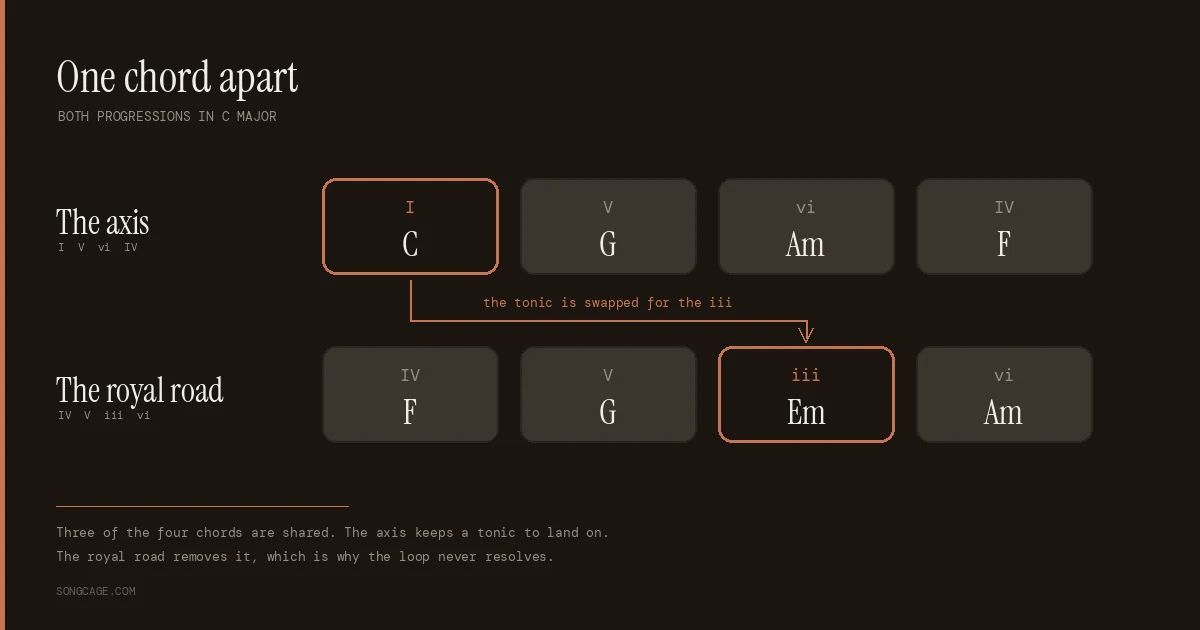
By exactly one chord. The axis progression uses I, V, vi and IV. The royal road uses IV, V, iii and vi. They share three of the four, but the axis keeps a tonic to land on and the royal road swaps that tonic for the iii.
This is the comparison everyone reaches for and almost nobody works out, so here it is properly.
The axis progression is the cycle vi-IV-I-V, most familiar in its I-V-vi-IV rotation: C, G, Am, F. Its chord set is {I, IV, V, vi}. The royal road's chord set is {IV, V, iii, vi}.
Both contain IV, V and vi. The axis contains I. The royal road swaps that I for iii. That single substitution is the entire difference, and it explains everything downstream: the axis has a tonic to land on, and the royal road has removed it from the deck.
The music theorist Mark Richards notices the same hinge from the other side. In "Tonal Ambiguity in Popular Music's Axis Progressions", discussing the "Pachelbel Rant" comedy routine, he observes in a footnote that the comedian "changes the fourth chord of the progression from iii to IV," and that "this small but critical alteration allows many more songs to appear in his rant since the ostinato now becomes the far more common I-V-vi-IV."
One chord apart, and one of them is everywhere while the other is a specialist tool.
Who named it, and why "royal road"?
A Japanese musician posting as 音極道 named it 王道進行 in October 2008, on a blog that is still online. 王道 carries the sense of a well-travelled or orthodox route, and his point was critical rather than admiring: the progression had been used so heavily it had become the default path.
The naming is unusually well documented, because it happened on a blog and the blog is still up.
In October 2008, a musician writing under the handle 音極道 (Otogokudo) posted a two-part video to Niconico Douga titled "The core of the J-POP sound was actually made of a single chord progression," along with a companion post on his blog. The argument he makes in the videos is critical rather than celebratory: the progression had been heavily used in 1980s Eurobeat, and after Eurobeat faded internationally it stayed lodged in Japanese ears and had been overused ever since.
His description of why it works is still the best short one anybody has written. The subdominant opening, he says, "itself has the function of holding tonality in reserve," and when it goes to iii instead of the tonic after the dominant seventh, "that sense of suspended tonality is strengthened further, and then in the end it cadences onto the minor side." His keyword for the effect: 「メジャーとマイナーの中間を漂う浮遊感」, a floating sensation that drifts between major and minor.
You can watch the name spread in real time. He is already using 王道進行 in his own posts that week, and by 18 October a trackback on the same page opens 「名づけて"王道進行"」: "naming it ōdō shinkō."
The other name: 小悪魔コード進行
In 2014 the producer Seiji Kameda gave the progression a second name on the NHK Educational series 亀田音楽専門学校: 小悪魔コード進行, the "little devil" progression. His gloss is the one at the top of this article. In the same episode, Takuya Ohashi of Sukima Switch added the working songwriter's version: "this progression can go to all kinds of endings, and it fits between any chords."
Which songs actually use it?
Verified examples span five decades and both hemispheres: Yumi Arai's "Sotsugyō Shashin" (1975), Anri's "Olivia wo Kikinagara" (1978), Kylie Minogue's "I Should Be So Lucky" (1987), the chorus of "Titanium" (2011), the verse of "Cruel Summer" (2019) and the body of Silk Sonic's "Leave the Door Open" (2021).
Every song below was checked against at least two independent sources for chords, key and section. Where sources disagreed, the disagreement is noted rather than smoothed over.
| Song | Year | Key | Chords | Where |
|---|---|---|---|---|
| "Sotsugyō Shashin" – Yumi Arai | 1975 | C major | Fmaj7 G/F Em7 Am7 | Chorus |
| "Olivia wo Kikinagara" – Anri | 1978 | G major | Cmaj7 D7 Bm7 Em7 | Chorus |
| "I Should Be So Lucky" – Kylie Minogue | 1987 | C major | F G Em7 Am | Intro and chorus |
| "Together Forever" – Rick Astley | 1988 | D major | G A F#m Bm | Chorus |
| "Part of Your World" – Menken/Ashman | 1989 | F major | IV V(4/2) iii vi | Opening line, bridge |
| "God knows..." – Aya Hirano | 2006 | E major | Amaj7 B G#m C#m | Intro and chorus |
| "Titanium" – Guetta ft. Sia | 2011 | E♭ major | A♭ B♭ Gm Cm | Chorus, breakdown |
| "Cruel Summer" – Taylor Swift | 2019 | A major | D E C#m F#m | Verse, pre-chorus |
| "Kaibutsu" – YOASOBI | 2021 | – | IV V iii vi | Chorus |
| "Leave the Door Open" – Silk Sonic | 2021 | C major | Fmaj7 G/F Em7 Am7 | Intro, verses, choruses |
Keys are the published keys where sheet music exists, and they describe the section named, not always the whole song: "I Should Be So Lucky" moves through four key centres and only its intro and chorus sit in C. "Titanium" and "Leave the Door Open" are each read differently by different credible sources, which is the subject of the next section but one.
Two entries deserve a note. "Cruel Summer" runs the royal road through its verse and pre-chorus and then does something instructive with it, which we come back to below. And Rick Astley has two songs in this conversation: "Together Forever" is a clean IV-V-iii-vi, while "Never Gonna Give You Up" sits one bass note away from it, which is the subject of a long and mostly pointless internet argument.
One note is the whole difference
"Never Gonna Give You Up" is recorded in D♭ major, where IV is G♭ and ii is E♭m. G♭maj7 is G♭-B♭-D♭-F. E♭m7 is E♭-G♭-B♭-D♭. They share three notes, so which one you think the record plays depends on how you read the bass, and published chord charts genuinely split: some write the loop as IV-V-iii-vi, others as ii-V-iii-vi. In this progression the identity lives in the bass note, and the song sits right on the line.
Is it in C major or A minor?
Both, and that is not a dodge. The same four chords read as IV-V-iii-vi in C major, where they never touch the tonic, and as VI-VII-v-i in A minor, where they land on it every four bars. Published theorists take both positions in print.
This is the real question, it has no settled answer, and the disagreement is the most interesting thing about the progression.
Take Fmaj7, G7, Em7, Am7. Call the song C major and you get IV-V-iii-vi, a progression that never touches its tonic. Call it A minor and you get VI-VII-v-i, a progression that lands on its tonic every four bars. Same four chords, same recording, opposite descriptions.
Serious people take both positions. Ramage reads the progression as major with an Aeolian tilt, and argues it can induce what he calls a binary tonal system. Trevor de Clercq's six-based-minor approach reads it from the minor end. Drew Nobile's work on double-tonic complexes says it is genuinely both at once, and Joy Li's 2026 article on Japanese anime songs adopts the minor reading partly because it "removes the need to analytically resolve any sort of double tonic complex."
"Titanium" is where this stops being academic. Its published key is E♭ major, in which the chorus is A♭-B♭-Gm-Cm, or IV-V-iii-vi, and never reaches the tonic. But Hooktheory files the same chorus in C minor, where it is VI-VII-v-i and hits home every four bars. The Wikipedia article on the song says both: E♭ major overall, "however the chorus and breakdown are in C minor." Nobody is wrong. The progression is under-determined by design.
The practical version
Richards' rule of thumb is that the melody decides. Whichever potential tonic your topline keeps emphasising is the one listeners will hear as home, regardless of what the chords are doing. If you want the floating quality, keep the melody off both C and A. If you want it to settle, land on one of them and hold it.
What is the minor form, and why do sources label it differently?
There are two minor forms and they get confused constantly. One is the same four chords relabelled from the minor end, VI-VII-v-i. The other rebuilds the pattern on the minor scale into a genuinely different chord set, iv7-v7-IIImaj7-VI. Labels differ because writers count from different scales.
There are two different things people mean by "the minor royal road," and conflating them causes most of the confusion online.
The first is a relabelling, not a new progression. In A minor, VI-VII-v-i is Fmaj7-G7-Em7-Am7. Those are the identical sounding chords as C major's IV-V-iii-vi. It is the same loop read from the other end, which is the ambiguity described above.
The second is a genuinely different chord set. Rebuild the royal road's interval pattern on the minor scale and you get iv7-v7-IIImaj7-VI: in A minor, Dm7-Em7-Cmaj7-F. Same shape, new chords.
The labelling trap is worth naming, because it catches people constantly. Some writers number the minor form against the parallel major and write it ♭VI-♭VII-v-i. Others number it against the natural minor scale and write VI-VII-v-i. These are the same pitches under two conventions, not two different progressions. If you are comparing two sources and one has flats the other lacks, check which scale each is counting from before assuming one is wrong.
Our guide to minor chord progressions covers which chords a minor key gives you and why the 6th and 7th degrees are the variable ones.

How do you get out of it?
Three exits, all of them used on hit records. Append a ii-V-I so the withheld tonic finally arrives. Answer the loop with a second progression that opens on the tonic, the way "Cruel Summer" does. Or let it resolve once, late, then push it away again.
The loop's problem is that it is a loop. It does not cadence, so left alone it circles until you stop it. Songwriters solve this three ways, and all three are worth stealing.
Add the cadence on the end. The traditional exit is a ii-V-I tacked onto the loop: IVmaj7-V7-iii7-vi7-ii7-V7-I. The descending-fifths chain runs from the iii onwards, and the tonic finally arrives after you have been denied it for four bars. This is the ending Wikipedia documents and the one most J-pop choruses use.
Answer it with a different loop. "Cruel Summer" runs IV-V-iii-vi through the verse, then the chorus keeps the iii, vi and IV but swaps the V for the tonic: A-C#m-F#m-D. The verse withholds home for its whole loop, and the chorus answers by putting home first. Its pre-chorus does something neater still, running the royal road once and then repeating IV-V and dropping the chorus straight onto A.
Let it resolve once, late, and then push it away again. "Leave the Door Open" loops Fmaj7-G/F-Em7-Am7 through the intro, the verses and the choruses, then on one pass swaps the second chord to G11 and resolves: Fmaj7, G11, Cmaj9. (The final chorus lifts the whole loop up a semitone into D♭.) The first real landing on the tonic comes about seventy seconds in, on "tell me that you're coming through," and is immediately shoved off by an A7♭9. In The Mix Review, Mike Senior notes the dominant's "tangible dominant impetus thwarted by the chorus's opening Fmaj7," resolving confidently only six bars later.
Aitken's account of the Stock Aitken Waterman formula, quoted by the songwriting academic Joe Bennett, is the same idea stated as craft: "It never actually settles until the very end of the chorus and then you give the game away and then everyone's happy by then." Bennett reads the delayed arrival at the I chord as a deliberate tension-and-release device, which is precisely what it is.
Why do so many pages get this wrong?
Because the name travels further than the definition. At the time of writing, a chord-tool site ranking on page one defines the royal road as I-V-vi-IV, which is the axis progression, and Wikipedia's song list leaves about 80% of its entries uncited. Check the chords, not the label.
Because the progression's name is more famous than its content, and the name has drifted.
At the time of writing, one chord-tool site that ranks on the front page for "royal road progression" defines it as I-V-vi-IV, the axis progression, and attributes songs like "Let It Be" and "With or Without You" to it. That is a different progression, one that Wikipedia lists as a separate article. The royal road's whole identity is that it has no I in it.
Wikipedia's own song list, meanwhile, runs to more than 240 rows, and about 80% of them carry no citation for the progression at all. It is a reasonable place to start and a poor place to stop.
The practical defence is to check the chords rather than the label. If you see a I in the loop, whatever else it is, it is not the royal road.
Where Song Cage fits
Song Cage will not suggest this progression to you, and the reason is worth saying out loud.
Put F and G into a song in C major, leave the next slot empty and ask what goes between it and the Am you have already placed. The chord palette offers C, labelled "Authentic cadence," then E7, then F. Em is not on the list. The suggestions are built to resolve, and they read the V as wanting to go home, which in ordinary songwriting it usually does. The palette names eleven progressions and cadences on the chips, from the deceptive cadence to the Andalusian cadence. The royal road is not among them.
That is not a gap so much as the point of the post. The royal road's signature move is the one a resolution-seeking suggester will not propose, which is exactly why it sounds like it does. All four chords are sitting right there in the In Key section (F, G, Em and Am are numbers 4, 5, 3 and 6 in C major), and the Roman-numeral label on each chip tells you what job it is refusing to do. You place them yourself, in that order, on purpose.
For the minor form, all four are In Key again in A minor, on numbers 6, 7, 5 and 1. Ask the palette what belongs between the G and the Am there and it offers C and the major E, pushing you toward the leading-tone V where the royal road keeps the flat-seven v. Same disagreement, other end of the key.
Our 7th chords guide covers the maj7 and m7 qualities this progression is usually voiced with, and the 10 most useful chord progressions covers the axis progression it is one chord away from.
Write the progression the suggester will not offer you
Song Cage labels every chord in your key by function, so you can see what a progression is doing and choose to do something else.
Frequently Asked Questions
What is the royal road progression in C major?
The royal road chord progression in C major is Fmaj7, G7, Em7, Am7. Written as scale degrees it is IVmaj7-V7-iii7-vi7. Plain triads work too (F, G, Em, Am), though the sevenths are the more common voicing in J-pop, where the progression is most at home.
Why is it called the royal road progression?
It translates 王道進行 (ōdō shinkō), coined in October 2008 by a Japanese musician posting as 音極道. 王道 carries the sense of an easy or well-travelled route. It has a second Japanese name too, 小悪魔コード進行 or "little devil" progression, given to it by the producer Seiji Kameda on NHK in 2014.
Is the royal road progression the same as the four-chord axis progression?
No, and the difference is exactly one chord. The axis progression uses I, V, vi and IV. The royal road uses IV, V, iii and vi. They share three chords, but the axis has a tonic to resolve to and the royal road replaces it with the iii, which is why it floats instead of landing.
Are there any Western songs that use the royal road progression?
Yes, though it is much rarer outside Japan. Verified examples include "Together Forever" by Rick Astley, "I Should Be So Lucky" by Kylie Minogue, the chorus of "Titanium" by David Guetta and Sia, the verse of Taylor Swift's "Cruel Summer" and the body of Silk Sonic's "Leave the Door Open."
How do you end a royal road progression?
The standard exit is a ii-V-I cadence appended to the loop, giving IVmaj7-V7-iii7-vi7-ii7-V7-I. The tonic you have been denied for four bars finally arrives. Alternatively, answer the loop with a second progression that opens on the tonic, which is what the chorus of "Cruel Summer" does.
Is the royal road progression in a major or a minor key?
Both readings are defensible and published theorists disagree. Fmaj7-G7-Em7-Am7 is IV-V-iii-vi in C major, where it never touches the tonic, and VI-VII-v-i in A minor, where it lands on the tonic every four bars. In practice the melody decides which one a listener hears.