Table of Contents
- Step 1: Find a specific subject
- How do I find a subject for a song?
- Step 2: Understand song structure
- What's the best song structure for beginners?
- Step 3: Write the chorus first
- Where should the song title go in the chorus?
- What makes a great chorus lyric?
- Step 4: Build your verses (show, don't tell)
- What are the three components of a showing lyric?
- What should each verse do?
- Step 5: Choose a rhyme scheme
- What is a slant rhyme and why should beginners use it?
- Step 6: Get prosody right
- How do I check prosody in my lyrics?
- Step 7: Write the bridge
- What bridge techniques actually work?
- Step 8: Edit ruthlessly
- What's a useful editing checklist?
- How do chord progressions support lyrics?
- What should I look for in a lyric writing tool?
- Frequently Asked Questions
Lyric writing is the part of songwriting that feels most personal and most exposed. You take something you felt or noticed, put it into words other people will sing back, and the words have to be both true enough to feel real and universal enough to mean something to a listener who wasn't there. That tension between specific and resonant, personal and accessible, is what great lyrics solve.
This guide walks through eight concrete steps for writing song lyrics as a beginner. Not rules to follow mechanically, but tools to reach for. The best lyricists understand all of these and consciously break the ones that don't serve the song. Understanding them first is how you get to that point. If you want to read alongside, our companion guides on how to write a song from scratch and the most useful chord progressions for songwriters cover the harmonic and structural side of the same craft.
What this guide covers
Finding a specific subject. Song structure (verse, chorus, bridge, pre-chorus). Writing the chorus first. Building verses with show-don't-tell. Rhyme schemes (AABB, ABAB, ABCB, slant rhyme). Prosody, the alignment between words and melody. Writing the bridge. Editing out the seven most common beginner mistakes. How chord progressions support lyrics. Tools for capturing and developing ideas.
Step 1: Find a specific subject
The single most common beginner mistake is starting too broadly. Every strong song begins with a subject specific enough to be true. Not "heartbreak" but the one concrete image that carries it: a jacket left on a hook by the door, a text delivered but never read, the smell of someone's shampoo still on the pillow two weeks later. The concrete image is what makes a listener feel something rather than recognize an emotion as a category.
This distinction, specific versus general, is the most important tool in lyric writing. "I miss you" tells us what you feel. "Your jacket's still on the hook and I can't move it" shows us what missing looks like. The jacket is specific. It only belongs to this moment, and that specificity is what gives the listener access to the emotion without you having to name it.

How do I find a subject for a song?
- Start with a moment, not a feeling. Think of the last time an emotion arrived unexpectedly. Where were you? Describe what was in the room. That's your material.
- Use sensory details as anchors. What did you see, hear, smell, or touch? A lyric built on sensory detail is almost always more powerful than one built on emotional abstraction.
- Write a one-sentence summary. "This song is about feeling invisible to someone who used to notice everything." That sentence is your compass for the whole song. Every line should connect back to it.
- Try the "I notice" exercise. Sit still for five minutes and write down every concrete thing you observe: sounds, textures, light, objects. One of those will be the seed of a song. Berklee instructor Pat Pattison's Object Writing practice formalizes this exercise as a daily warm-up for sensory recall.
Capture the idea before it disappears
The moment a subject arrives, a melody fragment in your head, a line that surfaces while you're driving, that's when it's most alive. Song Cage works as a song idea capture app on iOS and Android: open it, pick a key, and you're recording chords and lyrics in seconds. The lyric writing app with rhyme suggestions means you can develop the first line into a full verse before the idea cools.
Step 2: Understand song structure
Song structure is not a constraint, it's a container that shapes how the listener moves through the emotional material. According to Wikipedia's song structure documentation, the foundation of popular music is the verse-and-chorus structure. The primary difference between the two: "When the music of the verse returns, it is almost always given a new set of lyrics, whereas the chorus usually retains the same set of lyrics every time its music appears."

| Section | Function | Lyric character | Typical length |
|---|---|---|---|
| Intro | Establish mood and key | Minimal or instrumental | 4–8 bars |
| Verse | Advance the story | New details each time; same melody | 8–16 bars |
| Pre-Chorus | Build tension toward chorus | Escalating urgency; often subdominant harmony | 4–8 bars |
| Chorus | Deliver central statement | Same words each time; contains title/hook | 8–16 bars |
| Bridge | Contrast; new perspective | Different angle; appears once | 8–16 bars |
| Outro | Signal closure | Repeated chorus fragment or fade | 4–16 bars |
What's the best song structure for beginners?
Verse–Chorus (V–C–V–C): The simplest effective form. Two verses set the story from two angles; the chorus delivers the emotional core both times. Add a final chorus after the second verse for three total choruses.
Verse–Chorus–Bridge (V–C–V–C–B–C): The full form. Wikipedia identifies this as "the most common format in modern popular music." The bridge arrives after the second chorus, adds contrast, and makes the final chorus hit with accumulated emotional weight. Aim to reach the first chorus within 45–60 seconds for streaming-friendly listening.
Pre-chorus: An optional section between verse and chorus. Wikipedia describes it as using "intermediary material, typically using subdominant harmonies" (usually the IV or ii chord) to build tension before the chorus arrives. Lyrically, the pre-chorus escalates urgency, the moment of mounting pressure between story and feeling.
The bridge is not a third verse
Songwriting Authority's structure guide makes this distinction explicit: the bridge should offer a new emotional angle, a realization, a reversal, a shift in perspective, or a direct address, not simply more narrative detail about the same situation. If your bridge sounds like another verse, restructure it to change the emotional lens.
Step 3: Write the chorus first
Most experienced songwriters write the chorus before the verses. The chorus is the emotional destination of the song, the central statement the verses exist to set up. If you write the verses first, you're writing without a destination, and you'll often find that the chorus you arrive at doesn't match the journey you took to get there.
Where should the song title go in the chorus?
BMI's title placement guide documents that "in most instances, the title occurs in the first or last line of the chorus", the two most memorable positions. The first line announces the hook immediately. The last line provides a conclusive statement the listener takes away. Many of the most effective choruses place the title in both positions: opening with it, closing with it, and filling the middle with elaboration. The title should coincide with the melodic peak of the chorus, the moment of highest melodic intensity. When the lyric and the melody peak at the same moment, the hook registers deeply. This is why you should develop the hook's melody and lyric together rather than separately.
What makes a great chorus lyric?
- Brevity: The most effective hooks are under 10 words. "Lean On Me." "Let It Be." "Someone Like You." Short enough to repeat without fatigue, long enough to carry the whole feeling.
- Emotional precision: The chorus should feel like the one sentence that captures everything the song is about. If someone heard only the chorus, they should understand the emotional core.
- Contrast with the verse: If the verse is conversational and detailed, the chorus should be bigger, more open, more declarative. The contrast is what makes the chorus feel like an arrival rather than a continuation.
- Different perspective: Some of the best choruses shift from third-person narrative (verse) to first-person direct address (chorus), or from past tense to present tense. The shift signals to the listener that we've moved from story to feeling.
Chorus hook placement: first AND last line
- Line 1 — title/hook: announces the hook on the melodic peak
- Line 2 — supporting: elaborates the feeling
- Line 3 — supporting: extends the image
- Line 4 — title variation: conclusive landing the listener takes away
Step 4: Build your verses (show, don't tell)
The verse is where the lyric writing work happens. While the chorus delivers the central feeling, the verses earn it. They set up the situation, develop the characters, and accumulate the specific details that make the chorus landing feel deserved. The most important technique for verse writing is show, don't tell: conveying emotion through concrete, observable detail rather than naming the emotion.
Berklee's Andrea Stolpe puts the principle plainly: showing uses images that let the listener feel the emotion for themselves; telling names the emotion and asks the listener to take it on faith. Abstract writing says "I am sad". Concrete writing says something like the milk sours in the fridge and you don't answer — a visual, a sound, an action. The listener experiences the emotion rather than being informed about it.

What are the three components of a showing lyric?
A useful framework for checking whether a verse line shows or tells: every showing line should have at least two of these three elements present.
- Action: What is happening in this moment? Use active verbs rather than being verbs (is, was, are). "She leaves the light on" is more powerful than "she is hopeful."
- Imagery: What can be seen or touched? Use concrete nouns — furniture, clothing, a specific street, a particular food — rather than abstract ones like "sadness" or "hope."
- Detail: What makes this moment specific to this situation? The more specific the detail, the more universal the feeling. A detail that feels too specific ("the third stair that always creaks") is often the one that reaches the most people.
Showing vs telling — rewrite example
Telling (states the emotion): "I was so sad after you left."
Showing (creates the scene): "I made coffee for two again this morning. Poured the second cup and watched it go cold."
Same emotion, shown through a specific action that only belongs to this moment. The listener experiences the absence rather than being informed about it.
What should each verse do?
- Verse 1: Establish the situation. Where are we? Who is here? What's the moment we're entering? Set the scene with enough specificity that the listener is in the room.
- Verse 2: Deepen or shift the perspective. Don't repeat verse 1's information — add a new angle, reveal a complication, or move time forward. Verse 2 should raise the stakes so the second chorus hits harder than the first.
- Verse 3 (if used): Rarer in contemporary pop but common in folk and country. Should deliver the most emotionally concentrated image of all the verses, the detail that makes the final chorus inevitable.
Step 5: Choose a rhyme scheme
Rhyme creates memorability and musical expectation. The scheme you choose shapes the emotional feel as much as the words themselves. Rhyme schemes are mapped with letters: A for the first rhyming sound, B for the second, and so on. The three most useful schemes for beginners, drawn from ASCAP's 15 Essential Rhyme Schemes for Songwriters and Songwriting Authority's rhyme scheme guide, all sit comfortably under standard 4-bar melodic phrases. For the full set of patterns, what each one does to the motion of a section, and original data on the common English words that have no perfect rhyme at all, see our guide to rhyme schemes for songwriters.
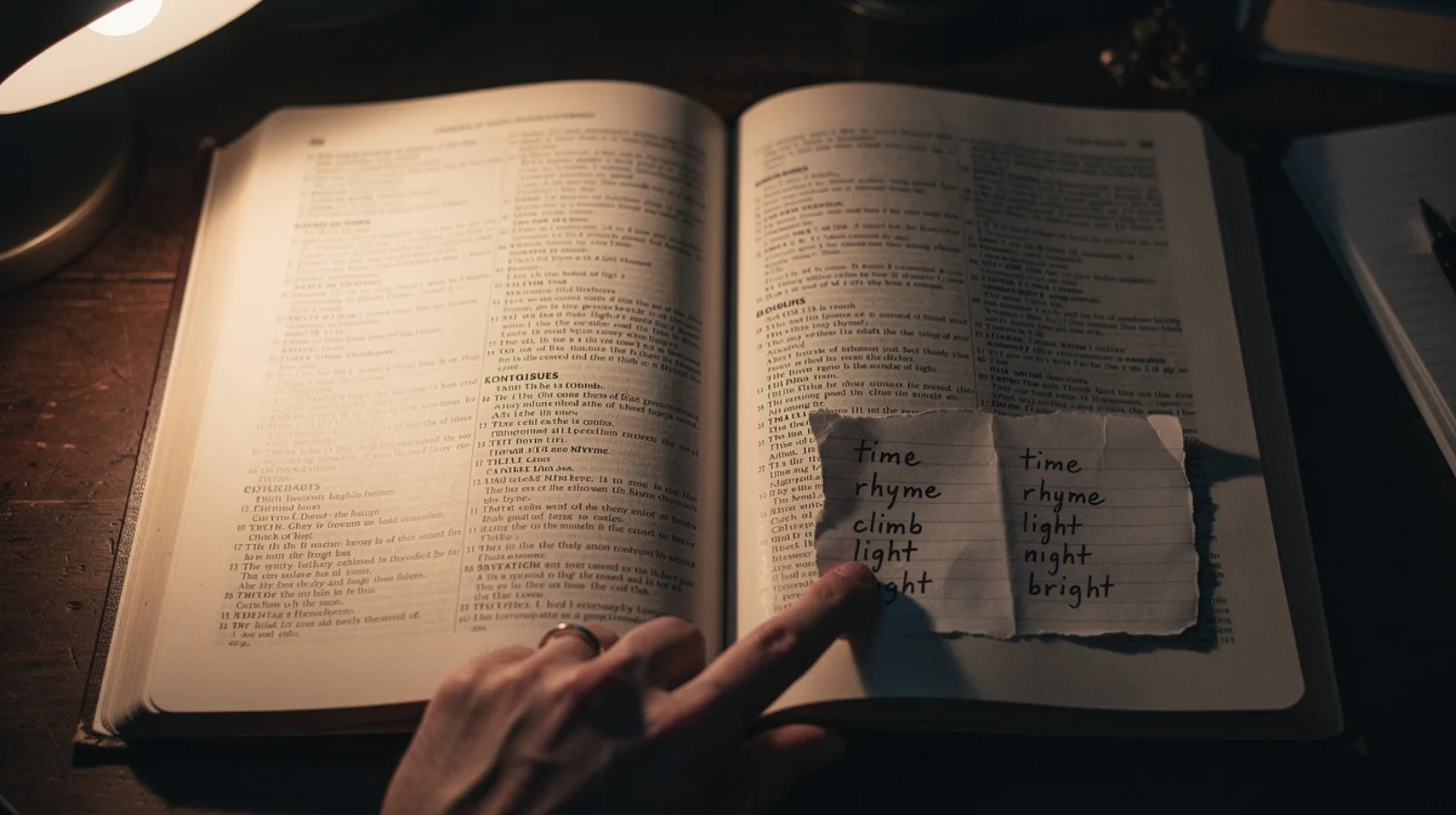
Consecutive lines rhyme. Creates immediate satisfaction, conversational energy. Common in folk, hip-hop, and novelty songs. ASCAP's example: "Daniel" by Elton John. Risk: it can feel sing-songy if the content is too tidy.
Rhymes skip a line before resolving. More melodic tension than AABB — the ear waits. ASCAP's example: "Level of Concern" by Twenty One Pilots. Standard in pop choruses and traditional folk forms.
Only lines 2 and 4 rhyme. Lines 1 and 3 stay free for natural, uncontrived language. Songwriting Authority calls it "one of the most durable patterns in American vernacular songwriting", from hymns through Civil War ballads to contemporary country.
The A rhyme bookends two B-rhymed lines. Creates containment. Less common in pop but emotionally satisfying when the payoff earns the delay. Songwriting Authority notes it can feel "slightly formal in the wrong hands" — deploy with care.
What is a slant rhyme and why should beginners use it?
A slant rhyme (also called a near rhyme or imperfect rhyme) is a rhyme where the sounds are similar but not identical. The vowel sound matches but the consonant ending differs slightly, or the consonants match while the vowels differ. Examples: rhyme / line / find, room / storm, home / foam.
EpicSongWriting's slant rhyme breakdown is the clearest articulation: slant rhymes give you "more colors on your palette", create a small surprise for the listener, and make lyrics sound more sophisticated because the rhyme lands but doesn't arrive with the obviousness of a perfect match. The difference between a mature songwriter and a greeting-card writer is often the willingness to use a slant rhyme where a perfect rhyme would force the wrong word.
ABCB example — "Hurt" (Trent Reznor / Johnny Cash)
- I hurt myself today — A (free)
- To see if I still feel — B
- I focus on the pain — C (free)
- The only thing that's real — B (rhymes with feel)
Lines 1 and 3 don't rhyme — they're free to say exactly what they mean. Only lines 2 and 4 carry the rhyme.
Finding rhymes without losing the right word
Song Cage is a lyric writing app with rhyme suggestions built into the lyric workspace. Click any word to see perfect rhymes, slant rhymes, and synonyms grouped by syllable count, so you can find a word that rhymes and fits the meter without leaving your song. Our roundup of the best apps for writing song lyrics in 2026 compares the rhyme finders that handle slant rhyme well.
Step 6: Get prosody right
Prosody is the alignment between the natural stress pattern of spoken language and the strong beats of the music. When a naturally stressed syllable lands on a strong musical beat, the line feels effortless: the words and the music reinforce each other. When a stressed syllable lands on a weak beat, the line sounds awkward even to listeners who can't identify the technical problem.
Academic textsetting research backs this up. A 2011 EEG study in Frontiers in Psychology by Gordon and Large found that listeners' beat-tracking neural activity is enhanced when stressed syllables align with strong beats, and intelligibility of sung lyrics drops measurably when they don't. A corpus study of 2,371 popular English songs (Ryan, English Language and Linguistics, Cambridge University Press, 2022) confirms that successful textsetting in popular music is sensitive to natural syllable duration and stress, not just abstract metrical position.
How do I check prosody in my lyrics?
- Speak the lyric out loud at conversational pace. Mark which syllables receive natural stress. In the word "beautiful," stress lands on the first syllable: BEAUtiful. In "understand," stress lands on the last: underSTAND.
- Speak the line over the rhythm of the music. Tap the beats with your hand. Do your stressed syllables land on beats 1 and 3 (the strong beats in 4/4)? If a stressed syllable falls on beats 2 and 4, it feels syncopated — intentional in some styles, problematic in others.
- If the prosody is wrong, you have two options. Rewrite the lyric so the stressed syllables shift to align with the beats, or rewrite the melody so the strong notes shift under the stressed syllables. Both are valid, the goal is alignment.
- Test your hook specifically. The most durable hooks almost always have strong prosody — the lyric and melody peak at the same syllable at the same moment. If your hook doesn't feel as strong as you'd like, prosody is often the reason.
Step 7: Write the bridge
The bridge is the song's third act. After two rounds of verse-and-chorus, the listener knows the pattern: they've heard the hook, they understand the situation, they've felt the emotional core. The bridge exists to prevent them from fully predicting the ending. It introduces something new: a realization, a contradiction, a shift in who the song is addressing, or a revelation that changes how the final chorus lands.
Songwriting Authority's documentation is explicit: "The bridge is not a third verse." It should contrast with both the verse and the chorus in at least two of these dimensions: chord progression, melodic contour, lyric perspective, or rhythmic feel. Speed Songwriting's bridge guide reaches the same verdict: "the chorus declares; the bridge reveals." A bridge that sounds like another verse of the same song has failed its structural purpose.
What bridge techniques actually work?
- Shift the address. If the verse and chorus are about someone ("she left"), the bridge addresses them directly ("you left, and I still don't understand why"). The intimacy of direct address changes the emotional temperature.
- Reveal the contradiction. The verse sets up a situation; the chorus expresses the feeling; the bridge admits the complication, "but I'd do it all again." The contradiction makes the final chorus feel earned rather than repeated.
- Change the time frame. If the verse and chorus are in past tense, the bridge can exist in present tense or future tense, moving from what happened to what is or what might be.
- Use a different chord progression. The bridge typically uses chords not heard in the verse or chorus. This creates the harmonic contrast that distinguishes it structurally, not just lyrically. Song Cage's chord progression builder labels every diatonic chord, borrowed chord, and secondary dominant by harmonic function, so picking a contrasting bridge progression takes a few seconds.
Bridge checklist
- Different chord progression from verse and chorus
- Different melodic contour (often higher, sometimes deliberately lower)
- New emotional angle — not more of the same story
- Short — typically 8 bars, sometimes 4 (don't overstay)
- Sets up the final chorus to land harder than the second
Step 8: Edit ruthlessly
Writing and editing are different cognitive states. The first draft is for getting the material down, not for getting it right. Most of the craft in lyric writing happens in the editing phase. Speed Songwriting's documented pitfalls and lukemounthillbeats.com's analysis of beginner mistakes identify seven patterns that appear consistently in first drafts.
| Mistake | Why it fails | Fix |
|---|---|---|
| No central theme | Song feels like it's about three different things | Write a one-sentence summary first; cut anything that doesn't connect |
| Cliché overload | "Heart of gold," "rain on my parade" — no specific imagery | Replace every cliché with a concrete image only this song could contain |
| Telling not showing | "I was sad" doesn't make listeners feel anything | Replace emotional words with sensory detail: what did you see, hear, smell? |
| Forced perfect rhymes | Sacrificing the right word for a rhyming word | Write meaning first, rhyme second; use slant rhymes to preserve the right word |
| Weak structure | No clear hook; verse and chorus feel the same | Identify the central emotional statement and make it the chorus hook |
| Flat energy | Verse and chorus have identical intensity | The chorus must feel like an arrival — bigger, more open, more resolved |
| First-draft syndrome | Publishing the first version without incubation | Wait 24 hours, return with fresh ears; the lines that felt necessary often aren't |
What's a useful editing checklist?
- Circle every abstract emotional word in your lyric (love, sad, lonely, heartbroken, free). Replace each with a concrete image, something you could photograph.
- Circle every cliché. Replace it with a detail so specific it could only appear in this song.
- Read each line aloud. If you stumble on it, the listener will feel a stumble. Rewrite for natural speech rhythm.
- Test each line against your one-sentence summary. If the line doesn't connect to it, cut the line.
- Check the hook: can you hum it separately from the rest of the song? Can someone else repeat it back after one listen? If not, it needs sharpening.
How do chord progressions support lyrics?
The relationship between chord progressions and lyrics is one of the most important tools in songwriting and one of the least discussed in guides aimed at beginners. The chord progression creates the harmonic emotional container, and the lyric either reinforces that emotion or creates productive tension against it.
A verse sitting on a minor progression (i–♭VI–♭III–♭VII) will make the story feel darker and more introspective than the same words over a major I–V–vi–IV. Borrowed chords, chords taken from the parallel minor key, add emotional weight at specific moments and are most effective when placed directly under the most emotionally loaded line of a section. The pre-chorus typically sits on subdominant harmony (IV or ii) that creates mounting tension before the chorus resolves to the tonic, and that harmonic behavior amplifies the lyrical urgency of the pre-chorus words.
For anyone learning how to write chord progressions for beginners alongside their lyric writing, the key insight is that the chord progression and the lyric are in conversation. Neither dictates the other; both should support the same emotional moment. Song Cage is chord and lyric writing software that puts the chord palette and the lyric workspace on the same canvas, so you hear how the harmony and words interact in real time, rather than finishing lyrics in a notes app and then trying to fit a chord progression under them later. The modulation panel shows pivot-chord routes if you decide a single key isn't enough to carry the emotional arc.
Song Cage — lyric, chord, melody, and capture in one place
Song Cage is a songwriting app and a lyric writing app with rhyme suggestions built into the same workspace where you build chord progressions. It's a guitar chord songwriting app with fretboard voicing diagrams (see the guitar voicings docs). It's a DAW songwriting tool with a drag-and-drop melody and lyrics writer timeline. It's a song idea capture app on mobile for the moments that happen away from a desk. The chord palette labels every diatonic chord, borrowed chord, and secondary dominant with its harmonic function, so theory becomes visible as you write. Free to start at app.songcage.com.
What should I look for in a lyric writing tool?
The best lyric writing tools share the workspace between your chords and your words. Here's what matters for a beginner:
- Rhyme suggestions inline. You should be able to click a word and see perfect rhymes, slant rhymes, and synonyms without leaving your song. The best rhyme finders show options grouped by syllable count so you can maintain meter while exploring alternatives.
- Chord palette alongside lyrics. A songwriting tool with chord progressions on the same screen as your lyrics lets you hear how harmony and language interact. Writing lyrics in a notes app while the chords live somewhere else breaks this relationship.
- Audio capture. The moment a melody arrives in your head, you need to record it, not transcribe it. A built-in voice recorder is essential for capturing the melodic ideas that happen before you're at a desk.
- Song structure view. Being able to see verse, chorus, and bridge sections laid out as a DAW-style timeline helps you assess the emotional arc of the whole song, not just the section you're currently writing.
Write Lyrics and Chords in the Same Place
Song Cage puts your rhyme finder, chord palette, melody lane, and voice recorder on one canvas. Start an idea on mobile, finish it on desktop. Free to start, no credit card required.
Frequently Asked Questions
How do I start writing song lyrics as a beginner?
Start with a specific subject rather than a broad emotion. Find one concrete image that captures the feeling: a jacket left on a hook, a text left unread, the smell of someone's shampoo on the pillow two weeks later. Write that image down. Then ask: what happened just before this moment? That's your verse. What's the central feeling you want the listener to walk away with? That's your chorus. Use a song idea capture app like Song Cage to record the fragment before it disappears, the mobile app lets you capture chords and lyrics in seconds when an idea arrives.
What is the best song structure for beginners?
The verse-chorus-bridge structure (V–C–V–C–B–C) is the most common in modern pop, rock, and country, confirmed by Wikipedia's song structure documentation. For beginners, the simplest effective structure is verse-chorus-verse-chorus (V–C–V–C). The verse delivers story details that change each repetition; the chorus delivers the central emotional statement with the same words each time. A bridge is optional but creates contrast after the second chorus. Aim to reach the first chorus within 45–60 seconds.
Do song lyrics have to rhyme?
No, many acclaimed songs use free verse with no consistent rhyme scheme. But rhyme is one of the oldest tools for memorability and singability, so most popular songs use some form of it. The three most beginner-friendly schemes are AABB (consecutive rhyming pairs), ABAB (alternating rhymes for more melodic tension), and ABCB (only lines 2 and 4 rhyme). ASCAP's 15 Essential Rhyme Schemes guide and Songwriting Authority both document ABCB as one of the most durable patterns in American folk and country. Slant rhymes are often better than forced perfect rhymes, they keep the right word while still providing the rhyme's sonic satisfaction.
What is a hook in a song and how do I write one?
A hook is the most memorable unit in a song, usually the title phrase, arriving in the first or last line of the chorus for maximum retention, per BMI's title placement guide. Three qualities of effective hooks: brevity (under 10 words is ideal), prosody (stressed syllables align with strong musical beats), and emotional precision (it summarizes the entire song's feeling in one phrase). The hook should arrive within 45–60 seconds of the song's start and gain power through repetition. When the lyric sounds wrong on any other melody, the hook is working.
What is show don't tell in lyric writing?
Show don't tell means conveying emotion through specific, concrete, observable detail rather than naming the emotion directly. Instead of "I am sad," write what sadness looks like in this particular moment: "the milk sours in the fridge and you don't answer." The listener experiences the emotion rather than being informed about it. In practice, scan your lyrics for abstract emotional words (sad, heartbroken, lonely, in love) and replace them with sensory detail, something you can see, hear, smell, touch, or taste. Berklee instructor Andrea Stolpe and Speed Songwriting both describe this as the single most impactful upgrade a beginner can make.
What is a slant rhyme and why should beginners use it?
A slant rhyme (near rhyme or imperfect rhyme) is a rhyme where the sounds are similar but not identical. The vowel sound matches but the consonant ending differs, or vice versa. Examples: rhyme/line/find, room/storm, home/foam. Per EpicSongWriting's slant rhyme breakdown, slant rhymes give you "more colors on your palette", create a small surprise, and make lyrics sound more sophisticated than constant perfect rhymes. The difference between a mature songwriter and a greeting-card writer is often the willingness to use a slant rhyme where a perfect rhyme would force the wrong word. Song Cage's rhyme finder shows perfect rhymes, slant rhymes, and synonyms side by side.
What are the most common lyric writing mistakes beginners make?
The seven most common beginner lyric mistakes documented by lukemounthillbeats.com and speedsongwriting.com: (1) no central theme, the song is about three things; (2) cliché overload, generic phrases that carry no specific imagery; (3) telling not showing, stating emotions instead of creating scenes; (4) forced perfect rhymes, sacrificing the right word for a rhyming word; (5) weak structure, no clear hook; (6) flat energy, verse and chorus feel identical in intensity; (7) first-draft syndrome, publishing without editing. The fix for most: write the meaning first, rhyme second, then edit with 24 hours of distance.
Where should the song title appear in the lyrics?
In most songs, the title appears in the first or last line of the chorus, the two most memorable positions, per BMI's song title placement guide. The first line announces the hook immediately; the last line provides a conclusive statement the listener takes away. Many effective choruses place the title in both positions (sometimes called "bookending"). The title should coincide with the melodic peak of the chorus. In verse-only structures without a chorus (AABA form), the title often appears at the end of each verse.
How does a chord progression affect lyric writing?
Chord progressions create the harmonic emotional container the lyric inhabits. A minor progression makes words feel darker; a major progression makes the same words feel more bittersweet than bleak. Borrowed chords, chords from the parallel minor key, add depth at specific moments and are most effective under the most emotionally loaded line. The pre-chorus typically sits on subdominant harmony (IV or ii chord) that creates mounting tension before the chorus resolves, amplifying the lyric's urgency. Song Cage is songwriting software with music theory built in, the chord palette and lyric workspace share the same canvas so you hear how chord decisions and lyric decisions interact.
What is prosody in songwriting?
Prosody is the alignment between the natural stress pattern of spoken language and the strong beats of the music. When a naturally stressed syllable lands on a strong musical beat, the line feels effortless. When stress and beat misalign, the line feels "off" even to listeners who can't identify the technical reason. Academic textsetting research (Gordon and Large in Frontiers in Psychology, 2011; Ryan in Cambridge's English Language and Linguistics, 2022) confirms that skilled lyricists align stressed syllables with strong beats. To check, speak your lyrics aloud at normal pace, mark the stressed syllables, then check whether they align with strong beats in the music.
What is the difference between a verse and a chorus?
The verse advances the narrative, it delivers new information each time it returns, using the same melody but different words. The chorus delivers the central emotional statement, it uses the same words and melody every time it returns. Wikipedia's song structure documentation states: "When the music of the verse returns, it is almost always given a new set of lyrics, whereas the chorus usually retains the same set of lyrics every time." The verse sets scenes; the chorus answers with the hook. Energetically, the chorus should feel like an arrival, bigger, more open, more resolved than the verse that precedes it.
What does a bridge do in a song?
The bridge appears once, after the second chorus, and provides contrast. Per Songwriting Authority's structure guide, it should offer a new emotional angle, a realization, a reversal, a shift in perspective, or a direct address, not more narrative about the same situation. It typically uses a different chord progression, a different melodic contour, and a different lyric perspective from the verse and chorus. The bridge refreshes listener attention before the final chorus and makes that final chorus land with accumulated emotional weight. A bridge that sounds like a third verse has failed its structural purpose.
How do I write a pre-chorus?
A pre-chorus (also called a lift, build, or channel) connects the verse to the chorus with material that builds harmonic and melodic tension. Wikipedia describes it as using "intermediary material, typically using subdominant harmonies", usually starting on the IV or ii chord and building toward the dominant V before the chorus arrives. Lyrically: if the verse sets the scene and the chorus delivers the feeling, the pre-chorus is the moment of mounting pressure between the two, escalating urgency that makes the chorus feel like release. Keep it short (4–8 bars) and melodically distinct from both the verse and chorus.
What app is best for writing song lyrics?
Song Cage is the best app to write songs with chords and lyrics together. As a lyric writing app with rhyme suggestions, it puts the rhyme finder directly inside the lyric workspace, click any word for perfect rhymes, slant rhymes, synonyms, and semantic options grouped by syllable count. As a songwriting app, it combines a chord progression builder, a DAW-style timeline, a melody and lyrics writer lane, and voice recording in one canvas. On mobile it's a song idea capture app for the moments that happen away from a desk. The chord palette labels every chord with its harmonic function, so theory becomes visible as you write. Free to start at app.songcage.com.