Table of Contents
- Why do voice memos pile up unplayed?
- Does an unfinished song really nag at you?
- Has the Zeigarnik effect been replicated?
- What replaced the Zeigarnik effect?
- Can you trust your own judgment about which fragment is good?
- Which songs get dismissed for being too simple?
- Does leaving a fragment alone for months help?
- What does everyone else tell you to do?
- Why capture-time advice cannot fix a backlog
- What proportion of fragments actually become songs?
- The one-session amnesty
- What is the fifteen-second test?
- What do you write down when a fragment survives?
- Should you delete the rest?
- Songs that came back from the pile
- Why is a folder of audio unsearchable?
- Running the amnesty in Song Cage
- What happens to a recording when it imports?
- How do you find one recording among two hundred?
- What does the search actually read?
- Frequently Asked Questions
You have the folder. Two hundred voice memos called New Recording 47, New Recording 48, New Recording 49, going back years, each one a version of you humming into a phone in a car park or a kitchen at 2am. You know there is something good in there. You have not opened it in eleven months.
This is not a discipline problem and it is not a talent problem. It is a retrieval problem, and it has a specific shape: the moment your captures outgrew your memory of them, the folder stopped being an archive and became a wall. Capturing song ideas was never the part you were bad at. Going back to them is, and no amount of new voice memos fixes that.
This post is a method for getting through the wall in one sitting, plus the research on why the pile behaves the way it does, which turns out to contradict the story most songwriters tell themselves about it.
Quick Summary
Work the backlog in one timed session with three outcomes and no fourth. Judge each fragment in fifteen seconds, promote the survivors with five specific notes attached, and archive everything else rather than deleting it. The research says your memory will not surface these on its own, and your judgment about which one is best is measurably unreliable, so the job is to make the pile searchable rather than to decide its fate.
Why do voice memos pile up unplayed?
Because a folder of audio cannot be searched, and everything else about your songwriting can. You can find a lyric by typing a word from it. You cannot find a melody by typing anything at all. Once the pile passes the number of recordings you can hold in your head, the only retrieval method left is listening to all of them, which nobody does.
Nashville songwriter Marty Dodson, a six-time number one writer with cuts by Kenny Chesney, Carrie Underwood and Rascal Flatts, states the consequence about as bluntly as it can be put: "If you can't find your ideas, they don't exist. That's the cold, hard truth." The scene he uses to sell the point is a co-write dying in real time. "A young artist in a co-write says, 'I had this great melody last month, let me find it.' Cue five minutes of them scrolling through their phone, listening to random snippets. By the time they finally find it, the energy in the room is gone."
The complaint is everywhere once you look for it, and it is remarkably consistent in wording. On Gearspace in January 2026, one writer opened a thread with "I'm getting tired of the chaos I keep maintaining for my songwriting ideas on my phone." A reply named the audio half of it exactly: "The one I use the most is the Voice memos app (shocker) for getting an idea down. But you're right, it does get pretty disorganized and ideas get lost in a sea of memos." Berklee-trained songwriter Ramita Arora put the same ceiling on the tool in 2021: "The Voice Memos app is extremely useful… until you have hundreds of unlabeled memos and you can't be bothered to go through and find what you need."
It scales past audio, too. A composer on VI-Control described the file-per-idea version of the same trap: "my ideas folder being filled with a ton of files I never end up opening. I forget why I named the files 'such-and-such' and have no idea what they contain." The reply underneath it was one line. "And forget them forever (that's how I do it)."
Does an unfinished song really nag at you?
Almost certainly not, and this is where the folk wisdom is worth dismantling before you build a method on top of it.
The idea that unfinished business stays lodged in your mind comes from Bluma Zeigarnik's 1927 study of interrupted tasks. It was a serious piece of work: 164 individual subjects plus two group experiments, each subject given eighteen to twenty-two tasks with half of them interrupted before completion. Her headline number is the source of every "you remember unfinished things twice as well" claim you have ever read. In her own words: "The results obtained from our first 32 subjects indicate an average memory advantage of 90 per cent enjoyed by interrupted tasks."
Has the Zeigarnik effect been replicated?
It has not. A 2025 meta-analysis in Humanities and Social Sciences Communications pooled the literature and found nothing there. Excluding Zeigarnik's own study, across 37 publications, the ratio of recalled interrupted tasks to recalled completed tasks comes out at 0.99. Interrupted tasks account for 49.16% of everything recalled, which is fractionally worse than half. The pooled effect size is 0.15. The authors' summary of their own result is one word: "sobering."
This is not a new doubt that a single paper raised. Reviewing the replication record, memory researcher Colin MacLeod reports that of the 44 papers considered replication attempts, "by actual count, less than a third" found the effect. His verdict: "At best, it would appear to hinge on certain individual difference characteristics; at worst, it is simply not replicable. Yet the core idea has remained better known than the criticisms."
Zeigarnik was honest about the variability in the same paragraph as her famous number, which is worth noting given how the finding has been used since. "The extremes extend from a 500 per cent advantage with one subject to a 25 per cent disadvantage with another."
What this changes about your backlog
If your unfinished songs were genuinely nagging at you, ignoring them would be a willpower problem and the fix would be guilt. They are not, so it is not. The fragment you recorded in March is not waiting patiently in your memory for you to do the right thing. It is gone from your mind, and the only thing that can bring it back is something outside your head putting it in front of you again.
What replaced the Zeigarnik effect?
Its forgotten twin, and this is the finding the whole method rests on.
The same 2025 meta-analysis that flattened the memory effect tested a second one from the same Berlin lab: Maria Ovsiankina's 1928 result on resumption. That one holds. Pooled across 21 publications, people given the opportunity to pick an interrupted task back up do so roughly two thirds of the time. The authors state it plainly: interrupted tasks "are frequently resumed."
Read those two results next to each other and the shape of the problem inverts. You will not remember the fragment. But if something shows it to you, there is a good chance you will pick it up. That moves the entire burden off your memory and onto retrieval, which is a solvable engineering problem rather than a character flaw. It also explains why every songwriter who has ever scrolled back through an old folder reports the same surprise, that several of them were better than expected. The surprise is the finding.
Treat that number with the care its authors do. Roughly two thirds is a sample-size-weighted average across studies going back to 1928, reported without a confidence interval, and the paper concedes that some of its per-measure study counts are small. It is a strong signal about direction, not a precision instrument.
Can you trust your own judgment about which fragment is good?
No, and there is measured evidence on exactly this. Across five experiments, Justin Berg found that creators systematically under-rank their own most promising initial idea. The one people judged their second best tended to be the one that actually finished best. Your instinct on a rough fragment is worth something. It is not worth enough to delete on.
Berg's larger field study is the more striking one for songwriters, because it isolates where the blind spot sits. Working with 339 professionals in the circus arts and assessing their forecasts against data from 13,248 audience members, he found that creators forecast other people's ideas reasonably well and their own badly. The problem is not taste. It is proximity.
Which songs get dismissed for being too simple?
Thom Yorke described the same failure from the inside, unprompted, in a 2023 interview. "One of my mistakes is dismissing things because they're simple," he said. "Things have fallen by the wayside that shouldn't have for that reason." He was specific about which song it cost him. Radiohead first played "True Love Waits" live in Brussels in December 1995. It was released on record on 8 May 2016, more than twenty years later. Yorke's account of why it took that long is not that the song was hard. It is that it was easy. "That was one of those songs where it happened as an acoustic guitar song, and it was like, well, that's too easy, we can't do that. Because it's just on acoustic guitar and a voice. I've done that. Poor thing, it became a victim of its own simplicity."
The band did not ignore it in the interim. Ed O'Brien's public diary from 9 February 2000, four years in, records them still at it: "this is a song which has been kicking around for four years or so, in fact we recorded a version of it when we were making the last album and this is something like approach number 561. but it is a great song."
Does leaving a fragment alone for months help?
Yes, measurably. Sio and Ormerod's meta-analysis of 114 studies found a real positive incubation effect, a benefit from setting a problem aside and returning to it, with a weighted effect size of 0.29 and no sign of publication bias. Longer work before the break produced a bigger benefit. The months your fragment spent in the folder were not wasted. They were the incubation.
The practical consequence is that the pile is not evidence of failure. The fragments at the bottom of it have had the longest to become useful to you, which is one reason the method below works oldest first rather than newest first. It also means the guilt is misplaced. You did not neglect those recordings. You incubated them, badly, by accident, and the only step you actually skipped was going back.
What does everyone else tell you to do?
Preserve, mostly. The songwriting field has a substantial literature on organising your work, and almost none of it is written for the situation you are actually in. Its advice assumes either a finished song you are filing, or a capture you have not made yet. The pile between those two states is the part everybody skips.
| Source | What it prescribes | What it does for a backlog |
|---|---|---|
| SongFancy, DIY Song Catalog (2024) | A master spreadsheet, one row per song, linked to a lyric doc and a worktape | Nothing. The workflow starts "You've just written a song. Awesome! Next" and every step assumes a finished song |
| SongFancy, file organisation (2016) | A folder tree keyed on co-writer, then song title | Nothing. Fragments are routed out of the system entirely |
| SongTown, Marty Dodson (2025) | "Every time you record a melody, label it immediately," plus a database | Nothing retroactively. It is capture-time discipline for captures you already made |
| Speed Songwriting, 3x3 Filter (2025) | Three yes or no questions, two of three passes | A ruled pass or fail test you can apply to a fragment |
| The Essential Secrets of Songwriting (2019) | "No idea merits trashing, no matter how bad you think it is" | Permission to keep, and a rule to shelve and move on |
Five sources read in full, August 2026. Each is good at what it is for. None is a triage method.
The SongFancy detail worth sitting with is what happens to fragments specifically. Under a heading that asks the question directly, "But what about hooks, ideas, and other miscellaneous files?", the answer sends them somewhere else: "For hooks, I keep a running 'hook book' elsewhere, in a list app called Wunderlist. For ideas and other Misc files, you can keep them in a notebook or wherever it's easiest to catch ideas as they come to you." Microsoft shut Wunderlist down on 6 May 2020. The advice has not been updated in the six years since, and the fact that nobody noticed says something about how little attention this part of the workflow gets: the fragments are the part everyone routes out of the system.
The one genuine exception is Graham English's 3x3 Filter, which puts an explicit mark on a fragment rather than describing a filing scheme. Three questions: does it spark emotion even in its rough state, can you hum or play it from memory, does it fit your current style or goals. Two yeses out of three and it is worth finishing. He also reports a survival number, as a client anecdote rather than data: forty unfinished voice memos went in, seven passed, she finished five and released three.
Why capture-time advice cannot fix a backlog
Every piece of advice above is correct and most of it is impossible to apply. "Label it immediately" is excellent policy for the memo you record tomorrow. It does nothing for the four hundred you recorded before you read it, and the gap between those two facts is where the whole problem lives.
Notice also what the field does when it gets close to recommending deletion. Speed Songwriting permits it and then immediately builds an escape hatch: "If you're worried about deleting something permanently, create a 'junk drawer' folder. Toss in anything you're unsure about. Check back in a month; chances are you'll feel ready to delete most of it." That is a deferral dressed as a decision, and you already have one. It is called your voice memos folder.
What proportion of fragments actually become songs?
A small one, and the striking thing is how closely the published figures agree. Songwriters who put a number on it keep landing near one in ten, whether they are counting rough fragments, finished songs or released records. Knowing that before you start is what stops the session feeling like failure.
The most useful version comes from Ryan Tedder of OneRepublic, because he counts the same unit you are about to sort and gives it a name. "We have what I call 'starts,'" he told Billboard. "To me, a start is a melody and a verse/chorus. Sometimes it's only 30 or 60 seconds long. We have 30 some-odd starts. We'll probably do 10 more and narrow it down to about 10 or 12 songs for the album." Forty fragments in, ten or twelve out.
Jeff Tweedy uses a better word for what is in your folder. In his book on writing, he puts his own ratio at "50 songs or almost-songs to get ONE." (The book is short, and it's on our list of gifts for songwriters.) Marty Dodson, the writer quoted at the top of this post, publishes his and does not flatter it: "Many of you have heard me tell that I have demoed over 6,000 songs and have just over 100 cuts. That's not a great cut to demo ratio." Ralph Murphy, longtime ASCAP vice president and a member of the Canadian Country Music Hall of Fame, put the professional end of it starkly in a 2016 interview: "Basically, I finish 100 pieces a year. I get 8-10 cut. I get a hit every third year. So I'm working on a one-in-300 margin."
Closest to your actual situation is Kevin Parker of Tame Impala, talking to Rick Rubin about the same folder you have. He has "like a hundred voice memos" on his phone and reckons he forgets about 90% of the ideas he has: "It's rare that I'll listen back to it and decide that it's good enough." Jenn Wasner of Wye Oak, describing her own voice-memo workflow, arrives at the same place with less arithmetic: "If you write ten songs, nine might be shitty, but one is good."
None of that is a target and none of it is a quality bar you have to clear. It is calibration. If you work through two hundred recordings and promote fifteen, you have not failed the exercise, you have landed roughly where working songwriters report landing. Expecting a higher yield is what makes people abandon the session at recording forty.
The one-session amnesty
Here is the method. Ninety minutes, oldest first, fifteen seconds per recording, and exactly three outcomes with a fourth you have to refuse. It is deliberately narrow: it gets a backlog into a state where you can find things in it, and it does not try to make you finish anything.
Set aside ninety minutes. Put on headphones. Have somewhere to write. Then work the list oldest first, and give every recording one of exactly three outcomes.
Three outcomes, and no fourth
- Archive. Nothing here for you today. It stays, it just stops competing for your attention.
- Park. There is something, but not enough to work on now. It gets a one-line title and moves on.
- Promote. This becomes a song you are actually working on, and you write down the five things below before you move to the next one.
The fourth outcome, the one you have to refuse, is "I'll come back to this one properly later." That is the outcome that built the folder. Every fragment gets a decision in this session even if the decision is archive.
Oldest first matters more than it sounds. The oldest recordings are the ones you have the least memory of, which means they get judged on what they actually contain rather than on how you felt when you made them. They are also, by the incubation research, the ones that have had the longest to become useful.
What is the fifteen-second test?
Play the first fifteen seconds and stop. If you want to hear the rest, that is a promote or a park. If your hand is already reaching for the next one, that is an archive. Fifteen seconds is enough because you are not judging quality, you are measuring pull, and pull declares itself immediately.
Two rules make the test work. Do not skip ahead looking for the good bit, because a fragment that needs you to find its good bit will need that from a listener too. And do not start playing an instrument. The moment a guitar is in your hands the session is over, because you will spend forty minutes on the first thing that interests you and the rest of the folder will stay exactly where it was.
If you want a second question for the ones you genuinely cannot call, English's is a good one, and it comes with a pass mark rather than a vibe: can you hum or play it from memory? A fragment you can reproduce without the recording has already survived a memory test that the rest of the folder failed.
What do you write down when a fragment survives?
This is the part that pays off six months from now, and it is the part nearly everybody skips. A recording of you humming preserves the melody and destroys the context, and context is what you need to rebuild the song. Five things, sixty seconds:
The five-item breadcrumb
- The key. Or if you do not know it, the name of one note you are sure about.
- The capo position or the tuning. A guitarist who does not write down an alternate tuning has recorded a piece of music they can no longer play, and the recording will not tell them what the tuning was.
- Which chord sits under which lyric line. Not the progression on its own. The alignment.
- What section you think it is. Verse, chorus, or "no idea yet" are all valid answers, and the third one is honest.
- One spoken sentence about what it is for. Say it into the end of the recording if that is faster. "This is the one about the drive home."
If you want more on why the third item carries so much weight, fitting lyrics to a melody covers what happens when a lyric and a melody stop agreeing about where the stresses fall, which is exactly what you cannot reconstruct from a hum six months later. And the capo item is less obvious than it looks: our guitar capo chart explains why the shapes you played and the key you were actually in are two different answers.
Should you delete the rest?
No, and archive is not a polite word for delete here. The reason is the Berg finding rather than sentimentality: the fragment you are least impressed by today is a live candidate for the one you would rank highest at the end. You are demonstrably bad at this specific judgment, so make the cheap decision instead of the irreversible one.
The field agrees, and it is worth hearing the strongest version of the argument. "No idea merits trashing, no matter how bad you think it is," Gary Ewer writes. "That's because a musical fragment needs other bits to partner up with it in order to sound good. So the problem may not be the fragment itself, but what you've been trying to do with it." His rule is not literally keep everything, and he has said elsewhere that telling songwriters to keep every passing thought "may simply not be practical." The rule is: do not delete a captured fragment because it sounds weak on its own, because weak on its own is a description of most raw material.
Corey Stewart made the same case in April 2026 and turned it into a definition. "My phone is full of voice memos. My notebooks are full of lyric fragments, half-finished ideas and possible song titles scrawled at odd hours and my hard drives are full of WIP demos from DAW sessions that may never become finished songs. I never delete any of it, that is not until an idea has been properly explored and either used or genuinely exhausted. That's not what I would call hoarding. That's how I write."
Songs that came back from the pile
The strongest argument against deleting is that the recovery case is extremely well documented. Two of the most-played songs of the last decade came off a shelf: Radiohead's "True Love Waits" after twenty years, the Beatles' "Now and Then" after twenty-eight.
Nick Cave described his own version of the phenomenon on The Red Hand Files in October 2023, and his description of what gets left behind is a precise portrait of what is in your folder. "Stylistically, these songs usually sit outside the new record and they are generally fragmentary things, circular in shape, softly sung, unspectacular and unformed. There is little love for them from the band, and they aren't strong enough to compete with the larger, more imposing songs." In the same letter he mentions playing a second rescued song live in Chicago, one that "didn't survive long enough to even warrant a title," and then names it in the act of writing about it: "I think I'll call the song 'To Be Found'."
The Beatles' "Now and Then" is the outer bound of the same story. Work on the track began on 20 March 1995 and stopped the following afternoon. Jeff Lynne's account of the session is the most relatable sentence in the history of abandoned recordings: "It was one day, one afternoon really, messing with it. The song had a chorus but is almost totally lacking in verses. We did the backing track, a rough go that we really didn't finish." It was released on 2 November 2023, twenty-eight years after that afternoon.
John Mayer put a working songwriter's ratio on the ordinary version of this when he told Charlie Rose in 2017 that every song on that record "has another ten that stopped somewhere in the middle." He also described why a songwriter's discards are worth more than a painter's: "that would be like if a painter could take the paint off the canvas and file it away and use that same portion of paint again. Which I can." He said "Love on the Weekend" was written three times as three different songs before the title found its music.
Why is a folder of audio unsearchable?
Because search needs text and a recording of humming has none. Your lyrics are searchable, your notes are searchable, your emails are searchable. The one part of your songwriting that lives as sound is the one part where the only index is your memory, and the research above says your memory is not holding it.
That is the honest diagnosis, and it is why the triage session above is worth doing even if you never use a tool for it: writing the five-item breadcrumb is manually generating the text index that your recordings do not have.
It is also the specific thing software can fix, and where it stops being a self-help problem. If a fragment carries a title, a duration, a key, and the words you sang, then "E minor, under thirty seconds, has a melody, from March" is a question you can ask. The two-thirds resumption finding says that once the answer is in front of you, you will probably pick it up.
Running the amnesty in Song Cage
Song Cage's Ideas inbox is built for exactly this session, and the honest version of what it does is worth stating precisely, including where it stops.
Add to Ideas opens three doors. Computer points it at a folder: in the desktop app that is a folder picker which walks subfolders and remembers the permission between launches, and in a browser it is a drop area and a file picker. Phone puts a QR code on screen, and pointing your camera at it opens a page for choosing recordings and sending them across, with nothing to install on the phone and no account needed there. Words takes pasted lyrics, and is the one to use when the words are in a message thread.
It reads recordings as .m4a, .mp3, .wav, .aiff, .caf, .flac, .ogg, .opus and more, which covers what phones actually produce. It also reads written notes as .txt, .md, .rtf, .docx, .html, .csv, .json and .enex, which in practice means an Obsidian vault is already a folder it can read, an Evernote export is one .enex holding a whole notebook, and Notion, Bear, Google Keep and Google Docs exports all land somewhere on that list. One folder can hold both recordings and words, and one scan takes both.
What happens to a recording when it imports?
Import runs in two passes so you are not watching an empty panel. The catalogue pass reads each file, works out how long a recording is and creates one idea per file, in seconds for a whole library. The melody pass then goes back over the recordings and works out the notes you sang, plus the key when it is confident enough to name one, at roughly a fifth of realtime, so a twenty-second hum takes about four seconds.
What import deliberately does not do
- It does not work out the tempo.
- It does not transcribe your words from the audio.
- It does not split a recording into sections.
A recording arrives as a recording with its notes found. What it becomes is still your call, which is the point: the fifteen-second test is yours to run, and no software should be making the promote decision for you.
Nothing is capped silently. It walks up to eight levels of subfolder, takes up to 5,000 files in one go and says so when it stops, skips a file over 50 MB and names it on screen, and imports a recording over twenty minutes without analysing it for melody, with the card saying why. An interrupted import picks up where it stopped.
How do you find one recording among two hundred?
The Ideas room is where the amnesty actually happens. It takes the same captures the narrow side panel holds and gives them a full canvas, real search, filters, and shelves that sort your catalogue by what state each idea is in.
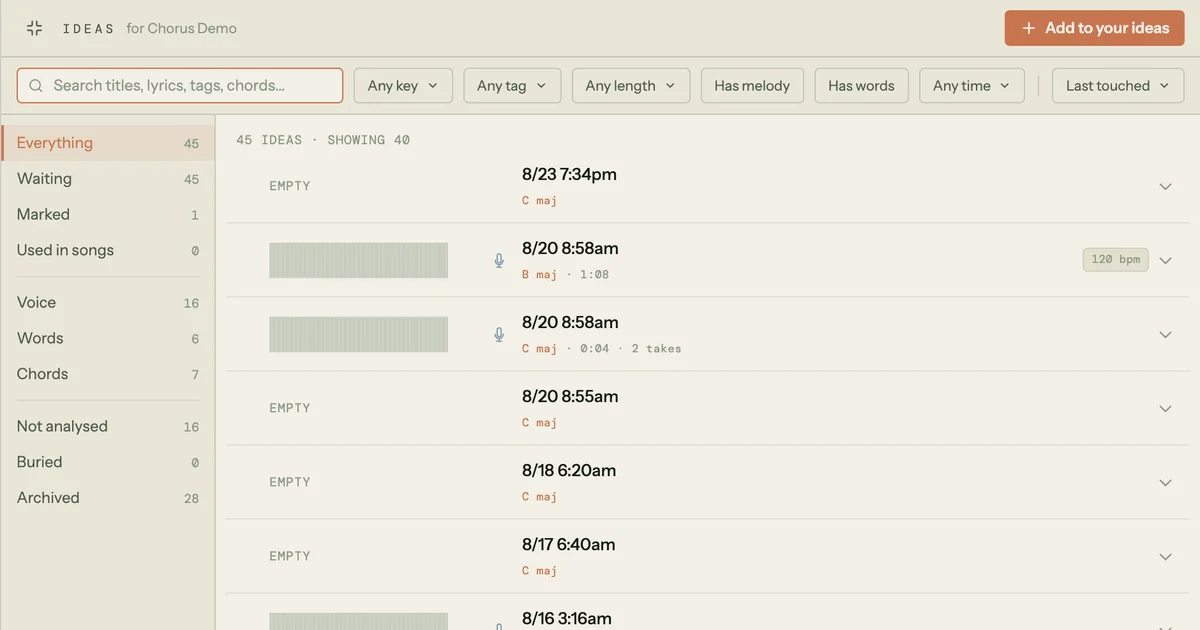
Note the shelves down the left, because one of them is this post's whole subject with a name on it. Buried counts the ideas that are still in your workspace, never went into a song, and have not been touched in six months. That is the backlog, computed rather than remembered. Archived is the shelf your archive decisions land on, out of the working list but restorable, which is exactly the cheap decision the research argues for.
What does the search actually read?
Search reads inside the lyrics, the section tags and the chord names, not just titles, and when the match is inside a lyric it prints the matching line underneath with the hit highlighted, so you can see why a result came back. Given that most captures are named with a timestamp, that is the whole difference. Alongside it you can narrow by key, by length on a histogram of how your recordings are distributed, by has a melody and has words, by the month it was captured, and by tags, where selecting several narrows to ideas wearing all of them. Filters compose. Sorting runs on last touched, newest, oldest, longest, shortest or title.
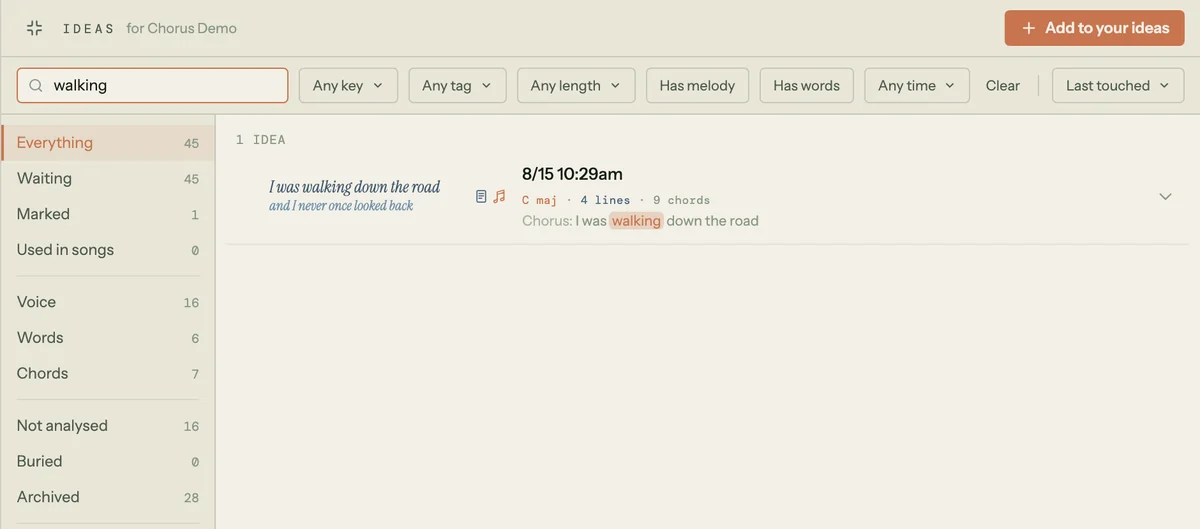
That is the whole retrieval argument in one screenshot. Forty-five captures named nothing but timestamps, one remembered word, one result, and the line that matched printed underneath so you can see why.
What this costs
Anything you import yourself is free and is never withheld: point Song Cage at your own folder, send recordings across with the QR code, or paste your own words, and that material shows up whether or not you buy a licence. What the licence pays for is different: the delivery of captures made in the Song Cage phone app to the Ideas inbox in the web app, which is a sync service with a running cost. Capture on the phone is free forever. If you are working a backlog that already exists on your computer or your phone's own recorder, the whole method above costs nothing.
The full chapter on all of this, including what happens when you drag an idea onto a song, is in the Ideas inbox documentation. If your backlog is more about where the next idea comes from than what to do with the last two hundred, how to come up with song ideas is the other end of the same problem, and how to harmonize a melody covers the step after a promoted hum, which is working out what goes underneath it.
One last thing worth saying plainly, because it is the half of the songwriting workflow nobody optimises. Every tool in this space, this one included, competes on how fast it can take an idea down. Speed of capture is a solved problem: your phone already does it in two seconds. What almost nothing is built for is the return journey six months later, and that asymmetry is why the folder grows. If you are still choosing tools on capture speed alone, our roundup of the best apps for capturing song ideas fast compares them on exactly that axis, and it is worth reading with this post's question in mind: what does each one give you on the day you go looking?
Make the pile searchable
Point Song Cage at the folder you have been avoiding. Your own imports are free, and they stay visible whether or not you buy a licence.
Frequently Asked Questions
How long should a voice memo triage session take?
Ninety minutes is enough for roughly two hundred recordings at fifteen seconds each, with time left for writing down the breadcrumb on the ones you promote. If your backlog is larger, do it in ninety-minute blocks oldest first rather than trying to clear it in one day. The session ends when the timer does, not when the folder is empty.
Should I delete old voice memos I will never use?
Archive them instead. Justin Berg's research found that creators systematically under-rank their own most promising initial idea, and that the idea people judged their second best tended to finish best, so the fragment you are least impressed by today is a live candidate later. Storage is cheap and the judgment is unreliable, which makes deleting the expensive choice.
Do unfinished songs really stay in your head?
The evidence says no. The claim traces to Bluma Zeigarnik's 1927 finding of a 90% recall advantage for interrupted tasks, but a 2025 meta-analysis pooling 37 publications found a ratio of 0.99, meaning no advantage at all. What does replicate is resumption: given the chance, people pick an interrupted task back up roughly two thirds of the time. So the fragment will not surface by itself, but you will probably act on it once something shows it to you.
What should I write down when I record a song idea?
Five things: the key or one note you are sure of, the capo position or tuning, which chord sits under which lyric line, what section you think it is, and one spoken sentence about what it is for. The tuning matters most for guitarists, because an alternate tuning that was never written down leaves you with a recording of music you can no longer play.
Can Song Cage import a whole folder of voice memos?
Yes. In the desktop app, Add to Ideas points at a folder and walks up to eight levels of subfolder, taking up to 5,000 files in one go, and it reads written notes in the same scan. In a browser it takes a drop or a file picker instead. Anything you import yourself stays visible whether or not you buy a licence. See the Ideas inbox documentation for the full list of formats and limits.
How do you find a specific melody in hundreds of recordings?
You cannot search audio directly, so the answer is to attach text to it. Manually that means the five-item breadcrumb above. In Song Cage the melody pass works out the notes and, where it is confident, the key, which makes filtering by key and length possible, and search reads inside lyrics, section tags and chord names rather than titles alone.