Table of Contents
- What is the difference between a songwriting prompt and a songwriting exercise?
- Why do most songwriting prompts skip the music?
- What do the musical prompts actually say?
- How long should a songwriting exercise take?
- Eight songwriting exercises that train a specific skill
- 1. The forbidden chord
- 2. Same four chords, new clock
- 3. Sing first, harmonize three ways
- 4. Range budget
- 5. The late downbeat
- 6. Borrow the groove, not the chords
- 7. The swap test
- 8. One line, twenty minutes
- What do the classic exercises actually teach?
- How do you know an exercise worked?
- Where does Song Cage fit?
- Frequently Asked Questions
Search for songwriting exercises and you will mostly get subjects. Write a song about the empty seat at the dinner table. Write a love song that never uses the word love. These are fine as a way in, and they are not practice. A guitarist who wanted to get better would not be handed a list of moods to play in. They would be given a drill with a name, a duration, and a thing it fixes.
This is a set of eight exercises built the second way. Each one sets a single constraint, trains one named skill, and tells you what to do for the next twenty minutes.
Quick Summary
A prompt gives you something to write about. An exercise gives you a constraint that trains a skill you can name. The songwriting-prompt genre is almost entirely the first kind, which is why it stops helping once you already have ideas.
What is the difference between a songwriting prompt and a songwriting exercise?
A prompt gives you a subject to write about. An exercise gives you a constraint that trains a specific skill, and you can say in advance what that skill is. "Write a song about your first car" is a prompt. "Write eight bars in which the chord your hands reach for first is banned" is an exercise, because the thing it trains is your harmonic reflex.
The distinction matters because the two solve different problems. A prompt solves a blank page, and if you are out of subjects a good list is genuinely useful.
An exercise solves something else: the fact that your songs keep coming out the same. No prompt fixes that, because the sameness is not in your subjects. It is in your defaults, and a subject does nothing to disturb them. You will write about a new thing in exactly your old way.
Almost no page ranking for either search makes this distinction out loud. Most use the two words interchangeably in the same paragraph.
Why do most songwriting prompts skip the music?
Because the genre grew out of lyric writing and never left. On the field's biggest list, The Song Foundry's 107 Song Prompts, only fourteen prompts begin from music at all. The rest name a subject, and even those fourteen hand you back to the lyric after a single word of musical instruction.
That list is the most complete in the field and organizes itself the right way, by starting point rather than by topic. Of its twelve categories, three are craft doors: 107 Song Prompts opens with Start with a Lyrical Hook, Start with a Melody and Start with a Groove. Eight name a subject. Fourteen of the 107 begin from music, five under melody and nine under groove.
What do the musical prompts actually say?
More telling is what those fourteen actually say. Four of the five melody prompts are the same sentence with one adjective swapped: write a perky melody, a simple melody, an expressive melody, a melancholy melody, each followed by "figure out a song story that fits it, then write that song." All five melody prompts and eight of the nine groove prompts end on that identical clause. The musical instruction is one word. Then it hands you back to the lyric.
That is the pattern across the genre, not one page's flaw. SongTown's 9-Minute Songwriter Workout is three timed drills, all lyric: dump titles, word-associate, hunt rhymes. It is a good routine, and it does not touch a chord.
The honest counterexample
Andrea Stolpe's 10 Quick & Creative Songwriting Exercises is the exception, and it is worth reading before this list. Seven of her ten are musical and several are time-boxed. A companion piece, 5 Exercises When You're Short On Time, has the cleanest constraint exercise in the field: pick three chords, then change only their order, tempo, meter and how many bars each one gets. It can be done. It just mostly is not.
How long should a songwriting exercise take?
Ten to twenty minutes, done daily rather than in long occasional sittings. That is the dose that turns songwriting practice into something that changes your writing, because what you are altering is a reflex, and reflexes move under repetition rather than under effort.
The one number worth copying comes from Pat Pattison at Berklee, whose object writing is the most durable songwriting exercise anyone has published. Berklee's faculty page quotes him plainly: "It's a 10-minute writing exercise you do every morning." In Songwriting Without Boundaries he adds the part people skip, which is the dose: ten minutes a day for at least six weeks.
He is also strict about the stop. Set a timer, and when it goes, stop mid-word if that is where you are. The interruption is the mechanism, not an inconvenience.
Ten to twenty minutes is the right size for everything below. Long enough to get past your first instinct, short enough that a failed attempt costs nothing. Clay Mills runs his workout at three minutes per drill. February Album Writing Month, running since 2004, sets fourteen songs in twenty-eight days, which works out to about the same pressure spread over a month.
Eight songwriting exercises that train a specific skill
Each one names the skill, the constraint, and what a finished attempt looks like. Several have a lineage, and it is credited. Do them badly on purpose the first time.
| # | Exercise | The constraint | What it trains |
|---|---|---|---|
| 1 | The forbidden chord | Ban the chord your hands reach for first, for eight bars | Breaking a harmonic reflex |
| 2 | Same four chords, new clock | Freeze one four-chord loop; change only how long each chord lasts | Hearing harmonic rhythm as its own parameter |
| 3 | Sing first, harmonize three ways | Sing eight bars with no instrument, then harmonize it three ways | Melody that is not dictated by your chord shapes |
| 4 | Range budget | Five distinct pitches in the verse, exactly two new ones in the chorus | Saving your best notes for the moment that needs them |
| 5 | The late downbeat | No vocal phrase begins on beat one, and none picks up into a downbeat | Back-heavy phrasing |
| 6 | Borrow the groove, not the chords | Transcribe only a song's timing skeleton, then write onto it | Separating timing from harmony |
| 7 | The swap test | Write two verses to one melody, then swap their order | Making the second verse carry new information |
| 8 | One line, twenty minutes | One real sentence, sung every way you can find, for twenty minutes | Prosody |
Every exercise runs in ten to twenty minutes and needs nothing but your instrument and a timer.
1. The forbidden chord
Skill: breaking a harmonic reflex. Before you play anything, write down the chord your hands go to first in your usual key. That chord is banned for the next eight bars. Not deprioritized, banned.
Write the eight bars. Then, once you have something, put the forbidden chord back in exactly one place and listen to what it does now that it has to earn its spot.
The reflex is the target, not the chord. This is a close relative of Ethan Hein's "Avoid the Tonic" from the NYU Music Experience Design Lab's compositional prompts, a set he published and invites anyone to reuse. The difference is that his constraint is theoretical (a named scale degree) and this one is personal (whatever you, specifically, always reach for). Yours is probably not the tonic. It is more likely the one chord you use to get out of trouble.
2. Same four chords, new clock
Skill: hearing harmonic rhythm as its own parameter. Pick a four-chord loop. You may not change a single chord for the next twenty minutes. You may only change how long each one lasts.
Make five versions. Even bars. One chord held for half the loop. A version where the third chord never lands on a downbeat. A version in three. A version where two chords go by in the time the first one took.
What you will hear is that whichever chord you give the most time to starts to sound like home, whatever the theory says. Stolpe teaches the borrowed-progression version of this and puts the emphasis in the same place, telling writers to focus "much more on the harmonic rhythm and your groove than the chords themselves." If this one lands, why your chord progressions sound boring goes further into it.
3. Sing first, harmonize three ways
Skill: writing a melody that is not dictated by your chord shapes. Put the instrument down. Sing eight bars and record them on your phone. No instrument in your hands, because the instrument is what makes your melodies come out the same.
Only then pick it up, and harmonize the recording three separate times: once using only plain triads from the key, once where the sung note is deliberately the seventh or ninth of the chord underneath it in at least two places, and once over a single held bass note.
Three harmonizations of one melody teaches more in twenty minutes than three new melodies. Stolpe's exercise five is the front half of this ("spend no time at all determining a chord progression, and simply begin to sing"); the three-pass structure is the part worth adding. How to harmonize a melody covers the mechanics.
4. Range budget
Skill: saving your best notes for the moment that needs them. The verse melody may use exactly five distinct pitches. The chorus may add exactly two, and those two must be the only new notes anywhere in the song.
The narrow-verse, wide-chorus idea is standard craft advice, and two people put real numbers on it. Writing for iZotope, David Bawiec frames it as a contrast rule: "If your verse is limited to 3 notes, try to expand the melody in the chorus to span a larger range (try 5, 6, 7 notes)." Clay Mills at SongTown gives the verse side as an instruction: "purposely limit yourself to a three- or four-note melody range in your verse", while cheerfully noting he does not mean on every song. The hard budget is what turns the principle into an exercise. Five and two, counted, with nothing new in the bridge.
Gary Ewer's two-note melody challenge supplies the best tightening, and it is his, not mine: reserve one pitch to be used exactly once in the whole song. As he puts it, the interesting question becomes where you spend it. See also how to write a melody.
5. The late downbeat
Skill: back-heavy phrasing. Write a chorus in which no vocal phrase begins on beat one, and no phrase picks up into a downbeat either. Beat two and the "and" of two are the clearest ways in.
The second half of that rule is the one that catches people. Starting on the "and" of four feels late, but it is a pickup into the downbeat, and Pattison's definition is explicit that phrases which "pick up to the downbeat" are front-heavy: the weight still lands on beat one. Back-heavy means the phrase starts after the downbeat and stays there, and as he puts it, the later it starts the less stable it feels. Front-heavy and back-heavy phrasing is taught in Berklee Online's graduate course Songwriting Tools and Techniques, co-authored by Scarlet Keys and Pat Pattison.
Front-heavy phrasing is stable and declarative. Back-heavy phrasing leans forward and pulls the listener with it. Most writers only own one of the two and never notice. If the words fight the beat, fitting lyrics to a melody is the companion piece.
6. Borrow the groove, not the chords
Skill: separating timing from harmony. Take a song you love and transcribe only its timing skeleton onto blank paper. Where the chords change. Where the vocal enters and stops. How many bars each section runs. No pitches, no chord names, nothing you could hum.
Now write your own song onto that skeleton, using your own chords.
Everyone has borrowed a progression. Almost nobody borrows the clock, which is often the thing that actually made the song feel the way it did. Stolpe does the mirror image of this, lifting a progression and then changing its rhythm: "hawk a chord progression from a song you know and slow the tempo way down. As you play, change the harmonic rhythm as feels natural." She also notes, on harmonic progressions for songwriters, that "harmonic progressions are not copyrightable". A page of timings with no pitches on it is further from the source still.
7. The swap test
Skill: making the second verse carry new information. Before writing a word, write two sentences: what verse one knows, and what verse two knows that verse one did not. Then write both verses to the same melody.
Now physically swap them. Sing verse two first. If the song works in either order, verse two is not doing its job, and no amount of better lines will fix it, because the problem is that nothing happened between them.
This failure is old enough to have a name that predates every blog on this subject. "Second Verse Curse (a.k.a. Second Verse Hell)" is a named subsection in John Braheny's The Craft and Business of Songwriting, sitting between First Lines and Rhyme. Marty Dodson's fix is to write a one-sentence plan for every section before the lyric exists, which is exactly the two sentences above.
8. One line, twenty minutes
Skill: prosody, by exhaustion. Pick one sentence you would genuinely say out loud to a real person today. That sentence is the only lyric you are allowed for twenty minutes.
Sing it every way you can find. Start it in four different places in the bar. Stretch one syllable across two beats, then across four. Put the stressed syllable on the downbeat, then deliberately off it. Change nothing about the words.
You will find two or three settings that make a plain sentence sound inevitable and a dozen that make it sound like it is being read aloud. That gap is prosody, and it is invisible on the page, which is why lyric-only exercises cannot teach it.
What do the classic exercises actually teach?
Three exercises have outlasted everything else in this field, and they survive for the same reason: each one removes a decision rather than adding a subject.
Object writing (Pattison, chapter one of Writing Better Lyrics, 1995) is timed, sense-bound writing across seven senses, including two most people never think to use: the organic sense, meaning your awareness of what your body is doing inside, and the kinesthetic sense, meaning your sense of your own relation to the world around you. It trains detail, and Gillian Welch, asked what mattered most from her time at Berklee, answered "object writing, no question." The book is still the one I'd give a lyricist, and it's on our list of gifts for songwriters.
Oblique Strategies (Brian Eno and Peter Schmidt, first printed January 1975 in a signed and numbered edition of 500) removes the studio default. Eno's rationale was not mystical: under pressure, he said, you forget there were other ways of working. On Bowie's "Sense of Doubt", the two each drew a card, kept it secret from the other, and took turns overdubbing to their own instruction.
Fourteen songs in twenty-eight days (FAWM, founded 2004) removes the option to keep polishing. Only a title is required to post. More than a quarter of a million songs have been written under it.
How do you know an exercise worked?
Not by whether you got a good song. Judge an exercise by whether you can name what changed: your reflex chord, where your chorus actually peaks, whether verse two carries new information. Most attempts produce something you never use, and that is the point.
Most of these will produce a throwaway, which is also why they are hard to keep doing. Judge them on whether you can say what changed. After the forbidden chord, you should be able to name your reflex, which you probably could not do before. After the range budget, you should know where your chorus actually peaks. After the swap test, you either have a second verse that earns its place or a diagnosis you can act on.
The best classic exercise ends in an artifact rather than a feeling. Berklee's destination-writing lesson finishes by sorting what you wrote into external and internal detail and calling the result "your word library for the song you are writing." Do the same here: keep the five pacing versions, keep the three harmonizations, and label them. A failed attempt you can still find in a month is worth more than a good one you did not save.
Where does Song Cage fit?
Song Cage is a songwriting workspace, and the reason it suits constraint exercises is that it responds while you work rather than handing you a list.
When there is a melody in a section, the chord suggestions are ranked against that melody and against the chords on either side of the slot, including across a section boundary. Change the melody and the order changes. Change the chord before it and the order changes again. Every chord is labelled by its role in the key, which is music theory for songwriters in the only form that helps mid-write: visible at the moment you are choosing, rather than looked up afterwards.
Which controls do these exercises actually use
- Sing first, harmonize three ways: the Fits Melody strip has a Support / Color / Reharm dial. Support favours the melody note as a chord tone, Color allows it to sit as a seventh or ninth, and Reharm opens up chromatic options. Flip it mid-audition and the same slot replays.
- The forbidden chord: arrow through the ranked suggestions with live audition and take the second one. There is no ban toggle, though replacing an existing chord does drop it from the list.
- Same four chords, new clock: drag a chord block's edge, or drag the boundary between two chords so one shortens as the other lengthens. Do this by hand, not with Auto Chords.
- Range budget and the late downbeat: hold a note and sing it, or play it in, then nudge notes by scale degree.
- The swap test: a new section tagged Verse names itself Verse 2, and its first chord is ranked against the last chord of the verse above it. Loop either section from its header while you compare.
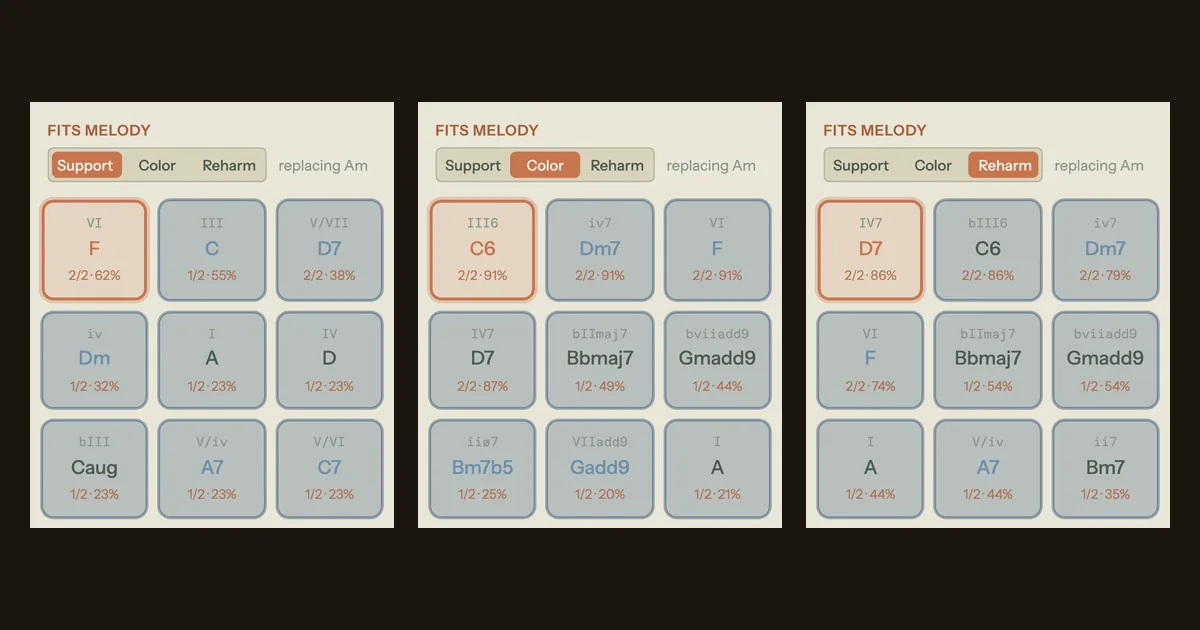
The three panels above are one slot in one song, photographed at each setting of that dial. Support puts plain triads on top, Color promotes sixths and sevenths, and Reharm reaches for borrowed and chromatic options. Same melody, three different answers, which is exercise three in a single screen.
Two honest limits. Setting a per-section key relabels that section, it does not move the notes into the new key; moving a song for real is a separate choice on the key chip. And nothing in the writing flow generates lyrics, titles, subjects or melodies. There is no prompt button, and there is not going to be one. Melody capture transcribes what you sang; it does not invent it. For an exercise practice that is the correct trade, because the whole value is in what your own defaults do when you take one of them away.
The full loop lives on desktop and web. The phone is for capture, including holding a word and singing its pitch, and those notes travel to the desktop with the idea. See how to come up with song ideas for the capture side, or the sections and the grid chapter for the section controls above.
Try one of these in the next twenty minutes
Open a section, put a melody in it, and flip the role dial three times. That is exercise three, start to finish.
Frequently Asked Questions
What is the difference between a songwriting prompt and a songwriting exercise?
A prompt gives you a subject ("write about a letter you never sent"). An exercise sets a constraint and trains a skill you can name in advance, like harmonic reflex or back-heavy phrasing. Prompts solve a blank page. Exercises solve songs that keep coming out the same.
How often should you do songwriting exercises?
Daily, in small doses. Pat Pattison prescribes ten minutes every morning for at least six weeks for object writing, and Clay Mills runs a nine-minute workout as three three-minute drills. Short and daily beats long and occasional, because the thing you are changing is a reflex.
What is object writing?
Pat Pattison's timed, sense-bound writing exercise, introduced in chapter one of Writing Better Lyrics in 1995. You write for ten minutes about one object using seven senses, including the organic sense (your awareness of what your body is doing inside) and the kinesthetic sense (your sense of your own relation to the world around you). You stop the instant the timer goes: in his words, "don't even finish the word you're in the middle of."
Do songwriting exercises work if you already write songs?
They work better. Beginners benefit most from prompts, because the problem is starting. Experienced writers have the opposite problem: strong defaults that make every song sound related. A constraint that removes one default is the only reliable way to hear what that default was doing.
What are Oblique Strategies?
A deck of instruction cards created by Brian Eno and Peter Schmidt, first printed in January 1975 in a signed and numbered edition of 500, subtitled "Over One Hundred Worthwhile Dilemmas". Each card carries one oblique instruction. Eno used them with David Bowie during the "Heroes" sessions, where the two drew cards privately and overdubbed to their own separate instructions.
Can an app give me songwriting exercises?
Song Cage does not generate exercises, prompts, lyrics or melodies, by design. What a workspace can do is make a constraint cheap to run: rank chords against the melody you actually sang, label each one by its role, loop a section while you compare versions, and keep the failed attempts next to the good one.