Table of Contents
- What counts as a song idea?
- Where do song ideas actually come from?
- 1. Start from a title
- 2. Try object writing
- 3. Write from a found phrase
- 4. Set a constraint
- 5. Write from a life
- 6. Start from music, not words
- What makes a strong song title?
- How do you turn an idea into lyrics?
- The step everyone skips: capture it before it's gone
- From spark to finished song
- Are song idea generators worth it?
- How do you build a weekly idea habit?
- Where Song Cage fits
- Frequently Asked Questions
Most songwriters do not have an idea problem. They have a losing problem. The spark that would have become your best song arrived while you were driving, or half asleep, or walking to the bus, and by the time you sat down to write, it was gone. This guide covers the whole loop: six reliable ways to find song ideas, how real hits actually started, and how to capture every spark before it fades so more of them become finished songs.
Quick summary
Ideas are cheap. Captured, developed ideas become songs. Here is the short version.
What counts as a song idea?
A song idea is any seed you can build a song on: a title, a single hook line, a hummed melody, a two-chord loop, an overheard phrase, one image, or a feeling. It does not have to be a topic or a finished thought. Most hits grew from something small and half-formed.
The seed can be almost nothing. "Lucy in the Sky with Diamonds" took its title from a nursery-school drawing John Lennon's three-year-old son Julian brought home and described in that exact phrase. Lennon did not sit down to write about anything: a child handed him six words and the song grew around them.
So stop waiting for a fully-formed concept. A stray line, a shape you hummed in the shower, or a phrase your friend said at dinner all qualify. The skill is not summoning big ideas on command. It is noticing the small ones and keeping them.
Where do song ideas actually come from?
Ideas feel like luck, but working songwriters run repeatable methods that make luck happen on schedule. Below are six that reliably produce raw material. None require inspiration to strike first. You can sit down cold, pick one, and have something to build on inside ten minutes. The verified origins after each method show the same tools at work in songs you already know.

1. Start from a title
Title-first writing means you begin with a short, catchy phrase and let it become the song's thesis. Every line then has to point back to it. This is the default approach in Nashville because the title usually lands in the chorus, so nailing it early keeps the whole song aimed at one target.
A strong title often pairs a concrete noun with a verb and hides a small turn or surprise. Test each line by asking whether it earns the title.
Adele built "Rolling in the Deep" (2011) this way. She adapted a British slang expression, "roll deep," meaning to always have someone who has your back, then reshaped it into the title phrase and wrote the whole song toward that feeling of a loyalty that turned out to be false. The title came first; the song chased it.
2. Try object writing
Object writing is timed, sense-bound freewriting: pick one concrete object, set a ten-minute timer, and describe it through every sense without stopping or editing. Songwriting teacher Pat Pattison, who named the technique at Berklee, counts seven senses: sight, sound, smell, taste, touch, organic (your inner body), and kinesthetic (motion).
You are not writing a song. You are mining raw, specific images to fish through later, and training the sensory muscle that keeps lyrics from going abstract.
Sometimes the object itself is the spark. Bob Dylan wrote "Mr. Tambourine Man" (1965) after session guitarist Bruce Langhorne showed up with a giant Turkish frame drum, "as big as a wagon wheel," as Dylan later put it. The instrument stuck in his mind and became the song's central figure.
3. Write from a found phrase
A found phrase is a striking line you overhear or stumble on, then reverse-engineer into a song. Move through the day with what writers call songwriter ears, collect the odd thing someone says, and ask what story and character would make that line true.
The world hands out titles for free. R.E.M.'s "Losing My Religion" (1991) takes its name from a Southern American idiom that has nothing to do with faith: it means being at the end of your rope, pushed past politeness into frustration. The White Stripes' "Seven Nation Army" (2003) came from Jack White's childhood mispronunciation of "Salvation Army," which he first used just as a working title to remember the riff. Keep a running list of overheard lines and you will never face a truly blank page.
4. Set a constraint
A constraint is a rule you impose before you write: one location, second-person point of view, no adjectives, a forbidden word, or a hard time limit. Removing options forces you off autopilot and toward fresher choices, which is why limitation reliably boosts originality instead of killing it.
The blank page is paralyzing because it offers infinite directions. A cage gives you edges to push against.
Try this recipe cold: write a breakup song set entirely in a parked car, in the second person, without using the words "love," "heart," or "cry." The restrictions do the creative work, steering you around the clichés your brain reaches for first. Constraints are also how volume challenges function: a month-long deadline is just a constraint that manufactures output when motivation will not.
5. Write from a life
The most durable ideas come from a real life, whether yours or a character's. Relive one specific moment, not the whole saga, then write down the raw feelings before shaping them. Because a song is about emotional truth more than fact, you can change details freely to reach something universal.
Dolly Parton's "Jolene" (1973) fused two real encounters: a red-haired bank teller who flirted with her new husband, and the name of a young red-haired fan she met at an autograph line. She kept the name and borrowed the threat.
You can also write as someone else. Plain White T's frontman Tom Higgenson met runner Delilah DiCrescenzo, told her he already had a song about her (he did not), and after she turned him down wrote "Hey There Delilah" about a long-distance relationship that existed only in his head. The song, a number-one hit in 2007, grew from a real spark and an imagined story.
6. Start from music, not words
You do not have to start with a topic. Begin from a groove, a riff, a chord loop, or a hummed melody and let the sound suggest the mood and eventually the words. Sing gibberish or placeholder lyrics until real ones arrive. The one rule: capture the musical feeling immediately, before it evaporates.
Paul McCartney woke with the entire melody of "Yesterday" (1965) fully formed from a dream. He held a placeholder lyric, "Scrambled Eggs," for weeks while he checked he had not accidentally stolen the tune from someone else. Jimi Hendrix built "Purple Haze" (1967) out of a dream he described as walking under the sea. Melodies and moods are ideas too, and they are the most fragile kind: hum it into something the moment it lands, or lose it.
What makes a strong song title?
The best titles are short, say something, and carry a hook of image, emotion, or surprise. A working test: say it out loud, check that it is not already a famous song, and make sure it points at a real feeling rather than a vague one.
Titles can come from anywhere in the room. The Police's "Roxanne" (1978) took its name from a Cyrano de Bergerac poster hanging in the seedy Paris hotel where Sting was staying, with the street scene below feeding the song. A little contradiction sells even harder: "Every Breath You Take" (1983) sounds like a tender love song and is actually a study of jealous, possessive surveillance, which is exactly why it lodges in your head.
| Title format | Why it works | Example |
|---|---|---|
| Hook phrase | A line the chorus can lean on | Rolling in the Deep |
| Image and emotion | A picture plus a feeling in one | Purple Haze |
| Contradiction | Two ideas that should not sit together | Every Breath You Take |
| Time or place | Roots the song in a world | Africa |
| Single word | A name or object you cannot forget | Jolene, Roxanne |
How do you turn an idea into lyrics?
Turn a spark into lines by locking one emotional thesis first: a single sentence that says what the song is really about. Choose two or three concrete images to carry it, and draft the hook before the verses so everything you write can aim at it.
The image matters more than the essay. Toto's David Paich had never set foot in Africa when he wrote "Africa" (1982). He assembled it from late-night documentaries, National Geographic magazines, and a childhood memory of missionary teachers, then hung the whole song on one line about blessing the rains. One vivid image, repeated, did the work.
When a line will not come, do not stall on it. Leave a placeholder and keep moving, or reach for a rhyme or a sharper synonym and return later. If you want the mechanics of prosody and rhyme, our guide on how to write song lyrics goes deeper than there is room for here.
The step everyone skips: capture it before it's gone
The real reason songwriters feel out of ideas is not scarcity. It is that sparks pile up unlabeled in voice memos and note apps and never become songs. This is the voice-memo graveyard, and escaping it is the single highest-leverage habit in songwriting: capture the idea the moment it arrives, in whatever form it arrived.
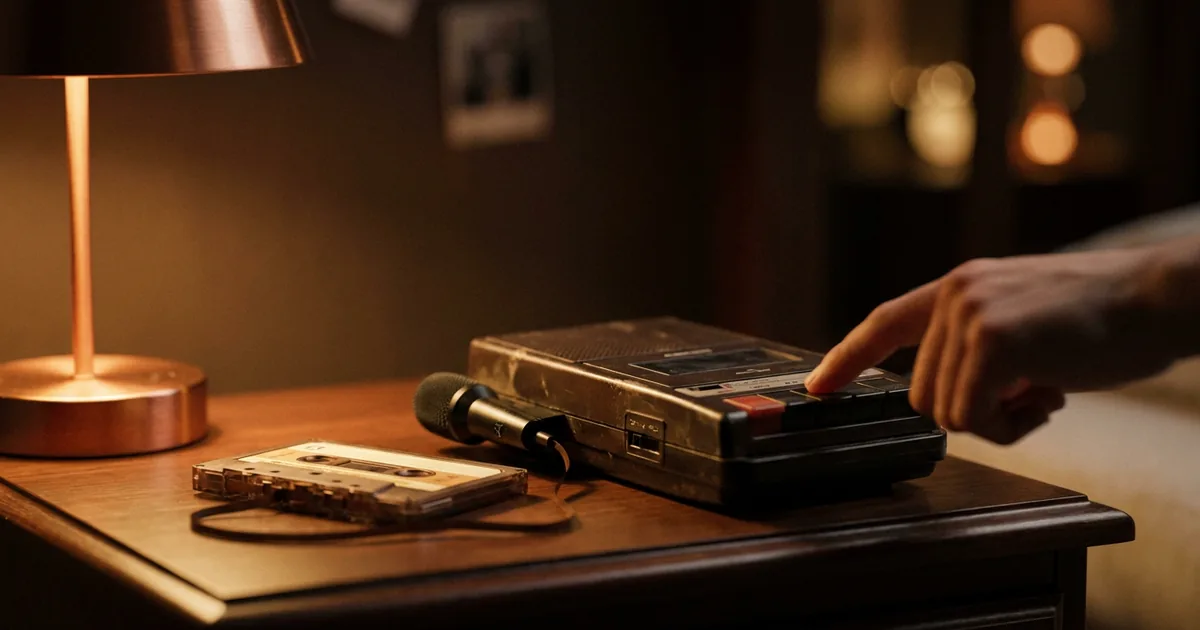
The most famous riff in rock exists because someone captured it in his sleep. Keith Richards woke in the night in 1965 with the "(I Can't Get No) Satisfaction" riff and title line in his head, recorded about thirty seconds onto a cassette player by the bed, and fell back asleep. The tape held the riff followed by roughly forty minutes of his own snoring. Had he trusted his memory until morning, one of the biggest songs of the decade would have evaporated. Your ideas deserve the same reflex. For a survey of tools, see our roundup of the best apps for capturing song ideas fast.
From spark to finished song
Capturing is half the job. Developing is the other half, and it is where most ideas stall. To finish, reverse-outline the fragment you caught, lock the emotional thesis, build contrast between sections so the chorus lifts, then bank the leftovers for the next song.
A captured hum is not a song yet, but it is a start you can return to. Give it structure: decide what the verse sets up and what the chorus pays off, and keep the two musically distinct. If you are unsure how the pieces fit, our guide to song structure maps verse, chorus, and bridge. For the whole order, from the title to a recorded first song, see how to write a song.
This is also where tools earn their keep, as long as they work on your idea and not for you. In Song Cage, once a section has a melody you hummed, Auto Chords suggests a progression ranked against your actual notes, and the Words panel surfaces rhymes and synonyms when you are stuck on a line. You supply the spark; the workspace helps you shape it.
Are song idea generators worth it?
AI song idea generators and prompt lists are useful for one thing: breaking a blank page. They can jolt you out of a rut. Their limit is that they invent a disposable concept with nowhere to live and no return path, and the idea is not yours, so it rarely carries the emotional truth that makes a song land.
Notice that the "generated-sounding" titles usually came from real life, not software. "Smells Like Teen Spirit" (1991) was graffiti a friend, Kathleen Hanna, scrawled on Kurt Cobain's wall, referencing a deodorant brand he did not recognize. No generator produces that.
So use a prompt to get unstuck, then get back to your own material fast. The durable win is not a better generator: it is a reliable habit of capturing and developing the ideas that are already yours. That is the deliberate stance behind Song Cage, which is built to start anywhere and capture your idea, not to write one for you.
How do you build a weekly idea habit?
Make ideas a practice, not an emergency. Forage on purpose, capture without judgment, and develop on a schedule so your idea bank stays full. When capturing becomes a reflex, "what should I write about" stops being a question you dread.
Keep a daily journal of specific people, places, and honest feelings; it doubles as a stockpile you can flip through later. Move through the world with songwriter ears and save every overheard line. And when you feel dry, borrow a deadline. Volume challenges like February Album Writing Month (14 songs in 28 days) and its summer sibling 50/90 (50 songs across 90 days) prove the well does not run dry when you silence the inner editor and just produce.
The songwriters who never run out are not more gifted. They forage and capture constantly, so there is always raw material waiting when it is time to write.
Where Song Cage fits
Song Cage is a songwriting app built around the two moves this guide keeps returning to: capture the idea before it fades, then develop it. Open it and put down whatever arrived first, a hummed melody, a lyric line, or a chord you just found, with no setup and no required order. Ideas captured on your phone sync to the desktop Idea Inbox, where you can search them, and turn a rough capture into a real song. It will not invent an idea for you, and that is the point. The spark is yours; Song Cage keeps it from getting lost and helps you finish it.
Capture your next song idea before it's gone
Song Cage keeps the hum, the words, and the chords of a spark together, from first idea to finished song.
Frequently Asked Questions
How do songwriters come up with ideas?
Working songwriters use repeatable methods rather than waiting for inspiration: starting from a title, timed sense-based object writing, found phrases they overhear, self-imposed constraints, mining their own life, and starting from a melody or groove instead of words. The common thread is that they capture the spark immediately, then develop it, instead of relying on memory.
What should I write a song about when I have no ideas?
Pick one small, true thing rather than a big theme. Relive a single specific moment from your week, describe one object through every sense for ten minutes, or write toward a phrase you overheard. Dolly Parton built "Jolene" from a flirtatious bank teller and a fan's name. Narrow beats broad: one concrete moment gives a song its shape.
What makes a good song idea?
A good song idea is small, specific, and points at a real feeling. It can be a title, a hook line, a hummed melody, an image, or a single word. It does not need to be a complete concept. "Lucy in the Sky with Diamonds" grew from six words on a child's drawing. The test is whether it makes you want to keep writing.
Where do song titles come from?
Titles come from overheard phrases, slang, place names, posters, and small contradictions. The Police's "Roxanne" came from a Cyrano de Bergerac poster in a Paris hotel. Keep titles short, say them out loud, and favor a concrete image or a small surprise. A strong title states what the song is really about and gives every line a target.
How do I stop forgetting my song ideas?
Capture the idea the moment it arrives, in the form it arrived, then keep captures in one place you actually return to. Most ideas die scattered across voice memos and note apps, the voice-memo graveyard. Keith Richards caught the "Satisfaction" riff on a bedside cassette in his sleep. Build the same reflex: record the hum, jot the line, and label it so you can find it later.
Are AI song idea generators any good?
They are good for breaking a blank page and little else. A generator hands you a disposable concept with nowhere to live and no emotional truth behind it, because the idea is not yours. Use one to get unstuck, then return to your own material. A reliable habit of capturing and developing your own sparks beats any generator over time.