Table of Contents
- What is the Dorian mode?
- What does the Dorian scale sound like?
- How do you find any Dorian scale?
- How do you play the Dorian mode on guitar and piano?
- What chords are in the Dorian mode?
- What is a Dorian chord progression?
- What songs are in Dorian mode?
- Why do people disagree about which songs are Dorian?
- How do hit songs actually use Dorian?
- Do hit songs stay in Dorian the whole way through?
- How do you write a song in Dorian mode?
- Start on i and get to the major IV fast
- Put the 6th in the melody, and hold it
- Keep the IV from going to ♭VII
- Use Dorian for a section, and natural minor for another
- How is Dorian different from natural minor and harmonic minor?
- Where does the name Dorian come from?
- How do you write in Dorian in Song Cage?
- Frequently Asked Questions
Play an A minor chord, then a D major. That second chord shouldn't be there. A minor's own IV chord is D minor, and the F♯ inside D major is a note the key doesn't have. Yet the move sounds warm rather than wrong, and it runs through records from "Venus" in 1969 to "Get Lucky" in 2013. That F♯ is the Dorian mode.
Most guides teach Dorian as a scale to run up and down. Songwriters mostly meet it as that one chord. In our own count of 92 minor-key songs from the Billboard Hot 100, the major IV turned up in nearly half and filled more bars than the minor iv the key is supposed to own. Below: the notes, the chords, the songs, what those hits show, and how to write in the mode without it sliding back into plain minor or into the major key it shares notes with.
Quick Summary
The Dorian mode is a minor scale with a raised 6th: 1, 2, ♭3, 4, 5, 6, ♭7. D Dorian is the white keys from D to D. The raised 6th turns the iv chord major, so a minor song with a major IV (Am to D) is the Dorian sound. In Song Cage's count of minor-key Hot 100 songs from 1958 to 1991, most of the songs that used that IV also used natural minor's chords, so it works as a color inside ordinary minor.
What is the Dorian mode?
The Dorian mode is a seven-note minor scale with a raised 6th. Its formula is 1, 2, ♭3, 4, 5, 6, ♭7, and its step pattern is whole, half, whole, whole, whole, half, whole. On a piano it's the white keys from D to D. It sounds minor, but brighter and less settled than natural minor.
Compare it with natural minor on the same root. A natural minor is A, B, C, D, E, F, G. A Dorian is A, B, C, D, E, F♯, G. One note moves, the 6th, up a half step from F to F♯. Everything that makes Dorian sound like Dorian comes from that note, so a lot of musicians just call it "minor with a major 6th."
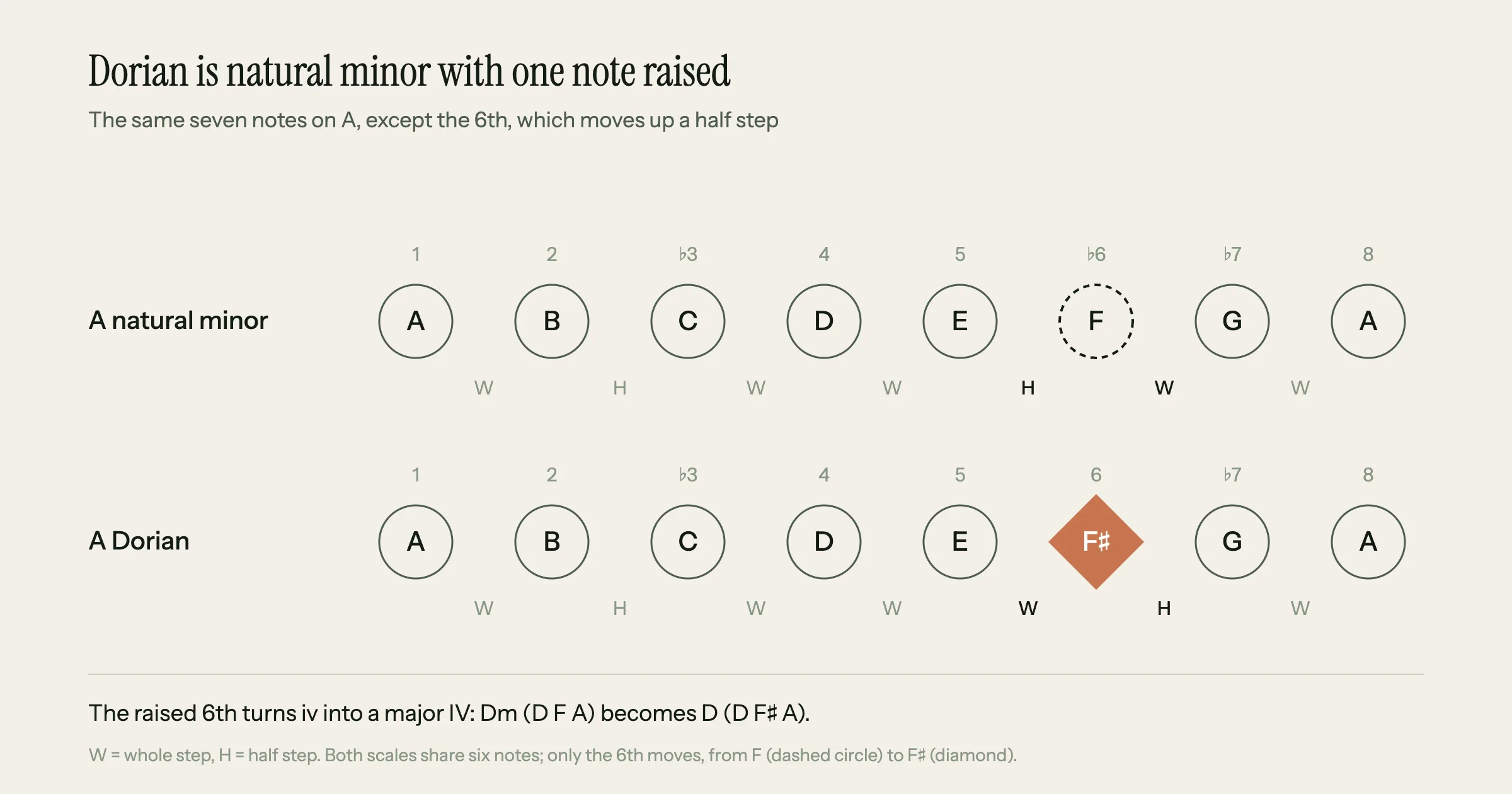
There are two ways to find it, and both give the same scale. The first is to take a natural minor scale and raise its 6th. The second is to play a major scale starting on its 2nd note: D Dorian uses the notes of C major, A Dorian uses the notes of G major. Because of that, A Dorian has the key signature of G major (one sharp), even though its home chord is A minor.
The step pattern reads the same forwards and backwards, which makes Dorian the one symmetric mode of the seven. If you know our guide to musical modes, Dorian sits one step brighter than Aeolian (natural minor) and one step darker than Mixolydian.
What does the Dorian scale sound like?
The 6th is the note a melody passes through on its way from the 5th up to the 7th or the octave. In natural minor that note is a half step above the 5th, and it leans down onto it with a heavy, sighing pull. In Dorian it's a whole step above, so the melody can sit on it without the weight. The result is minor at the root and lighter on top: cool, wistful, a bit hopeful.
You can hear both sixths back to back in "Eleanor Rigby." The Beatles' melody is in the Dorian mode, according to Alan W. Pollack's analysis, and in the refrain ("All the lonely people") an inner voice falls D, C♯, C, B, one note a bar, while the harmony moves from E minor through an implied A major to C. The C♯ is the Dorian 6th and the C the Aeolian one. Pollack hears that inner line as a "saddened, sighing gesture." The Dorian note brightens it for a bar, and the natural-minor note takes the brightness away.
How do you find any Dorian scale?
Take the major scale a whole step below your home note and play it from your home note. E Dorian uses D major's notes, B Dorian uses A major's, G Dorian uses F major's. Or take the natural minor scale on your home note and raise the 6th a half step.
Here are the Dorian scales songwriters reach for most, with the parent major scale and the note that makes each one Dorian:
| Dorian scale | Notes | Same notes as | Raised 6th (natural minor has) |
|---|---|---|---|
| D Dorian | D E F G A B C | C major | B (B♭) |
| E Dorian | E F♯ G A B C♯ D | D major | C♯ (C) |
| F♯ Dorian | F♯ G♯ A B C♯ D♯ E | E major | D♯ (D) |
| G Dorian | G A B♭ C D E F | F major | E (E♭) |
| A Dorian | A B C D E F♯ G | G major | F♯ (F) |
| B Dorian | B C♯ D E F♯ G♯ A | A major | G♯ (G) |
| C Dorian | C D E♭ F G A B♭ | B♭ major | A (A♭) |
Each Dorian scale shares its notes with the major scale a whole step below. The last column is the note that separates it from natural minor.
How do you play the Dorian mode on guitar and piano?
On piano, start with D Dorian: every white key from D to D, no black keys. For any other root, play the major scale a whole step down but treat your root as home, or play natural minor and raise the 6th.
On guitar, start from the minor pentatonic box you already know and add two notes: the 2nd and the major 6th. In A, the pentatonic at the 5th fret gives you A, C, D, E and G. Add B and F♯. The F♯ sits at the 7th fret of the B string and the 4th fret of the D string. Then play it over an A minor vamp. The F♯ is the note to lean on, because it's the one that tells the listener this isn't plain A minor. If it sounds no different from natural minor, you're probably skipping the 6th.
What chords are in the Dorian mode?
Building a chord on each note of Dorian gives i, ii, ♭III, IV, v, vi° and ♭VII. In A Dorian that's Am, Bm, C, D, Em, F♯° and G. Three of them hold the raised 6th: ii, IV and vi°. The major IV is the one that does the most work, because a minor key's own iv is minor.
| Degree | Triad | In A Dorian | In D Dorian | As a 7th chord (A) |
|---|---|---|---|---|
| i | minor | Am | Dm | Am7 |
| ii | minor | Bm | Em | Bm7 |
| ♭III | major | C | F | Cmaj7 |
| IV | major | D | G | D7 |
| v | minor | Em | Am | Em7 |
| vi° | diminished | F♯° | B° | F♯m7♭5 |
| ♭VII | major | G | C | Gmaj7 |
As triads, the ii, IV and vi° chords contain the raised 6th (F♯ in A Dorian, B in D Dorian) and the other four are shared with natural minor. As 7th chords, ♭VII becomes Gmaj7, which holds the F♯ too.
Two details matter when you write. First, the IV's 7th chord is a dominant 7th (D7: D, F♯, A, C), which is why Dorian vamps so often sound bluesy or funky. Santana's "Oye Como Va" rocks between Am7 and D9. Second, the v chord is minor. Dorian has no leading tone, so there's no major V pulling you home. A Dorian song comes back to i because you keep putting i on the strong bars, not because a dominant demands it.
What is a Dorian chord progression?
Any progression that sits on a minor i and uses the major IV (or the minor ii) reads as Dorian. The most common shapes in real songs:
- i–IV, the two-chord vamp. "Oye Como Va" (Am7 to D9) and the verse of "Venus" (Em to A).
- i–♭VII–IV, three chords falling then lifting. "Wicked Game" (Bm, A, E) and the verse of "White Wedding" (the same three chords, Bm, A, E).
- i–ii, the quiet version. "Moondance" shuttles between Am7 and Bm7, and the F♯ in Bm7 is the Dorian 6th.
- i–♭III–♭VII–IV, a four-chord loop. The Michael Andrews and Gary Jules cover of "Mad World" runs Fm, A♭, E♭, B♭.
- i–♭III–v–IV. "Get Lucky" loops Bm, D, F♯m, E.
Notice where the IV sits: last, or right before i. That placement keeps it pointing home. The minor chord progressions guide covers the rest of the chords a minor key can borrow.
What songs are in Dorian mode?
Well-known songs in Dorian include "Scarborough Fair," Miles Davis's "So What," "Oye Como Va," "Eleanor Rigby," "Venus," "Moondance," "Wicked Game," "Mad World" and Daft Punk's "Get Lucky." Each one sits on a minor home chord and uses the raised 6th, usually through a major IV chord.
| Song | Artist, year | Chords | Where the Dorian 6th is |
|---|---|---|---|
| "Scarborough Fair" | Traditional; Simon & Garfunkel, 1966 | Melody-led | The tune itself, one of the Dorian melodies the ballad was sung to |
| "So What" | Miles Davis, 1959 | Dm7, then E♭m7 | The whole piece: 16 bars of D Dorian, 8 of E♭ Dorian, 8 of D Dorian |
| "Oye Como Va" | Tito Puente, 1962; Santana, 1970 | Am7–D9 | F♯ in the D9 |
| "Eleanor Rigby" | The Beatles, 1966 | Em, C | C♯ in the melody and the refrain's falling inner line |
| "Venus" | Shocking Blue, 1969; Bananarama, 1986 | Em–A (verse) | C♯ in the A chord |
| "Moondance" | Van Morrison, 1970 | Am7–Bm7 | F♯ in the Bm7 |
| "White Wedding" | Billy Idol, 1982 | Bm–A–E (verse) | G♯ in the E |
| "Wicked Game" | Chris Isaak, 1989 | Bm–A–E | G♯ in the E |
| "Mad World" | Tears for Fears, 1982; Michael Andrews and Gary Jules cover | Fm–A♭–E♭–B♭ (cover) | D in the B♭ |
| "Get Lucky" | Daft Punk, 2013 | Bm–D–F♯m–E | G♯ in the E |
Years are first release. Chords are in the key of the recording we checked: Bananarama's for "Venus" and the Michael Andrews and Gary Jules cover for "Mad World."
Sources: So What, Scarborough Fair, Oye Cómo Va, Eleanor Rigby, Moondance, Wicked Game, Mad World, Get Lucky, Venus, White Wedding. The chords for "Venus" and "White Wedding" are read from the McGill Billboard transcriptions described below.
Why do people disagree about which songs are Dorian?
Because a loop that never cadences lets the listener choose where home is. Hooktheory files "Get Lucky" under B Dorian. Owen Pallett, writing about the same song in Slate, heard F♯ minor most of the time, with the Bm only creating "the aural illusion" of Dorian. (He wrote it out in white-key names, A minor and D minor, and noted that the record is really in F♯.) Same four chords; different home. "Wicked Game" splits the same way: Hooktheory calls it B Dorian, while Music Theory Alchemy calls it B minor with an E major borrowed from B major.
Both readings describe the same notes, so neither is wrong. What decides the label is which chord feels like the place the song rests, and that's a question about rhythm and emphasis as much as harmony. When you write in Dorian, that's useful to know. The mode is never guaranteed by the notes alone. You hold it in place by where you put the i chord. Our guide to telling what key a song is in walks through how to hear home when the chords are ambiguous.
How do hit songs actually use Dorian?
Mostly as one chord inside ordinary minor. In Song Cage's count of 92 minor-key Hot 100 songs from 1958 to 1991, 47% used a major IV, and it filled 6.9% of the bars that carry a major or minor chord, more than the minor iv (5.1%). But only 8 of the 92 used it while avoiding both the minor iv and ♭VI.
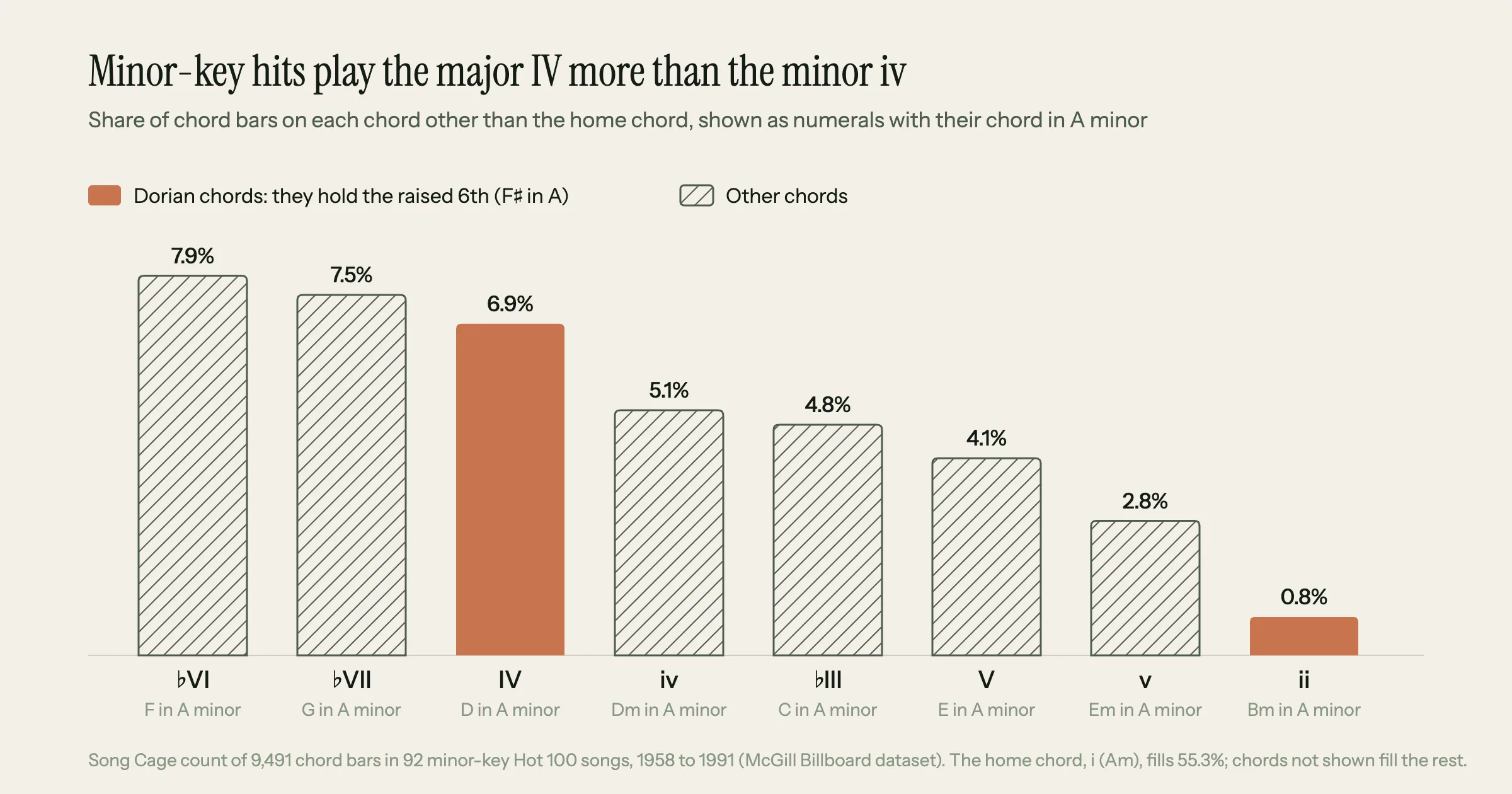
We read every minor-key song in the McGill Billboard dataset and counted which chords each one used, relative to its home chord:
| Chord | In A minor | Songs using it (of 92) | Share of chord bars |
|---|---|---|---|
| i | Am | 92 (100%) | 55.3% |
| ♭VI | F | 63 (68%) | 7.9% |
| ♭VII | G | 61 (66%) | 7.5% |
| ♭III | C | 53 (58%) | 4.8% |
| iv (minor) | Dm | 47 (51%) | 5.1% |
| IV (major, Dorian) | D | 43 (47%) | 6.9% |
| V (major) | E | 42 (46%) | 4.1% |
| v (minor) | Em | 31 (34%) | 2.8% |
| ii (minor, Dorian) | Bm | 11 (12%) | 0.8% |
Song Cage's count of 92 minor-key songs from the McGill Billboard dataset. A song counts if it uses the chord at least once. "Chord bars" are the 9,491 bars that carry a major or minor chord; a bar with two chords is split between them by beats.
Two things stand out. The major IV, the chord that isn't in the key, filled more bars than the minor iv that is. Of the 69 songs that used any IV chord, the major one outweighed the minor in 31.
Second, the major IV rarely came alone. 33 of the 43 songs that used it also used ♭VI, the chord built on natural minor's lowered 6th. Bananarama's "Venus" is a clean example: its verse rocks between Em and A6 (the Dorian 6th, C♯), and its chorus opens on Am7, the minor iv with the natural-minor C. Hooktheory files the verse as E Dorian and the chorus as E minor. Two sixths, one song.
Do hit songs stay in Dorian the whole way through?
Rarely. Only 8 of the 92 used a major IV and never touched the minor iv or ♭VI. Billy Idol's "White Wedding" is one: its verse is Bm, A, E, and neither the minor iv nor ♭VI ever appears. For a songwriter, that means Dorian works as a chord you add to a minor song for a section or a lift, as well as a scale for a whole song. The idea is the same one behind borrowed chords, aimed at a minor key.
How we counted
The McGill Billboard dataset is a set of expert chord transcriptions of songs sampled from across the Billboard Hot 100 between 1958 and 1991, described by Burgoyne, Wild and Fujinaga at ISMIR 2011. After removing repeats, we could read chords from 736 songs. We called a song minor-key when its most-played chord was a minor chord on the tonic the annotators marked, tracking key changes line by line. 92 songs qualified. Chords were read by root and quality (major or minor third) relative to that tonic.
Chords without a full triad (power chords, suspended chords, bare bass notes and bass-plus-interval shorthand) are left out. Songs the annotators marked on a major tonic, even when they lean on its relative minor, are not counted as minor-key, so the 92 is a cautious count.
How do you write a song in Dorian mode?
Set up a minor home chord, bring in the major IV early, and keep returning to i on strong beats. Put the raised 6th into the melody, ideally held over the i chord. Avoid a major V chord, and avoid letting IV move straight to ♭VII, which pulls the song toward the major key it shares notes with (G major for A Dorian).
Start on i and get to the major IV fast
The IV is the chord that announces Dorian, so let the listener hear it in the first few bars. A two-chord vamp (Am to D, two bars each) is enough to set the mode for a whole verse. Keep i on the downbeat of each phrase, and end phrases on it. If the song opens on IV or lingers there, the ear may start hearing IV as home instead, which is how a D-to-Am loop can drift into sounding like D major with a minor v.
Put the 6th in the melody, and hold it
The chords can carry Dorian on their own, but a melody that lands on the 6th makes it unmistakable. In A Dorian, sing F♯ over the A minor chord and hold it. Together they make an Am6 sound, the signature color of the mode. Over the D chord the F♯ is just the chord's third, so it blends in. Over i it stands out. "Eleanor Rigby" sets its Dorian color against a held E in the same way.
Keep the IV from going to ♭VII
In A Dorian, D to G is a V to I in G major. Play that move often and the song stops being in A Dorian and becomes a song in G that happens to start on Am. Songs that keep their Dorian color while using both chords tend to put ♭VII before IV, as "Wicked Game" does (Bm, A, E), and then go back to i. The same caution applies to a major V (E major in A): its G♯ belongs to harmonic minor, and a strong V–i cadence pulls the song back to ordinary minor. A minor v (Em) keeps the mode intact.
Use Dorian for a section, and natural minor for another
The Billboard numbers say most minor-key songs mix the two sixths. Use that as a structural tool. Write the verse over i and IV, then switch the chorus to i, ♭VI and ♭VII, or the other way round. The change of a single note between sections gives the chorus a different color without a key change, the way "Venus" moves from the verse's A6 to the chorus's Am7.
How is Dorian different from natural minor and harmonic minor?
All three have a minor 3rd. Natural minor (Aeolian) has a ♭6 and ♭7. Dorian raises the 6th. Harmonic minor keeps the ♭6 but raises the 7th. Each change creates a signature chord: the major IV in Dorian, the ♭VI in natural minor and the major V in harmonic minor.
| Scale | Notes in A | 6th | 7th | Signature chord |
|---|---|---|---|---|
| Natural minor (Aeolian) | A B C D E F G | ♭6 (F) | ♭7 (G) | ♭VI (F major) |
| Dorian | A B C D E F♯ G | 6 (F♯) | ♭7 (G) | IV (D major) |
| Harmonic minor | A B C D E F G♯ | ♭6 (F) | 7 (G♯) | V (E major) |
| Melodic minor (rising) | A B C D E F♯ G♯ | 6 (F♯) | 7 (G♯) | IV and V both major |
The four minor scales on A. Rising melodic minor is Dorian with a raised 7th.
In practice, songwriters move between them inside one song, and the Billboard count above shows it. The harmonic minor scale guide explains where that raised 7th goes and why classical minor relies on it. Dorian is the choice when you want a minor song without the drama of the leading tone or the heaviness of the ♭6. That's also why it suits a groove: a funk vamp can sit on i for minutes without needing to resolve anywhere.
Where does the name Dorian come from?
The name is ancient Greek, after the Dorian Greeks, but the scale isn't. According to Wikipedia's summary of the New Grove Dictionary, the Greek Dorian octave, in its diatonic form, matched the white keys from E to E, which is the pattern we now call Phrygian. Medieval chant theorists borrowed the Greek names in the 9th century and attached them to their own system, where the Dorian was the mode with its final on D. That medieval Dorian could still take a B♭ "by licence," so it wasn't fixed.
The modern Dorian mode is stricter: the white keys from D to D, or the same pattern on any root. The Russian composer Mily Balakirev called it the "Russian minor." Its afterlife is mostly in folk tunes, chant, modal jazz from "So What" on, and pop records that never name it. Nobody needs the history to write in it, but it explains why old textbooks and new ones sometimes disagree about what "Dorian" means.
How do you write in Dorian in Song Cage?
Song Cage keys are major or minor, so set the song to the minor key of your home note, A minor for A Dorian. The Dorian chords are then one tab away. The Borrowed tab of the chord palette lists the chords a minor key borrows, and in A minor that includes D major and B minor, the two Dorian chords. They carry a small ionian label because Song Cage borrows them from A major, which has the same F♯.
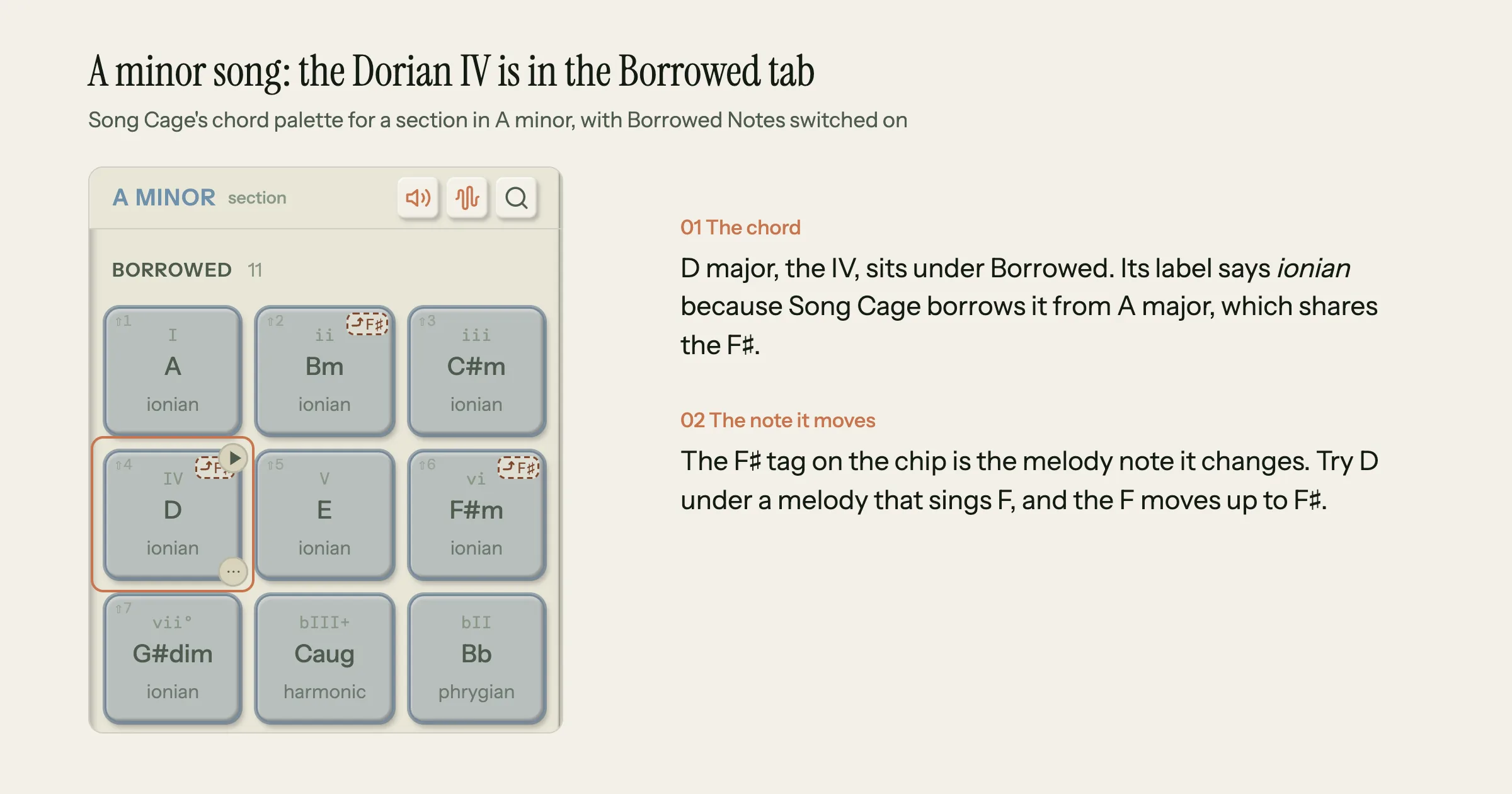
If you hum or play the melody in first, Fits Melody ranks chords against the notes you sang, borrowed ones included, so a melody that already holds the F♯ can bring D up as a fit. The reverse case is covered too. Switch on Borrowed Notes (Settings, under Input) and try D major under a melody that sings F: the chip shows a tag with F♯ before you click, and trying it moves that one note up a half step, as long as the note is held or moves on by step. Keep it and the chord and the moved note go in as one undo. The Borrowed Notes docs list the full rules.
Frequently Asked Questions
Is the Dorian mode major or minor?
Minor. Its 3rd is minor, so the chord on its home note is a minor chord. What sets it apart from natural minor is the raised 6th, which makes the IV chord major and gives Dorian a lighter sound than other minor scales.
What is the difference between Dorian and minor?
One note. Natural minor has a ♭6 and Dorian has a natural 6. In A, that's F against F♯. The change turns the iv chord (Dm) into a major IV (D) and the ii° chord (B°) into a minor ii (Bm).
What is D Dorian?
The Dorian mode starting on D: D, E, F, G, A, B, C. It's every white key on the piano from D to D, the same notes as C major with D treated as home. Its raised 6th is B, where D natural minor has B♭.
What key signature does A Dorian use?
One sharp, F♯, the key signature of G major, because A Dorian uses the notes of G major starting on A. Some charts use A minor's key signature instead and add the F♯ as an accidental.
Is Dorian a happy or a sad mode?
Neither, quite. It has a minor home chord, so it doesn't sound happy the way major does, but the raised 6th takes the weight off natural minor. Songs in it tend to sound cool, wistful or groove-led, like "Moondance" or "Oye Como Va," rather than tragic.
What is the most famous song in Dorian mode?
In jazz, Miles Davis's "So What" from Kind of Blue (1959), which is built on D Dorian and E♭ Dorian. In folk, "Scarborough Fair." In pop, "Get Lucky," "Wicked Game," "Venus" and "Mad World" are often-cited examples.
Capture the minor idea before it's gone
Song Cage keeps your melody, chords and words together in one place. Sing the tune in, set the key, and reach the major IV from the Borrowed tab while the idea is still fresh.