Ellie Goulding was about 15 when she managed it. "I'd managed to start singing and playing guitar at the same time," she told BBC Newsbeat in 2009. "It was a really hard thing for me to do. It's kind of like rubbing your head and your belly at the same time."
If you've tried it, you know the moment. You can play the chords. You can sing the song. Then you open your mouth and the strumming hand stops, or it starts copying the rhythm of the words. Both problems come from the same two places: the strum still needs your attention, and you don't yet know where each word lands against it. Fix those two things, in that order, and the rest follows.
Quick Summary
To sing and play guitar at the same time, get the strumming hand on autopilot first, so it keeps going while you talk. Then speak the words in rhythm over the strum, mark the syllables that land on beat 1 and where the chords change, hum the melody over it, and only then sing. Keep the guitar part simpler than the vocal, and let your foot keep the beat.
How do you sing and play guitar at the same time?
Learn the guitar part until it runs without you, then add the voice in layers. Speak the words over the strum, mark the syllables that land on the beat and where the chords change, hum the melody over it, then sing. Work slowly with a metronome, one section at a time, and tap your foot on the beat.
The order matters more than the amount of practice. Each step adds one new thing to a hand that can already cope with the last one, and when a step falls apart you only go back one rung, for the line that broke. The first song takes the longest. The strum you build for it carries over, so the next song with the same pattern mostly needs its words lined up.
The method on one card
- Pick a song with a few chords and a steady strum.
- Play the guitar part until you can talk over it for two minutes without the hand changing.
- Speak the words in rhythm over the strum. No pitch yet.
- Mark the syllable on beat 1 of each bar and the one where each chord changes.
- Hum the melody over the strum, then sing the words.
- Start slow, tap your foot, and speed up a few BPM at a time.
- Where a line won't go, simplify the strum under it.
Why is it so hard to sing and play guitar at the same time?
Both jobs want your attention, and a beginner's strum still needs all of it. Paul Fitts and Michael Posner described learning a movement in three stages: cognitive, where you think through every part, associative, where it smooths out, and autonomous, where it runs by itself. Until the strum reaches that third stage, singing takes the attention it was running on.
Fitts and Posner set the stages out in their 1967 book Human Performance. As a PLOS Biology summary puts it, in the first stage "large parts of the movement are controlled consciously", and by the third the movement "is largely controlled automatically."
Strumming follows the same path. On day one you watch the pick, count out loud and think "down, down-up". A sung line asks for attention too: the next word, the pitch, the breath. When both draw on the same supply, one of them falters. For most beginners it's the strumming hand that gives out.
So the first rule is to leave the voice out until the guitar part can run without you. Test it. Play the part and hold a conversation, count backwards from 100 or describe the room out loud. If the hand stops or changes, it isn't ready yet, and a melody will stop it again.
Should your voice or your hand carry the rhythm?
Your voice. In a 2022 study of 60 people, rhythm-and-beat tasks went better when the voice carried the rhythm and a hand or foot kept the beat than the other way round. Singing over a strum fits that easy arrangement only while the hand's part stays simple. A busy strum is a second rhythm, which the study didn't test.
Beginners feel this as the strumming hand copying the words. "At first you might find that your hands really want to do the same thing as your voice!" Stringkick's guide warns. The research explains which way round the jobs should go.
The study is "Coordination of voice, hands and feet in rhythm and beat performance" by Signe Hagner Mårup, Cecilie Møller and Peter Vuust, published in Scientific Reports in 2022. Its sixty right-handed participants (professional musicians, amateurs and non-musicians) performed short rhythms while keeping the beat, in 12 combinations of voice, hands and feet. The results ranked the body in five levels: left foot at the bottom, then right foot, left hand, right hand, and the voice at the top. Rhythm was more precise when it went to the higher level and the beat to the lower one, and the ranking held in all three groups. With the voice keeping the beat under a rhythm in the hands, the authors found the task "strikingly difficult."
Nobody in the study held a guitar: they tapped, clapped and vocalized. Read it as a direction, not a rule for strumming. The direction is useful, though. Let the voice lead, give the hand a part simpler than the vocal, and hand the beat to your feet, the bottom of the ranking.
How do you get your strumming on autopilot?
Play the guitar part until you stop thinking about it, then prove it with a distraction. Use the simplest strum the song will take, even one downstroke per beat, at a slow tempo with a metronome. When you can talk, count backwards or describe the room without the hand changing, it's on autopilot.
Four downstrokes a bar is a real accompaniment, and it's plenty to sing over. A fancier pattern can come back once the song works. Play the whole progression, chord changes included, because the change is where a strum usually breaks. A pattern that's perfect on one chord can stumble every time the fretting hand has to move.
Then add the distraction and see what survives. The distraction is the test and the practice at once: talking over a strum is the same skill as singing over one, with easier words and no pitch. Start with something you don't have to think about, like counting or reciting the alphabet, then move to something you do, like describing what you can see. When the hand keeps its pattern through a real sentence, it's ready for a lyric.
Should you watch your hand while you strum?
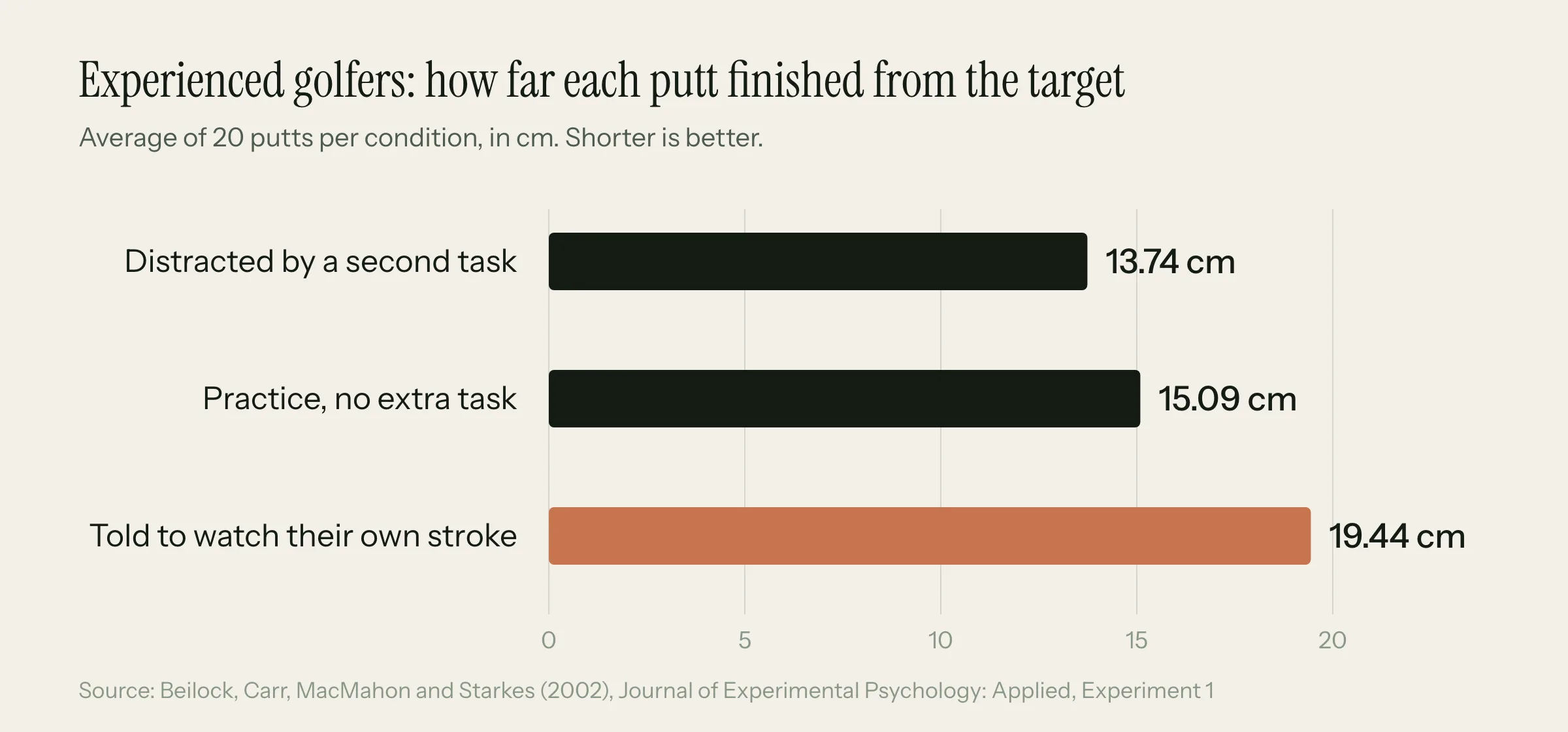
While you're learning the strum, yes. Once it's learned, look away. In Sian Beilock's 2002 experiments, experienced golfers putted worse when told to attend to their stroke step by step than when distracted by a second task: their putts finished 19.4 cm from the target on average, against 13.7 cm.
That's Beilock, Carr, MacMahon and Starkes, in the Journal of Experimental Psychology: Applied. Their second experiment ran soccer players through a slalom course. Novices dribbled better when told to attend to their foot, whichever foot they used. Experienced players did better distracted with their stronger right foot, and better attending with their weaker left one. The authors' conclusion: step-by-step attention helps a skill that isn't learned yet and harms one that is.
On guitar, both can be true in the same song. The strum on G and C may be learned while the change to D7 isn't. Watch and drill the part that isn't, on its own, until it runs. Then stop watching. Staring at a strumming hand that already knows its pattern is the experienced golfer told to watch the putter stop, and the putt gets worse.
How do you line up the words with the strum?
Speak the words in rhythm over the strum before you sing them. Strum slowly, say the lyric as if you were reading it to the beat, and notice which syllables land on a stroke and which fall between. Then mark the syllable on beat 1 of each bar and the one where each chord changes.
Speaking takes pitch out of the problem and leaves the timing, which is the part that fights the hand. Write the lyric out with each chord name over the exact syllable where it changes, and underline the syllables on beat 1. Those are your anchors. If the hand and the voice meet there, the rest of the bar fills in around them.
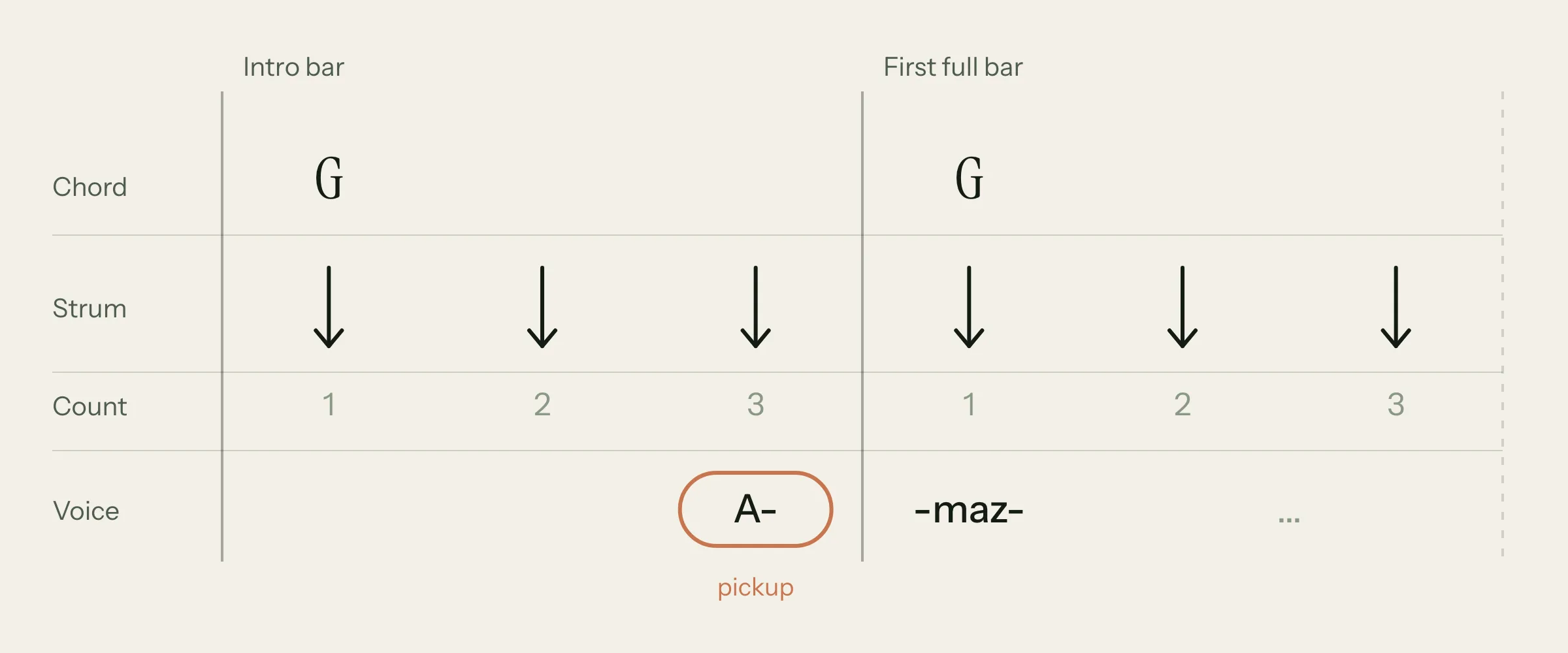
Amazing Grace is a good first map. It's in 3/4, and its first syllable comes early: the "A-" of "Amazing" is a pickup, one note before the first full bar. Strum a bar of G as an intro, sing "A-" on beat three of that bar without stopping the hand, and the next G lands on "-maz-". The lines that start on "That", "I" and "Was" are pickups too (the chords and where they fall). Happy Birthday does the same with two notes: "Hap-py" comes first and the first full chord lands on "birth-" (chords and notes).
What do you do when a word comes in before the chord?
Keep the hand going and let the word ride over it. A pickup belongs to the end of the bar before, so the strum you're already playing carries it. The mistake is stopping the hand to wait for the voice, which turns the start of every line into a restart.
Lines that open on a small word ("and", "I", "the") often start before the beat. Practice the join as a unit: the last two strokes of one line, the pickup, and the downbeat of the next. If the next chord starts on that downbeat, change on the downbeat, not on the pickup. Your fretting hand can leave the old chord during the last stroke of the bar and let the open strings ring for a moment, which buys the time a beginner's change needs.
A pickup is also where the two parts most often drift apart, because it's the one moment the voice moves before the hand does. Count it out loud the first few times ("one, two, A-", with "A-" on three), then just think it.
What about lines that are sung off the beat?
Those are the hardest, because the voice lands between the strokes on purpose. Under a syncopated line, strum only on the beats, or hit the chord once and let it ring, and bring the full pattern back for the lines that sit on the beat. The vocal keeps its push, and the hand has less to defend.
A syncopated line puts its stressed syllables on the "and" or ahead of the bar line. That's exactly where a hand that copies the voice will follow it, and the strum loses its shape. Giving the hand the simplest possible job under that line, one stroke per beat, keeps it in the beat-keeping role the Mårup study found easier for a hand while the voice carries the rhythm.
Work it the same way as everything else, slower. Speak the line over plain downstrokes and listen for which syllables fall between them. Say those syllables a little louder so you can feel the gap. When the line holds, add the upstrokes back one at a time and stop at the first one that breaks it. The finished part might keep a simpler strum under that line for good, which is fine. Plenty of players play less under the busiest words.
When should you start singing the melody?
When you can speak the whole section over the strum without the hand changing. Then hum the melody or sing it on "la" over the strum, so pitch is the only new thing. Add the words last. If the hand stops at any step, go back one step, for that line only.
Each step adds one thing: words, then pitch, then words and pitch together. Slow the metronome for every new step and bring it back up a few BPM at a time. Work a section at a time, and start with the hardest one rather than the first verse, or the first verse gets all the practice.
Tap your foot on the beat the whole time. In the Mårup ranking the feet sit lowest, the natural beat-keepers, and the paper points to earlier work showing that foot-tapping and nodding help people find the beat in a complex rhythm.
Record a take on your phone at the end of each session and listen back with the guitar down. You'll hear where the strum faltered far more clearly than you can feel it while you're singing. Once a song holds together, rehearse it the way you'll play it, standing and at full voice, which is also how memorizing the lyrics sticks.
Why is it harder to sing and play your own songs?
Nobody has worked out the guitar part for the voice yet. A cover comes with an arrangement a singer already plays and sings. Your strum and your melody may have been made separately, on different days, and nothing guarantees they fit. If a line won't go after real practice, the arrangement may be the problem.
Plenty of songs start as a melody hummed into a phone with no guitar at all, or as a chord loop strummed for an hour before any words existed. When the two meet, the strum you fell into while writing can fight the vocal: a stroke on every eighth under the wordiest line, a busy pattern where a long note wants space. "The main rule of accompaniment is to avoid overpowering the voice and lyrics of a song," as Acoustic Guitar's 2023 guide puts it. Under a busy line, play less. Under a held note, the guitar has room to move.
Check the key too. A chorus that sits at the top of your range takes effort the hand needed, and a song in the wrong key for your voice is harder to sing and play than to sing alone. A capo moves the key without changing a single chord shape.
How can Song Cage help you practice singing and playing?
Song Cage plays your song back with the chords strummed and the melody sung on its words, so you can split the job in two. Mute the melody and strum along with the chords. Mute the chords and play your guitar under the sung melody. Then mute both and do the whole thing yourself.
In Song Cage the chords sit over the syllables where they change, which is the marked-up lyric from earlier without the pencil. Press play and the chords sound in the rhythm pattern you pick in Settings, under Rhythm: Folk Strum, a two-bar campfire pattern whose first bar goes down, down-up, up-down-up; Waltz Strum, three downstrokes a bar for 3/4 songs; or Single Strum, one stroke per chord. Once you've put the melody in (sing a take and Detect melody turns it into notes), the default melody voice, Singer, sings each note on its own syllable of your lyric.
That gives you a ladder with one new thing per rung:
- Mute the Melody track and play along with the strum until your hand runs on its own.
- Unmute the melody, mute the Chords track, and play your guitar under the Singer. Your hand practices holding its pattern while words land on top of it.
- Mute both, turn on the metronome, and sing and play yourself.
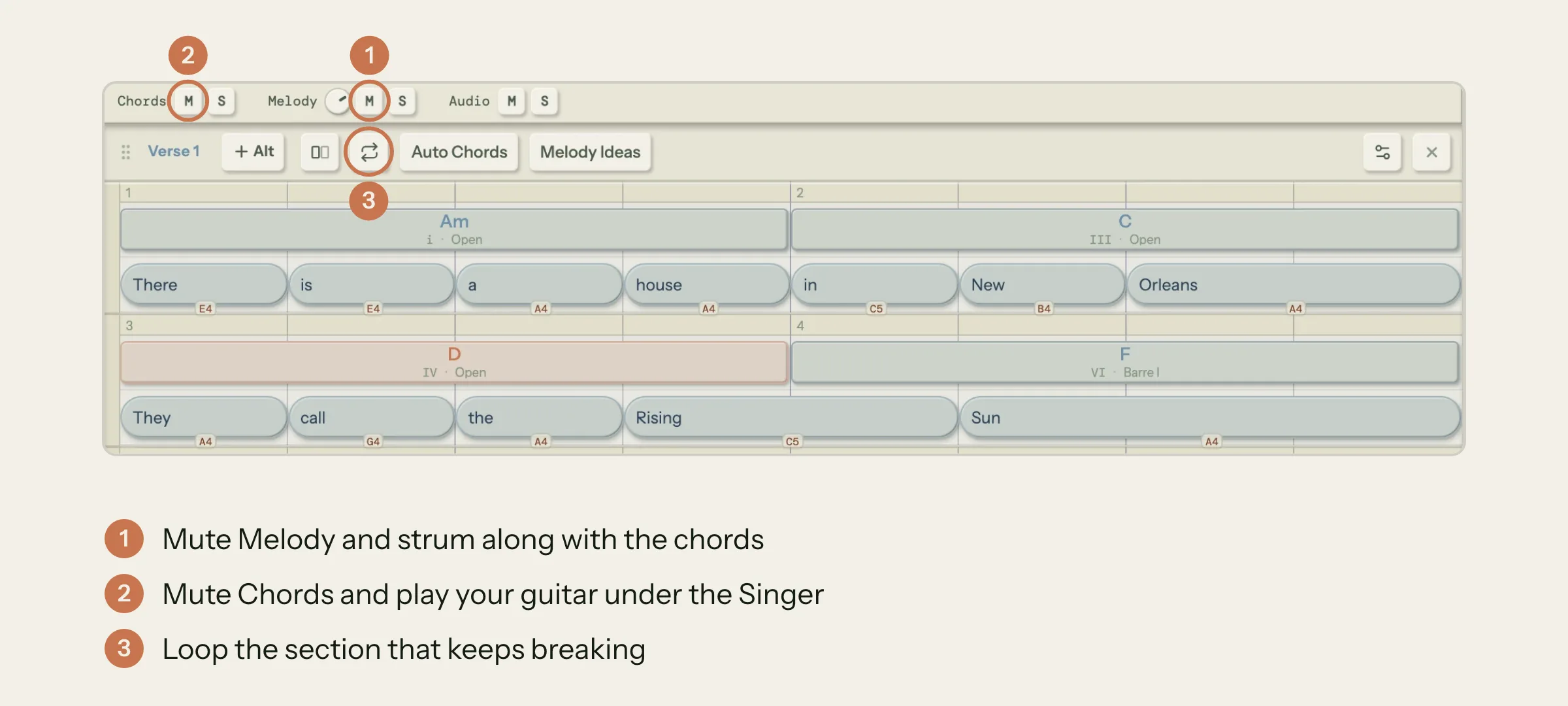
Drag the tempo down to start (it changes while the song plays), loop the section that keeps breaking with the loop button on its header, and press Space to hear the same phrase again from the same spot. The playback chapter of the docs covers every setting.
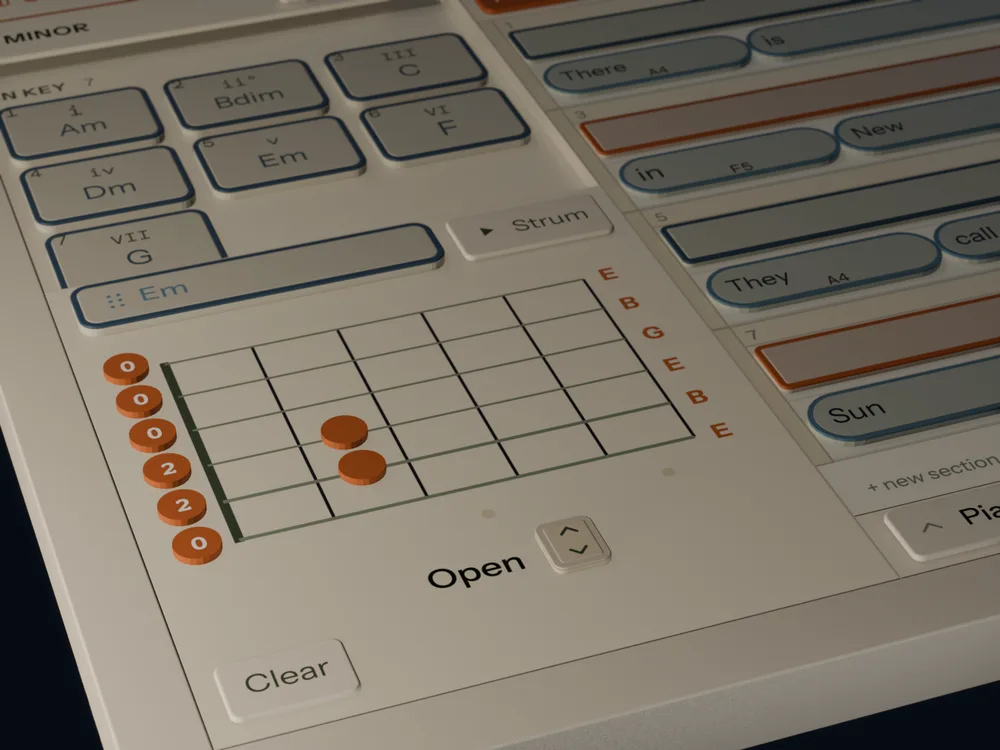
Practice the voice and the guitar one at a time
Song Cage plays your song back with the chords strummed under the words and the melody sung on them. Mute one part, play or sing the other, loop the line that breaks, and bring the tempo up when it holds.
Frequently Asked Questions
How long does it take to learn to sing and play guitar at the same time?
It depends mostly on how automatic your strumming is when you start. Ellie Goulding called it "a really hard thing" when she learned as a teenager, and Thomas Rhett told Guitar World in 2015 that learning to sing and play "took me a little while, but once I did, it was a pretty natural process." The first song is the slowest. Once a strum pattern runs on its own, the next song that uses it mostly needs its words lined up.
Why does my strumming stop when I start singing?
Because the strum still needs your attention, and singing takes it. Until a movement is automatic it runs on conscious control, so the hand stalls the moment your attention moves to the words. Test the strum by talking over it, counting backwards or describing the room. If the hand stops for that, it will stop for a song, so keep drilling the guitar part alone first.
What are easy songs to sing and play on guitar?
Songs with a few chords, a steady strum and words that land on the beat. Amazing Grace and Happy Birthday both use G, C and D7 in the key of G, and both are in 3/4 with a pickup at the start, which is good practice for coming in before the chord. Play three downstrokes a bar and keep the hand going through the pickup.
Should you tap your foot when you sing and play?
Yes. In a 2022 study in Scientific Reports, people kept time more precisely when the rhythm went to a higher level of the body (the voice at the top) and the beat to a lower one, and the feet sat at the bottom. Let the foot keep the beat, the hand keep a simple strum, and the voice carry the rhythm of the words.
Should you learn to play the song or sing it first?
Play it first, until the guitar part runs on its own, but know the melody well enough to sing it without the guitar too. Acoustic Guitar suggests practicing each part against the other: record the guitar and sing along to it, then record the vocal and play along with that. Song Cage does both from one song: mute the melody to practice the guitar, or mute the chords to play under the sung melody.