Table of Contents
- What is a suspended chord?
- Why is a sus chord neither major nor minor?
- How do you build a sus chord on guitar and piano?
- Why are sus2 and sus4 secretly the same chord?
- How does a sus chord resolve, and when should you leave it hanging?
- Where does the word "suspended" come from?
- Sus vs add: what is the difference between Csus2 and Cadd9?
- What is a 7sus4 chord?
- Which sus chords do real songs actually use?
- How do sus chords behave as embellishment?
- How do sus chords work as static, unresolved color?
- Sus2 vs sus4: which should you reach for?
- Build a sus chord and hear it resolve
- Frequently Asked Questions
A suspended chord is the sound of a held breath. It is the jangle that never quite lands in "Wonderwall," the tug under the D in "Free Fallin'," the little lift before a hundred worship-song choruses. It is also the easiest color in music to reach: on a guitar it is one finger, on a piano it is one note. Move the middle of a plain chord, and the whole thing tilts open.
This guide covers what sus2 and sus4 actually are, why they are secretly the same chord, how they resolve (and when to leave them hanging), how they differ from an add chord, what a 7sus4 does, and a stack of real, fact-checked songs, so you can hear each one before you write it.
Quick summary
A suspended chord removes the third of a triad and puts a neighbor in its place: the 2nd for a sus2, the 4th for a sus4. No third means no major and no minor: the chord floats. It is one finger on guitar, one note on piano, and it either resolves back to the plain chord or hangs there as color.
What is a suspended chord?
A suspended chord is a triad with its third taken out and replaced by the note next door: the major 2nd above the root gives a sus2, and the perfect 4th above the root gives a sus4. Built on C, that is Csus2 (C–D–G) and Csus4 (C–F–G). The root and fifth stay; only the middle voice changes. The abbreviation "sus" comes straight from "suspended," and the number tells you which note took the third's place.
The third is the note that decides a chord's mood. Keep the major third and the chord is bright; flatten it to a minor third and the chord turns sad. A suspended chord removes that decision entirely. What is left is open and unresolved: a root, a fifth, and a neighbor tone leaning toward the third that is no longer there. That is why sus chords sound like a question rather than a statement, and why songwriters reach for them exactly when a plain triad feels too settled.
Why is a sus chord neither major nor minor?
Major and minor live in one note: the third. A C major chord has an E; a C minor chord has an E flat. A suspended chord has neither, so there is nothing to make it happy or sad. In a sus2 the gap from the 2nd up to the 5th is a minor third, and in a sus4 the gap from the root up to the 4th is a perfect fourth: intervals that refuse to pick a side. This is more than trivia. Because the quality-defining note is gone, one sus voicing can stand in for either the major or the minor of that root, which is why the same shape can decorate C major in one song and C minor in another.
How do you build a sus chord on guitar and piano?
On piano, hold a major triad and move the middle finger. In C major (C–E–G), slide the E down to D for a sus2 or up to F for a sus4. On guitar, it is a one-finger change to a shape you already know: add or lift a single finger and the third becomes a 2nd or a 4th. No new grip, no theory in the moment: just swap the note that names the quality.

This one-move accessibility is why sus chords are everywhere in guitar music. The open D chord is the classic case: leave the shape, lift your second finger for Dsus2, or add your pinky for Dsus4, and you get the ubiquitous "D–Dsus4–D–Dsus2" oscillation heard across folk and rock. Open A, E, and G behave the same way. A pianist thinks of it as trading one key; a guitarist thinks of it as one finger. Both are doing the identical thing: taking the third out and dropping a neighbor in its place. Hearing it on both guitar and piano makes the move obvious.
Why are sus2 and sus4 secretly the same chord?
A sus2 and the sus4 built a perfect fifth above it contain the exact same three notes. Csus2 is C–D–G; Gsus4 is G–C–D. Same pitches, different note called the root. Suspended chords are inversions of one another, so every sus2 you learn hands you a sus4 for free, and vice versa. Most theory pages never mention this, which is a shame, because it is the single most useful fact about the chord.
The reason is the perfect fourth. Both chord types are really just two stacked fourths (or their flip, two stacked fifths): C–F–G rearranges to the fourths G–C–F. That quartal construction is what gives sus chords their open, non-committal ring, the sound modern jazz built whole tunes on. For a songwriter the payoff is practical. Learn the Asus2 shape and you also know Esus4. Spot a Dsus4 in a chart and you know its notes also spell Asus2. One shape, two labels, depending on which note the bass is sitting on.
The inversion rule
A sus2 equals the sus4 a perfect fifth higher. Dsus2 = Asus4. Csus2 = Gsus4. Esus2 = Bsus4. The three notes never change; only the bass note decides the name.
How does a sus chord resolve, and when should you leave it hanging?
A sus4 resolves by its 4th falling one step down to the third; a sus2 resolves by its 2nd rising one step up to the third. In C, the F of a Csus4 drops to E, and the D of a Csus2 climbs to E. The sus4 pulls harder, because a falling 4th sounds like tension letting go; the sus2 is softer and often just floats. That is the textbook motion, and it is the sound of thousands of cadences.
But resolution is optional. Popular music kept the sus chord and threw out the rule that it must resolve. Leave a sus hanging and it stops being a suspension and becomes a static color: open, modal, ambient. Oasis never resolves the Dsus4 and A7sus4 in "Wonderwall"; Coldplay lets the Fsus2 in "The Scientist" loop on unbothered. The most common beginner mistake is resolving the wrong direction, forcing a sus2 downward or a sus4 upward. Match the motion to the chord, or commit to not resolving at all: both are valid, but the half-measure sounds like a slip.
Where does the word "suspended" come from?
"Suspended" is borrowed from counterpoint, centuries older than the pop chord. In a classical suspension, a note from one chord is held over into the next, where it becomes a dissonance, and then falls by step to a consonance. The archetype is the 4–3 suspension: a 4th above the bass hanging over, then resolving down to the 3rd. The modern sus4 is a snapshot of that exact moment, frozen and named.
A true suspension has three stages: preparation (the note arrives as a consonance), suspension (the beat turns and it becomes a dissonance), and resolution (it steps down). Pop compressed that arc into a single chord symbol and dropped the requirement that the note be prepared or ever resolve. The scholarly analysis of the Beatles' "You've Got to Hide Your Love Away" shows the old form still alive: over the refrain's D chord the melody runs 4–3–2–3, the 4th suspending over the triad and stepping down to the third. Knowing the lineage tells you the deepest use of a sus chord: make the suspended note your melody, so the line itself is the tension resolving.
Sus vs add: what is the difference between Csus2 and Cadd9?
A sus chord replaces the third; an add chord keeps it. Csus2 is C–D–G with no E: the third is gone. Cadd9 is C–E–G–D: the third is still there and a 9th is stacked on top. That one note is the whole difference, and it changes everything, because the add chord stays clearly major while the sus chord goes ambiguous. Replaced third means sus; kept third means add.
The distinction trips up even published tabs. Boston's "More Than a Feeling" opens with a genuine Dsus4 resolving to D, but the C in that riff is a Cadd9, not a "Csus2," because it keeps its major third. Register is the tiebreaker on the name: when the extra note sits close to the root you tend to hear "sus2" or "add2"; when it sits an octave-plus up above the third, "add9" is the honest label. The quick test never fails, though: find the third. If a 2nd or 4th took its place, it is suspended. If the third is still ringing, it is an add.
The one-question test
- Is the third still in the chord? Then it is an add chord (Cadd9, Cadd2), still major or minor.
- Did a 2nd or 4th take the third's place? Then it is suspended (Csus2, Csus4), neither major nor minor.
What is a 7sus4 chord?
A 7sus4 is a dominant seventh with its third swapped for the 4th: root, 4th, 5th, flat 7th. C7sus4 is C–F–G–B flat, a C7 with F where the E used to be. Because the third is gone, so is the harsh tritone that gives a normal dominant its bite, which makes the 7sus4 a softened dominant: it still wants to move, but gently. It can stand in for a V7 in any key.
You hear it two ways. As a resolving dominant it often unfolds in two stages, V7sus4 to V7 to I, with only the 4th slipping down to the 3rd between the first two chords: the same forward pull a dominant gives you, but delayed. Pink Floyd's "Wish You Were Here" plants an A7sus4 at the peak of its intro riff; "Ain't No Mountain High Enough" runs gospel-style A7sus4-to-A suspensions through its bridge. As a static jazz color the same chord never resolves at all: the "jazz sus," a 9sus4 voiced as the ii chord over the dominant bass (Dm7 over G), fuses two functions into one open, quartal sound.
Which sus chords do real songs actually use?
Suspended chords fall into two working camps: embellishment, where the sus decorates a chord and resolves back to it, and static color, where the sus is left hanging as the sound itself. Nearly every famous example below was chosen because its sus chord is unambiguous in the recording, not an artifact of one shaky tab. Note how many hang on the open D and A guitar shapes, and how the inversion relationship lets the same three notes show up under different names.
| Song | Artist | The sus chord | What it does |
|---|---|---|---|
| Free Fallin' | Tom Petty | Gsus2, Asus4 | The whole loop: both resolve back to D |
| Crazy Little Thing Called Love | Queen | Dsus4 | Rockabilly D–Dsus4 pulse in every verse |
| Summer of '69 | Bryan Adams | Dsus2, Dsus4 | Acoustic riff oscillates around D and A |
| Pinball Wizard | The Who | Bsus4 | A descending chain of sus4-to-major moves |
| Dust in the Wind | Kansas | Asus2, Asus4 | Pedal-point suspensions into A minor |
| Wonderwall | Oasis | Dsus4, A7sus4 | Static color: neither one ever resolves |
| Message in a Bottle | The Police | C#sus2, Asus2, Bsus2 | An all-sus2 riff landing on F#m |
| The Scientist | Coldplay | Fsus2 | Hangs unresolved at the end of every loop |
| Photograph | Ed Sheeran | Asus2, Bsus4 | Open drones over a barred bass |
| Wish You Were Here | Pink Floyd | A7sus4 | Dominant 7sus4 at the peak of the riff |
Every chord above was cross-checked against multiple reputable sources; contested or single-source claims were dropped.
How do sus chords behave as embellishment?
Most sus chords in pop are decoration: a plain chord gets a sus neighbor for a beat, then snaps back. The move is so natural on guitar that it reads as strumming, not theory. Queen's "Crazy Little Thing Called Love" pulses D to Dsus4 and back through every verse. John Denver's "Leaving on a Jet Plane" ends each verse line by nudging the D up to a Dsus4 and releasing it. Bon Jovi's "Wanted Dead or Alive" opens on D, lifts to Dsus4, drops to Dsus2, and lands home. In each case the sus is a ripple on the surface of a chord you already hear: it adds motion without changing the harmony underneath. That is the entry-level use, and it is why the D shape gets suspended more than any other chord on the instrument.
How do sus chords work as static, unresolved color?
The advanced use is to not resolve at all. Here the sus chord is not decorating anything: it is the harmony. Oasis built "Wonderwall" on a Dsus4 and A7sus4 that never become plain triads, so the whole song rings with that unresolved jangle. The Police's "Message in a Bottle" stacks three sus2 shapes into a riff that slides up the neck without ever committing to major or minor until it reaches the F# minor. Goo Goo Dolls' "Iris" uses a Bsus2 that walks off to another chord rather than resolving back. This is the sound of quartal harmony: open, modal, suspended in the literal sense. Leave the third out and never put it back, and ambiguity stops being tension and becomes the mood.
Sus2 vs sus4: which should you reach for?
Reach for a sus4 when you want tension and forward motion: its 4th leans hard on the third below it and begs to fall, which is why it lives at cadences and dramatic lifts. Reach for a sus2 when you want openness and air: its 2nd is gentler, dreamier, and happy to hang unresolved. Sus4 is the held breath before the drop; sus2 is the wide-open sky. Same family, opposite temperaments.
In practice most writers audition both. Because they share a shape a fifth apart, trying the other one costs nothing: play your sus4, then move the same grip and hear the sus2. A sus4 pushes a chorus into its downbeat; a sus2 opens a verse into space. And because a suspended chord carries no third, either one slots over a major or a minor root without a fight, so you can drop a sus2 into a moody minor progression and a sus4 into a bright major one and both will sit. The choice is not right or wrong: it is tense or open, and the song tells you which.
Build a sus chord and hear it resolve
Suspended chords are one of the few pieces of theory you learn faster by ear than on paper, because the move is so small. In Song Cage, every chord in your key sits in one palette, and you can switch any major chord to its sus2 or sus4 with a tap, hear it voiced on guitar and piano, and see it labeled by its scale degree, so a Vsus4 reads as exactly that: the tension before the V. Play the sus, then play the plain chord, and the resolution teaches itself.
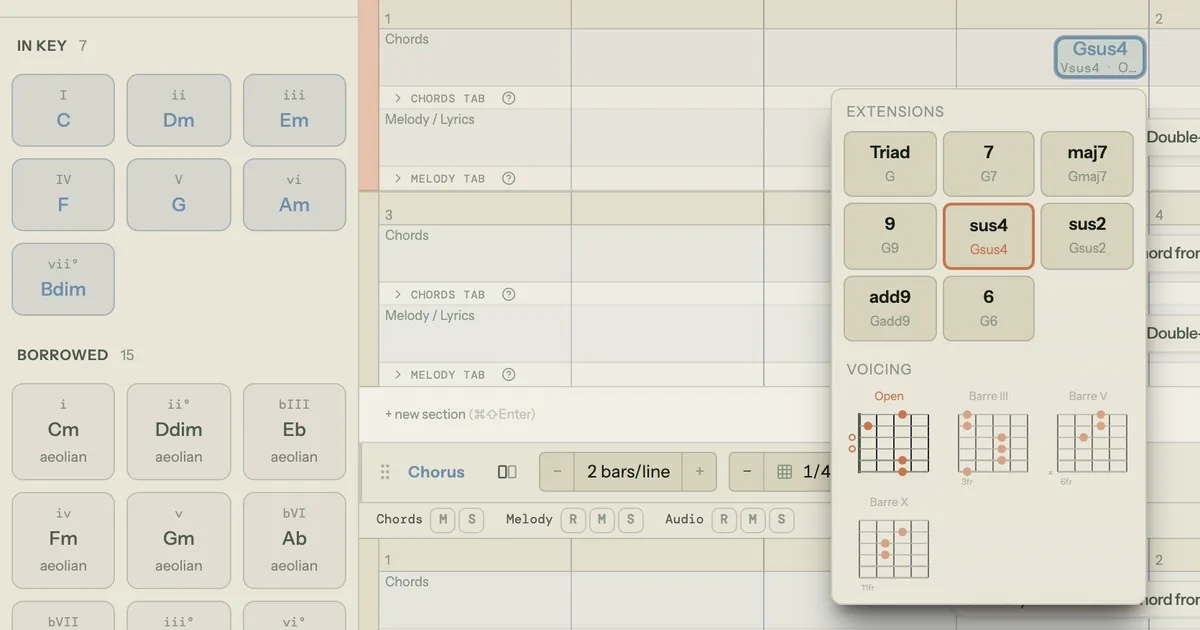
There is an honest limit worth knowing. Because a sus chord has no third, there is no such thing as a real "minor sus," so Song Cage will not hand you one that quietly throws the minor quality away. That constraint is the theory made visible: the third is the thing you are suspending, and you cannot suspend a note the chord no longer has.
Hear a sus chord before you write it
Swap the third for a 2nd or a 4th, hear it resolve on guitar and piano, and keep the version that fits your song. Song Cage is free to start, no card required.
Frequently Asked Questions
What is a suspended chord in simple terms?
It is a chord with its third taken out and a neighbor note put in its place. A sus2 uses the 2nd above the root (Csus2 = C–D–G); a sus4 uses the 4th (Csus4 = C–F–G). With no third, the chord is neither major nor minor, so it sounds open and unresolved, like a held breath waiting to land.
What is the difference between sus2 and sus4?
A sus2 replaces the third with the 2nd (1–2–5) and sounds open and dreamy; a sus4 replaces it with the 4th (1–4–5) and sounds tense and forward-leaning. They also happen to share notes: a sus2 and the sus4 a perfect fifth above it contain the same three pitches, so Csus2 and Gsus4 are the same chord with a different bass note.
Do suspended chords have to resolve?
No. Traditionally a sus4 resolves down to the third and a sus2 resolves up to it, but popular music kept the chord and dropped the rule. Leaving a sus unresolved turns it into a static, modal color, which is exactly what "Wonderwall" and "The Scientist" do. Resolve it for tension and release, or hang it for open ambiguity.
Is a sus2 the same as an add9?
No. A sus2 replaces the third, so Csus2 is C–D–G with no E. An add9 keeps the third and stacks a 9th on top, so Cadd9 is C–E–G–D. The add chord stays clearly major; the sus chord goes ambiguous. The quick test: if the third is still there, it is an add chord; if a 2nd or 4th took its place, it is suspended.
Can you have a minor suspended chord?
Not really. What makes a chord minor is its flatted third, and a suspended chord has no third at all, so "minor sus" collapses into a plain sus chord and loses the minor quality. That is a feature, not a gap: because it carries no third, one sus voicing can stand in for either the major or the minor of that root.
What is a 7sus4 chord?
A 7sus4 is a dominant seventh with the third replaced by the 4th: root, 4th, 5th, flat 7th (C7sus4 = C–F–G–B flat). Removing the third removes the tritone that gives a dominant its harsh edge, so a 7sus4 works as a softened dominant. It appears at the peak of "Wish You Were Here" and throughout gospel, soul, and jazz.