Table of Contents
- What is a 7th chord?
- What are the four 7th chords you'll actually use?
- How do you build a major 7th chord (maj7)?
- What makes a dominant 7th chord (7) pull home?
- What is a minor 7th chord (m7)?
- What is a half-diminished 7th chord (m7♭5)?
- From half-diminished to fully diminished
- What are the diatonic 7th chords in a major key?
- What are the diatonic 7th chords in a minor key?
- What do 7th chords do in a progression?
- How do you use 7th chords in your own songs?
- Two more you'll occasionally meet
- Build and hear 7th chords in Song Cage
- A real song for every 7th chord
- Frequently Asked Questions
Add one note to a chord you already know and it stops sounding like a beginner's chord. That note is the seventh, and it is the single most useful piece of color in a songwriter's kit. A 7th chord is how "Something," "Moondance," and every 12-bar blues get their character without anyone learning a hard new shape.
This guide covers the four 7th chords you will actually use, how to build each one on guitar and piano, what job each does in a progression, and a real, verified song for every quality. Two rarer sevenths get a short section at the end.
The short version
A 7th chord is a triad plus one stacked note a seventh above the root. Four qualities cover almost everything you write: the lush major 7th (maj7), the restless dominant 7th (7), the warm minor 7th (m7), and the dark half-diminished 7th (m7♭5). Every major key holds all four, on fixed scale degrees.
What is a 7th chord?
A 7th chord is an ordinary three-note triad with one more note stacked on top: a seventh above the root. That extra note is a color note. It turns a plain, settled chord into something richer, tenser, or dreamier, without changing the chord's root or its place in the key.
You build a triad by stacking two thirds (C to E to G gives C major). A 7th chord just stacks one more third on top (C to E to G to B gives Cmaj7). The four notes are the root, third, fifth, and seventh.
The exact flavor depends on two things: whether that top note is a major seventh (a half step below the octave) or a minor seventh (a whole step below), and whether the triad under it is major, minor, or diminished. Those combinations give the four everyday qualities below.
What are the four 7th chords you'll actually use?
Four qualities carry nearly all popular music: the major 7th, the dominant 7th, the minor 7th, and the half-diminished 7th. Learn to hear these four and you can name and use the sevenths in most songs. Here they are built from a C root, so you can compare them one note at a time.
| Chord | Symbols | Formula | Notes (on C) | Sound | Its job |
|---|---|---|---|---|---|
| Major 7th | Cmaj7, CM7, CΔ7 | 1 3 5 7 | C E G B | Lush, dreamy, restful | Rests on the I and IV |
| Dominant 7th | C7 | 1 3 5 ♭7 | C E G B♭ | Restless, bluesy | Pulls home from the V |
| Minor 7th | Cm7, Cmin7, C-7 | 1 ♭3 5 ♭7 | C E♭ G B♭ | Warm, mellow, soulful | Softens the ii, iii, vi |
| Half-diminished 7th | Cm7♭5, Cø7 | 1 ♭3 ♭5 ♭7 | C E♭ G♭ B♭ | Dark, unstable, yearning | Sets up the dominant |
♭ means flat (lower the note a half step). The only differences between these four chords are which notes get flattened.
How do you build a major 7th chord (maj7)?
A major 7th chord is a major triad plus a major seventh, the note a half step below the octave. On C that is C, E, G, and B. It sounds lush, floating, and unresolved in a pleasant way: the "sunset" chord, at home in soul, bossa nova, and soft pop.
Take any major chord and add the note a half step below the root, up an octave (that is B for a C chord). On guitar, an easy open Cmaj7 is the C chord with the B string played open instead of fretted. On piano, play C E G and reach up to B.
You hear it as a tension that never needs to resolve. The tonic chord that opens "The Girl from Ipanema" is a major 7th (Fmaj7 in the common lead-sheet key), and the hazy tonic vamp of Marvin Gaye's "What's Going On" sits on an Emaj7 sliding to C♯m7. In the Beatles' "Something," the second chord of the verse is a Cmaj7 as a voice slips quietly from C down to B.
What makes a dominant 7th chord (7) pull home?
A dominant 7th is a major triad plus a minor (flat) seventh: C, E, G, B♭. That flat seventh grinds against the chord's major third to form a tritone, and that clash is what makes the chord sound restless and pull strongly toward home. It is the engine of the blues and the classic V chord.
Write it as a plain number, like G7 or C7. Note the trap for beginners: a bare "7" always means the dominant quality (flat seventh), never the major seventh. "Cmaj7" and "C7" are different chords.
The tritone is the tell. In G7, the B and F sit a tritone apart and lean inward to the C and E of a C chord, which is why V7 to I feels like an arrival. The blues turns every chord into a dominant 7th: Stevie Ray Vaughan's "Pride and Joy" is a 12-bar blues built on E7, A7, and B7. String several dominants together and each one pulls to the next, as in "Five Foot Two, Eyes of Blue" (C, E7, A7, D7, G7, C) and the opening of "Sweet Georgia Brown," which marches E7 to A7 to D7, each falling a fifth. Those chained dominants are close cousins of secondary dominants.
What is a minor 7th chord (m7)?
A minor 7th chord is a minor triad plus a minor seventh: C, E♭, G, B♭. It is the warm, mellow upgrade to a plain minor chord, softening the sadness into something relaxed and soulful. It is the most common seventh in funk, soul, and jazzy pop.
Take any minor chord and add the flat seventh (the same note the dominant uses). Because the third is already minor, the result feels smooth rather than tense. On guitar, Am7 is an Am shape with one finger lifted; on piano, play A C E and add G.
The minor 7th is a workhorse. Van Morrison's "Moondance" grooves almost entirely on minor 7ths, with Am7 as its home base. Bill Withers' "Ain't No Sunshine" carries its whole moody weight on an Am7, and the verse of "Killing Me Softly" opens on an Am7, threading minor 7ths through a cycle of fourths. In a major key it lands naturally on the ii, iii, and vi chords, which is why the ii to V to I move, the most common progression in jazz, usually starts on a minor 7th.
What is a half-diminished 7th chord (m7♭5)?
A half-diminished 7th, written m7♭5 or ø7, is a diminished triad plus a minor seventh: C, E♭, G♭, B♭. It flattens both the third and the fifth. The sound is dark, unstable, and yearning, more unsettled than a minor 7th but softer than a fully diminished chord. Its job is to set up the dominant.
The name is a mouthful, but the shape is simple: a minor 7th with its fifth lowered a half step. That flat fifth is what darkens it.
You meet it in two predictable spots: on the seventh degree of any major key, and as the ii chord of a minor key, where it leans straight into the V. Gloria Gaynor's "I Will Survive" runs a descending cycle that reaches a Bm7♭5 right before the E7 pulls home to Am, the textbook "moody pre-dominant." The jazz standard "Autumn Leaves" is the classic teaching tune for the minor ii-V-i, and its ii chord is a half-diminished (Am7♭5 to D7 to Gm). "Stella by Starlight" even opens on one.
From half-diminished to fully diminished
The half-diminished chord is one small step away from a fully diminished 7th, and understanding the difference is the on-ramp to the whole diminished family. Both sit on a diminished triad (flat third, flat fifth). The only thing that changes is the top note: a minor seventh gives half-diminished; a diminished seventh gives fully diminished.
Lower that seventh one more half step and Cm7♭5 becomes Cdim7 (C, E♭, G♭, B♭♭). A fully diminished 7th is a perfectly symmetrical stack of minor thirds, so all of its inversions are the same chord, which is why it slides so easily between other chords as a passing tension.
Songwriters use the fully diminished 7th as a chromatic connector. In the Beatles' "Michelle," a fully diminished 7th builds tension before the arrival chord, and the Beach Boys' "God Only Knows" slips one between chords as a passing move. For the complete picture, see the full guide to diminished chords.
What are the diatonic 7th chords in a major key?
Every major key contains exactly seven 7th chords, one on each scale degree, and the pattern of qualities never changes from key to key. In any major key the I and IV are major 7ths, the ii, iii, and vi are minor 7ths, the V is a dominant 7th, and the vii is half-diminished. Memorize this once and you have it in all twelve keys.
Here it is in C major. This is your ready-made writing palette: any of these seven can stand in for its plain triad.
| Degree | I | ii | iii | IV | V | vi | vii |
|---|---|---|---|---|---|---|---|
| Chord in C | Cmaj7 | Dm7 | Em7 | Fmaj7 | G7 | Am7 | Bm7♭5 |
| Quality | maj7 | m7 | m7 | maj7 | 7 | m7 | m7♭5 |
The single dominant 7th (G7) is the only chord here that strongly pulls home, which is exactly why the V chord drives so many songs.
What are the diatonic 7th chords in a minor key?
A natural minor key holds the same seven qualities rearranged, because it uses the same notes as its relative major. In A minor the tonic i is a minor 7th (Am7), the ii is half-diminished (Bm7♭5), and the VII is a dominant 7th (G7). The difference is where the raised leading tone comes in.
Here is A natural minor:
| Degree | i | ii | III | iv | v | VI | VII |
|---|---|---|---|---|---|---|---|
| Chord in Am | Am7 | Bm7♭5 | Cmaj7 | Dm7 | Em7 | Fmaj7 | G7 |
| Quality | m7 | m7♭5 | maj7 | m7 | m7 | maj7 | 7 |
Natural minor has no strong pull home, so minor-key songs often borrow the raised seventh from harmonic minor to get a real dominant. Raising that note turns the v (Em7) into a dominant E7 that leans hard into Am. It also creates two of the rarer sevenths in the next section: it turns the tonic into a minor-major 7th (Am with a raised seventh) and puts a fully diminished 7th on the leading tone.
What do 7th chords do in a progression?
In a progression, 7th chords add motion and smoothness. A dominant 7th creates tension that wants to resolve; a major or minor 7th mostly adds color and lets chords glide into each other with barely a finger moving. This is why the same three-chord song feels more sophisticated the moment you add sevenths.
The clearest example is the ii-V-I, the backbone of thousands of songs. In C that is Dm7 to G7 to Cmaj7. Watch the voice leading: the seventh of one chord slips down a half step to become the third of the next. The C in Dm7 falls to the B in G7, and the F in G7 falls to the E in Cmaj7. Sevenths make those connecting lines smooth.
They also unlock inversions and slash chords, where a chord tone other than the root sits in the bass to create a walking bass line. For more on that, see chord inversions and the most useful chord progressions for songwriters.
How do you use 7th chords in your own songs?
The fastest way to use 7th chords is to swap a plain triad for its seventh when you want a specific effect. Reach for a minor 7th to soften a minor chord, a major 7th to make a chord float, and a dominant 7th to add pull toward the next chord. Change one chord at a time and keep what sounds right.
Three recipes to start with:
Swap-a-triad recipes
- Instant smoothness: turn a minor chord (ii, iii, vi) into a minor 7th. It relaxes the harmony without changing the mood.
- Instant pull: turn your V chord into a dominant 7th. It leans harder into the tonic and sharpens the sense of arrival.
- Instant sophistication: turn a I or IV into a major 7th for a dreamy, unresolved glow. Use it sparingly; too many maj7s and everything floats.
And one caution: do not add a seventh to every chord. A dominant 7th that never resolves loses its pull, and a wall of maj7s turns lush into mush. The sevenths mean the most when the plain triads around them let the color stand out.
Two more you'll occasionally meet
Beyond the everyday four, two sevenths show up often enough to name. Both are advanced colors, not beginner staples.
The minor-major 7th (written m(maj7) or mM7) is a minor triad with a major seventh on top: on C, that is C, E♭, G, B. The minor third and the bright leading tone rubbing together give it a tense, suspenseful, "spy movie" sound. It is literally the James Bond chord (an Em(maj7) closing the theme), and you hear it as the wistful second step of a descending line in Duke Ellington's "In a Sentimental Mood." The famous line-cliché intro to "Stairway to Heaven" is often charted with one too.
The augmented 7th (written 7♯5 or +7) is a dominant 7th with a raised fifth: C, E, G♯, B♭. The sharpened fifth acts like an extra leading tone, so it is an altered dominant that leans even harder toward its target chord. It is a spice, used to make a V chord sound more urgent before it resolves.
Build and hear 7th chords in Song Cage
Because Song Cage always knows your song's key, adding a 7th to a chord gives you the right quality automatically: a dominant 7th on the V, a major 7th on the I and IV, a minor 7th on the ii, iii, and vi, and a half-diminished on the vii. Each chord is spelled with a proper symbol and labeled with its number and quality, so you can see the function at a glance (V7, Imaj7, ii7, viiø7), and it keeps a half-diminished (ø7) distinct from a fully diminished (°7).
The chord palette is organized as your in-key chords, borrowed chords, and a Secondary Dominants row that hands you the dominant 7ths that tonicize other chords, each showing where it resolves. Start with triads, then add the seventh on any chord when you want the color. Whatever seventh you land on comes with real, playable shapes on both guitar and piano, so you can see the fingering and hear it back in context.
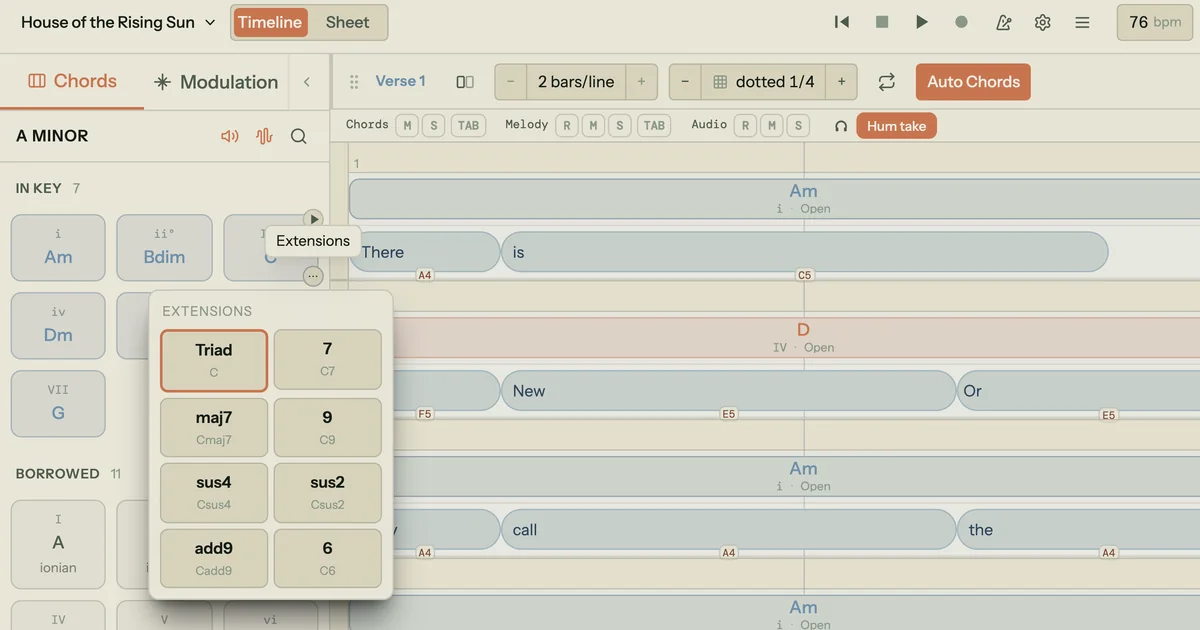
Write with 7th chords in your key
Song Cage shows you every chord in your key, spelled and labeled, and lets you add a 7th with the right quality on any of them, on guitar and piano.
A real song for every 7th chord
Every chord above appears in a real, widely-charted song. Use these to train your ear to each quality.
| Quality | Song | Where you hear it |
|---|---|---|
| Major 7th | "Something" · The Beatles | Cmaj7 as the second chord of the verse |
| Major 7th | "What's Going On" · Marvin Gaye | Emaj7 tonic vamp into C♯m7 |
| Dominant 7th | "Pride and Joy" · Stevie Ray Vaughan | E7, A7, B7 through a 12-bar blues |
| Dominant 7th | "Sweet Georgia Brown" · jazz standard | E7 to A7 to D7, a chain of dominants |
| Minor 7th | "Moondance" · Van Morrison | Am7 home base, Bm7 and Dm7 |
| Minor 7th | "Ain't No Sunshine" · Bill Withers | Am7 carrying the whole verse |
| Half-diminished 7th | "I Will Survive" · Gloria Gaynor | Bm7♭5 before the E7 home to Am |
| Half-diminished 7th | "Autumn Leaves" · jazz standard | Am7♭5 in the minor ii-V-i |
| Diminished 7th | "Michelle" · The Beatles | A fully diminished chord before the cadence |
| Minor-major 7th | "In a Sentimental Mood" · Duke Ellington | Dm(maj7) in the opening line |
Frequently Asked Questions
What is the difference between maj7 and a plain 7 chord?
They use different top notes. A "maj7" (like Cmaj7) has a major seventh, the note a half step below the octave (B over C), and sounds lush and restful. A plain "7" (like C7) is a dominant 7th with a flat seventh, a whole step below the octave (B♭ over C), and sounds restless and bluesy. A bare number after a chord always means the dominant quality, never the major seventh.
What is the difference between a diminished 7th and a half-diminished chord?
Both sit on a diminished triad (flat third, flat fifth). The difference is the top note. A half-diminished 7th (m7♭5 or ø7) adds a minor seventh, so it sounds dark but relatively soft and usually sets up a dominant. A fully diminished 7th (dim7 or °7) lowers that seventh one more half step, creating a symmetrical stack of minor thirds with maximum tension, often used as a chromatic passing chord.
Do 7th chords make a song sound jazzy?
Not by themselves. Major 7ths and minor 7ths do add the smooth color associated with jazz, soul, and bossa nova. But dominant 7ths are the foundation of blues, rock, and country, and every V chord in a folk song can be a dominant 7th. Sevenths add sophistication and motion in any genre; whether they read as "jazzy" depends on which quality you use and how often.
How do I know which 7th chord to use?
Let the key decide most of it. In a major key the sevenths land in a fixed pattern: major 7th on the I and IV, minor 7th on the ii, iii, and vi, dominant 7th on the V, and half-diminished on the vii. So if you are turning a chord in your key into a seventh, the quality is already chosen for you. The main creative choice is which chords to color and how often.
Do beginners need to learn 7th chords?
You can write good songs with plain triads, but 7th chords are one of the highest-value things a beginner can add. Most sevenths are a one-finger change from a chord you already play, and a single dominant 7th on your V chord, or a minor 7th on a minor chord, will make a simple progression sound noticeably more finished. Start with those two swaps.
Why does a dominant 7th chord want to resolve?
Because of a built-in tritone. A dominant 7th contains a major third and a flat seventh that sit a tritone apart (in G7, the notes B and F). A tritone is one of the most unstable intervals in music, and its two notes lean inward by a half step toward the third and root of the target chord. That built-in pull is what makes V7-to-I feel like coming home.