Table of Contents
- Can you actually tell if a song is AI-generated?
- What gives away an AI vocal?
- What gives away the music itself?
- Does the harmonic rhythm ever vary?
- Does the song ever borrow a chord?
- Does the key ever change?
- Are the sections perfectly square?
- What gives away AI lyrics?
- How do you check the artist instead of the song?
- Do AI music detectors actually work?
- Why none of this reaches a song that was written by a machine
- Where Song Cage sits
- Frequently Asked Questions
In November 2025 a survey found that 97 percent of listeners could not identify an AI-generated song when they heard one. A few months earlier, a real musician named Johnny Delaware, formerly of the band SUSTO, spent weeks being told by strangers on the internet that he did not exist.
Both facts are true at once, and together they describe the problem. The signals that give away AI music are real and worth knowing. They are also weak enough that people confidently apply them to the wrong artists.
What follows is what actually holds up: what to listen for in the voice, in the arrangement, in the words, and in the artist's footprint. Then the harder question of what none of it can tell you.
Can you actually tell if a song is AI-generated?
Sometimes, and less often than you would think. A BBC report cites a survey in which 97 percent of respondents could not spot an AI-generated song. The reliable signals cluster in four places: the vocal performance, the harmonic structure, the lyric writing, and the artist's presence outside the streaming platform.
Tony Rigg, a music industry adviser and lecturer at the University of Lancashire, puts the honest limit on all of it. He calls these signs "hints not proof," and says it is not easy for a casual listener to identify AI-generated songs.
That framing matters more than any individual tell. Every signal below appears in human music too. A bedroom producer working in the box with tight quantization can trip most of them at once. Treat them as evidence that accumulates, not as a test that any single track passes or fails.
What gives away an AI vocal?
Listen for the edges of phrases rather than the middle. AI vocals often show a slight fuzzy tail where the audio does not cut cleanly, consonants and plosives that land softly, and "ghost" harmonies where backing vocals appear and vanish at random. The performance is frequently too clean, with no strain anywhere in the range.
The BBC's reporting gathers these from working experts. Rigg notes that AI singers often sound slightly slurred, and that hard sounds like "p" and "t" are not quite right. He also points at what is missing: no strain in the vocal, overly polished production, unnatural emotional delivery.
LJ Rich, a musician and technology speaker, adds that AI vocals can feel breathless, and that the track overall reads as sweet but without much substance. "AI hasn't felt heartbreak yet," Rigg says. "It knows patterns."
The complication is that modern pop is also mixed to be flawless. Absence of strain is a signal, not a verdict.
What gives away the music itself?
This is the layer most guides skip, and it is the one that holds up best, because it describes decisions rather than artifacts. Generated music is very good at producing a plausible progression and very bad at making the choices a writer makes when a section needs to do something.
Four tells are worth training your ear on.
Does the harmonic rhythm ever vary?
One chord per bar, for the length of the song, is the single most common giveaway. Human writers speed the chords up going into a chorus and let one hang at the end of a bridge, because the rate of change is how a section builds tension or releases it. That variation is most of what makes a progression feel alive, and it is the first thing missing from generated tracks. If you can set a metronome to the chord changes and never adjust it, that is worth noticing. The test takes one pass. Count how many beats each chord holds through a verse, then count again through the chorus. If the two numbers match, and they match a third time in the bridge, you are listening to a grid rather than an arrangement. Human songs almost always move that number at least once, because the writer wanted the chorus to feel like it had arrived.
Does the song ever borrow a chord?
Generated progressions tend to stay strictly inside the key. A writer reaching for a minor iv in a major key, or a bVI at the end of a chorus, is borrowing from a parallel mode for a specific emotional reason, usually to make one moment ache. Models trained on averages rarely take that turn, because the average song does not. A track that is pleasant the whole way through and never once darkens is showing you something. The clearest reference point is Radiohead's "Creep," where the chord under the third bar turns minor and the whole song tilts underneath it. That single substitution is the moment people remember. Generated music is assembled from what usually comes next, and a borrowed chord is by definition the thing that usually does not come next, so it tends to get smoothed away.
Does the key ever change?
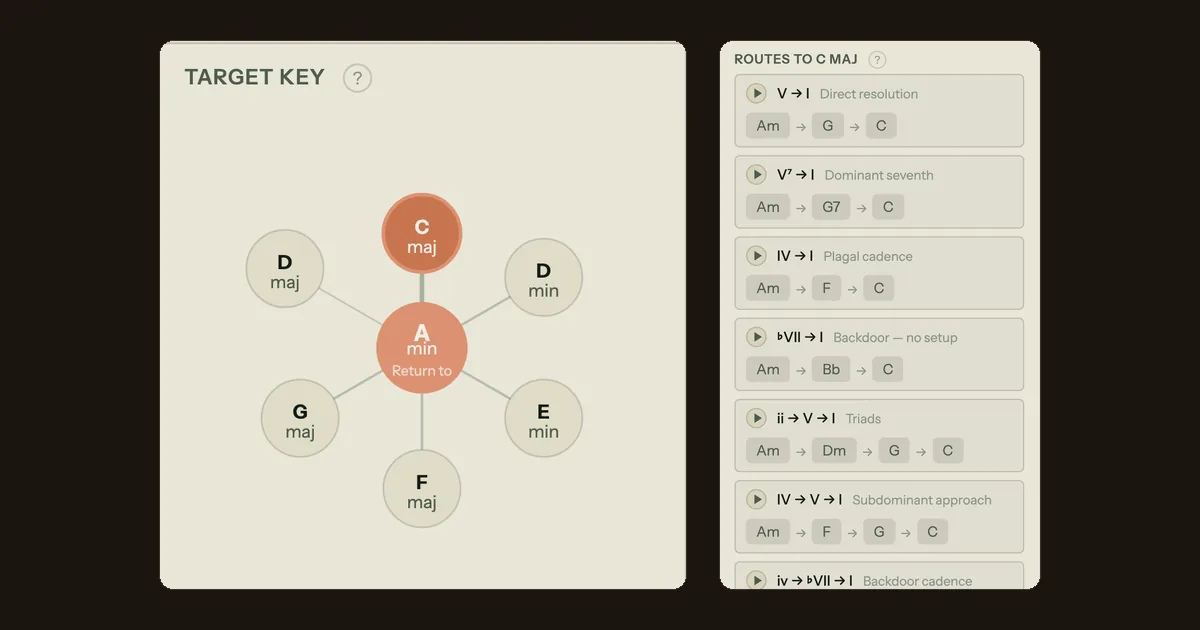
A key change is a deliberate structural decision with a setup, a pivot and a landing. Generated songs almost never modulate, because nothing in the track is planning several sections ahead. The final chorus arrives in exactly the same place as the first one, at the same pitch, with the same voicing under the hook. Compare that with the last chorus of "Livin' on a Prayer," which lifts a step and drags the vocal up with it, or "Love on Top," which climbs four separate times before it finishes. Both are decisions about the shape of the whole song rather than about the next four bars. A model generating forward has no reason to plan a lift it will not reach for another two minutes, so the ending just repeats what came before it.
Are the sections perfectly square?
Eight bars, sixteen bars, no truncated line to push into the chorus early, no extra two bars held before the last verse. The BBC notes AI songs tend to stick to generic verse-chorus structures and usually do not have a satisfying ending, which is the same observation arrived at from the structural side. Human arrangements are full of small irregularities that exist because a lyric needed one more beat.
| What you notice | What it is in theory terms | What writers usually do |
|---|---|---|
| Feels flat even though the chords are fine | Unvarying harmonic rhythm | Accelerate into the chorus, hang at the bridge |
| Pleasant but never aches | Strictly diatonic, nothing borrowed | Borrow a chord from the parallel minor |
| Last chorus lands the same as the first | No modulation | Lift the key, or change the voicing under the hook |
| Sections feel like a grid | Square 8 and 16 bar phrases | Truncate or extend a phrase for the lyric |
| Ending just stops | No resolution planned | Write toward a final cadence |
Each row is a hint rather than a verdict. Plenty of human songs sit squarely in the left column on purpose.
What gives away AI lyrics?
AI lyrics are usually too correct. They scan cleanly, the grammar is intact, and the rhymes are perfect end-rhymes that arrive exactly on schedule. What is missing is specific detail, the odd phrase that only one person would write, and the small grammatical wrongness that human writers reach for deliberately.
The BBC makes this point well with two examples. Alicia Keys sings "concrete jungle where dreams are made of," which is not a sentence. The Rolling Stones built a hook on a double negative in "(I Can't Get No) Satisfaction." Rich observes that AI is more likely to produce lyrics that follow correct grammatical structure, whereas some of the most memorable human lines do not quite make sense.
Two more things to listen for. Generated lyrics lean almost entirely on perfect end-rhyme, with little of the slant rhyme and internal rhyme that working writers use to keep a line from sounding like a greeting card. And the stress pattern is often subtly wrong, with strong syllables landing on weak beats, because fitting words to a melody is a negotiation the model is not really having.
How do you check the artist instead of the song?
Often the fastest answer is not in the audio at all. Look for a footprint outside the streaming platform: live performances, interviews, individual social accounts, photographs that were not generated. An artist with millions of streams and no history anywhere else is the strongest single signal available to a listener.
The Velvet Sundown case set the template. As the BBC reported, the band had no record label, a minimal social footprint, and hundreds of thousands of monthly Spotify listeners after two albums released weeks apart. There were no concert photos, no fan reviews, no interviews. The airbrushed press images with identical warm filtering did the rest. The project later described itself as "guided by human creative direction" and composed with the support of AI.
Forbes lists a similar set: an unusually fast rise in popularity, no online presence before the music appeared, credits that do not make sense, and production unusually polished for the genre. Professor Gina Neff of the University of Cambridge adds unrealistic productivity, describing one suspected artist who dropped multiple soundalike albums simultaneously.
Do AI music detectors actually work?
They work well on one narrow case and poorly everywhere else. Detectors reliably identify raw, unprocessed output from the largest generators. They do not reliably identify partially AI-assisted tracks, and they produce false positives on human music often enough that being flagged is a real hazard for working artists.
Deezer built the leading tool, has run it since January 2025, and licenses it to others. Billboard uses it to determine which charting tracks are AI-generated, and Deezer claims a false-positive rate under 0.01 percent, per Ars Technica. Billboard also notes the tool, like nearly all others on the market, only flags fully AI-generated recordings from the most prolific models and does not flag songs partially generated by AI.
The false positives land hard. Detection company Cyanite reports that in its ongoing artist survey, more than 70 percent of respondents fear being wrongly labeled as AI-generated. Johnny Delaware, a real songwriter, was described as a possible fake band in national press purely because Spotify listed him as a related artist to The Velvet Sundown, as the Post and Courier documented. Flags cluster in electronic, lo-fi, and heavily quantized styles, where human production naturally looks "too clean" to a classifier.
If you are checking someone else's track
- Run more than one detector. Disagreement between tools is common and informative.
- Treat a score as a prompt to look further, never as a conclusion you can publish.
- Weigh the artist's footprint more heavily than any percentage.
- Remember the cost of being wrong falls entirely on the artist, not on you.
Why none of this reaches a song that was written by a machine
Every signal on this page describes a recording. That is the boundary, and it is worth being precise about where it sits.
A performance leaves an acoustic fingerprint. A chord progression does not. There is no spectral signature for a melody, and no forensic test that separates a model's lyric from one written at a kitchen table at two in the morning. If a writer takes a machine-written verse, sings it in their own voice, and plays it on their own guitar, the recording is genuinely human and every detector on the market will agree.
That gap is not hypothetical. The music industry's July 2026 labeling framework states plainly that it "does not cover the use of generative AI in lyrics, composition, music videos or cover art at this point." We wrote about why the new AI music labels stop at the recording and what that leaves unanswered for songwriters. The short version: you will soon be able to know whether a machine sang it. You will have no way to know whether a machine wrote it.
Where Song Cage sits
I build a songwriting tool, so I will be direct about the connection rather than pretend there isn't one.
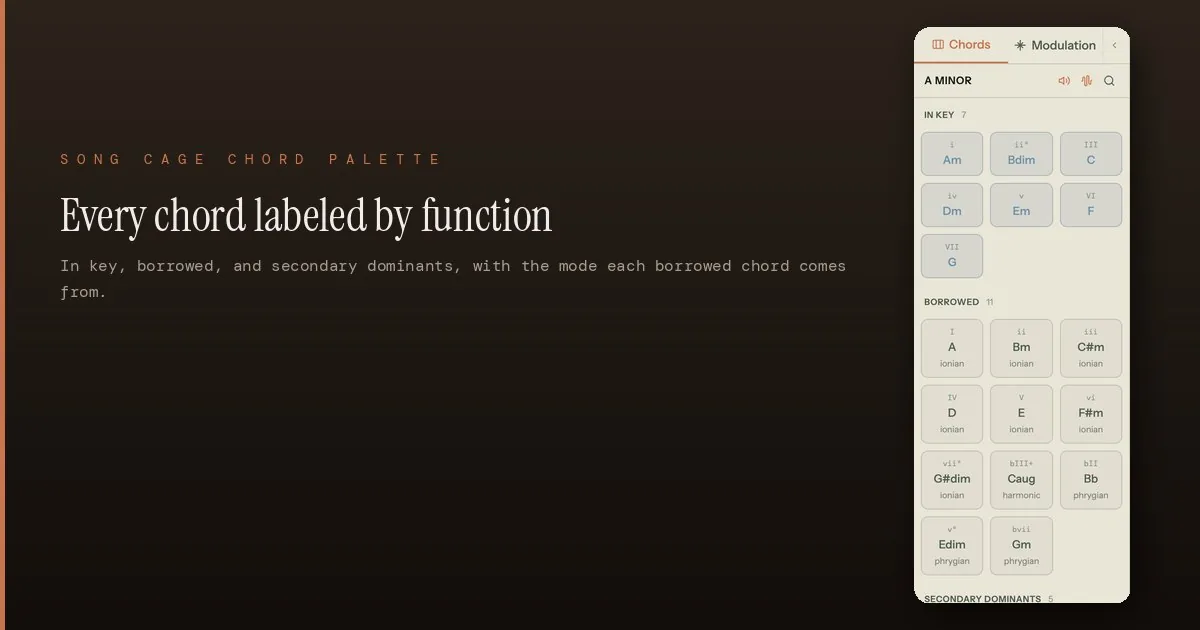
Song Cage has no generative AI in it. It does not write lyrics, melodies or progressions. What it does is name what you are already doing: every chord in your key labelled by its function, borrowed chords marked with the mode they came from, your lyric split into syllables so you can see which beat each one lands on.
That is also why the theory tells above were possible to write. The things generated tracks skip, varied harmonic rhythm, a borrowed chord, a key change, an uneven phrase, are exactly the decisions a writer makes on purpose.
Write the parts a model would skip
Song Cage shows you the theory behind the choices you are already making, and never makes them for you.
Frequently Asked Questions
Can you tell if a song is AI-generated just by listening?
Not reliably. A survey cited by the BBC in November 2025 found 97 percent of respondents could not spot an AI-generated song. Trained listeners do better by stacking signals: ghost harmonies and soft consonants in the vocal, unvarying harmonic rhythm, strictly diatonic progressions, square eight-bar sections, and lyrics that are grammatically correct but carry no specific detail. Music industry lecturer Tony Rigg calls these signs "hints not proof."
What are the most reliable signs a song is AI-generated?
The artist's footprint is usually stronger evidence than the audio. An act with large streaming numbers but no live performances, no interviews, no individual social accounts and no history before its first release is the clearest signal available to a listener. In the audio, the most durable tells are structural: harmonic rhythm that never varies, no borrowed chords, no key change, and an ending that stops rather than resolves.
Do AI music detectors actually work?
They work on one narrow case. Deezer's detector, which Billboard uses for its charts, is reported to have a false-positive rate under 0.01 percent, but Billboard notes it and nearly all others only flag fully AI-generated recordings from the most prolific models. They do not flag songs partially generated by AI. Treat any score as a reason to investigate further rather than as a conclusion.
Can a human-made song be wrongly flagged as AI?
Yes, and it happens often enough to be a working hazard. Detection company Cyanite reports more than 70 percent of artists in its survey fear being wrongly labeled as AI-generated. False positives cluster in electronic, lo-fi, sample-based and heavily quantized styles, where tight grids and polished mixes resemble the patterns classifiers were trained to distrust. The cost of a wrong flag falls on the artist, who has to prove a negative.
Can you tell whether the lyrics or melody were written by AI?
No. Detection analyses the recording, and a composition leaves no acoustic fingerprint. If a writer takes a machine-written verse and sings it themselves over their own guitar, the recording is human by every available measure. The music industry's July 2026 labeling framework acknowledges this directly, stating it "does not cover the use of generative AI in lyrics, composition, music videos or cover art at this point."
Does Spotify label AI-generated music?
Not automatically. Spotify relies on artist disclosure through its AI Credits feature, alongside Verified by Spotify and Artist Profile Protection, rather than scanning uploads and applying a label the way Deezer does. That means an undisclosed AI track can sit on the platform unlabelled. Deezer, which does scan, reported that AI-generated uploads passed half of all new daily uploads in June 2026.