Table of Contents
- What is internal rhyme?
- Internal rhyme vs. end rhyme: what is the difference?
- Is internal rhyme the same as a slant rhyme?
- What are the four types of internal rhyme?
- What does internal rhyme do in a song?
- Internal rhyme across genres: where do you hear it?
- How do you write an internal rhyme?
- How do you make internal rhyme sit in the melody?
- How much internal rhyme is too much?
- Frequently Asked Questions
Internal rhyme is one of the quietest tools in a songwriter's kit, and one of the most powerful. It is the rhyme you feel before you notice it: the echo tucked inside a line rather than parked at the end. This guide defines internal rhyme, separates it cleanly from slant rhyme and end rhyme, plays it back across seven genres, and shows you how to write internal rhymes that sit naturally in a melody.
What is internal rhyme?
Internal rhyme is a rhyme that lands inside a line of lyric rather than at its end, where end rhyme normally sits. Also called middle rhyme, it names a position, not a sound: an internal rhyme can be a perfect rhyme or a slant rhyme. Songwriters reach for it to build momentum, add density, and spotlight a key word.
The Poetry Foundation defines it as rhyme "within a single line of verse, when a word from the middle of a line is rhymed with a word at the end of the line." The Academy of American Poets keeps it even simpler: "When two words in the same line rhyme, it's called Internal Rhyme."
The textbook case is public domain and more than a century old.
The canonical example
Edgar Allan Poe, "The Raven" (1845): "Once upon a midnight dreary, while I pondered, weak and weary." The pair dreary / weary chimes inside the line, long before any line-ending rhyme arrives.
Internal rhyme vs. end rhyme: what is the difference?
The only real difference is position. End rhyme falls at the ends of lines, sets a song's visible rhyme scheme, and hands those end words automatic emphasis. Internal rhyme falls inside the line, off the metrical grid, so it reads as texture rather than structure. You register it as flow, not as a rhyme you could diagram.
A single line often carries both at once. In the same "Raven" stanzas where dreary / weary and napping / tapping ring internally, Poe lands lore / door at the line ends. The two devices stack without competing.
Here is the useful writer's insight: move a line break and an end rhyme becomes an internal one. Split "watched the hours crawl" onto its own line and crawl is an end rhyme; fold it back into a longer line and the same word turns internal. Position is a choice you control with the pen.
Is internal rhyme the same as a slant rhyme?
No, and this is the confusion that trips up almost every songwriter. Rhyme is sorted along two independent axes: position (where the rhyme sits in the line) and exactness (how closely the sounds match). Internal answers where. Slant answers how close. They do not trade off, so one pair of words can be an internal rhyme and a slant rhyme at the same time.
Poe's dreary / weary is perfect and internal. A pair like sweaty / heavy tucked inside a line is slant and internal. Same position, different exactness. Once you see the two axes as separate dials, the whole vocabulary of rhyme stops feeling like a single confusing list.
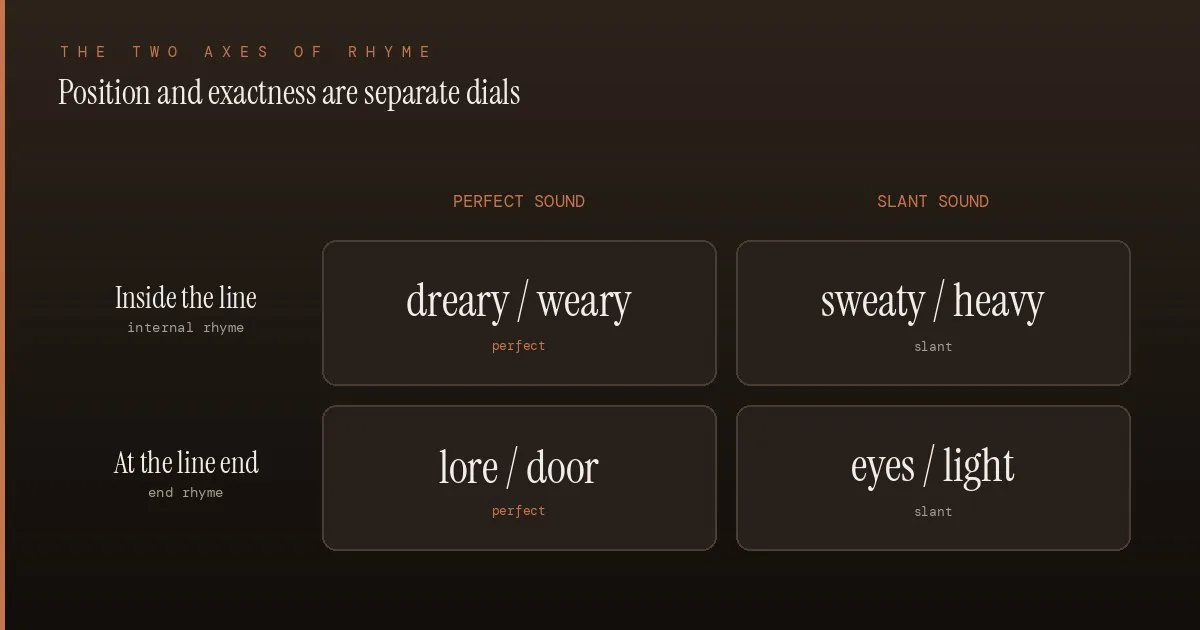
| Device | What repeats | Position or sound? | Quick example |
|---|---|---|---|
| Internal rhyme | A full rhyme, inside the line | Position | dreary / weary |
| End rhyme | A full rhyme, at the line's end | Position | lore / door |
| Slant rhyme | An approximate rhyme, sounds close but not exact | Sound | sweaty / heavy |
| Assonance | Vowel sounds only, consonants differ | Sound | light / time |
| Consonance | Consonant sounds only, vowels differ | Sound | blank / think |
| Alliteration | Initial sounds of nearby words | Sound | weak / while |
Internal rhyme can shade into assonance when only the vowels line up, which is common in rap. A true rhyme repeats the stressed vowel and every sound after it, so it is a fuller match than assonance or consonance alone.
What are the four types of internal rhyme?
Naming the placement makes it something you can aim for on purpose. All four examples below are public domain, so you can study the mechanics without any lyric-clearance worry.
Four placements
- Within-line rhyme: both rhyming words sit in one line. Coleridge, "The Rime of the Ancient Mariner" (1798): "The guests are met, the feast is set."
- Cross rhyme: a mid-line word rhymes with the word ending a nearby line, bridging the two. Britannica illustrates it with Shelley's "The Cloud."
- Interlaced rhyme: a mid-line word rhymes with a mid-line word in the next line, with neither at a line end.
- Leonine rhyme: the word right before the mid-line pause rhymes with the line's last word. Tennyson: "the long light shakes across the lakes." The classical name is a completeness point no competing article bothers to teach.
What does internal rhyme do in a song?
Effects like "momentum" stay vague until you turn them into jobs you can reach for. Internal rhyme does five specific things, and naming them tells you when to deploy it.
The five jobs
- Drive pace. Chained internal rhymes pull the ear forward. Poe's napping / tapping / rapping speeds the line up on its own.
- Add density. More rhyme per line reads as craft and richness, which is why rap prizes it.
- Spotlight a word. An echo mid-line puts a second beat of attention on the word you most want heard.
- Glue a hook. An internal rhyme inside a title line makes the hook harder to forget.
- Relieve the end rhyme. Carry the music inside the line and the final word is freed to carry meaning instead of straining for a rhyme. This is the underused move.
That last job is the one most guides skip. When the internal rhyme does the ear-pleasing work, your end word can be the honest, surprising, or plain word the line actually needs.
Internal rhyme across genres: where do you hear it?
Rap made internal rhyme its signature, and the technique reaches back to the earliest hits: it appears in the Sugarhill Gang's 1979 single "Rapper's Delight," per Wikipedia's survey of the device. But internal rhyme is far older and far broader than one genre. Here is a verified spread, with the song named and the effect described.
Rakim is widely credited with pioneering multisyllabic internal rhyme; MF DOOM, Kendrick Lamar, and Eminem all built dense internal-rhyme flows on that foundation.
Songwriting analysts flag internal rhyme in The Beatles' "Hey Jude" and Journey's "Don't Stop Believin'," where mid-line echoes keep long phrases moving.
Wikipedia names Bob Dylan's "Subterranean Homesick Blues" for rapid-fire internal rhyme; Paul Simon's "The Boxer" threads it through the verses.
Cole Porter's "Don't Fence Me In" uses it in the bridge; Lin-Manuel Miranda built "Hamilton" on it, saying the show rhymes "six times within every line" in places.
Craft breakdowns of Kacey Musgraves' "Merry Go 'Round" point to internal rhyme moving the chorus line along, a hallmark of its co-writer.
Wikipedia lists Smokey Robinson's "The Tears of a Clown" for soul-era internal rhyme, and the device carries into dancehall writing like Masicka's "Grandfather."
How do you write an internal rhyme?
You do not have to rap to use it. A method that works for pop, folk, and country writers is only five steps, and it starts from a line you already mean rather than from a rhyme.
- Write the honest line first. Say what you mean in plain words.
- Find the power word, usually the last word, the one carrying the emotion.
- Look earlier in the line for a filler word you can swap for a sound cousin of that power word.
- Place the echo before the line ends, so the rhyme resolves inside the phrase.
- Sing it. If the swap fights the natural stress, loosen it to a slant rhyme.
Original teaching example
Plain line: I sat there waiting, watched the hours crawl.
With an internal rhyme: I sat and stalled, and watched the hours crawl. The echo stalled / crawl adds motion inside the line without touching the end word. (Built for this guide, not a real lyric.)
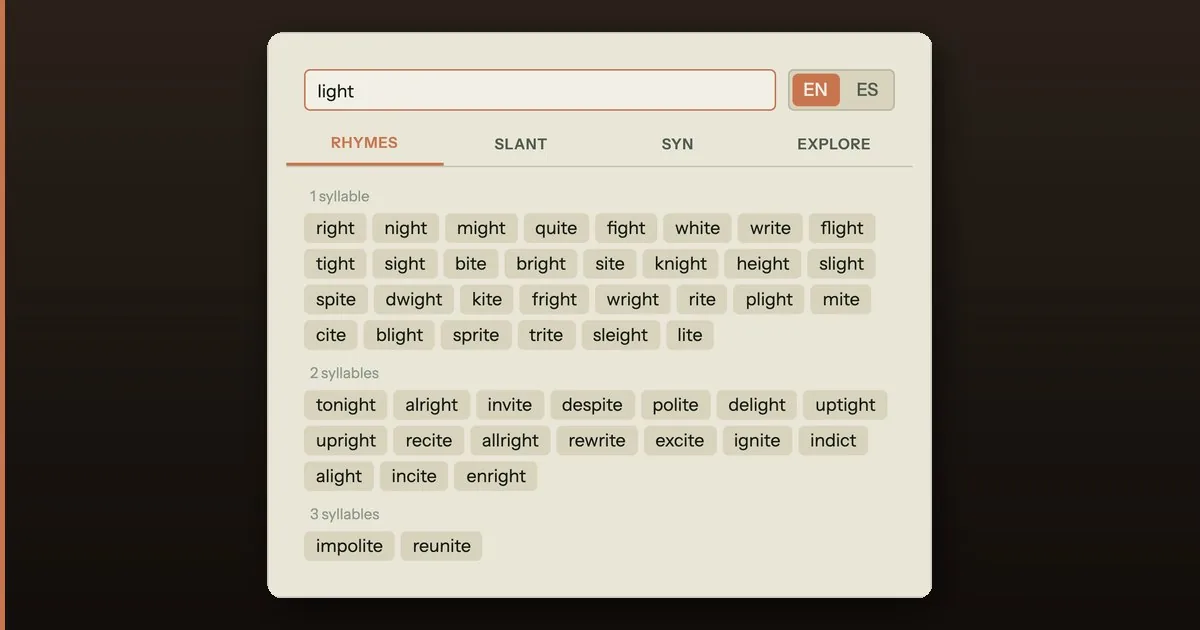
When you need a sound cousin fast, a rhyming dictionary or rhyme generator earns its place. In Song Cage, the Words panel sits beside your lyrics and follows your cursor: click any word for rhymes grouped by syllable count, a Slant tab for near rhymes, and synonyms, so you can audition mid-line matches without leaving the song. New to lyric writing? Start with our guide to writing song lyrics.
How do you make internal rhyme sit in the melody?
Internal rhyme is heard, not read, so prosody decides whether it lands. This is the guidance poetry pages skip and rap guides treat only as beat placement. Four principles carry over to any sung line.
Match the stress. Rhyme a stressed syllable with a stressed syllable. Poe's dreary / weary works because both are trochees, strong-weak, falling the same way. Rhyme a stressed word against an unstressed one and the ear misses it.
Land it on the beat. Put the internal rhyme on a stressed, on-beat melodic note. An echo buried on a weak upbeat disappears under the accompaniment.
Mind the vowel. Open vowels ring on sustained or high notes; closed vowels move the line along. Choose the vowel that fits the note you are singing, not just the word you mean.
Balance the syllables across the phrase so the rhyme feels placed, not crammed. Song Cage's Words panel groups rhymes by syllable count for exactly this reason.
How much internal rhyme is too much?
Internal rhyme clutters fast when you stop steering it. The fix for each common mistake is the same instinct: meaning wins.
Common mistakes and quick fixes
- Over-rhyming. Too many echoes per line reads as a gimmick. Thin them until only the important words chime.
- Forced word order. If you bent the sentence to land a rhyme, unbend it. A natural line beats a clever one.
- Burying the echo. A rhyme on a weak, off-beat note is wasted. Move it to a stressed syllable.
- Meaning for cleverness. Never trade the true word for the rhyming one.
- All-perfect monotony. A stretch of exact rhymes gets predictable. A slant rhyme breaks it up.
Strategy follows from that. Lean on internal rhyme in verses to build momentum, and keep it sparser in a chorus so the hook stays clean and singable. Save your densest internal rhyming for the emotional peak or the punch line, where the extra craft reads as intensity rather than showing off.
Find the rhyme without leaving the line
Song Cage keeps a Words panel beside your lyrics that follows your cursor. Click any word for rhymes grouped by syllable count, slant rhymes, and synonyms, then place the match wherever the line wants it. Capture your song before it's gone.
Frequently Asked Questions
What is internal rhyme?
Internal rhyme, also called middle rhyme, is a rhyme that falls within a single line rather than at the end where end rhyme sits. It can pair a mid-line word with the word at the line's end, or join any two rhyming words inside the line. It describes where the rhyme lands, not how exact it is, so an internal rhyme can be perfect or slant.
What is the difference between internal rhyme and end rhyme?
The only difference is position. End rhyme falls at the ends of lines, sets a song's visible rhyme scheme, and gives those end words automatic emphasis. Internal rhyme falls inside the line, off the metrical grid, so it reads as subtler texture. A single line can carry both at once, as Poe does in "The Raven" with dreary and weary inside the line and lore and door at the ends.
Is internal rhyme the same as a slant rhyme?
No. They answer different questions. Internal rhyme is about position, meaning where the rhyme sits in the line. Slant rhyme is about exactness, meaning how closely the sounds match. A rhyme tucked inside a line can be perfect or slant, so one pair of words can be an internal rhyme and a slant rhyme at the same time.
What are examples of internal rhyme?
The classic example is the opening of Poe's "The Raven": "Once upon a midnight dreary, while I pondered, weak and weary," where dreary and weary rhyme inside the line. Coleridge does the same in "The Rime of the Ancient Mariner" with "The guests are met, the feast is set." Internal rhyme is also used heavily in modern songwriting, especially in rap and hip-hop, where it drives the flow.
How do you use internal rhyme in songwriting?
Start from the line you already mean, find its strongest word, then swap a nearby filler word for a sound cousin so the echo lands before the line ends. Place the rhyme on a stressed, on-beat syllable so the ear captures it, and sing the line to confirm it feels natural. Use internal rhyme to build momentum through a verse and to take pressure off the end rhyme so the final word can carry the meaning.
Is internal rhyme only used in rap?
No. Internal rhyme is used heavily in rap and hip-hop, but it is much older and much broader. It runs through classic poetry like Poe and Coleridge, through musical theatre and standards, and through folk, country, soul, and pop. Any style that wants extra momentum or density inside a line can reach for it.