Table of Contents
- What is call and response in music?
- Is call and response the same as question and answer?
- What are the kinds of call and response songs?
- Leader and chorus
- Lead and backing vocals
- Two lead voices
- Instrument and instrument
- What makes a response sound like an answer?
- Where should the answer land?
- Should the answer keep the call's rhythm?
- What does the data say about how phrases end?
- How does call and response relate to antecedent and consequent?
- How do you write the answer to your own phrase?
- Can software write the answer for you?
- How do you write an instrument fill that answers the vocal?
- What are the most common call and response mistakes?
- Frequently Asked Questions
Every page about call and response gives you the same list of songs and stops there. The part a songwriter actually gets stuck on is the second half: you have a line that sounds like a question, and nothing you sing after it sounds like the answer. This post covers what call and response is and where it comes from, then spends most of its time on the answer: where it should land, what it should keep from the call, and what the data says about how real songs end their phrases.
Quick Summary
A call is a phrase that feels unfinished. A response is the phrase that finishes it. The answer usually keeps the call's rhythm, changes the ending, and lands on the tonic (scale degree 1) where the call stopped on 2, 5 or 7. That is the same shape music theory calls antecedent and consequent.
What is call and response in music?
Call and response is a pair of phrases where the second one answers the first. One voice or instrument plays a phrase that feels open, and another voice, a group, an instrument, or the same singer replies with a phrase that closes it. The two halves only make sense together, which is what separates a response from a repeat.
The form is a pervasive pattern in many African cultures. Enslaved Africans brought it to the Americas, where it carried on in religious observance and public gatherings and, most of all, in African-American music: gospel, blues, jazz, rhythm and blues, soul, rock and roll, funk, pop and hip hop, as Wikipedia's overview traces it. Most of the pop examples below come straight out of that gospel and R&B line.
The pattern is everywhere once you listen for it: a lead singer and the backing vocals, a vocal line and the guitar that fills the gap after it, two soloists trading phrases, or one singer who asks a question in the first half of a line and answers it in the second. The last one is the kind most songwriters use without naming it, and it is the one this post is mostly about, because it is the one you write alone.
Is call and response the same as question and answer?
Mostly, yes. Music teachers use "question and answer phrases" for the same idea, especially when one person writes both halves. Timothy Chenette's Foundations of Aural Skills uses the terms together: the call "should feel 'incomplete' in some way," and the response "should feel like it completes the thought." The small difference is emphasis. "Call and response" points at who is singing (a leader, then a group). "Question and answer" points at what the two phrases do to each other harmonically, and that is the part you can control when you write.
What are the kinds of call and response songs?
Call and response songs come in four common setups: a leader answered by a chorus, a lead singer answered by backing vocals, two lead voices trading lines, and one instrument answering another. They differ in who sings or plays each half, but the relationship between the halves is the same in all of them.
Leader and chorus
One voice calls and a group answers, often with the same short reply every time. Harry Belafonte's "Day-O (The Banana Boat Song)", from his 1956 album Calypso, is a traditional Jamaican work song sung by dock workers loading bananas: the leader sings a line and the crew answers. Cab Calloway's "Minnie the Moocher", recorded on March 3, 1931, turned the audience into the chorus: Calloway scatted "hi-de-hi-de-hi-de-ho" and the band and crowd sang each phrase back, as the Library of Congress essay on the recording describes. The Isley Brothers' "Shout" (1959) does it in church style: "You know you make me wanna" is answered by "Shout!"
Lead and backing vocals
The backing singers answer the lead, and the answer is often the hook. In The Who's "My Generation" (1965), Roger Daltrey sings a line and Pete Townshend and John Entwistle answer "Talkin' 'bout my generation." In Aretha Franklin's "Respect" (1967), her sisters Carolyn and Erma Franklin answer with "just a little bit," "re-re-re-re" and "sock it to me." The Beatles' "Twist and Shout" (1963) has John Lennon singing lead with Paul McCartney and George Harrison echoing and answering each line.
Two lead voices
Two singers trade lines as equals, usually as two characters. "Hit the Road Jack", written by Percy Mayfield, has Ray Charles pleading and Margie Hendrix of the Raelettes telling him to go. It reached No. 1 on the Billboard Hot 100 in October 1961.
Instrument and instrument
The call and the answer are both played. "Moanin'", written by pianist Bobby Timmons and recorded by Art Blakey and the Jazz Messengers in 1958, is built on it: the piano states a phrase and the horns reply with a two-chord figure straight out of church. Jazz players trading fours, four bars each in turn, is the same idea stretched across a solo section.
A fifth kind has no second performer at all: one singer asks in the first phrase and answers in the next. It is the one you write alone, and the rest of this post is about it.
What makes a response sound like an answer?
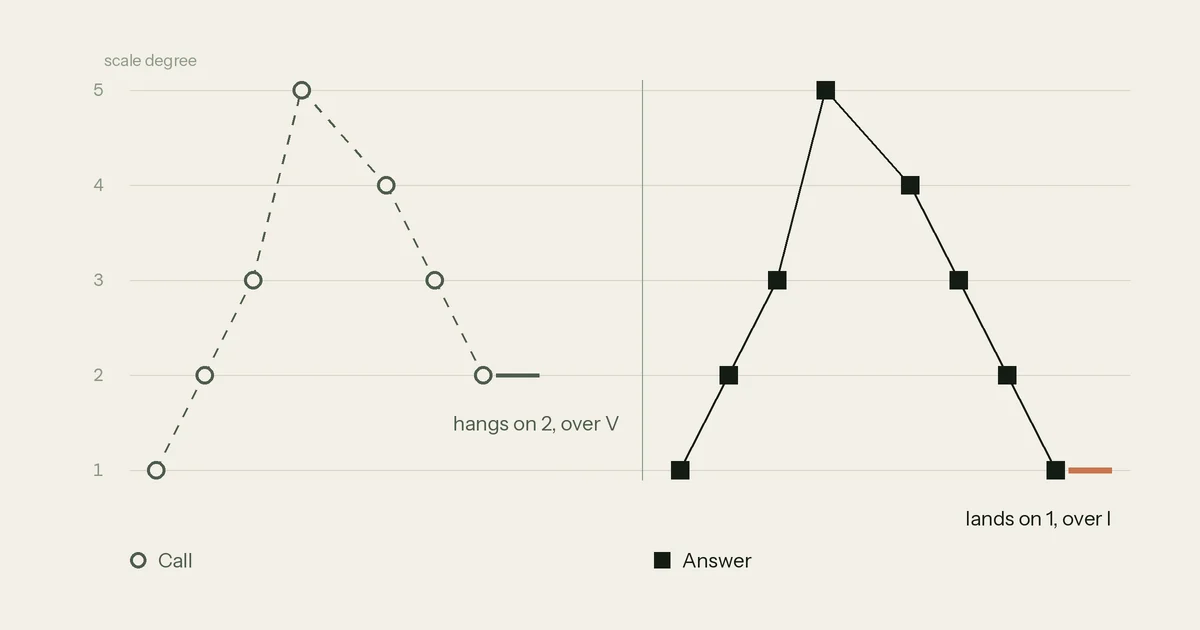
A response sounds like an answer when it lands somewhere the call did not. The call stops on an unstable note, usually scale degree 2, 5 or 7, over a chord that wants to move. The answer starts the same way, then closes on scale degree 1 over the home chord and holds it.
That rule comes straight from Chenette: in the common "question and answer" pairing, "the call and the response both start the same, but then they end differently," with the call often ending on 2 or 7 and the response "most often" ending on 1. Everything else in the answer can move. The ending is the part that cannot.
Where should the answer land?
On the tonic, held. "Twinkle, Twinkle, Little Star" is the pair at its simplest. "Twinkle, twinkle, little star" climbs and stops on "star", which is scale degree 5. "How I wonder what you are" walks back down one step at a time and lands on 1. Sing the first line and stop, and you can hear the second one being asked for.
The chord under the landing matters as much as the note. Robert Hutchinson's Music Theory for the 21st-Century Classroom splits cadences into conclusive ones, which end on the tonic chord (V to I, IV to I), and inconclusive ones, which do not (a half cadence ending on V, or V to vi). Scale degree 1 over the I chord closes the pair. The same note over a IV or vi chord still sounds open, which is why an answer can go wrong even when the melody is right. If you want to check what is actually under your line, how to harmonize a melody walks through reading the chord from the tune.
Should the answer keep the call's rhythm?
Usually, and this is the most useful thing to know when you are stuck. In a parallel period, the most common question-and-answer pair, Hutchinson notes that "the melodies in both phrases begin similarly." Keep the call's rhythm, and the second phrase sounds like a reply to the first rather than a new idea arriving. Change the pitches over that rhythm, and you get a different reply to the same question.
The exception is the last note. An answer that lands on 1 usually holds it, and that means the answer's final note is longer than the call's. If you copy the call's rhythm exactly, the ending will feel clipped. Keep the first half of the rhythm, and let the last note stretch to the bar line.
The other option is what Chenette calls a complementary pair: two phrases that do different things that seem to go together. His example is a call that starts on 5 and walks down to 1, answered by one that starts on 5 and climbs to 1. He notes that complementary phrases are harder to give advice on than question-and-answer ones, so try the parallel answer first.
What does the data say about how phrases end?
The rule holds up in a large set of real songs. Shuqi Dai, Huan Zhang and Roger B. Dannenberg at Carnegie Mellon analysed the phrase structure of 909 Chinese pop songs from the POP909 dataset, spanning seven decades, and looked at what happens where phrases end.
What 909 pop songs do at phrase ends
- V is the more common last chord of a phrase in the middle of a section. I is the more common last chord at the end of a section.
- In major keys, 58% of progressions at the end of a section are V to I, an authentic cadence.
- Only 6.4% of whole notes or longer fall at the end of a phrase in the middle of a section. 72% fall at the end of a phrase that closes a section.
- Over a I chord in major keys, scale degree 1 in the melody tends to arrive at the ends of sections, not at the start or middle of phrases.
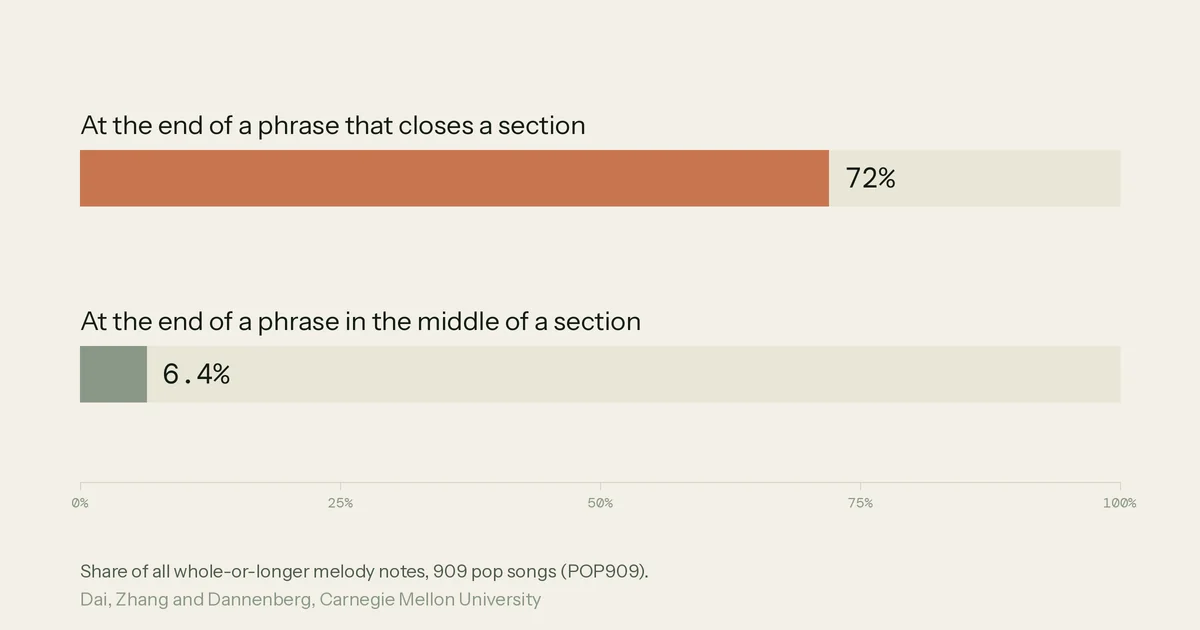
The authors draw the link themselves: half cadences turn up at phrase ends in the middle of sections, "consistent with the music theoretic concept that a half cadence calls for continuation." In songwriting terms, the call ends on V, the answer ends on I, and the answer's last note is the long one.
How does call and response relate to antecedent and consequent?
Antecedent and consequent is the classical name for the same pair. The antecedent is a phrase that ends on a weaker cadence, usually a half cadence on V. The consequent follows it and ends on a stronger cadence, usually V to I. Together they make a period, and Hutchinson describes the two as being in a "question and answer" relationship.
Hutchinson defines a period as "at least two phrases with the final phrase ending in a more conclusive cadence than the first phrase." His textbook example is the theme of Mozart's Piano Sonata K. 331, where the first four bars end on a half cadence and the next four close with a perfect authentic cadence. He also analyses Bill Withers' "Lean on Me" (1972) as a period, with a less conclusive cadence followed by a more conclusive one, which is a useful reminder that this is not a classical-only device.
Periods come in two kinds, and they map directly onto the two ways of writing an answer:
- Parallel period. Both phrases begin the same way and end differently. This is the answer that keeps the call's rhythm and opening notes, and changes the ending.
- Contrasting period. The phrases begin differently. This is the answer with a new shape that still closes on the tonic.
A period also sets the rule for when an answer should not resolve. Hutchinson's two standard patterns are a half cadence followed by an authentic cadence, or an imperfect authentic cadence followed by a perfect one. The second phrase is always the more closed of the two. If there is another pair still to come in the section, the answer can close less firmly than it will at the section's end, which is exactly what the Carnegie Mellon numbers show.
How do you write the answer to your own phrase?
To write the answer to your own phrase, stop the call on 2, 5 or 7 so it hangs, and leave a gap after it. Then sing the call's opening again in the same rhythm, bend the ending down to the tonic, and hold that last note to the bar line. Keep the answer the same length as the call.
Here is the method, start to finish, for one singer writing both halves.
- Sing the call and stop where it hangs. Record the first phrase on its own. If it already ends on the tonic, it is not a call yet. Move its last note to 2, 5 or 7 until the silence after it feels like a question.
- Leave room. The answer needs a gap to land in. If the call runs right up to the bar line, trim its last note, or start the answer on the next bar.
- Pick parallel or contrasting. Parallel is the safe first try: sing the call's opening again, same rhythm.
- Change the ending, not the start. Keep the first half of the answer close to the call. Bend the second half towards the tonic.
- Land on 1 and hold it. The last note should sit on the tonic, over the home chord, and ring to the end of the bar. The data says the answer's last note is the long one.
- Match the length. A four-bar call wants a four-bar answer. An answer that runs longer than its call starts to sound like a new idea.
A worked pair, in scale degrees
Call: 1 2 3 5 | 4 3 2 (held). Ends on 2, over a V chord. It hangs.
First try at an answer: 5 4 3 2 | 3 4 5. Different rhythm, ends on 5. Two questions in a row; nothing closes.
Better answer: 1 2 3 5 | 4 3 2 1 (held). Same start, then one extra step down to the tonic, over a I chord. The pair closes.
Once that works, go back and vary the answer's middle. The opening and the landing hold the pair together, so the notes between them have room to move. How to vary a melody without losing the tune covers which changes keep a phrase recognisable and which ones break it.
Can software write the answer for you?
Not from nothing, and you should be wary of anything that claims to. What a tool can do is take the call you sang and deal you answers built out of it, which is a quick way to hear options you would not have sung yourself.
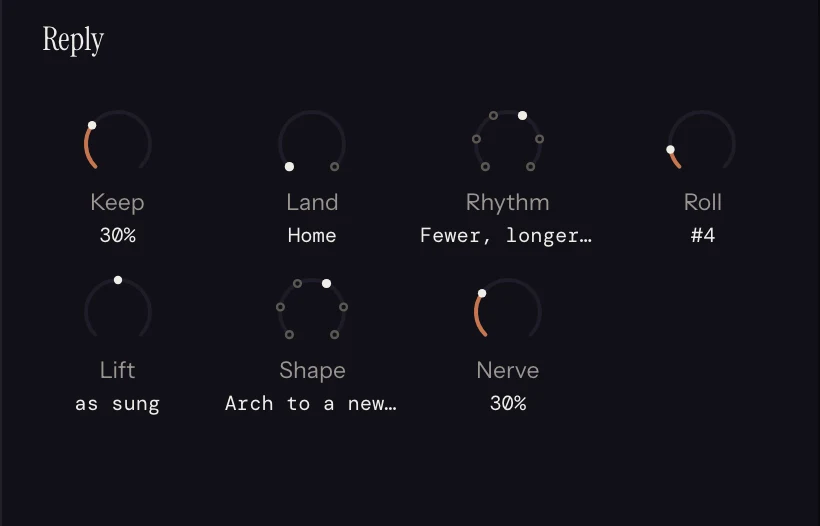
Melody Rack is a separate product from Song Cage: a MIDI effect plugin (AU and VST3, Mac and Windows) that sits in front of the instrument on a DAW track. You sing a phrase into it and its Reply effect writes the second half after your take, in the same length, without replacing anything you sang. Its controls follow the theory above. Land set to Home closes the answer on the tonic (or on the root of a chord you picked for that bar) and holds it to the bar line; set to Open, it stops on the fifth, second or seventh over V, which is the antecedent's half cadence. Rhythm can keep your rhythm as sung, repeat its first half, or use fewer, longer notes. Shape can follow your contour, mirror it, or arch to a new peak. Roll deals another answer, and the effect names the shape and rhythm each roll used, so you can keep the one you like. It makes no sound of its own, so it plays through whatever instrument is on the track.
How do you write an instrument fill that answers the vocal?
An instrument fill answers the vocal when it starts after the last sung word, stops before the next line, and resolves to the chord it is sitting on. The 12-bar blues builds that gap into its form, which is why it is the easiest place to learn the move.
The 12-bar blues is the model, because its lyric form builds the gap in. As the PBS essay on the 12-bar form explains, the lyric runs AAB: a line, the same line again, then a line that answers it. Each of the three lines gets four bars. The Western Washington University popular music text describes the split inside each line: the singer takes roughly the first two bars, and an instrumental fill responds in the rest.
That gives you three rules for any fill that answers a voice, in any style:
- Start after the last sung word, not on it. The fill is the answer, so the call has to finish first.
- Stop before the next line. A fill that runs into the vocal is no longer answering it.
- Land on the chord you are on. In a 12-bar blues, the fills in bars 3 and 4 and bars 7 and 8 sit over the I chord, so they resolve to it. The fill in bars 11 and 12 is the turnaround and heads back to V, because another verse is coming.
The same thinking works for a synth answering a vocal hook in a pop chorus or a guitar lick between the lines of a verse. Keep the fill shorter than the line it answers, and give it the rhythm of the vocal it follows if you want the two to sound like a conversation. If you want the second part to have a life of its own under the voice rather than in its gaps, that is a different job, covered in how to write a countermelody.
What are the most common call and response mistakes?
- The answer steps on the call. If the reply starts before the call's last note has finished, the call never gets to sound like a question. Leave at least a beat.
- The answer never lands. Two phrases that both end on 5 are two questions. One of them has to close.
- The answer is a copy. Repeating the call exactly, ending and all, is a repeat, not a reply. The ending has to change. The hook post covers when a straight repeat is the right choice, and it usually is not in the second half of a pair.
- The answer is a different song. A new rhythm, a new range and a new shape all at once breaks the link to the call. Change one thing at a time.
- The answer ends on the right note over the wrong chord. Scale degree 1 over a IV or vi chord is still open. Check the harmony under the landing.
For the step before all of this, getting the first phrase in the first place, how to write a melody covers shape, range and where phrases breathe.
Frequently Asked Questions
What is an example of call and response in music?
"Hit the Road Jack" (1961) is the clearest example: Ray Charles sings a line and Margie Hendrix of the Raelettes answers it, all the way through the song. Other well-known examples are The Who's "My Generation", where the band answers each line with "Talkin' 'bout my generation", and Aretha Franklin's "Respect", where her sisters answer with "just a little bit."
Does call and response need two people?
No. One singer can ask and answer within a single melody, which is the question-and-answer phrase pair. An instrument can also answer a voice, as a guitar fill does in the gap after a blues vocal line. What makes it call and response is the relationship between the two phrases, not the number of performers.
What note should a response end on?
Usually the tonic, scale degree 1, over the home chord, and held longer than the notes before it. The call it answers usually ends on 2, 5 or 7 over a V chord. If another pair of phrases follows in the same section, the answer can stay slightly open and save the firmest landing for the end of the section.
What is the difference between antecedent and consequent?
The antecedent is the first phrase of a period and ends on a weaker cadence, usually a half cadence on V. The consequent is the second phrase and ends on a stronger cadence, usually V to I. They are the classical names for a question phrase and its answer.
Is call and response the same as an echo?
No. An echo repeats the phrase it follows. A response changes it, usually by keeping the rhythm and opening and moving the ending to the tonic. If the second phrase could be swapped for the first without anything sounding different, it is an echo.
Sing the call. Roll the answer.
Melody Rack writes the second half of a phrase out of the first, in your rhythm and your range, and lets you roll for another until one is the tune.