
Say "home" out loud and look for a rhyme. The dictionary offers comb, dome, foam, roam, gnome, chrome and tome. The word your song probably wants is "alone", and it isn't on that list. It nearly rhymes, and that's enough once somebody sings it.
What is a slant rhyme?
A slant rhyme is a pair of words that sound alike without matching exactly, such as "home" and "alone". Usually the vowel matches and the ending differs, or the ending matches and the vowel differs. It's also called a near rhyme, half rhyme, imperfect rhyme or off rhyme, and songwriters use those names for the same thing.
A perfect rhyme needs the stressed vowel and every sound after it to match, with a different sound in front: "night" and "light". Change any of those matched sounds and you have some kind of slant rhyme.
The definition depends on who's asking. Britannica keeps half rhyme narrow: two words that share only their final consonant sounds, like "stopped" and "wept". LitCharts records the broader modern meaning, which also takes in words that share a vowel. Songwriters use the broad one, and so does this post. If you're writing for a poetry class, check which definition your teacher means.
Slant describes how close the sounds are. It says nothing about where the words sit in the line, so a slant rhyme can land at the end of a line or inside it.
What are the types of slant rhyme?
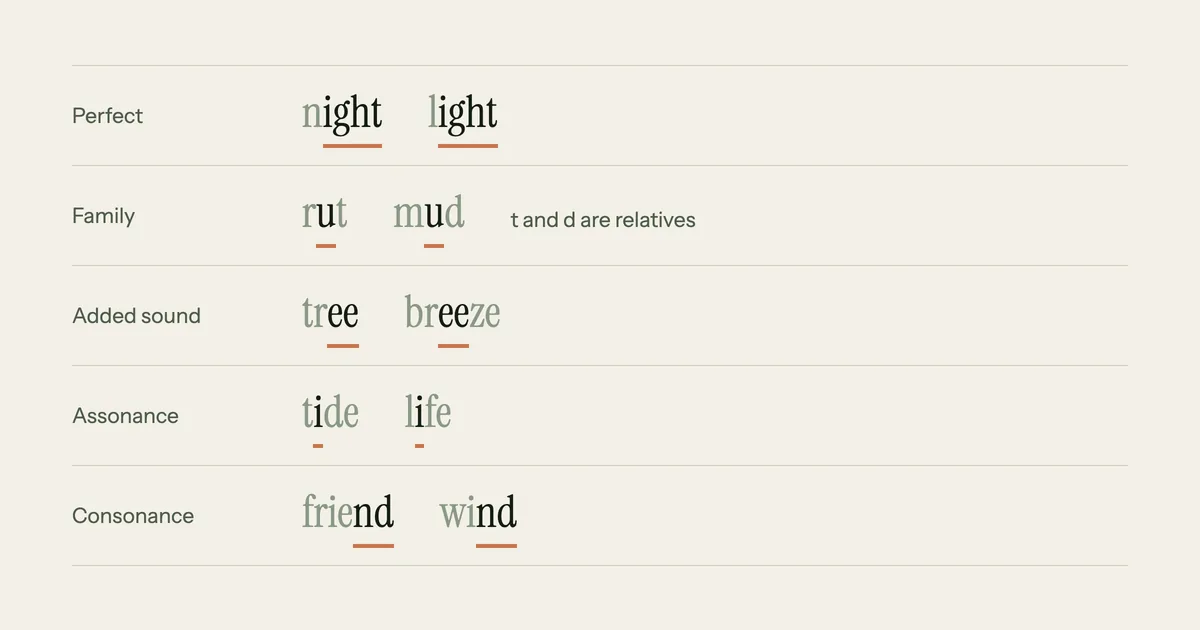
The usual split is two types, assonance and consonance. Pat Pattison, who teaches lyric writing at Berklee, uses a finer scale that runs from the most settled rhyme to the least: perfect, family, additive and subtractive, assonance, consonance. Each step closes the line less firmly.
The order below is Pattison's scale as taught at a 2008 seminar, with its examples where it gives them.
| Type | What matches | Example | How it feels |
|---|---|---|---|
| Perfect | Stressed vowel and everything after it | night / light | Finished |
| Family | Vowel, plus an ending from the same consonant family | rut / mud | Nearly finished |
| Additive or subtractive | Vowel, with a consonant added or dropped | tree / breeze | Mostly finished |
| Assonance | Vowel only | tide / life | Open |
| Consonance | Ending only, with a different vowel | friend / wind | Unsettled |
The "how it feels" words are mine. Pattison's own scale runs from most resolved to least resolved.
What is a family rhyme?
A family rhyme swaps the final consonant for a close relative. Pattison groups them into three families. Plosives and fricatives have voiced and unvoiced sides, and nasals are all voiced:
The consonant families
- Plosives, which stop the air: b, d, g and p, t, k. So rub, thud, bug, up, putt and stuck all family-rhyme.
- Fricatives, which squeeze the air: v, th, z, zh, j and f, th, s, sh, ch. So love, buzz, judge, fluff, fuss and hush.
- Nasals, which send it through the nose: m, n, ng. So strum, run and sung.
This is the most useful type to learn first, because the swap is easy to miss once it's sung. "Love" stops being limited to "above" and "dove" as soon as "judge" and "grudge" are on the table.
Are there other kinds of near rhyme?
Two more turn up in songs. A stressed-to-unstressed rhyme pairs a strong syllable with a weak one, as "slow" answers "follow". The linguist Arnold Zwicky calls this light rhyme, and his example is Bruce Springsteen rhyming "kiss" with "tenderness". An extra-syllable rhyme matches the stressed part and lets one word run on, like Zwicky's "face" and "places" from Ringo Starr and George Harrison's "Photograph".
Poets also use pararhyme, where the consonants on both sides of the vowel hold and only the vowel moves. Wilfred Owen's "Strange Meeting" rhymes "groined" with "groaned". That's mostly a poet's device. It's hard to hear once it's sung, for the reason in the next section.
Why does slant rhyme work when you sing it?
Singers exaggerate vowels, so the vowel does most of the rhyming. Two words that share a held vowel can sound like a rhyme even when their endings differ. That's also why consonance, the type that changes the vowel, is the hardest slant rhyme to hear in a song.
Pattison puts it this way: "Remember, lyrics are sung, not read or spoken. When you sing, you exaggerate vowels." A pair that looks wrong on the page can pass without comment over a band, so judge a slant rhyme by singing it.
A rhyme study points the same way, though nobody in it was singing. In a talk given in 2011, Sverre Stausland Johnsen reported asking 72 American English speakers to rate 77 written imperfect rhymes from 1 to 7. How similar two sounds are to the ear predicted the ratings better than how similar they are in the mouth.
Songwriters and poets also favor different swaps. The same talk reports that 83% of the imperfect rhymes in one study of English poets involved a fricative voicing mismatch, like s against z. Rock went another way. Zwicky's count of rhymes that swap one consonant for a close relative found 49% were nasals: m with n, or n with ng. That means "time" with "line", and "home" with "alone". If you're listening for one swap in rock songs, listen for that one.
How often do songs use slant rhyme?
A lot, and one type dominates. In a 1976 paper on rock lyrics, titled after a rhyme of "stop" and "rock", Arnold Zwicky went through many thousands of lines, mostly Bob Dylan and the Beatles, and counted the imperfect rhymes by type:
| Type | Examples Zwicky found |
|---|---|
| Assonance (vowel matches) | About 600 |
| Consonance (ending matches) | About 100 |
| Light and extra-syllable rhymes | Fewer than 12 of each |
Zwicky's rough counts, from one writer's reading of mostly 1960s and 70s lyrics. Treat the proportions as a guide rather than a census.
He also noticed that the consonants in these rhymes tend to stay close to each other. Writers mostly weren't pairing any two endings at random. They were making small moves like "stop" with "rock", which is close to the family idea Pattison later taught. Zwicky's name for this looser system was "rock rhyme".
What are examples of slant rhyme in songs?
These pairs all come from named sources, so you can check them and hear them for yourself.
| Song | Slant rhyme | Source |
|---|---|---|
| "Meant to Be", Bebe Rexha featuring Florida Georgia Line | back / relax / dash / fast / at | Two Story Melody |
| "Hell on Heels", Pistol Annies | heart / card, hand / man | A Linguist in the Wild |
| "Merry Go 'Round", Kacey Musgraves | twenty-one / die alone | Song Chops |
| "Up the Junction", Squeeze | happen / Clapham / common / forgotten | Wikipedia |
| "God Save the Queen", Sex Pistols | queen / regime | Wikipedia |
| "Mr. Tambourine Man", Bob Dylan | sleepin' / dreamin' | Zwicky |
| "Elderberry Wine", Elton John | wine / times | Zwicky |
| "Blackbird", the Beatles | night / fly / life / arise | Zwicky |
"Blackbird" shows a trick Zwicky calls linking. "Night", "life" and "arise" share a vowel but end on unrelated consonants (t, f, z). Each one connects to "fly", which has no ending at all, so the ear accepts the whole set. "Meant to Be" does something similar by stacking five words on one vowel. As Sam Gaffigan points out at Two Story Melody, the repetition teaches your ear what it's listening for.
In poetry, a standard example is Emily Dickinson's "soul" and "all" from "'Hope' is the thing with feathers".
How many more words does slant rhyme give you?
In Song Cage's word lists, 725 of the 5,000 most frequent English words have no perfect rhyme, and 1,652 have fewer than five. Slant rhyme is often the only route to the word you mean: "woman", "music", "family" and "something" are all on the no-rhyme list.
That's in line with the count in our rhyme scheme guide, where 424 of the commonest 3,000 words had no perfect rhyme. We ran these lookups for a few words songs lean on, or famously can't rhyme. The Close and Wide columns are the first few results from the two looser steps in Song Cage's Words panel.
| Word | Perfect rhymes | Close | Wide |
|---|---|---|---|
| love | of, above, shove, glove, dove | judge, grudge, buzz, fuzz | just, up, one, enough |
| life | wife, knife, strife, fife, rife | nice, ice, price, twice | like, right, time, night |
| world | curled, hurled, unfurled, swirled, twirled, whirled | girl, pearl, curl, whirl | first, work, heard, turn |
| baby | maybe | crazy, lady, lately, lazy | daydreams |
| month | None | once, lunch, bunch, punch | just, come, some, much |
| silver | None | sister, dinner, picture, river | interns, lizards, wizards |
| orange | None | lozenge, organs, orphans | important, normal, forest |
Counted on November 9, 2026, leaving out abbreviations and archaic words such as "thereof". A big unabridged dictionary can turn up a stray rare rhyme, and pronunciation varies by accent.
Look at "life". The perfect list has "wife", "knife" and "strife", and every song using them has already told you where it's going. One step out, you can sing about "price" and "twice".
When should you use a slant rhyme instead of a perfect rhyme?
Use a perfect rhyme when the line should feel settled, and a slant rhyme when the thought is still open or the perfect rhyme would change what you're saying. Seminar notes record Pattison calling rhyme type "a film score that comments on the idea", so the choice is part of the meaning.
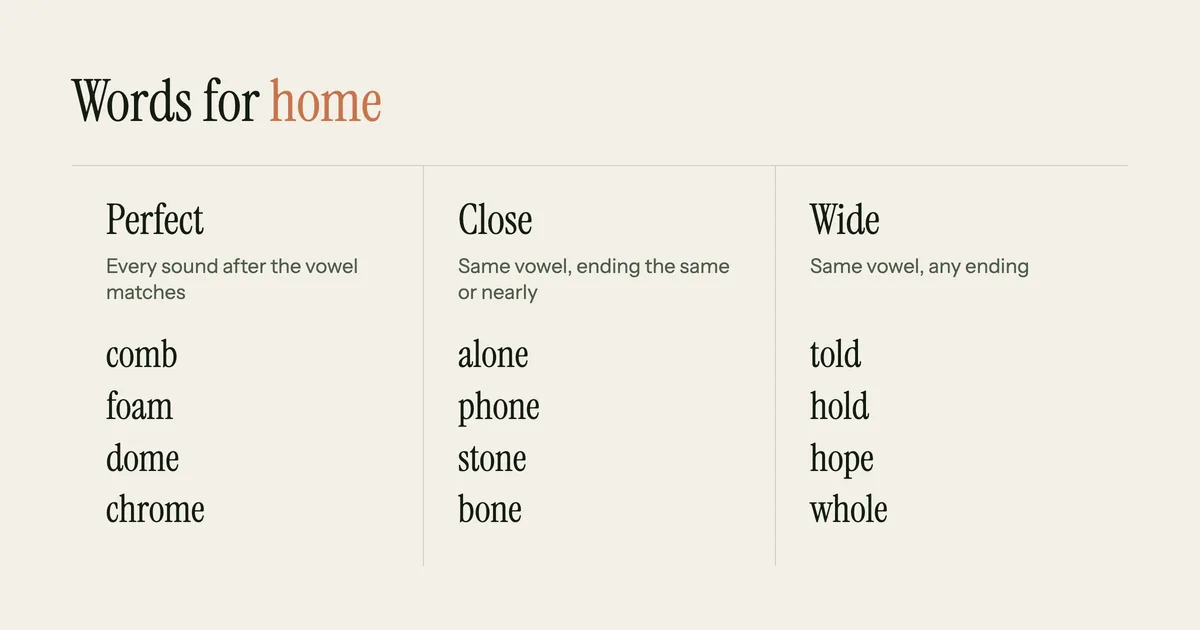
Try one setup line with three different answers. These are written for this post, and they aren't from any song:
You said you'd call when you got home...
- Perfect: I watched the tide pull back the foam. It closes neatly, and now there's an ocean in the song because the rhyme needed one.
- Close: I'm sitting here beside the phone. This is what the singer would actually be doing, and the pair still lands.
- Wide: I'm sitting here and losing hope. It connects but doesn't click shut, which suits a call that hasn't come.
A few working rules follow from that:
- Say the true thing first. If the perfect rhyme drags in a new image just to rhyme, take the slant one.
- Close on the line that matters. A perfect rhyme on a title or the last line of a chorus sounds like an ending. Save it for a place that should sound like one.
- Hide the loosest pairs mid-section. Song Chops makes this point about "Merry Go 'Round": a near rhyme in a non-critical spot passes without notice, while one on a key couplet sticks out.
- Leave a section open on purpose. A loose rhyme at the end of a verse can carry the listener into the chorus.
- Stack the vowel if a pair feels weak. Three or four words on the same vowel teach the ear the pattern, as "Meant to Be" does.
Slant rhymes count as rhymes when you're mapping a rhyme scheme, so a loose pair doesn't break an ABAB. They also have to fit the notes, and stress matters as much as sound. If a pair rhymes on paper and still fights the tune, the trouble is usually how the words sit on the melody.
How do you find a slant rhyme?
Start from the sound, and ignore the spelling.
- Find the stressed vowel in your word. In "follow" it's the "ah" of "fol". Say it out loud, because spelling will mislead you: "love" and "move" look alike and don't share a vowel.
- Try that vowel with the ending's relatives. Use the families above. For "safe", Pattison goes through "faith" and "case", then "brave", "praise" and "cage". He says fricative families can usually quadruple your options.
- Add or drop a sound. "Free" opens up to "trees" and "peace".
- Let the ending go. Keep only the vowel, and accept that the line will sit more open.
- Sing the pair on the actual notes. If it passes at full voice, it's a rhyme.
You can do this by hand, or use a rhyme tool that lists near rhymes. In Song Cage's web, desktop and plugin versions, the Words panel has a switch with three steps: Perfect, Close and Wide. Close covers family rhymes and added or dropped sounds, then last-syllable rhymes such as "slow" for "follow". Wide keeps only the vowels. If the word you've selected has notes under it, words that fit move to the top under a heading like "Fits 2 notes". The phone app has a Rhyme and Slant bar above the keyboard.
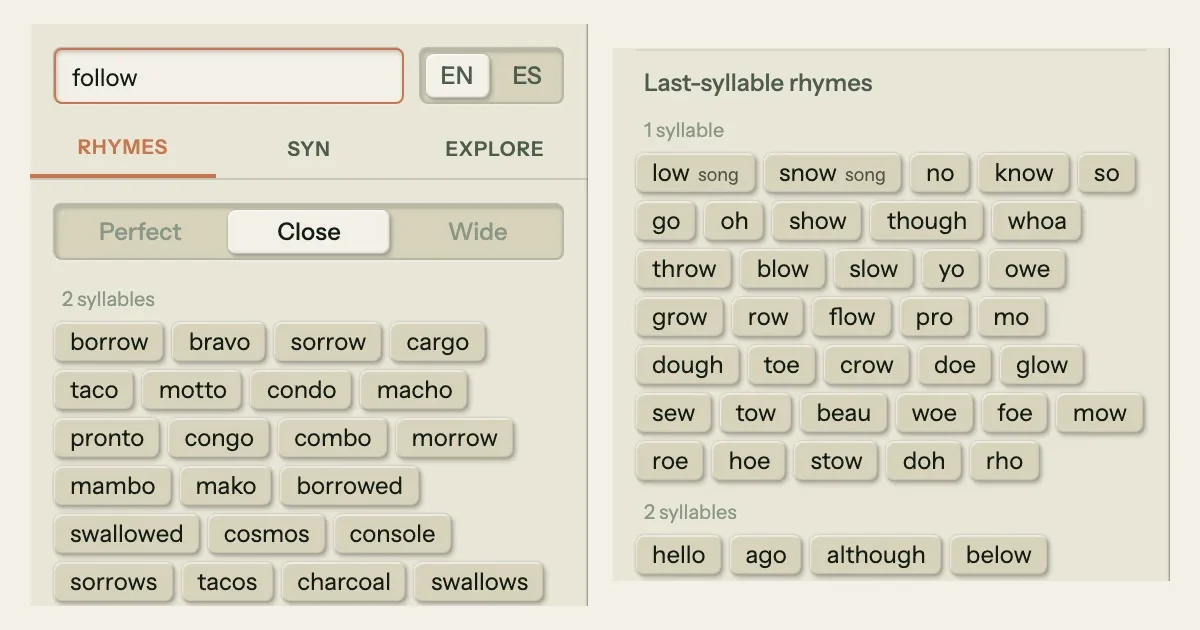
Both looser steps keep the stressed vowel, so neither will suggest a consonance pair like "friend" and "wind". For those you still need your own ear, which seems fair given how rarely they work when sung.
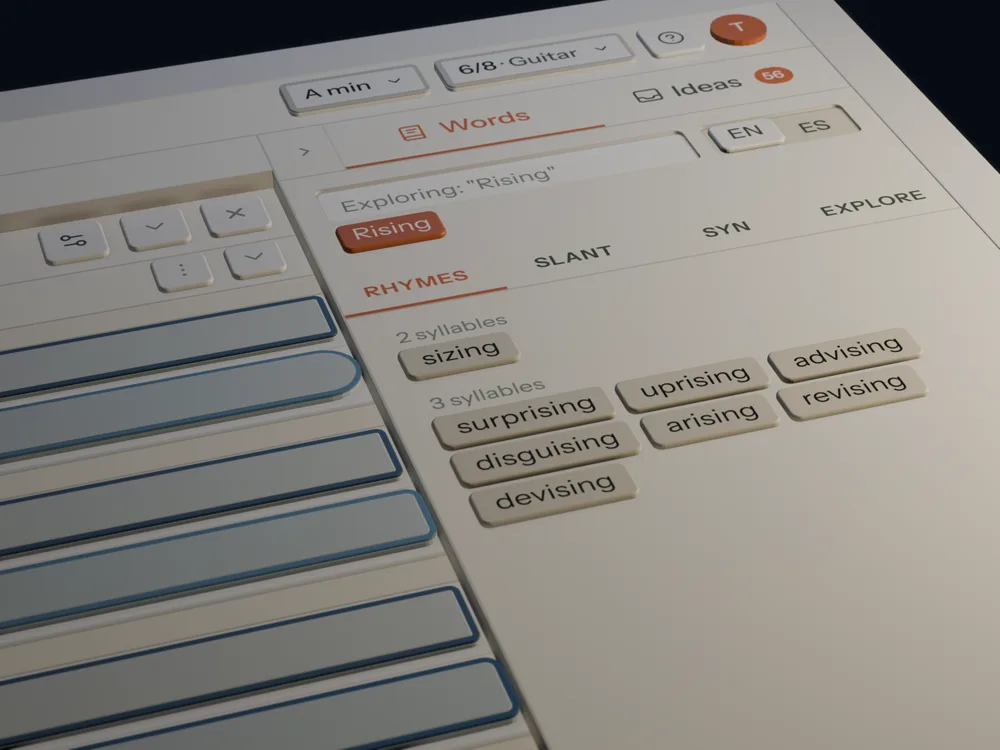
Find the word you meant, not just the word that rhymes
Click a word in your lyric and Song Cage shows its rhymes grouped by syllable count. Move the switch from Perfect to Close to Wide when the exact rhymes aren't what the song wants.
Frequently Asked Questions
Is a near rhyme the same as a slant rhyme?
For songwriting, yes. Slant rhyme, near rhyme, half rhyme, imperfect rhyme and off rhyme all mean words that almost rhyme. Some literary sources define half rhyme more narrowly: Britannica limits it to words that share only their final consonant sounds, like "stopped" and "wept".
What is an example of a slant rhyme?
"Home" and "alone" share a vowel and end on related sounds, so they almost rhyme. "Heart" and "card" do the same in the Pistol Annies' "Hell on Heels". In poetry, a standard example is Emily Dickinson's "soul" and "all", which share the final l but not the vowel.
What is the difference between a perfect rhyme and a slant rhyme?
A perfect rhyme matches the stressed vowel and every sound after it, as in "night" and "light". A slant rhyme matches only some of those sounds, as in "night" and "life". Perfect rhymes sound more finished, and slant rhymes leave a line more open.
Is slant rhyme the same as assonance?
Not quite. Assonance is a repeated vowel sound anywhere in nearby words. When it falls in the rhyming position, such as "tide" and "life" at the ends of two lines, it works as one type of slant rhyme. Consonance and family rhyme are other types.
What's the difference between a slant rhyme and an eye rhyme?
A slant rhyme is about sound, and an eye rhyme is about spelling. "Love" and "move" look as if they should rhyme, but their vowels are different. A listener can't see the spelling, so an eye rhyme does nothing for a sung lyric unless the two vowels happen to sound close.
Is using slant rhyme lazy?
No. "Lazy rhyme" is one of its other names, and a loose rhyme can be lazy if nothing was chosen. But the choice can be deliberate: Bob Dylan and the Beatles used it throughout the lyrics Arnold Zwicky studied. Songwriters still disagree. Irving Gordon was ashamed of a t-and-d rhyme in "Unforgettable", and Warren Zevon preferred imperfect rhymes. Our rhyme scheme guide covers that argument.
Does anything rhyme with orange?
Nothing in everyday English rhymes perfectly with "orange". Near rhymes work, though. Song Cage's Close step offers "lozenge", "organs" and "orphans", and Eminem bent it to "door hinge" on 60 Minutes in 2010.