Table of Contents
- What makes a melody recognisable in the first place?
- What can you change without losing the tune?
- Why is a new rhythm cheap but a flattened one expensive?
- How much should you repeat, and how much should you change?
- How do you find the skeleton of your own loop?
- How do you reduce an eight-bar loop to its skeleton?
- Do real songs actually do this?
- What is the cheapest useful change?
- Can you make a new section by changing only the chords?
- Why do inversion and retrograde sound wrong when you try them?
- What does the research not tell you?
- Where Melody Rack fits
- Frequently Asked Questions
You have an 8-bar loop and it is good. The chords sit right, the melody does what you wanted, and you have played it back forty times. Now you need a second section, and everything you try lands in one of two ditches: it is the same bar again with a different sound on it, or it is a completely different song stapled to the front of this one.
The advice you will find for this is about arrangement. Strip the drums, add a riser, automate a filter. That advice is fine and it does not touch the problem, because the problem is the tune. You need a second melody that a listener hears as the same idea in a new place.
That is a solvable problem, and it has been studied for fifty years by people asking a related question: what has to stay the same before a listener stops recognising a tune at all?
Quick summary
Melodic variation works when it keeps the right things. A melody holds its identity through a small number of features, and the research says which ones. Its short characteristic motif and its contour do most of the work. Its exact interval sizes do much less than people assume, and its rhythm can be swapped for a different rhythm more safely than it can be flattened. So the reliable move is to keep the phrase's skeleton, meaning the two or three notes a bar that carry it, and rewrite everything hung between them. Change the skeleton and you have written a different tune, which is sometimes what you want and is never what you want by accident.

What makes a melody recognisable in the first place?
A tune is carried by its contour and by one short characteristic motif, not by its exact intervals. In a study of familiar melodies, listeners identified 99% of undistorted tunes, 59% when the intervals were changed but the pattern of ups and downs was kept, and 28% when that pattern was destroyed. The shape is doing most of the work.
Those numbers come from W. Jay Dowling and Diane Fujitani's 1971 experiment in the Journal of the Acoustical Society of America, using five familiar folk tunes stripped to a common rhythm so that only the pitches were doing the identifying. Chance in that task sits somewhere between 20 and 30%. Keeping the relative sizes of successive intervals as well as the contour recovered a little, to 66%, and the worst condition is the instructive one: it kept the first note of every bar and the harmony underneath, and destroyed the contour. That was enough to take listeners most of the way to guessing. Correct chords under a phrase will not save a tune whose shape has gone.
The second finding is less famous and more useful. Anja Volk and Peter van Kranenburg had domain experts judge 360 Dutch folk melodies grouped into 26 tune families, deliberately choosing hard cases: their paper notes that "'Easy' tune families have not been selected." What predicted an expert calling two melodies the same tune was not the overall shape. It was "the recurrence of short characteristic motifs", while "global melodic features often used for the description of melodies (such as melodic contour) play a less important role."
That is the opposite of what most songwriting articles say, and it is the more actionable of the two. Your loop has a signature cell in it, probably one bar long. Keep that intact and you have a lot of freedom everywhere else.
What can you change without losing the tune?
Transposition and instrumentation cost nothing. Rhythm, ornament and interval size cost a little. The opening motif, the metric placement and the contour cost a great deal. Nobody has published a definitive ranking of these, so treat the ordering below as bands rather than a ladder.
That caveat is not modesty. Rainer Typke, Frans Wiering and Remco Veltkamp built the reference ranking later used for the MIREX melodic similarity task by putting 22 queries and roughly 50 candidates each in front of about 30 music experts drawn from a panel of 37. What came back was only a partial order, with melodies falling into groups whose ranks could not be separated. Their explanation is the honest ceiling on any list like the one below: "for some alternative ways of altering a melody, human experts simply do not agree on which one changes the melody more, so even increasing the number of experts might not always avoid situations where the ground truth contains only groups of matches whose correct order is reliably known."
Most music theory for songwriters stops at naming the techniques. This is the part that says what each one costs you, in four bands, each with the study that puts it there.
| Band | Change | What the evidence shows |
|---|---|---|
| Free | Transpose the whole phrase; change instrument, tempo, dynamics, articulation | Transposition invariance is the assumed baseline in every study here. Hébert and Peretz call timbre and tempo "secondary" rather than determining factors. |
| Cheap | Give the phrase a different rhythm; ornament it inside the scale and metre; widen or narrow the intervals while keeping the contour and the key | Swapping in another tune's rhythm cost nothing measurable (53% naming, against 49% for the same melodies flattened). Listeners were at chance telling an exact transposition from one with the same contour, same key, different interval sizes. |
| Costly | Flatten the rhythm; shift the pitches against the rhythm; move notes off the strong beats and phrase ends; break the signature cell; alter the first few notes | Identification of familiar songs fell from 85% to 55% when rhythm was flattened, and to 68% from a one-note shift of pitches against rhythm with nothing else touched. |
| A different tune | Destroy the contour; change pitch and rhythm together, chromatically and off the metre | Contour-destroyed familiar tunes fell to 28%. Chromatic-plus-unmetred transformations were rated as dissimilar to the original as a completely unrelated melody was. |
Sources, band by band: Dowling 1978; Hébert and Peretz 1997; Schulkind 1999; Dowling and Fujitani 1971; McAdams and Matzkin 2001. Each is linked where the section below discusses it.
Why is a new rhythm cheap but a flattened one expensive?
Because those are different operations, and two studies that look contradictory are measuring different things. Giving your phrase a real rhythm that is not its own leaves it recognisable. Giving it no rhythm at all, so every note is the same length, strips out something listeners store alongside the pitches.
Sylvie Hébert and Isabelle Peretz built chimeras: each familiar tune played with a different familiar tune's rhythm. Listeners still named 53% of them, against 49.2% for the same melodies made isochronous, and the authors concluded in Memory & Cognition that "there was no evidence of a decrement in recognition and naming relative to when the melodic pattern was presented without rhythmic variations."
Matthew Schulkind ran the mirror image and got the number that stops you being careless. Twenty well-known songs, pitches never touched, four rhythmic manipulations. Free identification: 85.2% as written, 68.1% with the pitches shifted one serial position against the rhythm, 55.5% isochronous, 45.2% with a random rhythm. His conclusion was that rhythm is stored in long-term memory alongside the tune.
Read together: rhythm is a poor way to find a tune from nothing, and a good way to lose one. Rewrite it into another shape and you are fine. Erase it and you are not.
The one-note finding, and why it should change how you nudge things
Schulkind's most quotable condition kept the pitches identical and the rhythm identical, and moved them against each other by a single serial position. Identification dropped seventeen points. His reading: "the relationship between the pitch and the rhythm of a melody is crucial for memory and perception."
The practical version is that dragging your melody a sixteenth to the left is not the small edit it looks like in a piano roll. It is one of the larger things you can do to a tune's identity while appearing to do almost nothing.
How much should you repeat, and how much should you change?
The evidence pulls in two directions, and both directions are worth knowing. Exact repetition makes listeners want to join in. It also makes them like what they are hearing less. Where you land between those is a decision about the section you are writing, not a rule you can look up.
Elizabeth Hellmuth Margulis ran 31 listeners with no formal musical training through six eighteenth-century rondos, in two versions: one where the performer shaded the theme a little differently on each return, and one digitally altered so every return was acoustically identical. Her result was that the identical version was rated as more repetitive and as having "made listeners more likely to move, sing, or tap along." Nobody was observed tapping, and verbatim repetition did not improve recognition memory. Margulis hedges it herself in Aeon, noting that classical rondos "provide very little opportunity for audience participation" in the first place.
Pushing the other way, Alexandru Popescu and Andrei Holman compared five kinds of within-song repetition on liking, beauty and interest in Musicae Scientiae. The verbatim stimuli were among the most fluently processed and the least complex, and were rated lowest on all three measures. "Exact repetitions render the musical piece as too simplistic."
The winner in that study is the part worth stealing. Alongside stimuli with no repetition at all, the highest-rated pattern was the rondo: a theme that keeps returning, with new material in between. It was rated as more complex than the verbatim version and still came out ahead on all three measures, because it repeats enough to be fluent and departs enough to stay interesting. That shape, an idea you come back to with something else between the returns, is what a verse and chorus already are. The question this article is answering is what the something else should be made of.
Arnold Schoenberg got to the same place without a laboratory, in Fundamentals of Musical Composition: "Repetition alone often gives rise to monotony. Monotony can only be overcome by variation." And then the passage this whole article is a footnote to, written in the 1940s and describing what the perception researchers spent the next fifty years measuring:
He does not tell you which features are the important ones, and says so: "determining which features are more important depends on the compositional objective." The bands above are the closest thing to an answer that has been measured since.
How do you find the skeleton of your own loop?
Reduce the phrase to the one or two notes per bar that carry it. Those are the notes that are longest, that land on strong beats, and that agree with the chord underneath. Everything else is decoration, and decoration is what you are free to rewrite.

Trevor de Clercq, who co-built the de Clercq and Temperley rock harmony corpus, calls this a melodic skeleton and uses it to teach reharmonisation. In Engaging Students he reduces the first eight bars of "Hey Jude" to scale degrees 3, 2, 4-1, 3, 6, 5, 5, 1: one or two per bar, across eight bars of a melody everyone can sing. His method is the useful part, and he is honest that it is "somewhat subjectively, I admit" done. The skeleton "simply identifies the most important melodic notes for each bar, typically those that are held for longer, occur on strong beats, or are chord tones in the original harmonization."
Do that to your loop and you will usually find three or four notes doing the work across eight bars. That is your constraint and your permission at the same time. Every technique in the melodic development toolkit, from ornament to sequence to reharmonisation, is a decision about what to hang on those notes.
How do you reduce an eight-bar loop to its skeleton?
Run four passes over the phrase, marking notes as you go, and keep whatever gets marked twice or more. The four signals are duration, metric position, agreement with the chord, and phrase ending, in that order of strength. Aim to finish with one or two marked notes per bar.
The four passes
- Length. Mark every note longer than the ones around it. A held note is a structural note almost every time.
- Beat. Mark whatever lands on beat one, then beat three. Metric position is the second-strongest signal after duration.
- Chord. Of what is left, mark the notes that are in the chord underneath them. Passing tones are decoration by definition.
- Breath. Mark the last note of every phrase. Phrase endings carry identification weight out of proportion to their length.
What is marked twice or more is a bone. If you end up with five in a bar, your reduction is too generous and the variation you build on it will just be the original again.
Do real songs actually do this?
Yes, and one of the most successful pop writers alive has a name for it. Max Martin calls it the Prince Theory: use the same melody for the verse and the chorus, change the lyrics, and let the arrangement carry the difference in energy.
He described it at a 2016 masterclass, reported by Swedish public broadcaster SVT, and named Prince's "Let's Go Crazy" as the model and Robyn's "Do You Know (What It Takes)" from 1997 as his own first application of it. He put it more bluntly to Dagens Industri, quoted by NME: "you can also sing the chorus melody as a verse. For instance, take 'I Wanna Be Your Lover' with Prince. The verse and chorus of that song are exactly the same. But as a listener, you don't really notice since the energy of the chorus is completely different."
A subtler version of the same trick runs through "Opalite" from Taylor Swift's 2025 album, written with Martin and Shellback. The analysis firm Hit Songs Deconstructed traces one melodic cell, an octave leap followed by a descending D-C-B-A, planted in the opening verse "disguised within the verse melody", doubled up per line in the pre-chorus, withheld in the first two chorus lines, reassembled in the third, delivered whole on the title line, and then restated in quarter notes instead of eighths. One cell, five costumes, and the listener experiences it as a song that keeps arriving.
Shaboozey's "A Bar Song (Tipsy)" does it with three notes. Hit Songs Deconstructed identifies a descending A-F#-E motif, scale degrees 3-1-7, that "appears throughout the verses, pre-choruses, choruses, and post-choruses, in both its proper form and in subtle variations": proper, fragmented to just 3-1, and transposed to 7-4-3 for the title hook.
What is the cheapest useful change?
Reverse the direction the phrase ends on. It is the smallest edit that turns a repeat into an answer, it leaves every other identifying feature untouched, and it has been sitting in plain sight on hit records for sixty years.
Alan W. Pollack's note-by-note analysis of "I Want to Hold Your Hand" describes the verse's first two phrases as a couplet in which each contains "the same harmony and even melody; the sole difference being that the first phrase melodically ends going down to F#, but the second goes up to that note (an octave higher than the first time)." Same phrase, one ending turned around, and the pair reads as a question and an answer.
The whole-song version of the same economy is "Norwegian Wood", which Pollack calls "admirably economical in terms of both form and content, with everything but the bridges being derived from the same hook motif". Even the contrasting bridges keep the parent contour: "the melodic gesture of those otherwise contrasting sections still remains prevailingly downward."
Can you make a new section by changing only the chords?
You can, and it is the least destructive option available, because it leaves the melody's every identifying feature untouched. The same phrase over a different progression does a different job in the song without asking the listener to learn anything new.
Drew Nobile documents exactly this in the Beatles, in Music Theory Online. In "Eight Days a Week", the phrase on "I ain't got nothing but love, babe" mimics the earlier "Ooh I need your love babe"; in "You Won't See Me", "And I will lose my mind" mimics "When I call you up". In both cases the returning phrase sits over a pre-dominant prolongation rather than the tonic one it started on. Same notes, different harmonic function, different feeling.
If you want the mechanics of putting new chords under a line you already have, that is the subject of harmonizing a melody.
Why do inversion and retrograde sound wrong when you try them?
Because they cost more recognition than the textbooks imply, and the cost is measurable. Against a baseline of 87% correct in Dowling's earlier melody-recognition work, turning a phrase upside down brought performance down to 70 or 73%. Playing it backwards brought it to 64%. Doing both at once was the condition listeners handled worst of all.
That is Dowling again, in a 1972 paper in Perception & Psychophysics devoted to exactly this question. Inversion and retrograde are the two operations most likely to be taught first in a lesson on motif development, and they are the two that a listener has the most trouble following. His finding was an ordering rather than a verdict: "the ascending order of difficulty was: inversion, retrograde, retrograde inversion." All three were recognised better than chance in the easier conditions, so the popular claim that nobody can hear a retrograde overstates the record. Dowling also limits his own scope, noting that the study does not attempt to show these transformations work "in actual music, but only the existence of one of the necessary conditions of that effectiveness."
Fred Lerdahl gives the cleaner explanation of why they disappoint in practice. In "Cognitive Constraints on Compositional Systems" he separates two kinds of operation: reordering the notes, and elaborating them. "Serialism is a permutational rather than elaborational system. Pitch relations in virtually all 'natural' compositional grammars are elaborational." Inversion and retrograde are permutations. They produce a relationship that is real on paper and that a listener's memory has no obvious way to represent.
Two honest qualifications. Inversion done diatonically, measuring the flip in scale steps rather than semitones, stays in the key and survives much better than the chromatic version, because it can only land on notes the key already contains. And a 2017 study by Ivana Bianchi and colleagues in Symmetry, with 180 non-musicians, found participants were more sensitive to retrograde than to inversion, and that performance improved when the stimuli had a rhythmic profile rather than equal note lengths. The research is not unanimous and the ordering above is a tendency, not a law.
What does the research not tell you?
All of it was measured on single melodies, heard once, in a laboratory, by listeners answering a questionnaire. None of it was measured on a song section arriving three minutes into a track you have heard before. Treat the numbers as a direction of travel rather than a specification.
Three specific limits are worth carrying. Dowling's famous contour result, the one that gets quoted as a general law, came from five-note novel fragments compared two seconds apart, and by 1991, testing seven-note melodies of varying tonal strength across delays, he had concluded the opposite of a clean separation: contour "is not an entirely separable feature of melodies but rather that a melody with its contour constitutes an integrated perceptual whole". The pitch-over-rhythm ordering reverses for unfamiliar material, which is precisely the songwriting case, since nobody has heard your tune before. And Cecilia Taher, Robert Hasegawa and Stephen McAdams, testing motives inside real musical context rather than in isolation, found that the context both helps and hinders recognition of a variation depending on surface contrast and where the variation falls in the form.
Stephen McAdams and Daniel Matzkin's own conclusion, after rating systematic transformations of three reference melodies, is the honest summary of the whole literature, and it is also the encouraging one: "the space of possible variation of thematic material that still maintains a link of perceptual similarity to the original is limited." Limited, and mapped well enough to work inside.
Where Melody Rack fits
Melody Rack is an AU and VST3 MIDI effect for macOS and Windows, and a separate product from Song Cage. It exists for this specific problem: you sing a phrase into it, and one of its effects reduces the phrase to its structural notes and builds a new line on them out of your own material.
That is also what separates it from the rest of its category. A melody generator that starts with your melody sets out the difference in full: almost every tool sold under that name writes a line from a key and a scale you pick, or from a prompt you type, and this one only ever writes from what you sang.
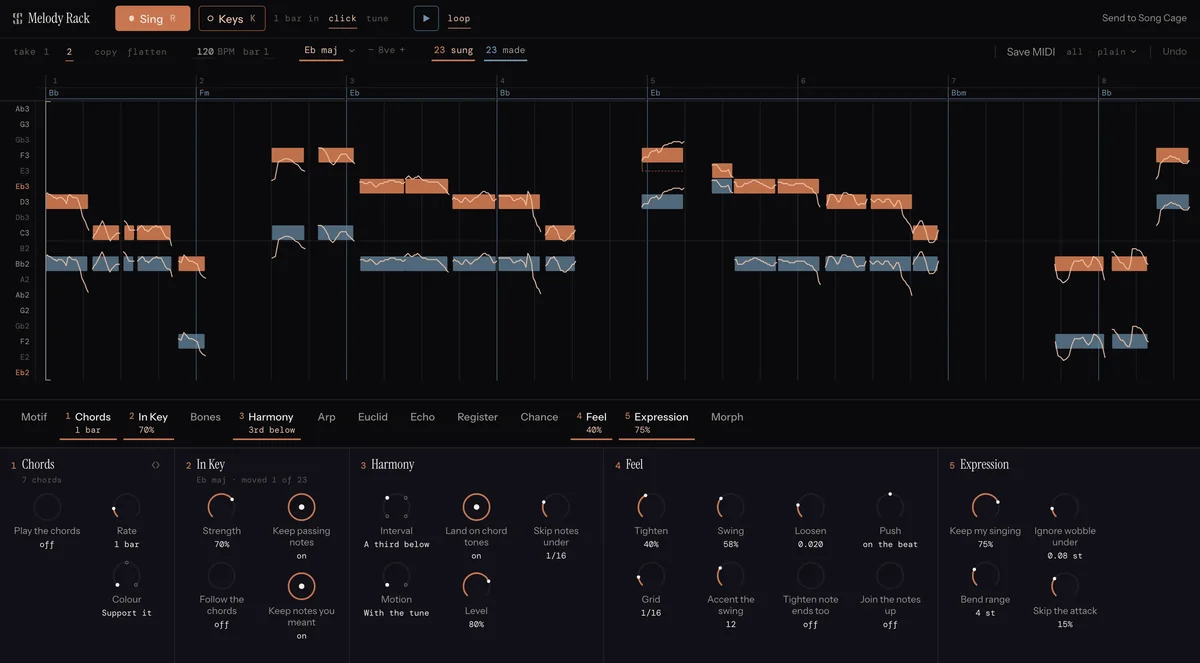
The effect is called Bones, and the reduction it runs is the one described above. Every sung note is scored on how long it is, how strong its beat is, whether it agrees with the chord underneath, and whether it closes a phrase. The best of them survive as the skeleton, and a dial decides how many. What it hangs on that skeleton is the part worth explaining, and it is the same argument this article has been making. Filling the gaps with fresh figures produces motion without a tune, because a listener hears melody in repetition and nothing invented afresh each bar can come back. So the fills are built from one thing only: the bar of your own take that carries the most weight. The dials squeeze or stretch that bar's intervals, move it on or off the beat, and decide how much of each gap it fills.
A second effect, Morph, walks between two takes you have sung. It reduces both to their skeletons, pairs the notes they share, and trades the decoration across as you turn one dial, which is modelled on the melodic morphing method Masatoshi Hamanaka, Keiji Hirata and Satoshi Tojo published in the Journal of New Music Research. At one end you have your verse, at the other your chorus, and in between a line that is audibly related to both.
It registers as a MIDI FX in Logic and sits in the equivalent slot elsewhere, so it needs a DAW. It comes with a 14-day trial, and there is a reduced price if you already own the Song Cage desktop and plugin bundle. If you would rather work on the tune before it reaches a DAW at all, writing the melody and deciding the sections are the earlier halves of the same job.
Sing the phrase. Keep the bones. Change the rest.
Melody Rack takes a sung phrase, works out the chords under it, and gives you fourteen harmony-aware ways to turn it into the next section.
Frequently Asked Questions
How different should a verse melody be from the chorus?
Different enough that the chorus feels like an arrival, which is usually a matter of register and rhythmic density rather than new material. Max Martin's stated approach is to reuse the melody outright and let the arrangement and the lyric carry the change, as Prince did in "I Wanna Be Your Lover". If you want genuine contrast, raise the chorus a few notes and lengthen its notes rather than writing an unrelated tune.
Is melodic variation the same as writing a countermelody?
No. A variation replaces the melody in a later section; a countermelody runs at the same time as the melody and has to stay out of its way rhythmically. They solve different problems and the tests for them are different. Writing a countermelody covers the second one.
Why does my inverted melody sound wrong?
Two likely reasons. If you inverted it by semitone, the mirror lands outside the key, because the scale's steps are unequal. Invert by scale step instead and the result stays in the key. The second reason is that inversion costs real recognition even when done well: Dowling measured 70 to 73% against a baseline of 87%. It is a legitimate technique with a price attached, not a free variation.
Can I just quantize or nudge the melody to make it feel new?
You can, but it is a bigger change than it looks. Schulkind shifted pitches against their rhythm by a single serial position and identification of well-known songs fell from 85% to 68%. Moving a melody against the grid is one of the more expensive edits available, so do it deliberately rather than as tidying.
How do I get a hummed idea into notes I can vary?
Sing it into a converter and then repair the result, in that order. The conversion will be imperfect, and the repairs that matter are octave errors, stray notes from breaths, and note lengths, roughly in that sequence. Audio to MIDI covers what to fix and, more importantly, what to leave alone.
Does exact repetition actually work, or should everything be varied?
Both findings exist and they disagree. Margulis found that identical repetitions of a theme made listeners report a stronger urge to move, sing or tap along. Popescu and Holman found verbatim repetition rated lowest of five repetition types on liking, beauty and interest. The reasonable reading is that exact repetition buys participation and costs interest, so spend it where you want people singing along and vary where you want them listening.