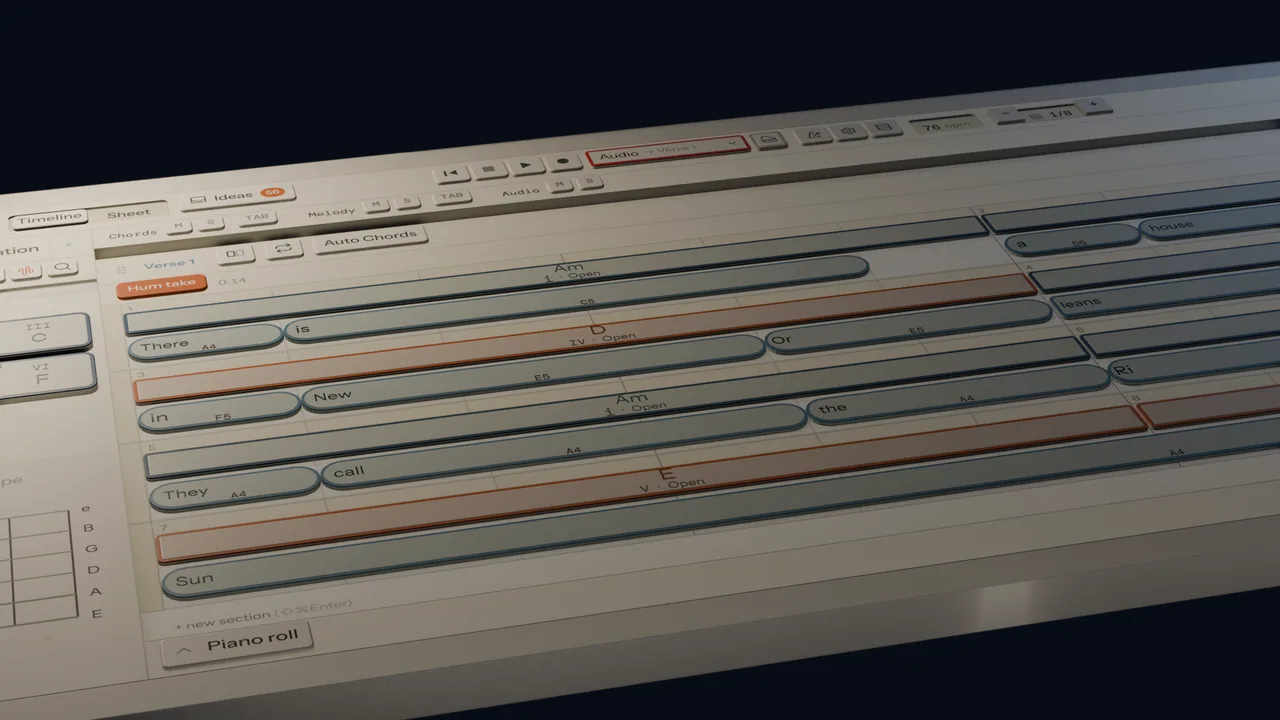
The Amazing Grace chords in G are G, C and D7, with G7 as a lead-in to C, and the same four chords work on guitar, piano and ukulele. Below are the chords with the words, the piano notes for the tune, the song in every common key, and the separate histories of the words and the tune, which met in 1835.
The chart is in G, where every chord is an open shape on guitar and the tune is all white keys on piano. Some hymnals print it in G and others in F; if yours is in F, put a capo on the third fret and play the D-shape chords from the key table below.
The short version
Four chords in G: G, G7, C, D7. The tune is in 3/4, starts with a pickup on "A-," and spans one octave, from the D just above middle C to the D above that. It uses only five different notes, so in G it's all white keys on a piano. For a group, G or F works.
What chords are in Amazing Grace?
Amazing Grace uses the 1, 4 and 5 chords of its key, with the 1 chord turned into a seventh on the way to the 4. In G that's G, C and D7, plus G7. G carries most of the song, C comes under "sweet the" and "now am," and D7 comes under "me" and "I."
Each half of the verse runs the same way. G holds through "Amazing," G7 arrives on "grace" and pulls toward C on "sweet," and the line comes home to G on "sound." The second line stays on G until "me," where D7 leaves it hanging, like a question. The second half repeats the pattern ("I once was lost, but now am found"), and the last line saves its D7 for "I," one beat before "see" lands on G.
| Number | Chord in G | Piano notes | Where it comes |
|---|---|---|---|
| 1 | G | G, B, D | Most of the song |
| 1 (as a 7th) | G7 | G, B, D, F | "grace," "lost" |
| 4 | C | C, E, G | "sweet the," "now am" |
| 5 (as a 7th) | D7 | D, F♯, A, C | "me," "I" |
The same four chords work on guitar, piano and ukulele. G7 is optional: play G there and the song still works.
Amazing Grace lyrics and chords
These are John Newton's words as most American hymnals print them, with the Amazing Grace chords in G. Each chord sits on the syllable where it changes and rings until the next one. Every verse uses the same chords.
Verse 1 (3/4, key of G)
A[G]mazing [G7]grace! How [C]sweet the [G]sound
That saved a wretch like [D7]me!
[G]I once was [G7]lost, but [C]now am [G]found;
Was blind, but now [D7]I [G]see.
Verses 2 to 4
'Twas grace that taught my heart to fear,
And grace my fears relieved;
How precious did that grace appear
The hour I first believed!
Through many dangers, toils and snares,
I have already come;
'Tis grace hath brought me safe thus far,
And grace will lead me home.
When we've been there ten thousand years,
Bright shining as the sun,
We've no less days to sing God's praise
Than when we'd first begun.
The last verse isn't Newton's; see the history below. Some hymnals sing "when we first begun" or "'tis grace that brought me safe thus far," and Newton's 1779 original has "'tis grace has brought me."
Newton's other three verses
The Lord has promised good to me,
His word my hope secures;
He will my shield and portion be
As long as life endures.
Yes, when this flesh and heart shall fail,
And mortal life shall cease,
I shall possess, within the veil,
A life of joy and peace.
The earth shall soon dissolve like snow,
The sun forbear to shine;
But God, who called me here below,
Will be forever mine.
How do you play Amazing Grace on guitar?
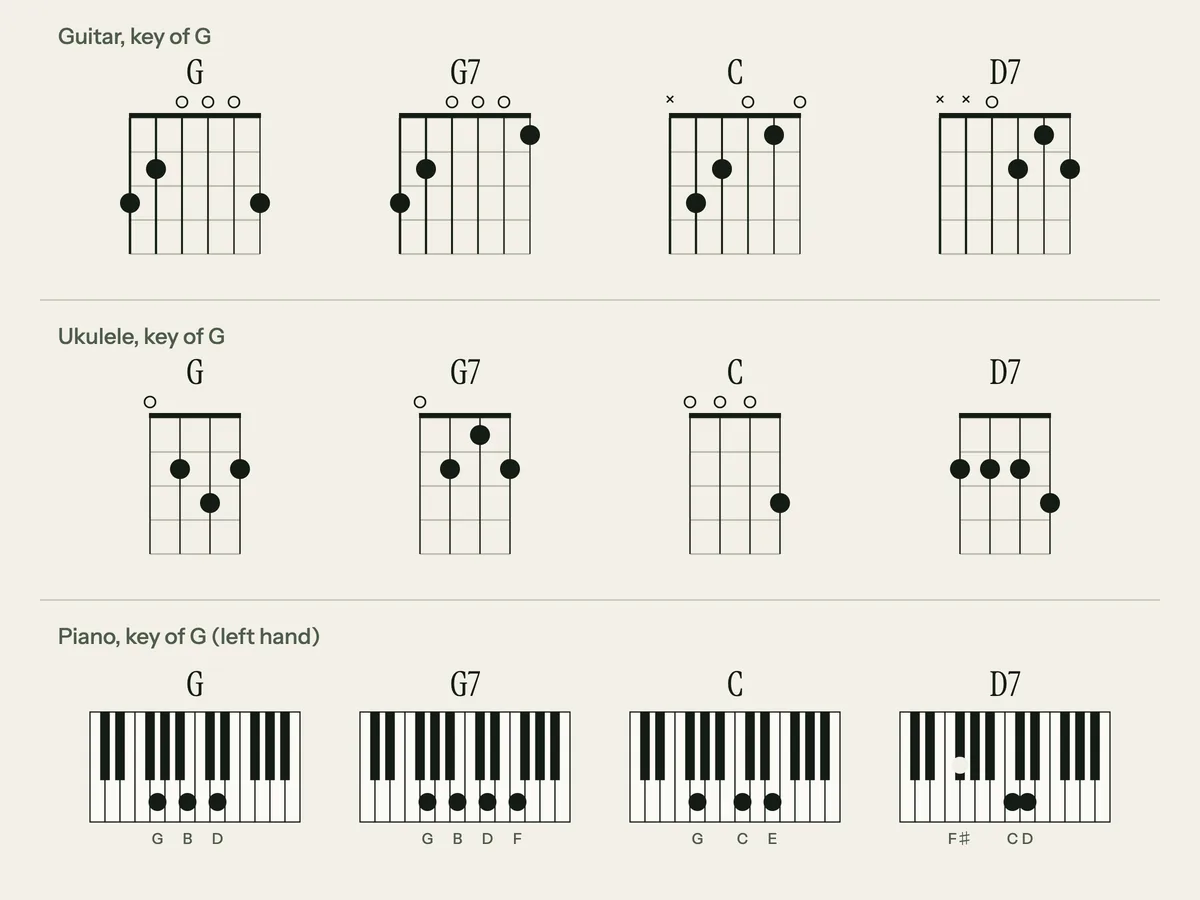
The Amazing Grace guitar chords in G are G (320003), G7 (320001), C (x32010) and D7 (xx0212), counting strings from the low E. It's a slow 3/4: pick the bass note on beat 1 and strum the chord on beats 2 and 3, and start on "A-," which comes before the first beat.
The "A" of "Amazing" is a pickup, one note before the first full bar, so count "three" on it and land the G chord on "maz." The "That," "I" and "Was" that start the other lines are pickups too. Pickups don't make the song syncopated: the stressed syllables still land on beat 1, as the syncopation post explains.
G7 is G with one finger moved: lift the finger off the high E string's third fret and put one on its first fret. That single note, F, is what pulls the ear toward C.
Most guitar charts play D7 under "me." Edwin Othello Excell's hymnal harmony, the version most American churches sing, keeps the home chord there instead, with B in the bass. Both fit the melody, which holds a D on "me." To sing higher, a capo on the second fret puts the same shapes in A; the guitar capo chart has every fret.
What are the piano notes for Amazing Grace?
The Amazing Grace piano notes in G are all white keys. The tune starts on the D just above middle C and jumps up to G: D G B G B A G E D, "Amazing grace! How sweet the sound." Play G, C and D7 in the left hand.
Amazing Grace: piano notes (right hand, key of G)
Amazing grace! How sweet the sound: D G B G B A G E D
That saved a wretch like me: D G B G B A D
I once was lost, but now am found: B D B D B G D E G G E D
Was blind, but now I see: D G B G B A G
The high D on "me" and on "once was" is the D an octave above the opening one. Some syllables carry two notes ("-ing," "a," "once," "was," "now," "am," "but"), so a line can have more notes than words.
The whole tune uses five notes: G, A, B, D and E, the G major pentatonic scale. There's no C and no F sharp, the only black key in G major, so it's all white keys in G. The tunebook that first printed versions of the melody in 1829 already had them pentatonic, according to the Hymnology Archive. The same fact gives the old party trick: in G flat, the five notes are G flat, A flat, B flat, D flat and E flat, so you can play the tune on the black keys alone.
For the left hand, play G under most of the song, G7 under "grace" and "lost," C under "sweet the" and "now am," and D7 under "me" and "I." Play D7 as F sharp, C and D so your hand barely moves from G.
What are the ukulele chords for Amazing Grace?
The Amazing Grace ukulele chords in G are G (0232), G7 (0212), C (0003) and D7 (2223), where the numbers are frets on the G, C, E and A strings in that order. G7 is the G shape with the E-string finger moved from the third fret to the first.
The ukulele can play from the same chart as the guitar and piano. Strum down on beat 1 and lightly on beats 2 and 3, or pick the strings one at a time for a slower, quieter feel. The change to D7 on "I" lasts a single beat, so practice "now I see" (G, D7, G) on its own.
For lower voices, the key of C uses four of the easiest ukulele shapes: C (0003), C7 (0001), F (2010) and G7 (0212). It sits a fourth lower than G, from the G below middle C up to the G above it. The lullabies on guitar and piano post has more songs on three chords.
Amazing Grace chords in every key
Amazing Grace works in any major key with the same four chords. Its lowest note is the 5 of the key, a fourth below the key note, and its highest is the 5 an octave up, so pick the key whose range fits your voice and read the chords across.
| Key | 1, 1 (7th), 4, 5 (7th) | Lowest and highest note (middle C is C4) | Guitar shapes |
|---|---|---|---|
| C | C, C7, F, G7 | G3 up to G4 | Open (F is a barre) |
| D | D, D7, G, A7 | A3 up to A4 | Open |
| E | E, E7, A, B7 | B3 up to B4 | Open, or D shapes capo 2 |
| F | F, F7, B♭, C7 | C4 up to C5 | D shapes capo 3 |
| G | G, G7, C, D7 | D4 up to D5 | Open |
| A | A, A7, D, E7 | E4 up to E5 | Open, or G shapes capo 2 |
The high note is an octave above the low one. Men singing the tune sing it an octave lower than written.
In Nashville numbers, the first line is 1, 1 (7th), 4, 1; the second stays on 1 until a 5 (7th) on "me"; the third repeats the first; and the fourth stays on 1 until a 5 (7th) on "I," then 1. The Nashville Number System post explains how to read a chart like this.
What key should a group sing Amazing Grace in?
G is a good place to start: the tune runs from the D above middle C up to the D an octave higher, D4 to D5. F (C4 to C5) is a step lower and easier on deep voices, and it's the key several current hymnals use.
Hymnals split between the two. Glory to God (2013), the Presbyterian hymnal, prints it in G major; the Baptist Hymnal (2008) and the Episcopal Hymnal 1982 print it in F major.
Both ends of the range come in the first two lines. "A-," the first note, is the lowest, and "me" is the highest. So the opening is a complete test of the key: if "me" strains, drop the key; if "A-mazing" disappears, raise it.
If you're leading and want to check your own range first, the free vocal range test finds your lowest and highest notes and suggests keys that fit, with guitar capo frets.
Who wrote Amazing Grace?
John Newton, an English clergyman and former slave-ship captain, wrote the words for a New Year's Day sermon in 1773 at Olney, Buckinghamshire. They were published in 1779 in Olney Hymns, the book he made with the poet William Cowper, under the title "Faith's Review and Expectation."
According to Wikipedia's history of the hymn, Newton was pressed into the Royal Navy and later worked in the Atlantic slave trade. In March 1748, during a violent storm aboard the ship Greyhound, he called out to God for mercy, a moment that marked his conversion. Even so, he stayed in the slave trade, by then as a captain, until poor health ended his seafaring in August 1754, according to the Hymnology Archive. He was ordained in 1764 and became curate of Olney.
Olney Hymns printed the words in six verses, with no music, as the Hymnology Archive notes, and hymnbooks of the day were usually words only. After leaving Olney in the 1780s, Newton became an outspoken abolitionist and joined William Wilberforce's campaign against the slave trade, which ended in the Slave Trade Act of 1807.
Where does the Amazing Grace tune come from?
The tune most hymnals call "New Britain" is a folk melody of unknown origin, first printed in 1829 in Columbian Harmony, a Cincinnati tunebook, in two versions named "St. Mary's" and "Gallaher." William Walker first set Newton's words to it in 1835, in his shape-note book Southern Harmony.
Nobody knows who wrote the tune. The Hymnology Archive traces its earliest surviving copy to the back of a letter the hymn writer Lucius Chapin received from his son Cephas, notated around 1828. It appeared again in Virginia Harmony in 1831 as "Harmony Grove." Before 1835, Wikipedia counts more than twenty other tunes in circulation for Newton's words. Some hymnals now name the tune simply "Amazing Grace."
The version sung in most American churches today comes from Edwin Othello Excell, a publisher who smoothed the folk tune for city church choirs in hymnals printed between 1900 and 1910. Those hymnals also made the "ten thousand years" verse standard: it first appeared with the hymn in a 1909 hymnal Excell helped edit, then in his own Coronation Hymns (1910). Newton didn't write it: it was printed in 1790 at the end of "Jerusalem, My Happy Home," and Harriet Beecher Stowe put it with "Amazing Grace" in Uncle Tom's Cabin in 1852.
Judy Collins's a cappella recording came out in 1970 and reached number 15 on the Billboard Hot 100 in early 1971. In 1972, a bagpipe version by the Royal Scots Dragoon Guards spent five weeks at number one in the UK. The words and the tune are both in the public domain.
How do you put Amazing Grace into Song Cage?
Song Cage shows a song as chords over the words, like a printed chord sheet, and moves the whole song to a new key in one step. Type the words into a song in Sheet view, put the four chords on, set the meter to 3/4, then pick a key from the key chip and choose Move song.
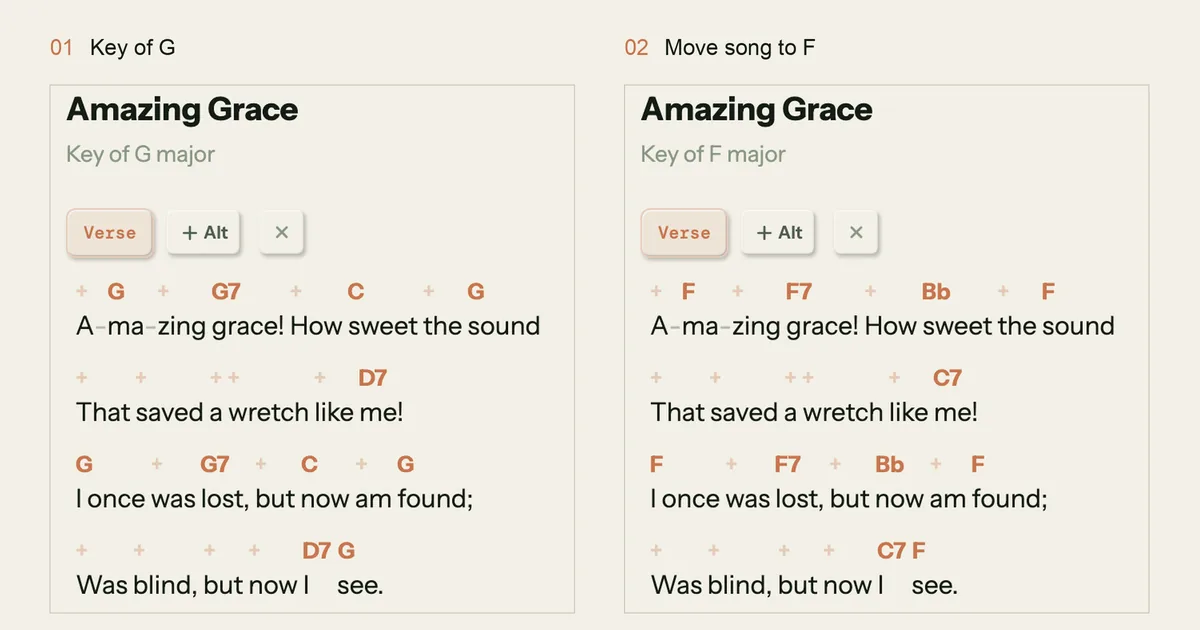
Move song is how the chart in G becomes the hymnal's F: the chords move together and land on the same words. View > Nashville Numbers shows the song as numbers in any key, and clicking a chord shows its guitar shape or piano keys, with a capo if you set one. The changing keys chapter covers Move song and Relabel.
To hear the words on the tune, add the melody by singing it in and using Detect melody, or by entering the notes, and the Singer voice sings each syllable on its note. It sounds like an 80s talking computer played off an old cassette, rough but clear enough to hear how the words sit. A five-note tune that has lasted nearly two hundred years is also a lesson in melody writing, and how to write a melody looks at why small, repeated shapes stick. For seasonal songs, see Silent Night chords, Joy to the World chords and Away in a Manger chords.
Play Amazing Grace in your key
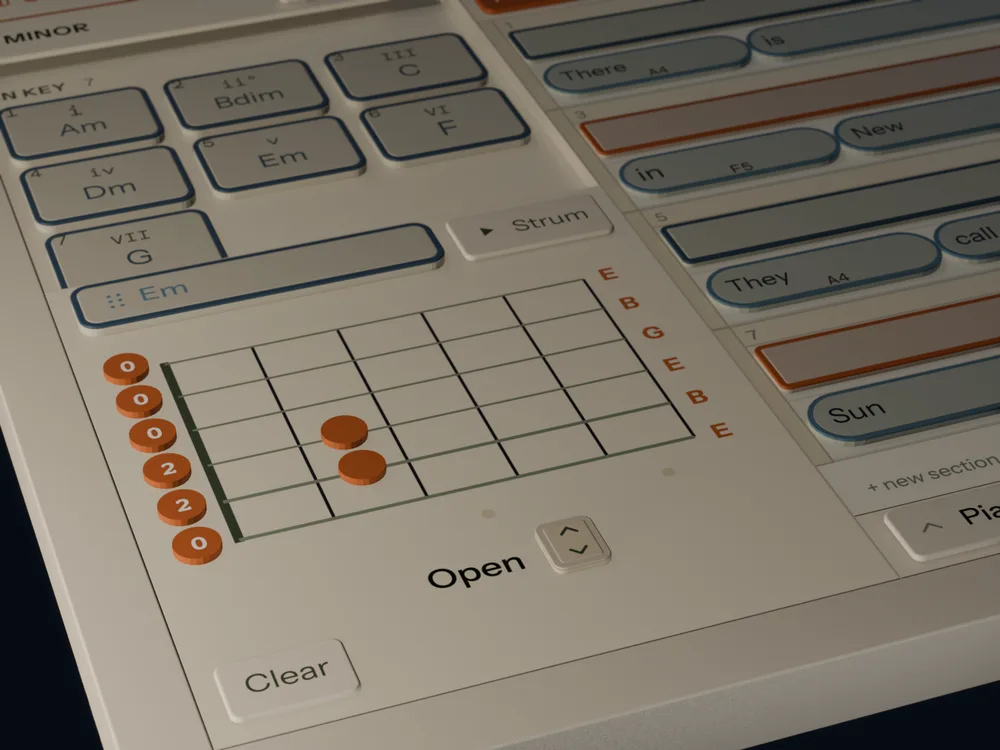
Put the chords over the words in Song Cage, move the song from G to your hymnal's F or any other key, and see every chord as a guitar shape or as piano keys.
Frequently Asked Questions
What are the chords for Amazing Grace?
In G: G, C and D7, with G7 as an optional lead-in to C. G carries most of the song, C comes under "sweet the" and "now am," and D7 comes under "me" and "I." The same four chords work on guitar, piano and ukulele.
What key is Amazing Grace in?
Hymnals print it in G or F. Glory to God (2013) uses G; the Baptist Hymnal (2008) and the Episcopal Hymnal 1982 use F. On guitar, G is the easiest, since all four chords are open shapes.
What time signature is Amazing Grace in?
3/4, three beats to the bar, with "A-" as a pickup before the first full bar. Count "three" on "A-" and land beat 1 on "maz."
Can you play Amazing Grace on just the black keys?
Yes. The tune uses only five notes, the 1, 2, 3, 5 and 6 of the major scale. In G flat those are G flat, A flat, B flat, D flat and E flat, which are exactly the five black keys. In G, the same tune is all white keys.
Who wrote the music for Amazing Grace?
Nobody knows. The tune, "New Britain," is a folk melody first printed in 1829 in Columbian Harmony, a Cincinnati tunebook. William Walker paired it with John Newton's words in 1835, and Edwin Othello Excell's arrangements from 1900 to 1910 became the version most churches sing.
Is Amazing Grace in the public domain?
Yes. John Newton published the words in 1779, the tune was printed in 1829, and the "ten thousand years" verse dates from 1790. Modern arrangements, such as newer songs that borrow its verses, and recordings can still be under copyright.