"I picked up guitar in college, you know, so I just was too lazy to actually learn all the finger formations," Mitski told Song Exploder in 2016, taking apart "Your Best American Girl." "And so, what I do is actually just tune the guitar to a D major chord, so that if you strum the guitar, just a D major chord immediately rings out. So I could just pick up the guitar, and play simple chord progressions without thinking about it."
That tuning is open D: D A D F# A D. Joni Mitchell built her early songs in it and its cousin open E. Richie Havens played nearly everything in it, and it has been in American guitar music since the 1850s. Below: how to tune to it by ear, the chords you'll need (every shape checked note by note), the songs written in it, and what it does to the songs you write.
Quick Summary
Open D tuning is D A D F# A D, low to high, so the open strings sound a D major chord. From standard, lower the 6th, 2nd and 1st strings a whole step and the 3rd string a half step. Every major chord is then one finger laid across one fret; a minor chord moves the 3rd string back a fret.
What is open D tuning?
Open D tuning sets the guitar's strings to D A D F# A D (often written DADF#AD), from the lowest string to the highest. Strummed without fretting, those six notes make a D major chord: three D's (the root), two A's (the fifth) and one F# (the major third). Laying one finger across any fret moves that chord up the neck.
The intervals between the strings are the ones in the E major chord you already know, 0 2 2 1 0 0, moved to the open strings and down a step. Richie Havens put it that way on his own website: "I tune my guitar in an open D tuning, which is in the structure of an E chord, of a correctly tuned guitar."
The tuning's old name is Vestapol. Henry Worrall, a guitarist and artist whose music was published in Cincinnati, wrote a parlor piece called "Sebastopol" about the 1854 to 1855 siege in the Crimean War, and it asked the player to retune to open D. According to guitarist and historian Robert Ferguson, it first appeared in a shortened form in Worrall's Eclectic Guitar Instructor of 1856, and in full in 1860. Ferguson names it, with "Spanish Fandango," one of the two most popular guitar solos in America in the late 1800s and early 1900s, and players went on naming the tuning after it: "Sebastopol tuning," often worn down to "Vastopol" or "Vestopol" (today usually spelled Vestapol). Elizabeth Cotten played the piece, and blues historian Stefan Grossman found versions of it, and its tuning, in recordings by Mississippi John Hurt and Furry Lewis, as American Blues Scene traces.
How do you tune a guitar to open D?
To tune to open D from standard tuning, lower four strings and leave two alone. The 6th string goes down a whole step from E to D, the 3rd down a half step from G to F#, the 2nd down a whole step from B to A, and the 1st down a whole step from E to D. The 5th (A) and 4th (D) stay where they are.
| String | Standard | Open D | Change |
|---|---|---|---|
| 6th (lowest) | E | D | Down a whole step |
| 5th | A | A | No change |
| 4th | D | D | No change |
| 3rd | G | F# | Down a half step |
| 2nd | B | A | Down a whole step |
| 1st (highest) | E | D | Down a whole step |
A tuner set to chromatic mode is the quickest way. Without one, tune each string to a string that's already in tune, so you're always matching two notes at the same pitch:
- 6th string to D: fret it at the 7th fret and lower it until that note matches the open 5th string (A).
- 3rd string to F#: lower it until it matches the 4th string at the 4th fret.
- 2nd string to A: lower it until it matches the 4th string at the 7th fret.
- 1st string to D: lower it until it matches the 2nd string, now A, at the 5th fret.
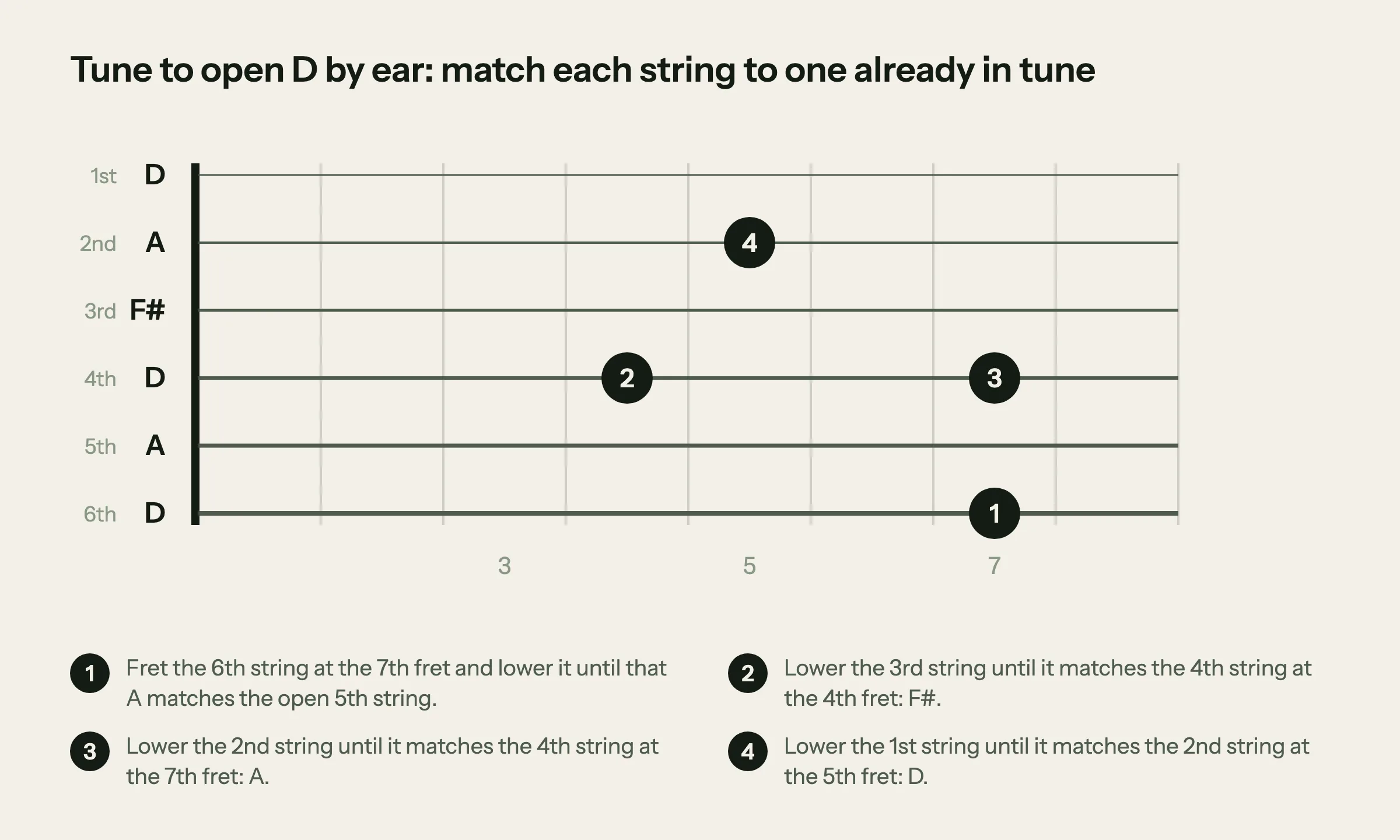
Then strum all six open. A clean D major chord means you're done; a sour one means one string is off, and you can find it by checking each pair again.
Is open D tuning bad for your guitar?
No. Open D only lowers strings, so the strings pull on the neck less than in standard tuning, not more. The risk runs the other way: slacker strings can buzz against the frets, especially the low D. Some players who stay in open D move to a slightly heavier set of strings to firm them up.
That's the reason to prefer open D over open E, which has the same shape a whole step higher. Getting to open E from standard means raising the 5th, 4th and 3rd strings above their normal pitch. Jeffrey Pepper Rodgers, writing about Joni Mitchell's tunings in Acoustic Guitar, calls that potentially "inadvisable depending on the guitar and string gauge," and plays her open E songs in open D instead, with the capo two frets higher, which sounds the same notes.
A neck settles for a few minutes after any retune, so the strings drift a little at first. Check the tuning again after you've played a song through, and once more before you record.
What chords can you play in open D?
Most open D chords take one finger. Every major chord is one finger laid flat across the strings at one fret: the open strings are D, the 2nd fret is E, the 3rd F, the 5th G, the 7th A. For a minor chord, keep the barre and fret the 3rd string one fret lower. Shorter shapes on the top strings avoid the barre altogether.
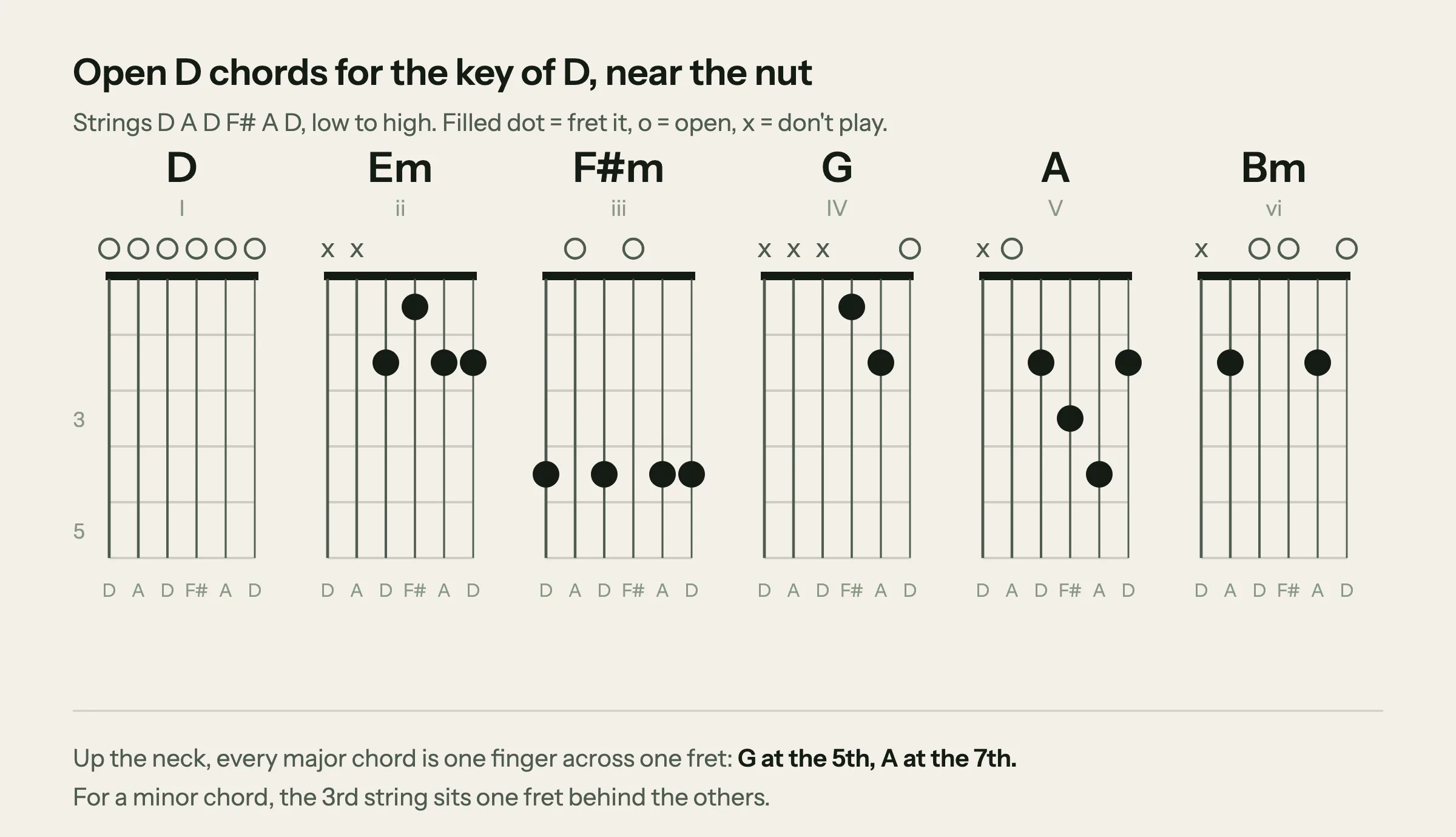
The table gives each chord low string to high, with x for a string you don't play. Every shape was checked note by note against D A D F# A D, and each one sounds the chord it's named for and nothing else.
| Chord | Barre shape | Shorter shape | Role in the key of D |
|---|---|---|---|
| D | 0 0 0 0 0 0 | – | I, home |
| Em | 2 2 2 1 2 2 | x x 2 1 2 2 | ii |
| F#m | 4 4 4 3 4 4 | 4 0 4 0 4 4 | iii |
| G | 5 5 5 5 5 5 | x x x 1 2 0 | IV |
| A | 7 7 7 7 7 7 | x 0 2 3 4 2 | V |
| Bm | 9 9 9 8 9 9 | x 2 0 0 2 0 | vi |
| A7 | 7 7 7 7 10 7 | x 0 2 1 4 2 | V7 |
| D7 | – | 0 0 0 0 3 0 | I7, leads to G |
| C | 10 10 10 10 10 10 | x 3 2 1 3 x | ♭VII, borrowed |
| E | 2 2 2 2 2 2 | – | II, leads to A |
| Dm | – | 0 0 3 3 0 0 | i, for a minor turn |
Frets from the 6th string (low D) to the 1st (high D). 0 = open, x = not played. In a minor barre, the 3rd string sits one fret behind the others, so cover the strings either side of it with your other fingers instead of one flat barre.
The rule for the majors runs all the way up: D at the open strings, E flat at the 1st fret, E at the 2nd, F at the 3rd, F# at the 4th, G at the 5th, A flat at the 6th, A at the 7th, B flat at the 8th, B at the 9th, C at the 10th, C# at the 11th, and D again at the 12th. For a dominant 7th, keep the barre and fret the 2nd string three frets above it, which turns that string's fifth into the flat seventh. D7 at the nut is just the 2nd string at the 3rd fret.
Why are minor chords harder in open D?
Because open D has the major third built into its open strings. The 3rd string sits on F#, the note that makes D major, and a minor chord needs that note a half step lower. Up the neck you fret the 3rd string one fret behind the barre. At the nut there's no fret behind, so D minor needs a different shape.
D minor moves the minor third onto the 4th string instead: 0 0 3 3 0 0 puts F on the 4th string and A on the 3rd. Shorter minor shapes skip the 3rd string's problem by starting higher, like Bm, x 2 0 0 2 0, which lets the open D and F# ring as part of the chord.
Richie Havens took years to find the barre version. In a 1987 interview for Guitar Player (the recording is on Jas Obrecht's Talking Guitar), he said that for his first four years he retuned the guitar to D minor for minor songs and couldn't get back to major within the song. Then he learned to barre the chord and fret the 3rd string a fret lower with a separate finger, so his minor chord was the same shape anywhere on the neck. Keep that in mind when you choose songs for the tuning: one with a lot of minor chords, or in a minor key, will fight it. For a minor song, the variant D A D F A D (open D minor) is the same idea with the third already lowered.
Which keys work best in open D?
Songs in D major fit open D best, because the I, IV and V chords (D, G and A) sit at the open strings, the 5th fret and the 7th fret. A capo moves that to other keys: capo 2 gives E, capo 4 gives F#, capo 5 gives G. Songs that lean on minor chords or leave the key often fight the tuning.
That limit is old. Robert Ferguson, in his study of Worrall, writes that open tunings "force a single key to predominate, making it more difficult to venture into other tonal regions or even to leave the tonic-dominant axis." It's also why the tuning makes some chords outside the key easy. Every major chord is one finger, so a borrowed C in the key of D (the flat VII that defines the Mixolydian sound) is as easy to play as G, just higher: a barre at the 10th fret.
To pick the key, start with the singer. Find the capo fret where the melody sits comfortably for your voice (the capo chart gives every fret's key), and every shape in the table still works above it. If the song only fits one key and it isn't one the capo reaches easily, that's the moment to check whether the song is in the wrong key for your voice to begin with.
What's the difference between open D, open E, DADGAD and drop D?
Open E is open D a whole step higher. DADGAD changes one string: its 3rd string is G, not F#, so the open strings sound a D chord with no third. Drop D only lowers the 6th string, so everything above it plays like standard tuning.
| Tuning | Strings, low to high | Open strum | From standard |
|---|---|---|---|
| Open D | D A D F# A D | D major | Lower four strings |
| Open E | E B E G# B E | E major | Raise three strings |
| DADGAD | D A D G A D | Dsus4 | Lower three strings |
| Open G | D G D G B D | G major | Lower three strings |
| Drop D | D A D G B E | No plain major or minor chord | Lower one string |
DADGAD's open strum is a D with a G in place of the F#: a sus4 chord, neither major nor minor. That makes DADGAD easy to bend toward minor and modal tunes, where open D's built-in F# would get in the way. Going from open D to DADGAD takes one string, the 3rd, back up a half step.
What songs are in open D tuning?
Joni Mitchell's "Chelsea Morning," "Big Yellow Taxi" and "Both Sides, Now" (the last two recorded in open E, the same shape a step higher), Elmore James's "Dust My Broom" (open D or open E), Mumford & Sons' "The Cave," and Mitski's "Your Best American Girl." Richie Havens played almost all of his songs in it.
| Song | Artist | Year | What to know |
|---|---|---|---|
| Dust My Broom | Elmore James | 1951 | Slide in open D or open E; transcriptions differ |
| Both Sides, Now | Joni Mitchell | 1969 | Recorded in open E with capo 2; open D with capo 4 matches it |
| Chelsea Morning | Joni Mitchell | 1969 | High fretted notes over open bass strings |
| Big Yellow Taxi | Joni Mitchell | 1970 | Recorded in open E; open D with capo 2 matches it |
| You Turn Me On, I'm a Radio | Joni Mitchell | 1972 | Open D; opens on I, Imaj7, IV, V |
| People's Parties | Joni Mitchell | 1974 | Open D |
| The Cave | Mumford & Sons | 2009 | Usually played with a capo at the 2nd fret |
| Awake My Soul | Mumford & Sons | 2009 | Open D, on Sigh No More |
| Roll Away Your Stone | Mumford & Sons | 2009 | Open D, on Sigh No More |
| Your Best American Girl | Mitski | 2016 | Written with the guitar tuned to a D major chord |
Joni Mitchell's official site lists more than thirty transcriptions under D A D F# A D. Her early recordings of "Big Yellow Taxi" and "Both Sides, Now" are in open E, Rodgers notes in Acoustic Guitar, and he plays them in open D, capoed up to the original keys. Open E is open D two frets higher, so that puts the capo at the 2nd fret for "Big Yellow Taxi" and, since "Both Sides, Now" was already capoed at the 2nd in open E, at the 4th for that one. "Chelsea Morning" is his example of fretting high on the neck, at the 10th and 12th frets, while the open bass strings ring underneath.
Elmore James's 1951 slide riff on "Dust My Broom" climbs to the 12th fret, where, in open D, the 3rd, 2nd and 1st strings make a D chord. The Library of Congress essay on the record, added to the National Recording Registry in 2013, says it was played "with the guitar tuned to an open-D or open-E chord." Wikipedia and most tab sites put Mumford & Sons' "The Cave," "Awake My Soul" and "Roll Away Your Stone," all from Sigh No More, in open D.
Why do songwriters write in open D?
Because a tuning changes which chords are easy, and the easy chords become the song. In open D the open strings keep ringing under whatever you fret, a one-finger barre is a whole chord, and the familiar standard-tuning shapes stop working, so your hands go somewhere new.
Joni Mitchell started there. "In the beginning, I built the repertoire of the open major tunings that the old black blues guys came up with," she told Acoustic Guitar in 1996, naming open D among them. "Then going between them I started to get more 'modern' chords, for lack of a better word." Eric Andersen, who showed her his open tunings in Detroit in the mid-1960s, told Acoustic Guitar in 2018 that "she hated playing guitar in standard tuning," naming the F barre chord as the kind of thing that made it hard. In open D, F is one finger at the 3rd fret.
Havens describes the same discovery in his autobiography, quoted by the Bethel Woods museum: once the guitar was tuned to a chord, "it took me all of ten seconds to realize I could slide my thumb along the neck of the guitar to make different chords at every fret stop." Mitski's reason is the plainest. The tuning let her "play simple chord progressions without thinking about it," which leaves the thinking for the words and the melody.
How do you write a song in open D tuning?
To write in open D, start from the drone, not from the chord chart. Strum the open strings, then move one finger along the top two strings and listen for a line you'd sing. Add the one-finger chords at the 5th and 7th frets for G and A, and let the open strings ring under every shape.
A few ways in, each one built on what the tuning does well:
- Write the melody on the 1st string. Leave the other five open and walk a melody up and down the high D string. Every note sounds over a D drone, so you hear right away which notes pull and which settle.
- Keep the bass open under moving chords. Barre G at the 5th fret on the top four strings, skip the 5th string and let the low D ring: 0 x 5 5 5 5. That's G over a D bass, a different color from G, and the open D ties the whole progression to the key.
- Add or lift one finger. The open D chord with the 1st string at the 2nd fret adds E, the ninth: D(add9). G at the 5th fret with its 2nd string left open adds A, the ninth of G: G(add9). Chords with long names, one finger each.
- Move one shape up the neck. A short shape slid up the neck over open bass strings changes the chord at every fret. That's the sound of "Chelsea Morning." Havens did the same with his thumb barring all six strings, sliding to "different chords at every fret stop."
Then write the tuning down with the song. An idea recorded on your phone in open D doesn't say what the strings were tuned to, and six months later the chord shapes in your head won't match the recording.
How can Song Cage help with songs in open D?
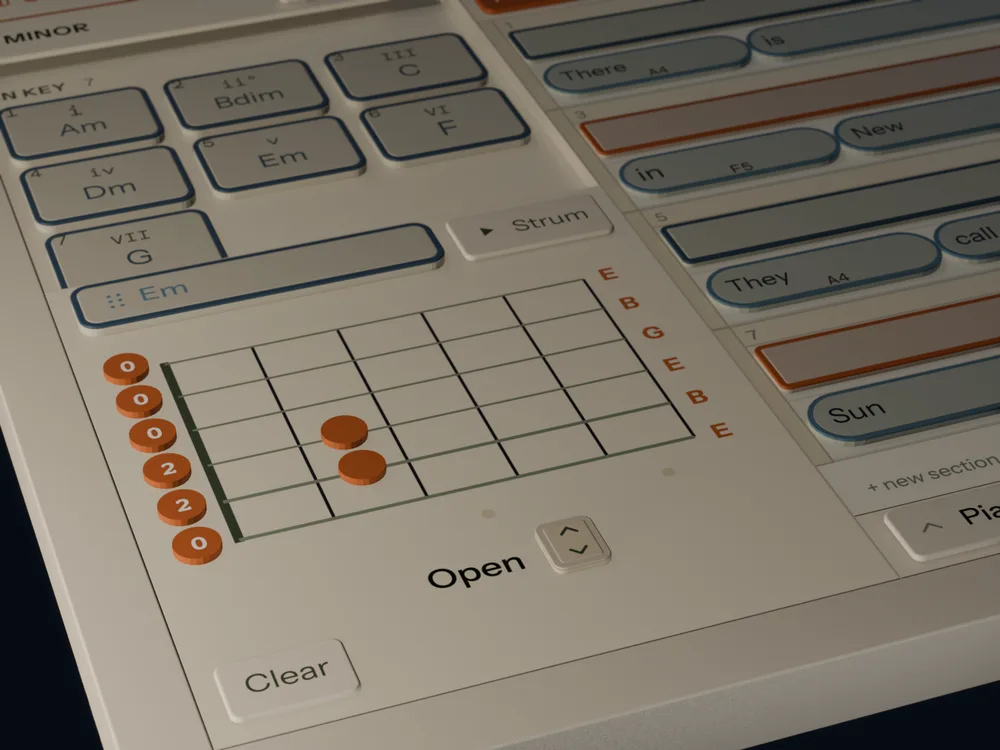
Set the song's tuning to Open D and Song Cage draws every chord as a shape for D A D F# A D. The chord names stay what they sound like, the playback strums the strings as tuned, and the tuning is saved with the song, so the next time you open it you know how to retune.
On the computer, iPad or in a DAW, open Settings and pick Open D from the Tuning list, next to Capo (Chapter 12 of the docs covers the guitar settings). Song Cage has 18 tunings in that list, including DADGAD, Drop D, open G, open E and open C. Changing the tuning redraws the shape for every chord already in the song. A G that showed 3 2 0 0 0 3 in standard comes back as a shape for the new strings, and each shape is worked out from the notes the strings are tuned to, so it sounds the chord it's named for.
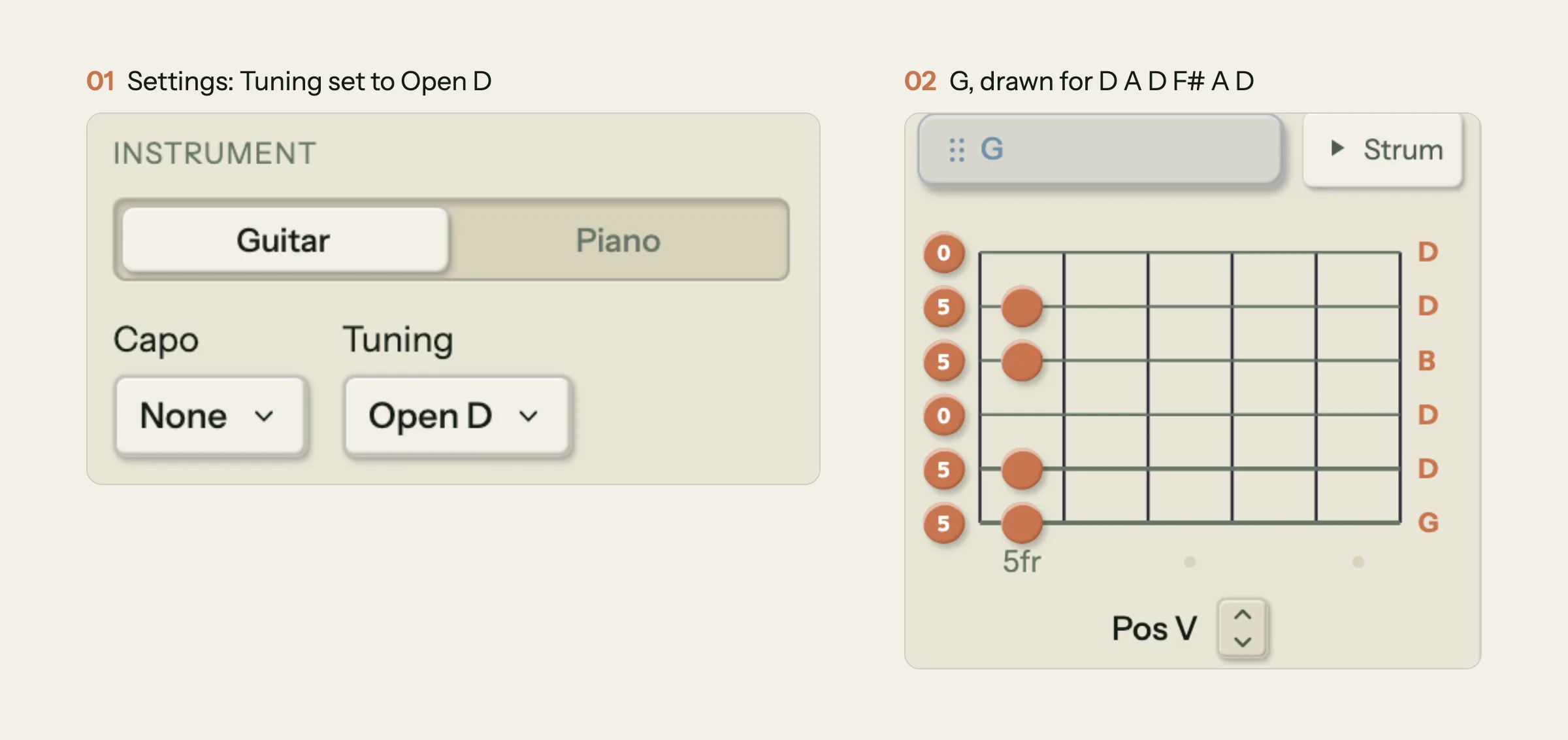
Press play and the chords sound as they would on a guitar in open D, with the capo on top if you set one. The guitar tab dock writes the frets for the tuning and shows its name in the header. On the phone, the same choice sits in Song settings under Tuning, and the chord diagrams there follow it too.
Keep the tuning with the song
Song Cage saves the tuning and capo with every song and draws each chord as a shape for the strings as they're tuned. Pick Open D once, and every chord, the playback and the tab follow it.
Frequently Asked Questions
What are the notes of open D tuning?
D A D F# A D, from the 6th string (lowest) to the 1st (highest). Three strings are D, two are A and one is F#, the notes of a D major chord. From standard tuning you lower the 6th, 2nd and 1st strings a whole step and the 3rd string a half step.
Is open D tuning good for beginners?
For songs in D major, yes: the open strings are a D chord, and G and A are one finger each at the 5th and 7th frets. Mitski tuned to it because she didn't want to learn standard chord shapes. Minor chords are harder, though, so a beginner learning songs written in standard tuning is better off staying there.
How do you play a D minor chord in open D?
Play 0 0 3 3 0 0: the 4th string at the 3rd fret gives F, the minor third, and the 3rd string at the 3rd fret turns its F# into A. The usual minor rule, a barre with the 3rd string one fret behind, can't work at the nut, because there's no fret behind the open string.
Is open D the same as DADGAD?
No. They differ by one string. Open D's 3rd string is F#, so the open strings sound D major. DADGAD's 3rd string is G, so they sound Dsus4, a chord with no third. Raise open D's 3rd string a half step and you're in DADGAD.
Do you need a slide to play in open D?
No. The tuning is famous for slide guitar, because a slide laid across one fret plays a whole major chord, as in Elmore James's "Dust My Broom." But Joni Mitchell, Richie Havens, Mumford & Sons and Mitski all play it fretted and strummed, with the open strings ringing under the chords.
What is the difference between open D and drop D?
Drop D lowers only the 6th string, to D, so the other five strings and every chord shape above them work as in standard tuning. Open D lowers four strings, so the open strings make a D major chord and most standard shapes no longer work.