Table of Contents
- What do you actually need to write a song on piano?
- Why do piano songs by trained players sound the same?
- What is a chord voicing on piano?
- How do inversions change a progression?
- Where on the keyboard should your left hand sit?
- What should the left hand actually play?
- Why does the "Clocks" riff roll instead of jump?
- Does the key you write in matter on piano?
- How do you turn four chords into a whole song?
- How do you keep the melody out of the chords?
- How do you keep the voicing you actually played?
- Frequently Asked Questions
You can play. That is the strange part. You took lessons, you can read a chart, your hands know where the chords live. But every time you sit down to write something of your own, what comes out is a song you have already heard, played in the middle of the keyboard, in C.
This is the most common message on piano songwriting forums, and it almost never comes from someone who lacks technique. It comes from people with ten years of playing behind them. The problem is not that you need more chords. It is that nobody has told you what the piano is actually for.
Here is the thing every guide skips. A guitarist gets roughly one shape per chord. You get nine, before you change a single chord. That difference is the whole instrument, and learning to use it is the fastest route from "I can play" to "I wrote this."
Quick summary
To write a song on piano: pick four chords, then stop treating them as fixed shapes. Change which note sits in the bass so the bass line moves by step instead of jumping. Keep close-spaced chords above roughly an octave below middle C, and use octaves or fifths below that. Give each hand one job, not two. Sing the melody away from the keyboard so it stops being the top note of a chord. Then capture the voicing you actually played, not just the chord name.
What do you actually need to write a song on piano?
To write a song on piano you need four things: a key, three or four chords that belong to it, a left hand that stays out of the melody's way, and a way to keep what you played. Everything else, including reading music, is optional. Notice that only one of those four is about chords.
The bar is genuinely low, and that is not encouragement, it is a description. Plenty of standards run on three chords. What separates a song from an exercise is not the size of the harmonic vocabulary, it is whether the arrangement moves. If you write on six strings instead, the same logic applies from the other side: see how to write a song on guitar. The rest of this guide is about the three non-chord items, because the chord item is the one every other article already covers.
Why do piano songs by trained players sound the same?
Search for piano chord progressions and look at what the ranking guides actually teach. Pianote's six-step guide says pick C major, then use I–V–vi–IV, ii–V–I or I–IV–V, and at one point suggests writing chords on slips of paper and drawing them from a hat. MusicRadar's nine tips for piano players says start in C major, then offers I–IV–V, the "pop-punk" I–V–vi–IV, and the "doo-wop" vi–IV–I–V.
Both are competent. Neither mentions an inversion, a voicing type, a register, or how to divide the hands. So you follow the advice, you play I–V–vi–IV as four root-position triads in the middle of the piano, and it sounds like a lesson. The chords are identical to the ones on the record. The arrangement is not, and the arrangement is the part you can hear.
The fix is not a rarer chord. It is the same four chords, voiced like someone who has done this before.
What is a chord voicing on piano?
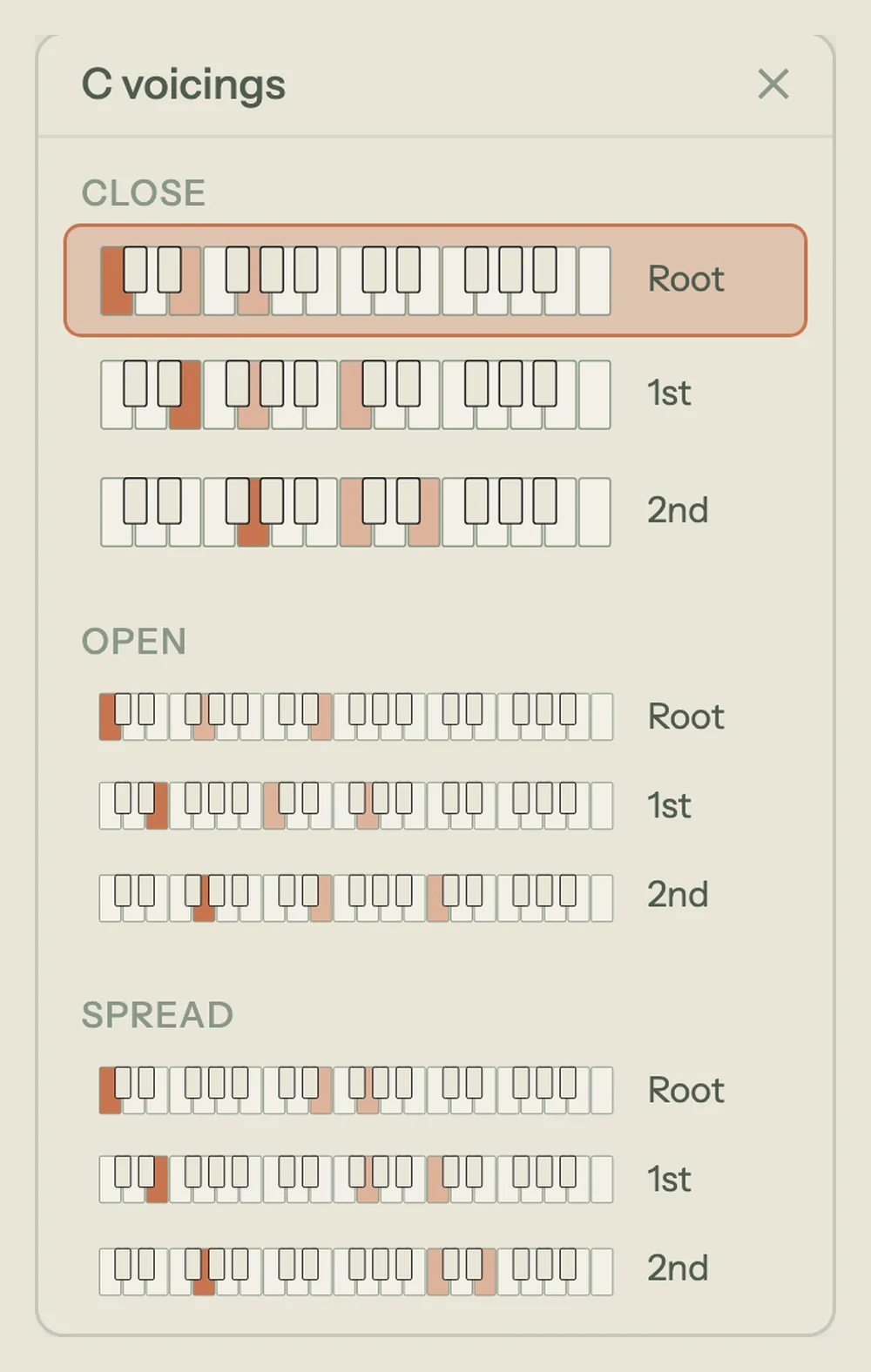
A voicing is the specific arrangement of a chord's notes: which note is lowest, how far apart the notes sit, and which octave they land in. C–E–G and G–C–E are the same chord and a completely different sound. The chord symbol tells you which notes. The voicing decides what the chord actually does.
Four piano voicings cover most of what pop and singer-songwriter writing needs:
| Voicing | What you do | What it sounds like |
|---|---|---|
| Close | All notes stacked inside one octave | Compact, clear, the default |
| Open | Move the second-from-bottom note up an octave | Airier, a gap in the middle |
| Spread | Root stays low, everything else an octave above | Wide, orchestral, big |
| Drop-2 | Move the second-from-top note down an octave | Rich, open, the jazz staple |
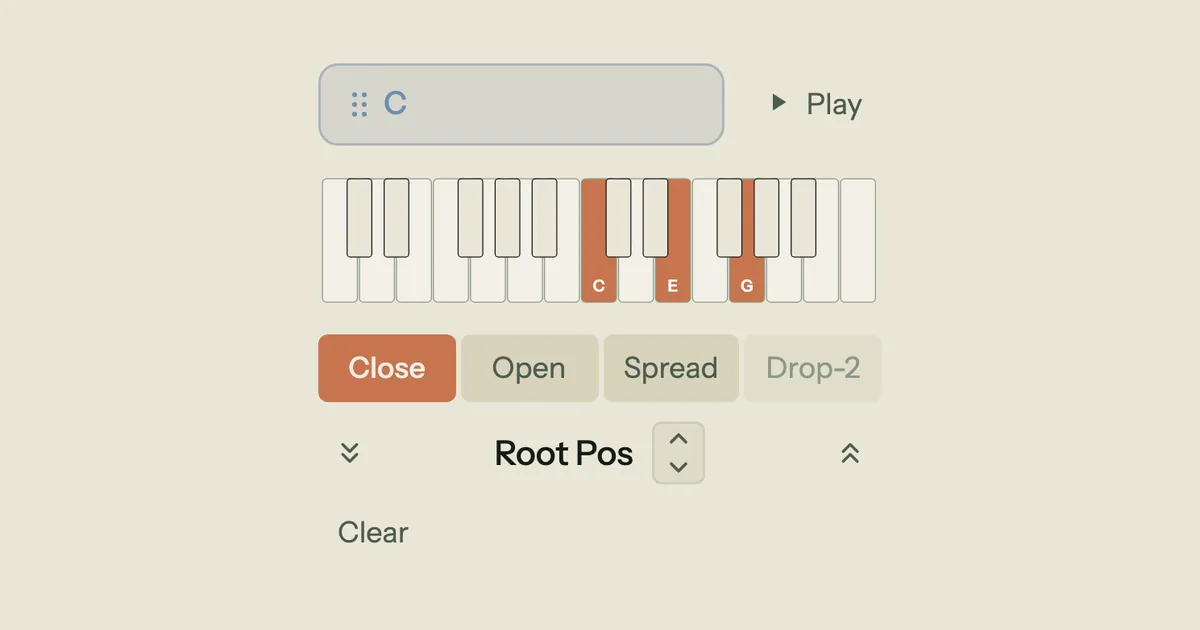
Drop-2 is worth knowing by name because it is the most reliable "why does theirs sound better" fix in the list. Learn Jazz Standards and Jazz Guitar Online define it the same way: take a four-note chord in close position and drop the second-highest note down an octave. It needs four notes to work, so it applies to seventh chords and larger, not to plain triads. Song Cage exposes all four spacings on its keyboard panel, documented in the guitar and piano chapter, and greys Drop-2 out on triads for exactly that reason.
How do inversions change a progression?
An inversion changes which chord tone sits in the bass. Root position puts the root lowest, first inversion the third, second inversion the fifth. The chord name barely changes. The bass line changes completely, and the bass line is what listeners follow. This is the single highest-return idea in piano songwriting.
Adele's "Someone Like You" is the clean example. The BBC's GCSE music analysis gives the verse as I–iii/V–vi–IV: A, C#m/G#, F#m, D. That second chord is a C#m with its fifth in the bass, a second inversion, and it exists to put G# under the harmony. The bass line then walks A, G#, F# before dropping to D. Play the same four chords in root position and the bass jumps A, C#, F#, D. Same chords. One of them is a hit.
A footnote for anyone choosing an instrument: co-writer Dan Wilson told American Songwriter that Adele first showed him the verse on guitar, and that when he moved to the piano she said, "That's way more inspiring!" He played piano for the rest of the session. For the full grammar, see chord inversions and slash chords.
Where on the keyboard should your left hand sit?
Close-spaced chords stop sounding like chords in the low register. A minor third starts to turn muddy below roughly the C an octave beneath middle C, so down there you want octaves, fifths, or single notes instead of triads. Almost no songwriting guide mentions this, and it is the most common reason a home demo sounds cloudy.
Arrangers have a name for it. Film Music Theory explains low interval limits as the lowest point at which each interval still reads clearly, and puts the minor third's limit at about C3 and E♭3, an octave below middle C. Sweetwater's reference entry gives the acoustic reason: as pitches fall, the frequency gap between two close notes shrinks until the ear can no longer separate them.
This is also why a spread voicing works. Putting the root low on its own and the rest of the chord an octave up is not a flourish, it is the arrangement obeying physics. If a section sounds thick and you cannot say why, move the left hand down to bare octaves and the right hand up.
What should the left hand actually play?
Give each hand one job. When both hands play the harmony, you have an exercise. When the left hand holds the ground and the right hand moves, you have a part. Four options cover most songs:
Four left-hand jobs
- Sustained root or octave. One note, held. The most underrated option and the hardest for trained players to accept.
- Block chords on the beat. Rhythmic drive, good for choruses, muddy if you play them low.
- Broken chord. The notes of the chord spread across the bar, which keeps sustain moving under a slow vocal.
- Alberti bass. A specific pattern, not a general term.
Alberti bass is worth naming precisely because people use the label loosely. It is the figure lowest, highest, middle, highest, repeated, and Robert Hutchinson's open music theory text and Wikipedia agree on that definition. Mozart's Piano Sonata K. 545 is the standard example, and the same figure turns up transposed into E minor in The Chantays' 1962 surf single "Pipeline." Any other broken left hand is a broken chord, not an Alberti bass.
Coldplay's "Clocks" is the model for hand separation. Wikipedia has it in E♭ Mixolydian on an E♭–B♭m–Fm progression, with the left hand anchoring roots in octaves while the right hand carries the entire moving part.
Why does the "Clocks" riff roll instead of jump?
Because the shapes barely move. Piano tutorials that transcribe it independently agree on the notes: E♭–B♭–G, then D♭–B♭–F, then C–A♭–F, each looped in a three-plus-three-plus-two grouping across eight eighth notes.
Look at what happens between the first two chords. B♭ is in both and never moves. The top note falls a step, E♭ to D♭. The bottom note falls a step, G to F. Playground Sessions' breakdown spells out the consequence: played as root-position triads, the hand would leap around the keyboard, and inverting them means almost nothing moves. That economy is the riff. It is also ordinary voice leading, applied by a songwriter rather than an arranger.
Worth noticing: this is three notes. Not a seventh chord, not an extension. Three notes, chosen well, repeated.
Does the key you write in matter on piano?
On guitar it matters enormously. On piano it barely matters at all, and that freedom is a real advantage you are probably not using. Most trained pianists default to C, G and F for the same reason guitarists default to G, C and D: comfort, not sound.
The guitar's bias is structural. Premier Guitar points out that in C, G and D, all six open strings land on notes in the key, and the more sharps you add the fewer open strings you keep. Flat keys are worse still: the article calls E♭ a "sucky" guitar key because the lowest root sits nearly an octave above the open sixth string. Guitarists reach for a capo largely to get open shapes back, which is what our guitar capo chart is for.
A piano has no open strings and no capo, so every key is available with the same five fingers. "Clocks" is in E♭. That is not a coincidence, it is a piano song written where a guitar would not have gone.
How do you turn four chords into a whole song?
You already have the tool: you just stop applying it to individual chords and apply it to sections. Keep the same progression and change how it is voiced, and the arrangement does the work an extra chord would have done badly.
A verse can be a single held octave in the left hand and a close voicing at the bottom of the right. The same four chords become a pre-chorus when the left hand starts moving and the right hand rises an octave. The chorus opens into spread voicings with the melody sitting on top. Nothing harmonic changed. The energy did, because register and density did. This is the same job song structure does at the macro level, executed with your hands instead of a section map.
The practical version: write the progression once, then decide what each section's voicing and register will be before you write another chord. Most beginner songs add chords when they should have added octaves.
How do you keep the melody out of the chords?
The pianist's specific trap is that both hands are already playing pitches, so the "melody" ends up being whatever note happens to be on top of the right-hand chord. That is a harmony line, not a tune, and it is why a lot of piano demos have no hook.
The test is simple and slightly uncomfortable: stand away from the keyboard and sing what you have. If you cannot sing it without the chords underneath, you have not written a melody yet. A tune has to survive on its own, which is the whole argument of our guide to writing a melody from scratch. Write the vocal line first if you can, or hum it and place the notes afterwards. In Song Cage the inline piano opens under the lyric block you are working on and highlights the chord tones by their role, so you can see which notes are safe landings before you commit to one, as described in the melody chapter.
How do you keep the voicing you actually played?
Here is the gap that costs pianists finished songs. You work out a progression, you find a voicing that makes it come alive, you write "Am F C G" on a napkin, and three days later you play four root-position triads and wonder where the song went. The chord symbol is a lossy recording of what you did.
Song Cage stores the voicing on the chord itself, not just the chord name. On the keyboard panel you browse close, open, spread and Drop-2 across each inversion, shift the shape by octaves, or click keys directly and let the app name the chord you built. A plain triad has nine voicings there, three spacings across three inversions; a seventh chord has sixteen once Drop-2 unlocks. Whichever you pick is what plays back, what goes into the MIDI export, and what prints as a mini keyboard diagram on the PDF chord sheet you hand your bandmates.
Write it at the piano. Keep the voicing.
Song Cage keeps the shape you played, not just the chord name, so the song you come back to is the one you wrote.
Frequently Asked Questions
Do I need to read music to write a song on piano?
No. Reading music is a way of storing and sharing what you wrote, not a way of writing it. Many working songwriters do not read fluently. What you do need is a way to keep what you played, whether that is notation, a chord chart that records the voicing, or a recording made the moment it happened.
What are the easiest piano chord progressions to write over?
I–V–vi–IV, vi–IV–I–V and I–IV–V will all carry a song. They are also the ones every other piano guide gives you, which is why the arrangement matters more than the choice. Pick one and spend your effort on inversions, register and hand separation rather than on hunting for a rarer progression. We ranked the most useful chord progressions separately.
What is the difference between a chord and a voicing?
The chord is the set of notes: C major is C, E and G in any order or octave. The voicing is the specific arrangement you play: which note is in the bass, how widely the notes are spaced, and which register they sit in. One chord symbol covers many voicings, and they do not sound alike.
Why do my piano chords sound muddy in the left hand?
You are almost certainly playing close-spaced chords too low. Arrangers use low interval limits to describe the point at which an interval stops reading clearly, and a minor third begins to blur below roughly the C an octave under middle C. Move the left hand to bare octaves or fifths down there and put the fuller chord in the right hand.
Should I write on piano or guitar?
They pull in different directions, which is a reason to try both. Guitar favours keys with useful open strings and rewards rhythmic strumming. Piano treats all twelve keys equally and rewards voicing and register. Adele wrote the verse of "Someone Like You" on guitar and it came alive when her co-writer moved to the piano, so the answer can change inside a single session.
Can I use Drop-2 voicings on a simple triad?
No. Drop-2 works by moving the second-highest note of a four-note chord down an octave, so it needs at least four notes. On a triad there is no inner voice to drop without destroying the chord. Add a seventh first, then Drop-2 becomes available. For triads, use open or spread spacing to get a similar sense of width.