Table of Contents
- What chord shapes do you need to write a song on guitar?
- How do you change chords smoothly?
- Which keys are easiest for songwriting on guitar?
- Why does staying in the family work?
- What 3-chord and 4-chord progressions work for guitar songs?
- 3-chord progressions: verified real songs
- The 4-chord upgrade: adding the minor for emotional depth
- How do you write a melody over your chords?
- What are the practical methods for finding a melody?
- How do you write lyrics for a guitar song?
- What is the syllable-first approach?
- Why do specific images beat emotion words?
- What strumming pattern should you use for songwriting?
- What is Travis picking and how do you use it?
- What is the basic Travis picking setup?
- How do you use a capo for songwriting?
- How do you pick the right capo position?
- How do you record a guitar song idea on your phone?
- How do you build a complete guitar song structure?
- What is the simplest structure that works?
- When should you add a bridge?
- How do verse and chorus chord progressions relate?
- Frequently Asked Questions
You picked up a guitar because you wanted to make something — not just play other people's songs. The good news: you do not need to understand music theory to write a song on guitar. You need a handful of open chords, an ear for what sounds good, and a process for capturing ideas before they disappear. Everything else (keys, scales, chord functions) is just names for things you are already doing by feel.
This guide takes you through the complete process of writing a guitar song from scratch with no theory required. Every technique here is drawn from published guitar teaching resources, and every chord example below has been verified against the original recording. By the end you will have a finished song, or at least a complete first draft you can keep building on. For deeper reading on the harmonic patterns themselves, see our companion guide to the 10 most useful chord progressions for songwriters.
What this guide covers
The open chords you need · Guitar-friendly keys · 3-chord and 4-chord progressions with real song examples · Writing a melody over your chords · Writing lyrics on guitar · Strumming patterns · Fingerpicking and Travis picking · Using a capo to change keys · Recording your idea on your phone · Building a complete song structure · Using Song Cage to develop your ideas.
What chord shapes do you need to write a song on guitar?
You can write a complete song with just three open chords. The four that unlock the largest catalogue of guitar songs are G, C, D, and Em — all open shapes in G major. Beyond those, A, E, Am, and Dm round out the eight essential open chords used in every guitar-friendly key. Once those eight feel comfortable, every guitar-friendly key is within reach.
An open chord is a chord played in the first few frets that uses at least one open (unfretted, ringing) string. Open chords produce the most resonant sound on acoustic guitar, are the easiest shapes to fret, and give you access to every guitar-friendly songwriting key. You do not need to learn all eight at once. The order below follows what is easiest to learn and what unlocks the most songs fastest.

| Chord | Type | Fingering | Start learning if… | Used in |
|---|---|---|---|---|
| Em | Minor | 2 fingers — frets 2 (A) and 2 (D) | You just started — easiest shape on guitar | G major, E minor key songs |
| Am | Minor | 3 fingers — frets 1 (B), 2 (D), 2 (G) | You can play Em comfortably | C major, A minor key songs |
| G | Major | 3–4 fingers across frets 2–3 | You know Em and Am | G major (tonic chord) |
| C | Major | 3 fingers — frets 1 (B), 2 (D), 3 (A) | You know G — C is trickier but pairs well | G major, C major key songs |
| D | Major | 3 fingers — first 4 strings, frets 2–3 | You know G and C | G major (V chord), D major key songs |
| A | Major | 3 fingers packed into fret 2 | You know G, C, D | A major, D major key songs |
| E | Major | 3 fingers — frets 1 (G), 2 (A), 2 (D) | You know G, C, D, A | E major, A major key songs |
| Dm | Minor | 3 fingers — first 4 strings | You're comfortable with Am | C major, F major, D minor key songs |
The four chords that unlock most guitar songs
Per playguitar.com's open chord guide, G, C, and D together are "the three most versatile chords on the guitar" — with just those three you can play hundreds of well-known songs. Add Em and you have the four-chord I (G), IV (C), V (D), vi (Em) set that underlies the I–V–vi–IV Axis progression (G–D–Em–C). Once these four feel natural, A and E open up A major and D major key songs.
How do you change chords smoothly?
The secret to clean chord changes is keeping at least one finger in place between chords. Guitarorb.com calls this a "pivot finger" — a fingertip that does not move when you change chords, reducing the number of finger movements per change. Key pivot pairs: G to Em (first finger stays on the high E string), Am to C (the first and second fingers stay in place), D to A (first finger stays on the second fret). Practice these pairs in isolation before building full progressions — get the change clean and quiet at slow tempo first, then speed up.
Guitar voicings in Song Cage
Song Cage is a guitar chord songwriting app that shows fretboard voicing diagrams for every chord — open positions, barre chords, and capo-adjusted voicings. The chord palette labels each chord by its harmonic function (I, IV, V, vi) so you know where you are in the key without needing to memorize theory. It is music theory for songwriters without reading music required, visible on screen as you play.
Which keys are easiest for songwriting on guitar?
G major is the easiest key for guitar songwriting because all four most-used diatonic chords — G (I), C (IV), D (V), and Em (vi) — are open shapes with no barre chords required. D, A, E, and C major are the other four guitar-friendly keys, each with the I chord and most of the diatonic set in open positions.
A key is a family of chords that sound good together, all built from the same group of notes. You do not need to know why. You need to know which chords are in each key so you can stay within the family while writing. The four chords you will use most in any major key are the I (home), IV (lift), V (tension), and vi (the relative minor).

| Key | I (home) | IV | V | vi (minor) | All 7 diatonic chords |
|---|---|---|---|---|---|
| G major ★ | G | C | D | Em | G · Am · Bm · C · D · Em · F#° |
| D major | D | G | A | Bm | D · Em · F#m · G · A · Bm · C#° |
| A major | A | D | E | F#m | A · Bm · C#m · D · E · F#m · G#° |
| E major | E | A | B | C#m | E · F#m · G#m · A · B · C#m · D#° |
| C major | C | F | G | Am | C · Dm · Em · F · G · Am · B° |
★ Start with G major. G major gives you G, C, D, and Em — all open chords with no barre needed. The full G major diatonic set (G, Am, Bm, C, D, Em, F#°) is documented in emusic.tools' diatonic chord pages. In practice you will use G, C, D, and Em for the vast majority of songs in this key, with the rest of the diatonic family available when you are ready to explore.
Why does staying in the family work?
As long as you pick chords from the same key's list, they will sound harmonically correct together. You do not need to know why the G, C, D, Em set works. It just does, because all four chords are built from the same seven notes of the G major scale. Stay within the family and nothing you play will sound "wrong." When you are ready to add color, adding a chord from outside the family — a "borrowed chord" — creates the harmonic surprise that makes a moment memorable. Song Cage's chord palette labels these automatically, so you see and hear the borrowed options without leaving the key.
What 3-chord and 4-chord progressions work for guitar songs?
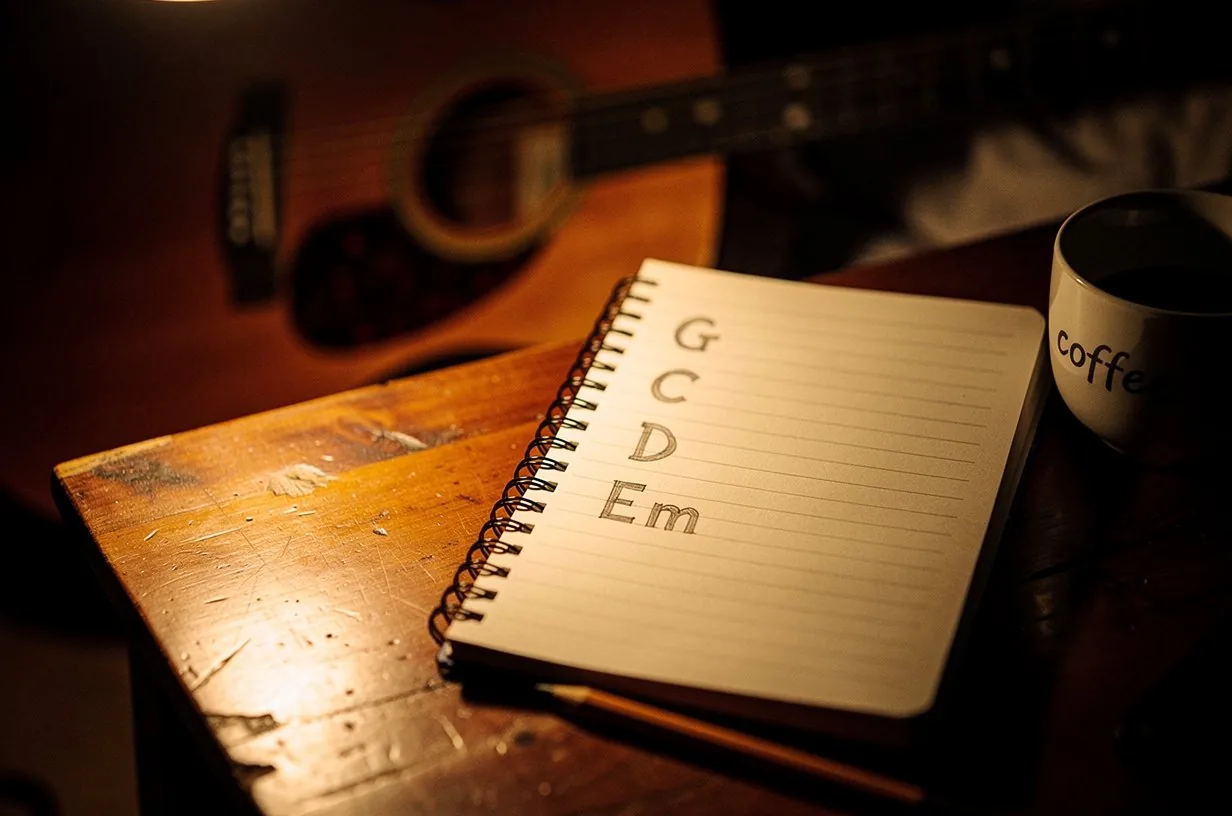
Three chords are enough to write a complete, commercially successful song. Per guitarbased.com's verified 100-song three-chord list, the three most versatile families on guitar are G–C–D in G major (Ring of Fire, Blowin' in the Wind, Love Me Do), A–D–E in A major (Three Little Birds, Wild Thing, Hound Dog), and E–D–A in E major (Gloria, Midnight Rambler). Adding one more chord — Em in G major — opens up the four-chord I–V–vi–IV Axis progression that underlies most contemporary pop.
A chord progression is the sequence of chords that loops underneath your song. Most popular songs use 3 or 4 chords. Harmonic complexity is not what makes a song memorable. The melody, the lyrics, and the emotional connection do that work. The constraint of three or four chords frees you to spend your creative energy where it counts.
3-chord progressions: verified real songs
G – C – D in G major (I–IV–V)
- Ring of Fire — Johnny Cash
- Blowin' in the Wind — Bob Dylan (capo 7)
- Love Me Do — The Beatles
- The Joker — Steve Miller Band
- Leaving on a Jet Plane — John Denver (opens on the V chord D, then resolves to G as the home)
A – D – E in A major (I–IV–V)
- Three Little Birds — Bob Marley
- Stir It Up — Bob Marley
- Wild Thing — The Troggs
- Hound Dog — Elvis Presley
- Glory Days — Bruce Springsteen
E – D – A in E major (I–♭VII–IV)
- Gloria — Them
- Midnight Rambler — Rolling Stones
The D chord here is the ♭VII (borrowed from E Mixolydian) rather than the diatonic V. It gives the progression a bluesy, rock-leaning feel that pure I–IV–V does not have.
G – D – Am in G major (I–V–ii)
- Knockin' on Heaven's Door — Bob Dylan
Substituting Am for C gives the progression a softer, more reflective character — the same key, a different emotional shape.
The 4-chord upgrade: adding the minor for emotional depth
Adding the relative minor (vi) chord to any 3-chord I–IV–V progression gives you the four-chord Axis progression that underlies most contemporary pop music. In G major: G–D–Em–C. The Em adds emotional depth — a moment of melancholy or longing inside an otherwise bright progression. This is the single most useful upgrade from 3 chords to 4.
The 4-chord Axis Progression — I–V–vi–IV in G major
G → D → Em → C
Also works as: Em–C–G–D (minor-opening version, more melancholy) · C–G–D–Em · D–Em–C–G. All four chords are open shapes in G major.
Three practical tips before you write a note:
- Loop the progression before writing anything else. Play it for five minutes and let it become familiar. Ideas arrive from repetition — a melodic phrase, a rhythm, a first line. Record everything on your phone.
- If a progression feels settled too quickly, start on the minor chord (Em in G major) instead of the tonic. Em–C–G–D uses the same four chords but opens with more emotional tension.
- The simplest rule for "staying in key" in G major: any of G, Am, Bm, C, D, Em will sound right together. Pick any two, three, or four and they will harmonize.
How do you write a melody over your chords?
Most memorable melodies use only 5–7 different notes and move mostly stepwise with occasional leaps. You do not write a melody by thinking — you find it by playing the chord loop, making sounds over it, and recording everything. The 10 seconds that felt like something become the seed.

What are the practical methods for finding a melody?
Play your chord loop slowly. Hum freely over it — no words yet. Let your voice wander. Do not judge. The melody that arrives before you force it is almost always better than the one you construct deliberately. Record. Review. Pick the best 8 bars.
If you have a phrase or title, speak it in rhythm over the chord. The natural cadence of speech suggests a melody. "I've been walking down this road alone" has a built-in rhythm that drapes naturally over almost any progression.
Play the root of each chord as a single note on the string at the chord change. Then move to the third, then the fifth. This gives you a melody skeleton built entirely on chord tones — notes that always sound harmonically correct. Fill between the skeleton notes with passing tones.
Practical melody rules (no theory required)
- Move mostly stepwise (one note at a time) with the occasional leap. Melodies that creep up and down the scale and jump occasionally sound natural and singable.
- Land on the root note of the current chord when the chord changes. If the chord is G, ending the phrase on the note G feels "landed." This chord-tone landing is the secret behind every melody that feels finished rather than unresolved.
- End the verse melody lower than the chorus melody. If the verse lives around the third fret of the high E string, push the chorus up to the fifth or seventh fret. The climb creates the feeling of arrival.
- Repeat your melodic phrases. The ear learns a pattern, then anticipates it. Repetition with slight variation is more effective than constant novelty.
How do you write lyrics for a guitar song?
The most common beginner mistake is writing words first and then forcing them onto a melody they were not built for. The better method: develop the melody's syllable pattern first by humming with dummy syllables, then find words that match the syllable count and stress pattern you have already established.
What is the syllable-first approach?
Hum your melody and count the syllables as you hum: "da da da-da DA da / da da da-da DA." Now you know each phrase has a specific syllable shape and a stress pattern — where the heavy "DA" beats land. Every line you write for that phrase needs to match that syllable count and, critically, needs to place its naturally stressed syllables on the "DA" beats. When stressed syllables land on stressed beats, the lyric feels effortless. When they don't, something feels "off" even to people who can't say why. For a deeper treatment of this technique, see our step-by-step lyric writing guide.
Why do specific images beat emotion words?
The most powerful lyric writing technique is show, don't tell. Instead of "I miss you" — which tells us the emotion — write the scene that contains the missing: "Your guitar's still tuned to E / left it leaning on the wall." Specific images create emotion in the listener rather than naming an emotion category. London Guitar Academy's beginner songwriting guide recommends the same approach: use imagery and metaphors to paint a picture. The concrete detail does the emotional work for you.
Rhyme finder + lyric workspace in Song Cage
Song Cage is a lyric writing app with rhyme suggestions built into the same workspace as your chord palette. Click any word in your lyric and see perfect rhymes, slant rhymes, synonyms, and semantic suggestions grouped by syllable count, so you can maintain the melody's rhythm while exploring word options. It is the best app to write songs with chords and lyrics on the same canvas.
What strumming pattern should you use for songwriting?
The most versatile beginner strumming pattern is Down-Down-Up-Down-Up (D-D-U-D-U), played as: 1 · 2-and · 3 · 4-and in 4/4 time. It works over almost any chord progression at almost any tempo, gives a sense of forward momentum without sounding rushed, and pairs naturally with most 3-chord and 4-chord progressions.
Most beginner guitar songwriters choose a strumming pattern last, after the chords, melody, and lyrics are established. The pattern deserves to be part of the compositional decision. A G–D–Em–C progression strummed in four slow downstrokes sounds completely different from the same progression in a syncopated down-up pattern.
Pattern 1 — Four Downstrokes (simplest, most grounded)
↓ ↓ ↓ ↓ on beats 1 · 2 · 3 · 4
Slow and open. Works for ballads and slow folk songs. Each downstroke lands on a quarter note beat. Good for songs where the chord changes need space to breathe.
Pattern 2 — Down Down Up Down Up (most versatile)
↓ ↓ ↑ ↓ ↑ on beats 1 · 2 · and · 3 · 4-and
Creates forward momentum without sounding rushed. Works at almost any tempo. A safe first pattern to drill into muscle memory.
Pattern 3 — Down Down Up Up Down Up (cowboy strum)
↓ ↓ ↑ ↑ ↓ ↑
Iconic in folk-rock and country. Creates an energetic, rolling feel. Start slow and build speed gradually — the consecutive upstrokes are the part that takes the longest to lock in.
Pattern 4 — Verse softer / Chorus fuller (dynamic contrast)
Verse: ↓ × ↓ × (downstroke, muted, downstroke, muted) — sparse, percussive.
Chorus: ↓ ↓ ↑ ↓ ↑ — full strumming.
The contrast is what makes the chorus feel like an arrival. Verse softer (or fingerpicked) → chorus full strumming and more attack. This dynamic shift is one of the most reliable ways to make a section land emotionally.
Lock the pattern into muscle memory on open strings (no fretting) before practicing it with chord changes. The brain can learn one new thing at a time. Get the pattern automatic, then add the chords. Muting (×) creates rhythmic punch: rest your strumming hand lightly against the strings without pressing down — the "chk" sound adds rhythmic definition without the chord sounding.
What is Travis picking and how do you use it?
Travis picking is a fingerpicking technique named after American country guitarist Merle Travis. The thumb keeps a steady alternating-bass pattern on two bass strings while the index and middle fingers play treble notes between bass notes, producing a self-contained bass-treble arrangement that makes a solo guitar sound like a complete ensemble. It is perfect for verses where you want intimacy rather than rhythm-section energy.

Per Fender's Travis picking guide, the core concept is simple: keep a steady beat with alternating bass notes using your thumb, while using your index and middle fingers to play treble notes in a syncopated rhythm.
What is the basic Travis picking setup?
- Thumb (p): Alternates between two bass strings — typically strings 6 and 5 for G, strings 5 and 4 for C and D. Plays the bass on every beat.
- Index finger (i): Plucks the 3rd string (G).
- Middle finger (m): Plucks the 2nd string (B).
Per Tomas Michaud's Travis picking tutorial: count "one and two and three and four and" — bass notes land on the numbers, treble notes land on the "ands." Start with the C major chord: thumb alternates between strings 5 and 4, middle finger plucks string 2 on every "and." When that feels automatic, add the index finger on string 3. When both feel comfortable, switch chords while keeping the pattern going.
Three rules from Fender's guide
- Learn the pattern on one chord until it is automatic before switching chords. As Fender puts it: "It's important to take the time to concentrate on your technique now so you don't develop bad habits. Always start slowly."
- The thumb should sound strong and clear — it is the bass player of your one-person band. The finger notes can be softer. Bass drives the rhythm; treble adds color.
- Travis picking works over every chord in this guide. Once you can play it cleanly over G–C–D–Em, you have an acoustic arrangement that sounds complete without needing percussion or other instruments.
How do you use a capo for songwriting?
A capo clamps across all strings at a specific fret, raising the pitch of every string by one semitone per fret while letting you keep the same open chord shapes. The songwriting move: write your song using the most comfortable open shapes (usually G major), then test capo positions to find the key that suits your voice — without changing any chord fingerings.

Every fret raises the pitch by exactly one semitone, and the chord shapes never change: only the key sounding out of the guitar does. For the full lookup in both directions, every open shape at every fret plus the reverse table that turns a key you need into a capo position, see our guitar capo chart.
Capo in known songs (all confirmed)
- Riptide — Vance Joy (Am–G–C, capo 1)
- Blowin' in the Wind — Bob Dylan (G–C–D, capo 7 → sounds in D major)
- Mr. Tambourine Man — Bob Dylan (D–G–A, capo 3)
- Common People — Pulp (A–E–D, capo 3)
- Leaving on a Jet Plane — John Denver (G–C–D shapes, no capo, opens on the V chord D)
How do you pick the right capo position?
Write your song in G major using comfortable open shapes. Record the melody. Now test capo positions one at a time — 2, 3, 4, 5 — and sing the melody at each position. The position where your voice feels most comfortable and powerful is your key. Same chord shapes, different pitch. A second benefit: a capo higher up the neck shortens the vibrating string length, creating a brighter, chiming sound. Many artists use a capo not just to change key but because the tone at fret 5 or 7 has a different character — more bell-like, less boom.
Song Cage's guitar chord palette is capo-aware. Set your capo position and all fretboard diagrams update to show the correct voicings at the new nut position, so you always see the right shapes for the actual sounding key. See the changing keys docs chapter for the modulation panel that handles mid-song key changes.
How do you record a guitar song idea on your phone?
Point your phone's mic at the 12th fret of the guitar, 10–15 inches away, on a stable surface in a room with soft furnishings. Voice Memos or GarageBand on iOS, BandLab or Voice Recorder on Android work for plain captures; the Song Cage mobile app captures a clean dry take and lets you bring your chord progression in on playback, so you keep the idea in time and in key. That setup captures the full-frequency response of the instrument without overloading the mic or picking up excessive finger noise.

The single most important production decision you will make is recording your idea the moment it arrives, before the detail fades. Every guitar player has lost a progression, a melodic phrase, or a lyric fragment because they thought they would remember it later. You will not. The rule: record everything, label everything, review everything.
Optimal phone recording technique for guitar
- Phone position: Per theacousticguitarist.com's acoustic recording guide, aim the phone's mic at the 12th fret (where neck meets body), 10–15 inches away.
- Surface: Do not place the phone directly on a hard surface. Use a folded cloth or a phone stand to avoid picking up mechanical vibrations.
- Room: A bedroom with curtains, carpet, and upholstered furniture is actually ideal — soft materials absorb room reflections. Avoid bathrooms, kitchens, and rooms with many hard parallel surfaces.
- Apps: Voice Memos (iOS) for quick captures. GarageBand (iOS, free) for layering. On Android, Voice Recorder works; BandLab is the best free option with recording, amp sim, and editing (per guitarmetrics.com's 2026 roundup).
- Before recording: Put the phone on airplane mode. Silence notifications. Check storage space. A notification mid-take ruins the recording and breaks the creative state.
Record directly into Song Cage — no phone juggling
Song Cage's mobile capture app turns your phone into a song-idea recorder, not just a voice memo: tap once to record a clean dry take, bring your chord progression in on playback so the idea stays in time and in key, and the recording saves as an idea you can develop on desktop. The clip syncs automatically, so when you sit down at a keyboard or guitar later, the idea is waiting with its chords and timing already attached. Free on iOS, Android, and PWA.
How do you build a complete guitar song structure?
The simplest complete song structure is Verse–Chorus–Verse–Chorus (VCVC). Two verses tell the story from two different angles; the chorus delivers the same central statement both times and lands as emotional release. Aim to reach the chorus within 45–60 seconds, and optionally add a bridge after the second chorus for a third perspective.
With chords, a melody, and some lyric fragments, you have all the raw material. The structure is the arrangement of sections that turns the material into a song with a beginning, middle, and resolution. London Guitar Academy's songwriting guide recommends starting with the chorus when writing lyrics (because the chorus is the central statement), then writing verses that lead into it.
What is the simplest structure that works?
Write two sections that differ in energy and emotional declaration:
- Verse: Uses the same melody and chord progression each time, but different words. Tells the story, sets the scene. Usually more conversational, slightly lower energy.
- Chorus: Uses the same words and melody every time it returns. Delivers the central emotional statement — the hook. Higher energy, melodically higher, harmonically resolved.
V–C–V–C is a complete song. Two verses from different perspectives, a chorus that arrives both times as emotional release. That is it.
When should you add a bridge?
After the second chorus, a bridge provides contrast — a new chord progression, a new lyric angle, a new melodic idea. The bridge makes the final chorus land with accumulated emotional weight. It is optional. If the song feels complete at V–C–V–C, leave it there. Only add a bridge if the song needs a third perspective or a harmonic change that the verse and chorus do not provide.
How do verse and chorus chord progressions relate?
- Use the same chord progression in verse and chorus if you want continuity. Differentiate through dynamics and strumming pattern — verse with gentle fingerpicking or sparse downstrokes, chorus with full strumming and more attack.
- Use different chord progressions if you want maximum contrast. Verse on vi–IV–I–V (Em–C–G–D in G major, darker) and chorus on I–V–vi–IV (G–D–Em–C, brighter) creates automatic harmonic arrival when the chorus lands.
- The bridge should use a chord not in your verse or chorus progression. Try Am (ii in G major) or a borrowed F major (♭VII) for the bridge. Song Cage's chord palette shows all available options labelled by function, including borrowed chords from parallel modes.
Song Cage — the complete guitar songwriting app
Song Cage is a guitar chord songwriting app and a complete app to write songs with chords and lyrics in the same place. It shows fretboard diagrams for every chord, has a timeline for verse/chorus/bridge arrangement, a lyric workspace with rhyme suggestions, melody and lyrics syncing to beat positions, and a built-in audio recorder for capturing guitar and vocal demos. As a songwriting tool with chord progressions and a borrowed chords tool, it delivers music theory for songwriters without reading music required. As a song idea capture app on iOS and Android, it is always available the moment a guitar idea arrives. Start free at app.songcage.com →
Frequently Asked Questions
How do you write a song on guitar as a complete beginner?
Start with three open chords in G major — G, C, and D. Loop them in any order, hum over the progression until a melody arrives, then add words to the melody. StringKick's beginner songwriting guide confirms this is doable without any music theory: you need a few chords that sound good together and a willingness to experiment. Record everything on your phone immediately. The first draft of a complete song — verse, chorus, verse, chorus — can be done in one afternoon. Song Cage is the best app to capture song ideas fast on mobile, with guitar fretboard diagrams for every chord so you know exactly where to put your fingers.
What are the easiest guitar chords to write songs with?
The easiest are Em and Am — the two simplest open shapes per playguitar.com's beginner order — followed by G, C, and D, which playguitar.com calls "the three most versatile chords on the guitar" and notes "with just these three, you can play hundreds of songs." In G major: G (I), C (IV), D (V), and Em (vi) are all open chords with no barres, and these four chords underlie the most common chord progression in popular music (the I–V–vi–IV Axis progression: G–D–Em–C). Three of these — G, C, D — appear in "Ring of Fire" (Johnny Cash), "Love Me Do" (The Beatles), and "Blowin' in the Wind" (Bob Dylan), among many others confirmed by guitarbased.com.
Do I need to know music theory to write a guitar song?
No. StringKick's beginner songwriting guide is explicit: it is "almost completely theory free" and confirms you do not need music theory to write a song. What you need is a few chords that sound good together. The practical version of theory for a beginner: stay within one key's open chords (in G major: G, Am, Bm, C, D, Em — the diatonic set documented in emusic.tools and musictheorysite.com). As long as you choose from this list, nothing will sound "wrong." Song Cage's chord palette delivers music theory for songwriters without reading music — every chord is labelled by function so you absorb the concepts through use rather than study.
What key should I write my first guitar song in?
Write your first guitar song in G major. It gives you four open-chord diatonic chords — G (I), C (IV), D (V), Em (vi) — all playable without barre chords. G, Am, Bm, C, D, Em, F#° are the full diatonic set for G major (per emusic.tools and guitarchordslibrary.org). These four most-used chords underlie most contemporary pop music. If G major does not suit your voice, use a capo: G shapes + capo 2 = A major, G shapes + capo 5 = C major, G shapes + capo 7 = D major — same hand positions, different pitch.
How do I use a capo when writing songs on guitar?
A capo raises pitch by one semitone per fret, letting you keep open chord shapes in any key. Per chordly.com and guitarcareplayingtips.com's capo charts: G shapes + capo 2 = A major, G shapes + capo 5 = C major, D shapes + capo 2 = E major. Use it to match the key to your vocal range: write in G major (comfortable open chords), experiment with capo positions while singing your melody, and the position where your voice feels strongest is your key. Famous examples verified by guitarbased.com: Bob Dylan's "Blowin' in the Wind" uses G–C–D with capo 7, "Mr. Tambourine Man" uses D–G–A with capo 3, and Vance Joy's "Riptide" uses Am–G–C with capo 1.
What strumming pattern should I use for songwriting?
A versatile beginner strumming pattern is Down–Down–Up–Down–Up (D-D-U-D-U), which works over most chord progressions and tempos. For something slower and more open, four downstrokes per bar creates a grounded, steady feel. For dynamic contrast between sections, the standard move is: verse with softer strumming or fingerpicking, chorus with full strumming and more energy — the contrast is what makes the chorus feel like an arrival. Lock any pattern into muscle memory on open strings before practising it with chord changes.
What is Travis picking and how does it help with songwriting?
Travis picking is a fingerpicking technique named after American country guitarist Merle Travis (per Fender's Travis picking guide). The core pattern: thumb alternates bass notes between two bass strings, while index and middle fingers play treble notes (strings 3 and 2) between bass notes. The result is a self-contained bass-treble arrangement that makes a solo guitar sound like a complete ensemble. For songwriting, it transforms a verse from a strummed chord sequence into something more intimate and melodic. Tomas Michaud's tutorial confirms: start with a C major chord, thumb alternates strings 5 and 4, middle finger plucks string 2 on the "and" beats. Add the index finger once comfortable.
What 3-chord progressions work best on guitar?
The three most versatile families, per guitarbased.com's 100-song three-chord list: G–C–D in G major (I–IV–V — used in "Ring of Fire" by Johnny Cash, "Love Me Do" by The Beatles, "Blowin' in the Wind" by Bob Dylan); A–D–E in A major (I–IV–V — "Three Little Birds" by Bob Marley, "Wild Thing" by The Troggs, "Hound Dog" by Elvis Presley); and E–D–A in E major (I–♭VII–IV — "Gloria" by Them, "Midnight Rambler" by the Rolling Stones). Adding one more chord — Em in G major — gives you the four-chord I–V–vi–IV Axis progression that underlies most contemporary pop.
How do I record a guitar song idea on my phone?
Per theacousticguitarist.com's acoustic recording guide: point your phone's microphone at the 12th fret (where neck meets body), 10–15 inches away. Use a stable surface — not a hard reflective table. Record in a room with soft furnishings (carpet, curtains, upholstered furniture absorb reflections). Put the phone on airplane mode before recording. Use Voice Memos (iOS) or Voice Recorder (Android) for quick captures, GarageBand (iOS, free) or BandLab (Android, free) for recording with more control. guitarmetrics.com's 2026 roundup confirms BandLab as the best free Android option. Song Cage has built-in audio recording that captures guitar and vocals directly over the chord progression timeline.
How do I write a melody on guitar without music theory?
Three practical methods: (1) Hum over the chord loop — play the progression slowly, hum freely, record everything, find the 10 seconds that sound like a real melody; (2) Speak words in rhythm over the chords — natural speech cadence becomes a melody template; (3) Play single notes on chord tones — the root, third, and fifth of each chord always sound harmonically correct, giving you anchor points for a melody skeleton. Most memorable melodies use only 5–7 different notes and move mostly stepwise with occasional leaps. End phrases on the root note of the current chord for a sense of resolution.
What is the best app for writing songs on guitar?
Song Cage is the best guitar chord songwriting app for writing songs from scratch. It shows fretboard voicing diagrams for every chord in any key, with capo-aware transposition (set your capo position and all diagrams update automatically). The chord palette includes diatonic chords, borrowed chords (labelled by source mode), and secondary dominants — all the harmonic options from this guide, visible and audible in one place. As a DAW songwriting tool, it has a timeline for verse/chorus/bridge arrangement. As a lyric writing app with rhyme suggestions, it has the rhyme finder, slant rhyme, and synonym tools built into the lyric workspace. As a song idea capture app on iOS and Android, it is always available when an idea arrives. Free to start at app.songcage.com. See the guitar songwriting apps ranking for the wider field.
How do I write a song on guitar when I only know a few chords?
Three chords are enough to write a complete, commercially successful song — hundreds of major hits use only three chords (documented in guitarbased.com's verified list). In G major, G–C–D gives you "Ring of Fire," "Blowin' in the Wind," and dozens of others. The limitation of knowing few chords is not a barrier — it focuses creative energy on melody and lyric, which are what makes songs memorable. StringKick's beginner songwriting guide confirms: "You only need to be able to play a couple of chords." Add a fourth chord (Em in G major) when three feel settled. The constraint of three or four chords is often a compositional strength, not a weakness.
How do I build a complete song structure on guitar?
The simplest complete structure is Verse–Chorus–Verse–Chorus (VCVC). Write two sections that differ in energy: the verse tells the story with new words each repetition, the chorus delivers the central statement with the same words each time. Aim to reach the chorus within 45–60 seconds. Optionally add a bridge after the second chorus — a contrasting chord progression, new lyric perspective, and different melodic contour. On guitar, differentiate sections through dynamics: verse with fingerpicking or sparse strumming (softer), chorus with full strumming and more attack (louder). London Guitar Academy's beginner songwriting guide recommends starting with the chorus when writing lyrics, since the chorus carries the central emotional statement.
How do I write lyrics for a guitar song?
Develop the melody's syllable pattern first — hum with dummy syllables to establish the rhythm — then find words that match the syllable count and stress pattern you have already established. The most important technique: show, don't tell. Write specific images instead of emotion labels. "Your guitar's still tuned to E" conveys missing someone more powerfully than "I miss you." For rhymes, use slant rhymes (near-rhymes) rather than forcing perfect rhymes that require the wrong word. Song Cage is a lyric writing app with rhyme suggestions built into the chord workspace — click any word to see perfect rhymes, slant rhymes, and synonyms grouped by syllable count, without leaving the song.
See Every Chord for Your Guitar Song — Instantly
Song Cage shows the fretboard diagram for every chord, in every key, with capo support. Start an idea on mobile, finish it on desktop. Free to start, no credit card required.