Table of Contents
- How do you memorize lyrics fast?
- Why doesn't reading the lyrics over and over work?
- How do you test yourself on lyrics?
- Should you learn a song one section at a time?
- Why do the verses get mixed up but never the chorus?
- How do you keep the verses in order?
- Why is it harder to memorize a song you wrote?
- How do you stop an old draft line coming back?
- Should you sing the lyrics or speak them while you learn?
- How often should you practice lyrics before a gig?
- How do you stop forgetting lyrics on stage?
- Is it cheating to use a teleprompter for your own songs?
- How can Song Cage help you rehearse your own songs?
- Frequently Asked Questions
In August 2023, on tour with the High Flying Birds, Noel Gallagher admitted that he struggles with the words to some of Oasis's hits. "I've found myself on this tour consciously thinking: 'What is the next line to this song?'" he said. He was 56, and they were songs he had written.
So if you blank on your own second verse at an open mic, you're in good company. You're also probably learning the words the slow way. Reading the lyric sheet over and over is the method that feels best and holds up worst. Testing yourself is faster, short sessions on separate days beat one long one, and a song you wrote has a problem a cover doesn't: every old draft of every line is still in there, waiting on the same notes.
Quick Summary
To memorize lyrics fast, stop rereading and start testing yourself: sing a section from memory, check the sheet only once you're stuck, and start the next pass at the line you missed. Learn the song a section at a time. Learn what changes from verse to verse so the verses can't swap. Spread short sessions over several days, and rehearse standing up, at full voice, the way you'll perform.
How do you memorize lyrics fast?
The fastest way to memorize lyrics is to practice remembering them, not reading them. Read one section with the melody, close the sheet, sing it from memory, then check what you missed. Start the next pass on the misses. Spread short sessions over several days, and rehearse in the conditions you'll perform in.
Every step below comes from memory research, most of it measured with prose, word lists and facts rather than songs. Where a song behaves differently (verses that share a melody, a writer who has sung four versions of the same line), that gets its own section. The short version fits on an index card:
The method on one card
- Read one section with the tune, once or twice.
- Close the sheet and sing it from memory. Don't peek until you're stuck.
- Check, circle the lines you missed, and start the next pass on those.
- Add the next section only when this one comes out clean.
- Know what each verse is about, so verse two can't jump into verse one.
- Stop for the day. Tomorrow, test before you read.
- Rehearse standing, with the instrument, at full voice.
Why doesn't reading the lyrics over and over work?
Rereading builds familiarity, and familiarity feels like memory without being memory. In Roediger and Karpicke's 2006 study, a passage students had reread was recalled better five minutes later than one they had tested themselves on. A week later the result flipped: 56% of the self-tested passage came back, against 42% of the reread one.
That study is Henry Roediger and Jeffrey Karpicke's "Test-Enhanced Learning", published in Psychological Science. Students studied short prose passages, then either studied a passage again or took a recall test on it with no feedback. After two days the tested passages were already ahead, 68% to 54%. In a second experiment the gap was wider still: students who studied once and then tested themselves three times recalled 61% a week later, against 40% for students who only studied. The rereaders had read the passage 14.2 times on average. The self-testers had read it 3.4 times.
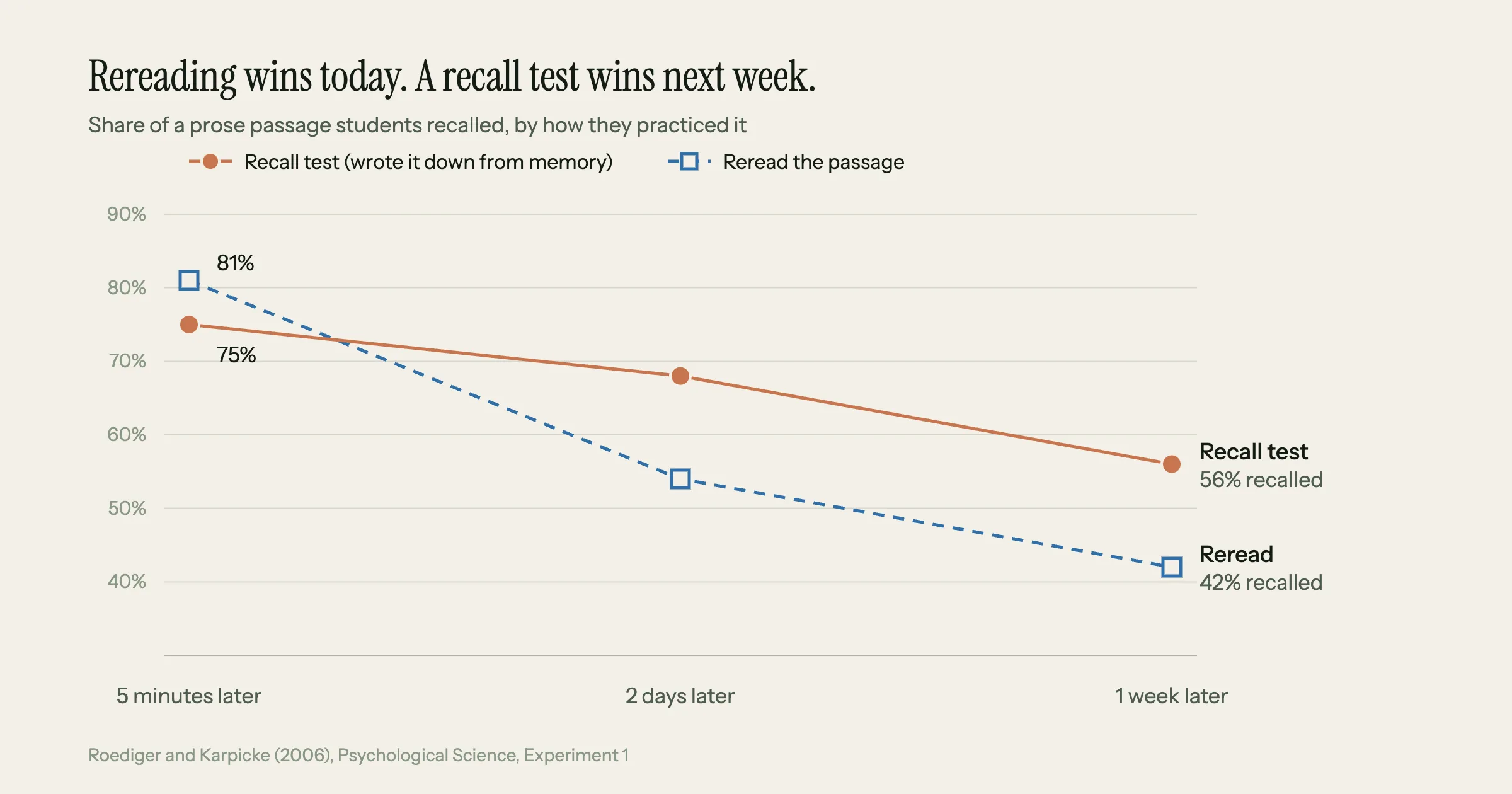
The detail that matters most for a singer is the five-minute result. Rereading won the short test, and the rereaders were the most confident about the week-later one, which they did worst on. A lyric you read twenty times this afternoon will feel solid tonight. Two days from now is where it falls apart.
How do you test yourself on lyrics?
Test yourself by producing the words from memory before you look at them, then checking. Anything that makes you pull the lyric out of your own head counts: writing it on a blank page, singing to a backing track with the sheet face down, or reading from a cue sheet of first letters.
A few ways to do it, from hardest to easiest:
- Blank page. Write the section out from memory, then check it against the sheet and circle every word you got wrong or left out.
- Face down. Play the song (your own guitar, a demo, a backing track) and sing it with the lyric sheet turned over. Flip it only when you stall.
- First letters. Write just the first letter of each word: I w u i t k, t r w s o for "I woke up in the kitchen, the radio was still on." The letters stop you freezing, and you still have to find every word yourself.
Whichever you use, start the next pass at the line you missed, not at the top. Starting over every time gives the first verse far more runs than the bridge, which is how you end up knowing the opening cold and drifting by the last verse.
Should you learn a song one section at a time?
Yes, for anything long or wordy. Bluegrass singer Rhonda Vincent learned her 392-word parody "I Ain't Been Nowhere" by splitting it into its seven sections and taking them one at a time, stopping and restarting every time she slipped, until she no longer needed the teleprompter she'd been using for it.
"The song has 7 sections, so I just took it section by section," she told Taste of Country in 2021. "Every time I would mess up, I would stop and try it again until I could figure it out, and eventually, I had it down." She worked through it in a series of Facebook Lives with her fans, which is also a neat way to make yourself rehearse under a little pressure.
Your song's sections are the natural chunks: verse one, the pre-chorus, the chorus, verse two, the bridge. Learn one until it comes out clean from a blank page, then learn the next, then run the two together. The joins are where people stall, so practice them on purpose. The last line of the chorus into the first line of verse two is a different skill from either section alone.
Why do the verses get mixed up but never the chorus?
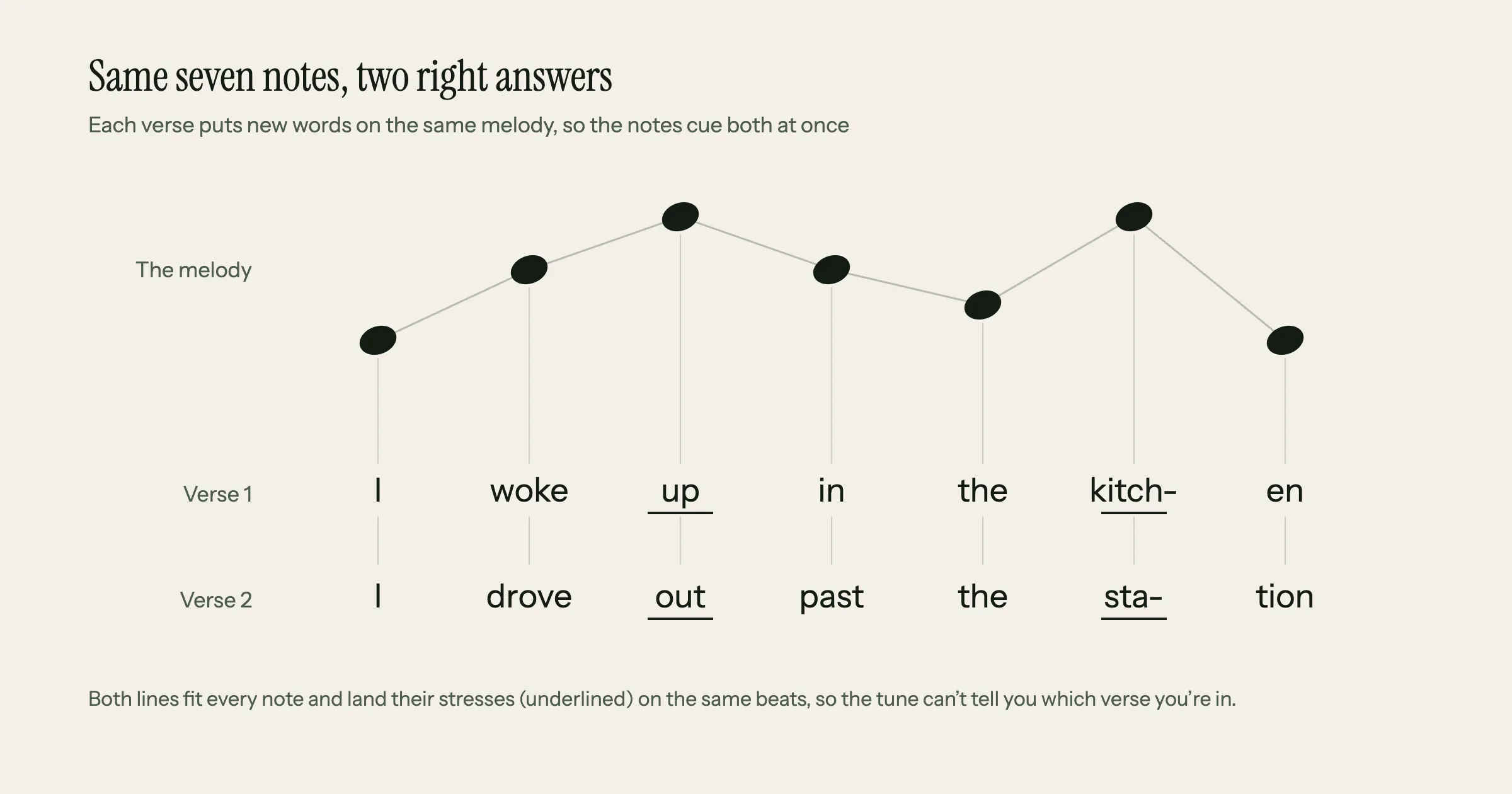
Verses get mixed up because they share a melody. Every verse puts different words on the same notes, so when the melody comes round it cues all of them at once. The chorus usually has one set of words, repeated, so its notes only point one way.
The melody is a strong memory aid in its own right. In Wanda Wallace's 1994 experiments, published in the Journal of Experimental Psychology: Learning, Memory, and Cognition, listeners who heard three verses of a text sung to the same melody remembered more of it than listeners who heard it spoken. Wallace found the music doing more than keeping time: it "chunks words and phrases, identifies line lengths, identifies stress patterns." The tune tells you how many syllables the next line has and where its stresses fall. It narrows the options. (A line whose stresses fight the beat gets less of that help, which is one more reason to fit the words to the melody.)
What the tune can't do is tell verse one's line from verse two's. Both fit the notes perfectly. Psychologists call this interference, and it gets worse the more alike the competing memories are. The classic lab version has people learn a word pair, A with B, then a second pair, A with C. The shared cue, A, keeps dragging up the wrong partner. In a song, the melody is A.
How do you keep the verses in order?
Learn what each verse is for, not only what it says. Professional actors in Helga Noice's 1992 study described learning long scripts word for word by working out why the character says each line. If verse one is the kitchen at dawn and verse two is the car that night, the story holds the verses apart where the melody can't.
The actors finding is Helga Noice's. When she asked seven professional actors how they learn a role, all seven said they don't memorize lines by rote. They read the script many times, trying to work out the motivation behind each line, and the exact words stick as a side effect. In a later study with Tony Noice, students taught to take a character's point of view this way, which the authors call active experiencing, remembered text word for word better than students who simply tried to memorize it.
For a song, write one line per verse saying what changes: the time, the place, who's talking, what they know now that they didn't. Then give each verse an anchor word, usually its first noun. Kitchen. Car. Porch. When you blank at the top of a verse, the anchor tells you which one you're in, and the rest of the line has somewhere to come from. The rhyme scheme does the same job at the end of each line: once you know which lines rhyme, the last word is half-chosen for you.
Why is it harder to memorize a song you wrote?
Your own song is harder because you've already learned it several times, with different words. Every draft line you sang on those notes is still in memory, and the oldest drafts have usually had the most practice. When the melody comes round, the old line and the new line both answer.
The APA's dictionary defines proactive interference as "interference in new learning due to previous learning of similar or related material", with the example of high-school French getting in the way of college Spanish. A songwriter has the most similar material there is. You may have sung the first draft of a chorus dozens of times while you worked out the tune. The line that replaced it gets sung for the first time on the day you fix it, and from then on it's competing with a version that has a long head start.
There's a second, quieter problem. You wrote the song with the page in front of you. All those hours of singing it were hours of reading it, which is the rereading trap from earlier, at full strength. It's easy to sing a song you wrote a hundred times and never once sing it from memory.
How do you stop an old draft line coming back?
Commit to one version, write it out clean, and stop singing the alternatives, even to compare. Then practice the new line in context, from the line before it into the line after, because that's where the old one ambushes you. If the old line keeps winning under pressure, check whether it was actually better.
Practicing a replaced line on its own doesn't help much. The trouble happens on the way in: you're singing the line before, the melody turns the corner, and the version with the most practice gets there first. So drill the transition, three lines at a time, until the new line is the one that arrives.
It's also worth asking why your mouth keeps choosing the old line. Sometimes it's only the head start. Sometimes the old line sat better on the beat, kept a rhyme the new one broke, or had a vowel that was easier to hold. Sing both against the melody. If the old one sings better, the edit may be the mistake, and the song is telling you so every time you perform it.
Should you sing the lyrics or speak them while you learn?
Sing them, once the melody is settled. In Wanda Wallace's 1994 experiments, a three-verse text heard sung was remembered better than the same text heard spoken, but only when the same melody repeated for every verse. With a single verse, or a different melody for each verse, the spoken version was remembered better.
Wallace's subjects listened rather than sang, so applying this to your own practice is a step beyond the study. The logic carries, though: the melody helps because it is learned too. Three verses on one tune let listeners learn the tune quickly, and from then on the tune carried the words. One verse wasn't enough repetition, and a new tune per verse was one more thing to learn, so in both cases the music got in the way instead of helping. That maps onto writing pretty directly. While you're still changing the melody, speak or write the lyric when you practice it, because each new tune is a new thing to learn and the old ones compete. Once the melody is fixed, learn the words and the tune together, and let the repetition across the verses do its work.
The chorus gets this help more than any other section, because its words repeat along with its melody.
How often should you practice lyrics before a gig?
Short sessions on separate days beat one long session. In Cepeda and colleagues' 2008 study of more than 1,350 people, the best gap between first study and review grew with how long they needed to remember: of the gaps tested, one day when the test was a week away and eleven days when it was five weeks away.
That's Nicholas Cepeda and colleagues, also in Psychological Science. People learned a set of obscure facts, reviewed them after a gap of up to three and a half months, and were tested up to a year later. For a fixed amount of study, the right gap raised final recall by 64% compared with reviewing straight away. They also found that a gap somewhat too long costs much less than a gap too short.
These were facts, not lyrics, so treat the numbers as a shape rather than a rule. The shape is clear enough. A gig a week away wants a few minutes a day, test first. A gig a month away can start with longer gaps, and still wants daily runs in the last week.
A week before the gig
- Day 1: learn each new section: read it once with the tune, sing it from memory, check, repeat on the misses.
- Days 2 to 6: test first, read second. Run the set in order once, standing, at full voice. Fix only what broke.
- Gig day: one run in the morning with the sheets face down. No changes to the words.
That last rule is the writer's one. A lyric you rewrite on the afternoon of the show is a new line with zero practice, up against an old one that has had a week.
How do you stop forgetting lyrics on stage?
To remember lyrics on stage, rehearse the way you'll perform. Memory leans on the setting it was learned in: in Godden and Baddeley's 1975 study, divers who learned words underwater recalled them best underwater, and words learned on land were recalled best on land. A lyric learned sitting down and half-sung was learned in the wrong place.
That's Duncan Godden and Alan Baddeley's study in the British Journal of Psychology, and a stage is about as far from your sofa as dry land is from the seabed. So practice standing up, playing the instrument you'll play, at the volume you'll sing. Run the songs in set order, and say the bits between songs out loud, because a blank is often a bad transition and not a lost word. Singing it out also tells you early if the song sits wrong for your voice once you stop singing it softly.
The other enemy is a wandering mind. Paul McCartney described it on the SmartLess podcast in 2020, as The Independent reported: singing "Eleanor Rigby" on autopilot, his mind drifts to what he'll have for dinner. "Sometimes that breaks down and I forget the song."
Decide in advance what you'll do when it happens. Keep playing the form. Sing the verse's first line again, or hum the melody on "ooh", or go straight to the chorus, which you will remember. A repeated line keeps the song going. Stopping is the thing to avoid.
Is it cheating to use a teleprompter for your own songs?
No. Paul McCartney, Bruce Springsteen and Elton John have all performed with lyric prompters. The real risk is dependence: Elbow's Guy Garvey said that without his, "I start panicking and I forget my words." Treat a prompter as a safety net you rehearse without.
McCartney told SmartLess plainly: "I have a teleprompter." The Guardian's 2023 report on Gallagher noted that Elton John used one when he headlined Glastonbury that June, and that Springsteen "has used one for years."
Garvey's version is the cautionary one. "I used to mock older front men for having them," he told Absolute Radio in 2014, as NME reported. "But now if I haven't got the teleprompter, I start panicking and I forget my words. Two and a half thousand words the last album was." A screen you always read from is rereading again: you're never asking your memory to do the work, so it never learns to. Use the prompter at rehearsal only for the run where you're checking, and on stage only for the first line of a verse if you stall.
How can Song Cage help you rehearse your own songs?
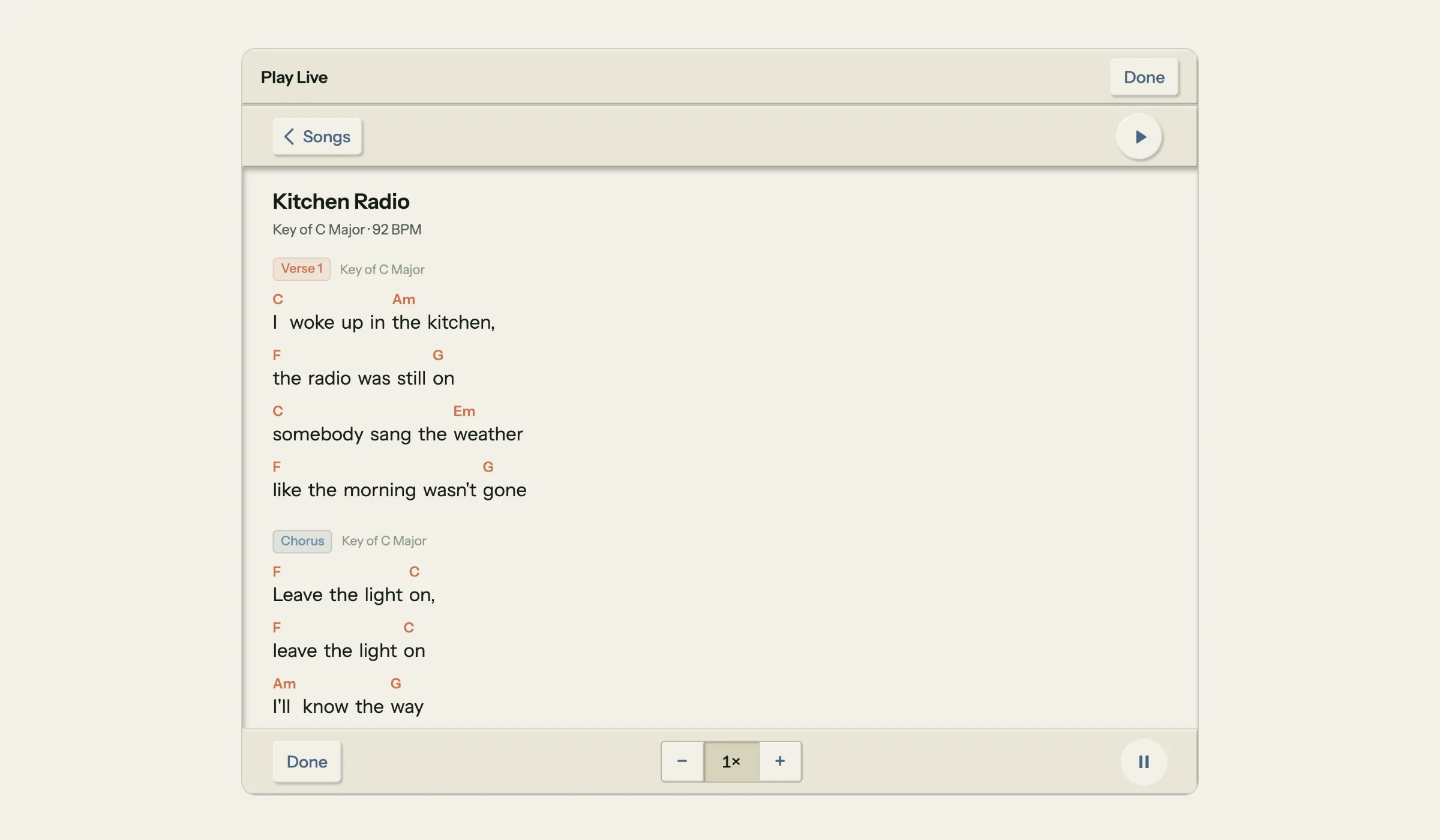
Song Cage turns every song you build into a chord sheet on your phone that plays back exactly as you wrote it. Turn the phone face down and it's a backing track to test yourself against. Autoscroll turns the same sheet into a silent teleprompter, and set lists run your songs in order.
In the Song Cage phone apps for iPhone and Android, the Songs tab holds every song you've built in the full editor on the web or the desktop app. Tap Play and the song sounds from the top, chords and melody, in your key, capo, tempo and tuning, with the current line lit up. Tap Autoscroll and nothing sounds: the sheet scrolls at the song's own tempo, with a speed trim from half speed to double, and the screen stays awake. Rest a finger on the sheet to pause. Both are free once you're signed in so your songs sync. The mobile app chapter of the docs walks through it.
Set lists put songs in playing order. The sheet shows where you are ("2 of 7") and what's next, and moving on while Autoscroll is running opens the next song in Autoscroll, paused at the top. On an iPad, on the web and in the desktop app, Play Live in the song menu opens the same screens full-screen. (It isn't in the plugin.) The Garvey rule still applies: rehearse with the phone face down, and keep Autoscroll for the stage.
Frequently Asked Questions
How long does it take to memorize a song?
It depends on how long and wordy the song is, and on how you practice. A short, repetitive song can come out clean after a couple of sessions of testing yourself. A dense one takes longer: Rhonda Vincent needed a series of practice sessions, section by section, before she could sing her 392-word parody without a teleprompter. Spread the work over several days rather than one long night: spaced sessions hold up better, and the advantage grows the longer you need to remember.
What's the fastest way to memorize lyrics the night before a gig?
Work section by section: read once with the tune, sing it from memory, check, and start the next pass on the lines you missed. Cramming does work in the short term (rereaders in Roediger and Karpicke's study did best on a test five minutes later), so a late session isn't wasted. Test yourself again in the morning before you look at the sheet, and don't change any words on the day.
Does writing lyrics out by hand help you memorize them?
Writing them from memory does, because it's a recall test: you have to produce every word and then check what you got wrong. Copying them out from the sheet is closer to rereading, since the answer is in front of you the whole time. If you like writing, cover the sheet, write the section, then compare.
Why do I forget the lyrics to songs I know well?
Usually one of three things. Your attention wandered, the way Paul McCartney describes drifting off to thoughts of dinner mid-song. The verses swapped, because they share a melody and the notes cue every verse's words at once. Or the setting changed: memory leans on where it was learned, so a song you've only sung on the sofa can go missing on a stage. Rehearsing standing, at volume, in set order helps with all three.
Do professional singers use teleprompters?
Many do. Paul McCartney has said he uses one in case he forgets Beatles lyrics, The Guardian reported that Bruce Springsteen has used one for years and that Elton John used one at Glastonbury in 2023, and Elbow's Guy Garvey said in 2014 that he uses one for his band's wordy songs. Garvey also warned that relying on it made him panic without it, so rehearse without the screen even if you keep it on stage.
Rehearse your songs the way you'll play them
Song Cage keeps every song you build as a chord sheet on your phone. Play it back as you wrote it and sing along with the screen face down, then turn on Autoscroll and run the whole set in order. Your words, your chords, your arrangement.