Your song is protected by copyright the moment it's fixed: recorded on your phone, saved in a session, or written down. Registering it with the U.S. Copyright Office is a separate step you choose to take, and it's the one that lets you sue an infringer and claim statutory damages. Online registration costs $45 or $65 until January 4, 2027, and $55 or $85 from January 5.
I'm a songwriter, not a lawyer, and this is general information about U.S. law, not legal advice. Everything below links to the Copyright Office's own pages or the statute, so you can check each step against the source.
Is my song already copyrighted?
Yes, if it exists in a fixed form. The Copyright Office says a work is protected "the moment it is created and fixed in a tangible form," and that registration is voluntary. A voice memo, a DAW session or a lyric sheet all count as fixed. A song you've only sung in your head doesn't.
The Office's general FAQ is short and worth reading in full. It also says what automatic protection doesn't give you: "You will have to register, however, if you wish to bring a lawsuit for infringement of a U.S. work."
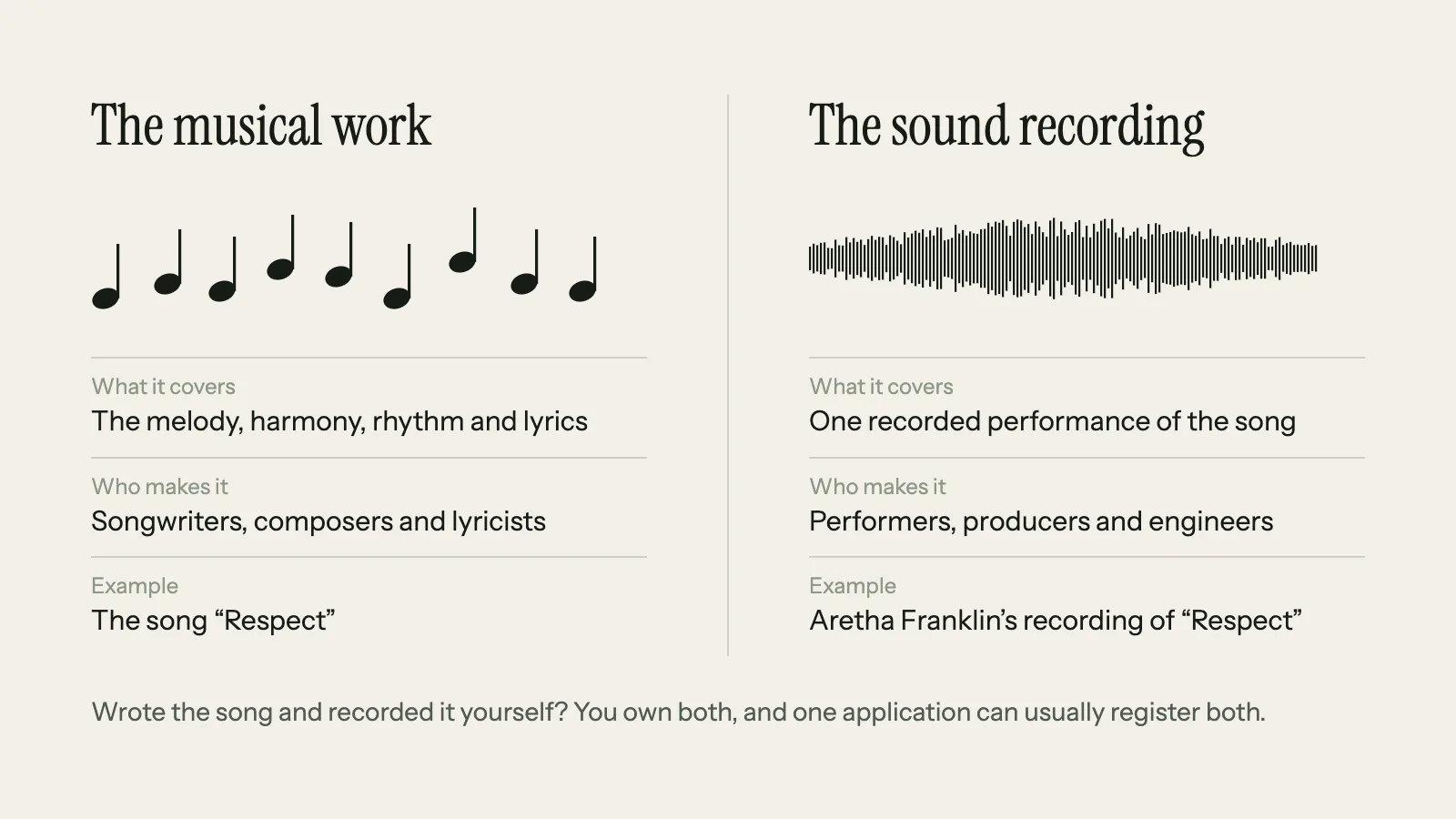
One song can hold two separate copyrights. The Office's Circular 56A separates the musical composition (the music and the lyrics, written by composers, lyricists and songwriters) from the sound recording (a particular recorded performance, made by performers, producers and engineers). Its own example: the song "Respect" and Aretha Franklin's recording of it are two distinct works. If you wrote a song and recorded it yourself, you own both, and you can usually register both on one application.
What parts of a song can be copyrighted?
The melody, the rhythm, the harmony and the lyrics, as long as they are original and more than a tiny fragment. Standard chord progressions, scales, arpeggios and short phrases are not protected on their own, however catchy they are.
The Copyright Office's examiners work from the Compendium, Chapter 800, which lists those four elements of a musical work. The same chapter lists "common property" that no one can own, including this one: "Chord symbols based on standard chord progressions." Its harmonization rule is blunter still: adding chords to a melody is only new authorship if it's more than "standard chords in common sequences such as C, F, G, C."
Length matters too. The Compendium says "short musical phrases are not copyrightable," and gives examples, such as the phrase "I love you so much it hurts" and a few notes like clock chimes, that are too short and too lacking in creativity to register. A standard progression is free for anyone to use, which is why writing a chord progression is about choices rather than ownership. The melody over it, and the words, are where your copyright lives.
How do you register a song with the Copyright Office?
Online, through the Office's Electronic Copyright Office (eCO) system. You create an account, pick the right application, describe the work and its authors, pay the fee, and send a copy of the song, usually an uploaded audio file or PDF. The Office examines the claim and, if it approves, issues a certificate.
The steps, from the registration portal and Circulars 50 and 56A:
- Make an eCO account at the Copyright Office's registration portal.
- Pick the application. The Single Application is for one work by one author who is also the only owner, not made for hire. Co-written songs and anything else use the Standard Application. You can also register up to ten unpublished songs together as a group of unpublished works, or the songs on one album as a group.
- Choose the type of work. For the song alone, Circular 50 says to select "Work of the Performing Arts." If you're registering the song and your recording of it together, Circular 56A says to select "Sound Recording" on the Type of Work screen, or you'll have to start over.
- Fill in titles, authors and claimants, and say whether the song has been published. Releasing copies to the public is publication; a live performance on its own isn't.
- Pay and send the deposit. For an unpublished song, or one released only digitally or only as a recording, upload one complete copy: a PDF of the sheet music or lead sheet, or a recording such as an MP3. Published printed sheet music means mailing one copy of the best printed edition, as Circular 50 explains. If you register the song together with a recording released on CD or vinyl, Circular 56A asks for two physical copies.
Circular 56A has one catch for the Single Application: it only covers a song and its recording together if you're the sole performer on the recording and the sole owner of both. Hire a drummer and you're on the Standard Application.
How much does it cost to copyright a song?
Copyright itself is free. Registering a song online costs $45 on the Single Application or $65 on the Standard Application until January 4, 2027, and $55 or $85 from January 5. A group of up to ten unpublished songs costs $85, rising to $130.
The current amounts are on the Office's fees page; the new ones are in the final rule published November 18, 2026.
| Registration | Until January 4, 2027 | From January 5, 2027 |
|---|---|---|
| Single Application (one author, sole owner, one work) | $45 | $55 |
| Standard Application (co-writers, songs plus recordings with other performers) | $65 | $85 |
| Group of unpublished works (up to 10 songs) | $85 | $130 |
| Group of musical works on an album | $65 | $85 |
| Group of sound recordings on an album | $65 | $130 |
| Paper application | $125 | $185 |
Electronic filing unless marked paper. Fees per application, from copyright.gov and the Federal Register final rule.
If you have a folder of unreleased songs, the group option is the one to notice. Ten unpublished songs on one $85 application works out to $8.50 a song, against $45 to $65 each on their own, and the Office says that even at the new $130 fee the group options cost "no more than $13 per work" at their maximum size. The group of unpublished works has rules: the songs must share the same author or co-authors, who must also be the claimant for every song.
How long does it take to copyright a song?
Copyright itself takes no time. Registration took an average of 3.4 months for online applications with an uploaded file and no questions from the examiner, for claims closed between April 1 and September 30, 2026, according to the Office's processing times report. When the examiner wrote back with questions, as happened on about 28% of online claims, the average was 5.3 months. Paper filings take longer.
The wait matters less than you'd think, because under 17 U.S.C. § 410(d) a registration takes effect on the day the Office has received an acceptable application, deposit and fee, not the day the certificate arrives. Answering the examiner's emails quickly is the easiest way to keep it moving; the Office asks for a reply within 45 days.
Why register if copyright is automatic?
Because the extra remedies depend on it. You need a registration to sue over a U.S. work, and statutory damages and attorney's fees are only available if you registered before the infringement began, or within three months of first publishing the song.
That timing rule is 17 U.S.C. § 412. For an unpublished song, there are no statutory damages or attorney's fees for any infringement that started before the registration date. For a published song, the same applies unless you registered within three months of first publication. Without them you can still recover your actual damages and the infringer's profits, which are often small and hard to prove.
The Copyright Office lists two more reasons in its FAQ. A registration puts your claim on the public record, and one made within five years of publication "is considered prima facie evidence in a court of law." For smaller disputes there is the Copyright Claims Board, a voluntary small-claims forum run inside the Office that can award up to $30,000 in total, with statutory damages capped at $15,000 per work.
Does poor man's copyright work?
No. Mailing yourself a copy of your song in a sealed envelope, the old "poor man's copyright," isn't recognised anywhere in copyright law. The Copyright Office's FAQ says: "There is no provision in the copyright law regarding any such type of protection, and it is not a substitute for registration."
What the envelope was trying to show, that you had the song on a certain date, is still worth having, just not as a substitute for registering. In 2022 the High Court in London cleared Ed Sheeran and his co-writers of copying in the "Shape of You" case, and the judgment pieced the day the song was written together from the session's audio clips and voice notes, alongside the writers' own evidence. Two of its findings: "At 11:42 the Logic audio project was first saved." And: "The first timed recording of any vocal part is a voice note made on Mr McDaid's phone at 11:46." That is a UK case, but the lesson travels: dated drafts made while you write carry weight that a story told years later can't.
So keep your voice memos and sessions with their dates intact (there's a whole post on what to do with a voice memo backlog), and register the songs that matter.
Can you copyright a song made with AI?
Only the parts a person wrote. The Copyright Office says copyright protects the human expression in a work even if it includes AI-generated material, but not material an AI generated on its own, and that with current technology, prompts alone don't give enough control to count as authorship. You must disclose AI material that is more than de minimis when you register.
The Office set this out in its Part 2 report on copyrightability, released January 29, 2025. Among its conclusions: "The use of AI tools to assist rather than stand in for human creativity does not affect the availability of copyright protection for the output." And: "Based on the functioning of current generally available technology, prompts do not alone provide sufficient control." The report also repeats the 2023 registration guidance: if a work contains more than a de minimis amount of AI-generated material, the applicant should disclose it and briefly describe the human author's contribution.
The courts agree on the human requirement. The D.C. Circuit upheld the Office's refusal to register an AI-made artwork in Thaler v. Perlmutter in March 2025, and the Supreme Court declined to hear the appeal on March 2, 2026. The performing rights organizations follow the same line: since October 28, 2025, ASCAP, BMI and SOCAN accept registrations of partially AI-generated works but not works created entirely with AI.
If you use AI for part of a song, the practical job at registration time is describing what you wrote yourself. That's much easier if you kept track of it while you were writing, which is also the part of the record a detector can't supply, as I explain in what AI music detectors catch and miss.
How can you show when you wrote a song?
I build Song Cage, a songwriting app with no generative AI in it, and since November 27, 2026 it keeps a Writing Record for every song saved to your Song Cage account. Open a song in the desktop app or the web app and choose File > Writing Record… to see it.
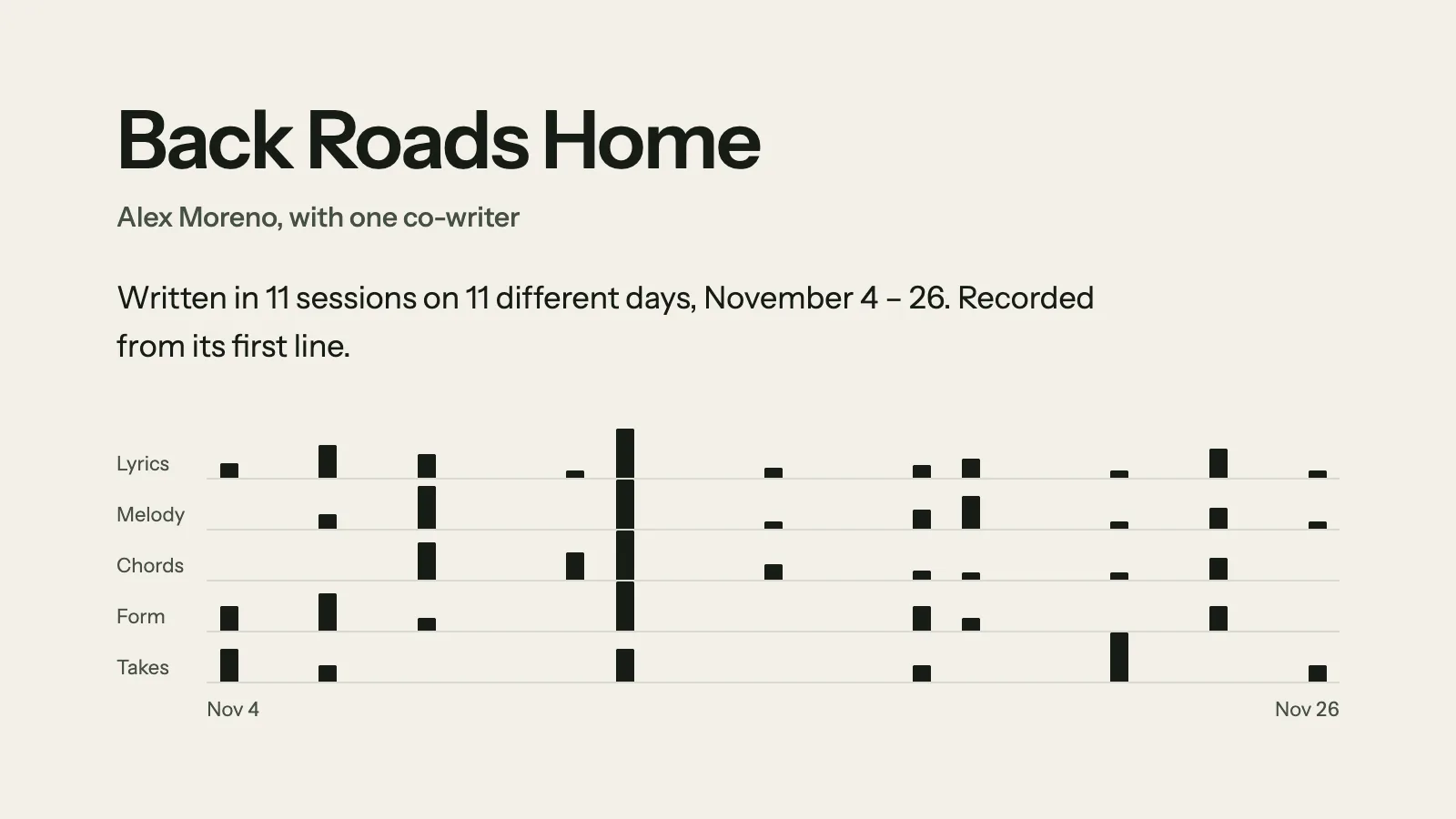
The top of a made-up sample song's public record page, to show the layout.
The record shows each day the song was worked on, with a row for each part that changed (Lyrics, Melody, Chords, Form and Takes), and a list of writing sessions with the date, the time and what arrived, such as "12 lyric changes, 3 chord changes and 1 take." It counts new content only, so saving the song again, undoing, or switching back to an earlier version adds nothing. When a song has co-writers, each session lists whose account it came from. Every night that day's record is sealed and signed by two independent time-stamping authorities, so a past day can't be edited later without its seal failing.
You can make a link to the record for a publisher, a library or a contest that asks how the song was made. The page shows the record, the song's title and your name, never the lyrics or the music, and anyone with the link can check the seals in their browser and download the proof. You can turn the link off at any time.
Be clear about what it is. It isn't a copyright registration and doesn't replace one. It shows when new content arrived and how much, not who sat at the keyboard or where the words came from, since pasted and imported lines count like typed ones. What it gives you is a dated account of your own writing, kept as you go, which helps when an AI disclosure asks you to describe your own contribution, and is the kind of dated file history the Sheeran judgment leaned on.
Write songs with a dated record of how you wrote them
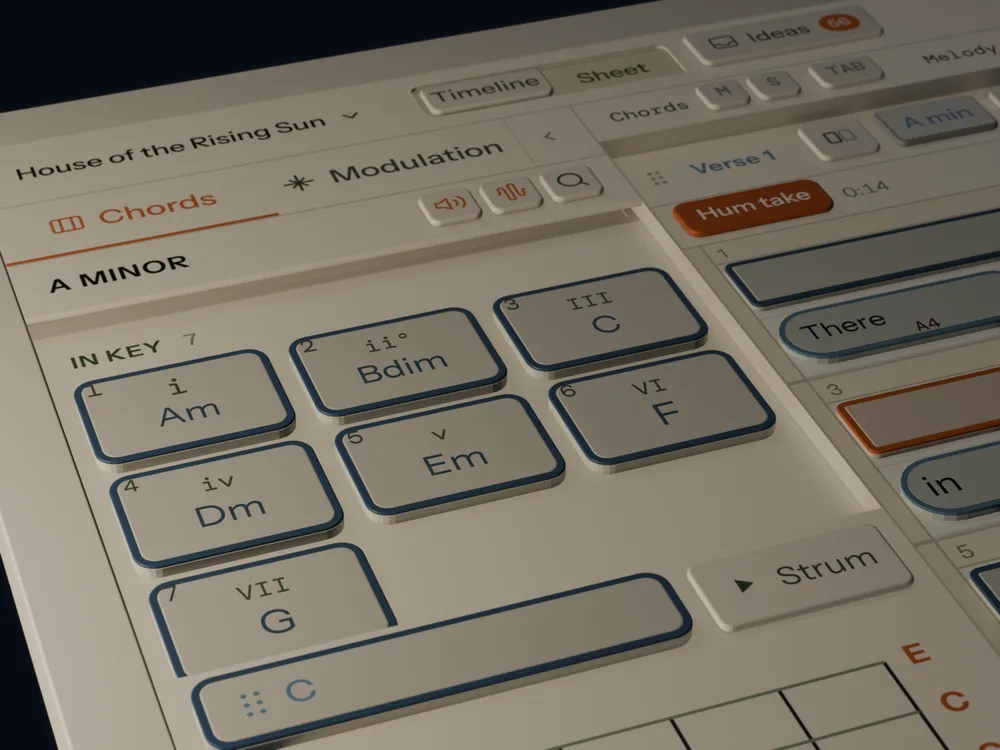
Song Cage keeps your lyrics, melody and chords on one timeline, ranks chords against the melody you sang, and keeps a sealed Writing Record of every writing session. Nothing in it writes the song for you.
Frequently Asked Questions
How much does it cost to copyright a song?
Copyright itself is free and automatic. Registering a song with the U.S. Copyright Office online costs $45 on the Single Application (one author who is the only owner) or $65 on the Standard Application, until January 4, 2027. From January 5, 2027 those fees become $55 and $85. Up to ten unpublished songs can be registered together for $85, rising to $130.
Can I copyright a song for free?
Yes, in the sense that copyright is automatic and costs nothing: your song is protected once it's recorded or written down. Registration, which you need to sue over a U.S. work and to claim statutory damages, always has a fee. Mailing a copy to yourself, the "poor man's copyright," isn't recognised in copyright law; the Copyright Office says it "is not a substitute for registration."
Do I need to copyright the lyrics separately?
No. According to the Copyright Office's Circular 56A, a registration for a musical composition covers the music and the lyrics in it. Lyrics you've written with no music yet can be registered on their own: in eCO you choose Work of the Performing Arts and tick only the lyrics box.
Can you copyright a chord progression?
Not a standard one. The Copyright Office's Compendium lists "Chord symbols based on standard chord progressions" as common property, and says adding chords to a melody is only new authorship if it's more than "standard chords in common sequences such as C, F, G, C." The melody and lyrics you write over a progression are what copyright protects.
Can I copyright a song I made with AI?
You can register the parts you wrote. The Copyright Office protects human expression in a work that includes AI material, but not material the AI generated on its own, and it says that with current technology, prompts alone are not enough. Disclose AI-generated material that is more than de minimis and describe your own contribution. ASCAP, BMI and SOCAN accept partially AI-generated works but not fully AI-generated ones.
How long does a song's copyright last?
For a song written today by a named person, the author's life plus 70 years. For a co-written song, it runs 70 years from the death of the last surviving author. Works made for hire, and anonymous or pseudonymous works, last 95 years from publication or 120 years from creation, whichever ends first, according to the Copyright Office's Circular 15A.