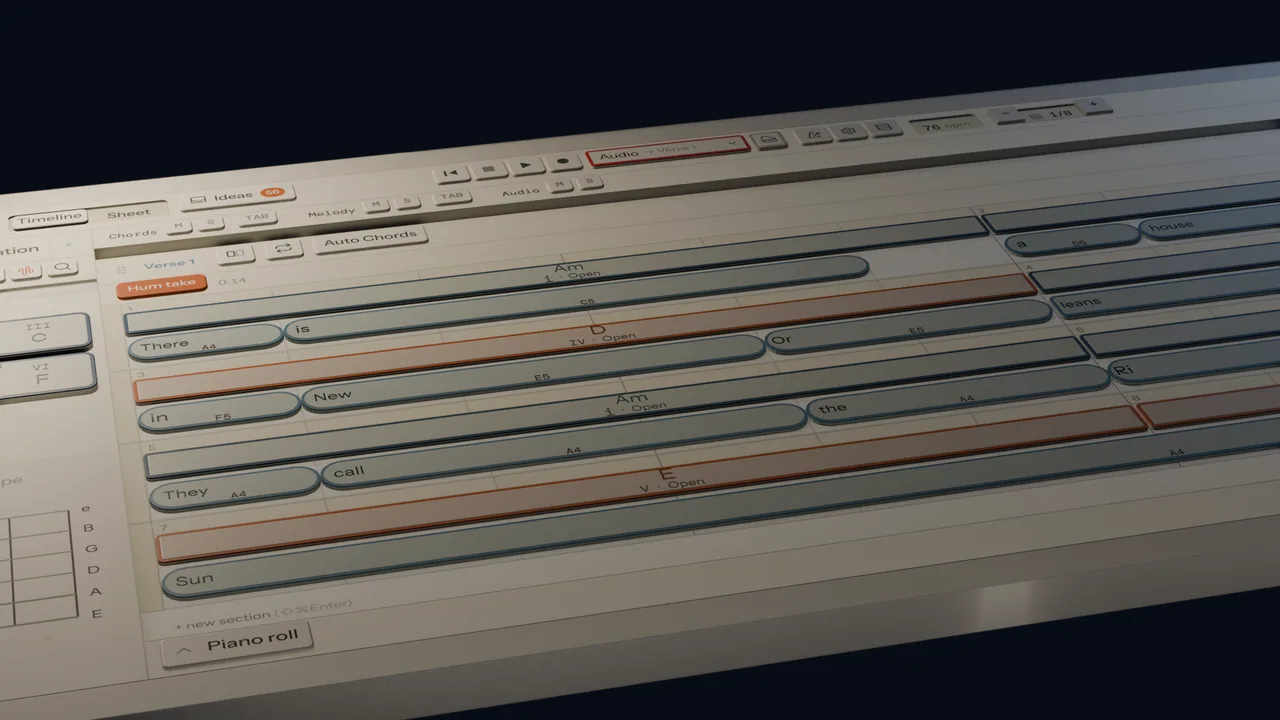
"I started to write things on it like Kashmir because I was used to playing it in the DADGAD tuning, so Kashmir came out on that guitar," Jimmy Page told Total Guitar in 2020. The guitar was a Danelectro he'd bought for about £45 in the 1960s and kept as a spare, tuned to DADGAD.
DADGAD is the six strings read from low to high: D A D G A D. Davey Graham brought it back from Morocco in the early 1960s, Irish guitarists made it the sound of traditional accompaniment, and Pierre Bensusan has played almost nothing else since 1978. Below: how to tune to it by ear, a chord chart for the keys it suits (every shape checked note by note), the songs recorded in it, and how to write in it.
Quick Summary
DADGAD tuning is D A D G A D, low to high, so the open strings sound a Dsus4 chord with no third. From standard, lower the 6th, 2nd and 1st strings a whole step each. Chords without a third take one or two fingers; full major and minor chords need the third fretted.
What is DADGAD tuning?
DADGAD tuning sets the guitar's strings to D A D G A D, from the lowest string to the highest. Strummed without fretting, they sound Dsus4: three D's, two A's and one G, and no third. Without a third the chord is neither major nor minor, which is why the tuning suits modal and Celtic music.
The third is the note that decides a chord's mood. Open D tuning has one built into its open strings: the F# that makes them a D major chord. DADGAD puts a G where that F# would be, so the open strum is a suspended chord, and the strings ring as a drone under whatever you fret. It's often called Celtic tuning, after the music it's most used for, or D modal, and those drones come close to the sound of the pipes in Irish and Scottish music.
Without a third, the open strings fit more keys. A little pitch math shows how many. D, G and A, the three notes DADGAD is made of, all belong to five major scales: C, D, F, G and B flat. Standard tuning's open notes (E, A, D, G, B) fit three, and so do open D's (D, F#, A). Put another way, the open strings sit under five of the seven modes built on D: Ionian (D major), Dorian, Phrygian, Mixolydian and Aeolian (D minor). Only Lydian and Locrian clash with them.
Who invented DADGAD tuning?
DADGAD is credited to Davey Graham, the British folk guitarist, who popularized it in the early 1960s. He worked it out while traveling in Morocco, so he could play along with the oud players he heard there, and used it on his 1963 arrangement of the Irish air "She Moved Through the Fair."
The Guardian's series on key events in folk music dates it to July 1963 and says the tuning "revolutionised folk accompaniment and inspired a new generation of guitarists." Graham's arrangement came out on the 1963 EP From a London Hootenanny, and Guitar World traces a line from it to Jimmy Page's "White Summer." Wikipedia's entry on Graham adds the trade-off he accepted: the tuning frees the treble strings to improvise over a steady bass, "though it restricts the number of readily playable keys."
Irish music took it up next. Mícheál Ó Domhnaill and Dáithí Sproule, who played together in the group Skara Brae, "introduced the DADGAD guitar tuning to Irish music," according to Ó Domhnaill's Irish Times obituary, having been influenced by John Renbourn and Bert Jansch of Pentangle. Ó Domhnaill went on to co-found the Bothy Band in 1974. The French guitarist Pierre Bensusan has used DADGAD "exclusively since 1978," he told Premier Guitar.
How do you tune a guitar to DADGAD?
To tune to DADGAD from standard tuning, lower three strings a whole step each and leave the other three alone. The 6th string goes from E down to D, the 2nd from B down to A, and the 1st from E down to D. The 5th (A), 4th (D) and 3rd (G) strings stay where they are.
| String | Standard | DADGAD | Change |
|---|---|---|---|
| 6th (lowest) | E | D | Down a whole step |
| 5th | A | A | No change |
| 4th | D | D | No change |
| 3rd | G | G | No change |
| 2nd | B | A | Down a whole step |
| 1st (highest) | E | D | Down a whole step |
A chromatic tuner does it in a minute. Without one, tune each string you're changing to a string that hasn't moved, so you're always matching two notes at the same pitch:
- 6th string to D: fret it at the 7th fret and lower it until that note matches the open 5th string (A).
- 2nd string to A: lower it until it matches the 3rd string at the 2nd fret.
- 1st string to D: lower it until it matches the 2nd string, now A, at the 5th fret.
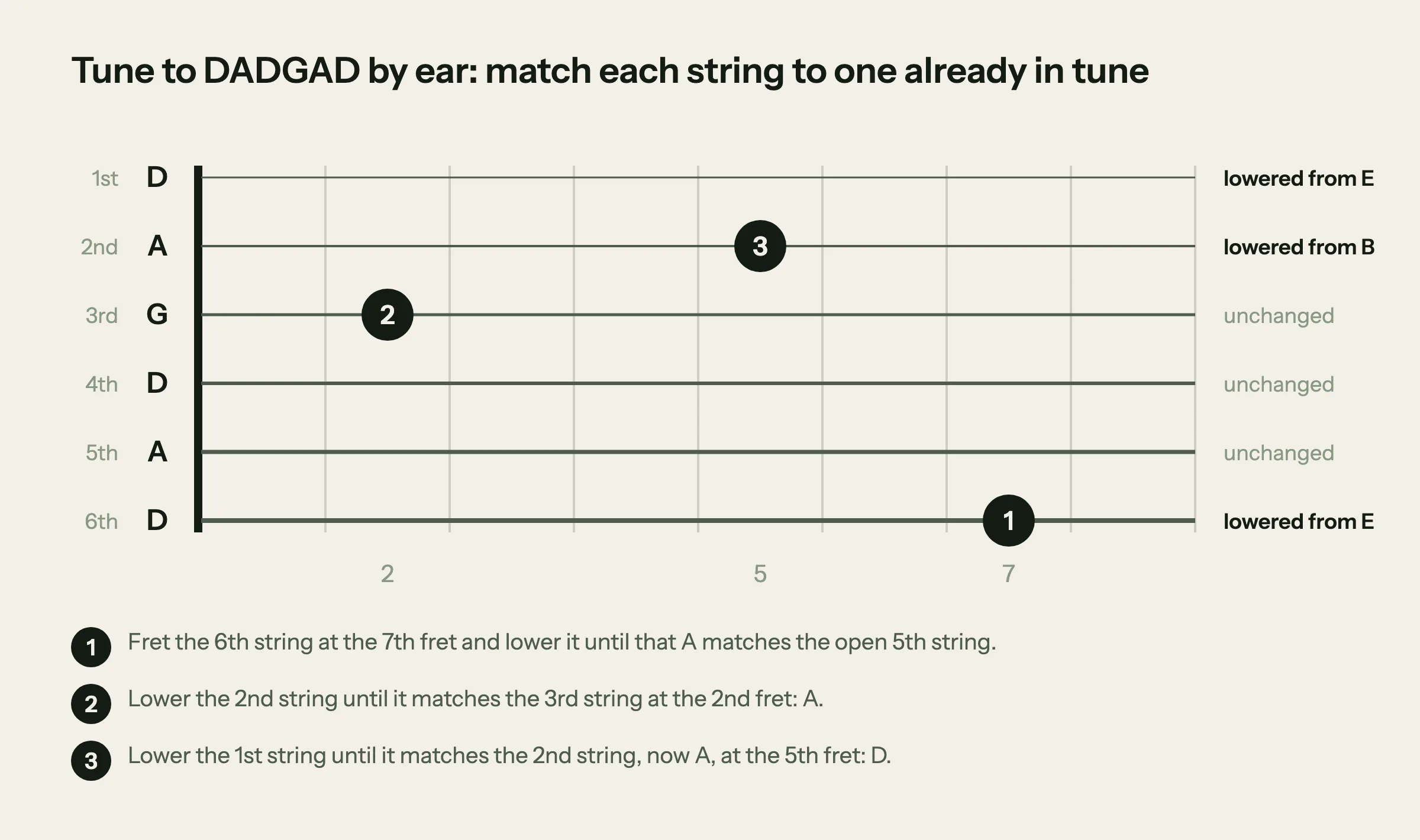
Then strum all six open. Dsus4 sounds unfinished on purpose, as if it wants to fall to D major, but it shouldn't sound sour. If it does, check each pair again. From open D the move is shorter still: raise the 3rd string a half step, from F# to G.
Is DADGAD tuning bad for your guitar?
No. DADGAD only lowers strings, so the strings pull on the neck less than in standard tuning, not more. The slacker low D and the two top strings can buzz against the frets on a guitar with a low action, and some players who stay in the tuning move to a slightly heavier set of strings to firm them up.
A neck settles for a few minutes after any retune, so the strings drift a little at first. Check the tuning again once you've played a song through, and once more before you record. If you switch back and forth a lot, the same rule applies in reverse: standard tuning puts the tension back, and the neck takes a moment to follow.
What chords can you play in DADGAD?
The easiest DADGAD chords are the ones without a third, like D5, Dsus4, Gsus2 and A7sus4, because the open strings fill them in and they take one or two fingers. Full major and minor chords need their third fretted on purpose, so A, Bm and C take three or four fingers.

The table gives each chord low string to high, with x for a string you don't play. Every shape was checked by naming the note on every string against D A D G A D, and each one sounds the chord it's named for and nothing else.
| Chord | Shape | Notes, low to high | Role in the key of D |
|---|---|---|---|
| Dsus4 | 0 0 0 0 0 0 | D A D G A D | I, the open tuning |
| D5 | 0 0 0 2 0 0 | D A D A A D | I, no third |
| D | 0 0 4 2 0 0 | D A F# A A D | I, major |
| Em11 | 2 2 0 0 0 0 | E B D G A D | ii |
| Em | x x 2 0 2 2 | E G B E | ii |
| F#m | x x 4 6 0 4 | F# C# A F# | iii |
| Gsus2 | 5 0 0 0 0 0 | G A D G A D | IV, no third |
| G | 5 5 0 0 2 0 | G D D G B D | IV |
| A7sus4 | x 0 2 0 0 0 | A E G A D | V, no third |
| A | x 0 2 2 4 2 | A E A C# E | V |
| Bm7 | x 2 4 4 0 0 | B F# B A D | vi |
| Bm | x 2 4 4 2 0 | B F# B B D | vi |
| Cadd9 | x 3 0 0 3 2 | C D G C E | ♭VII, borrowed |
| C | x 3 2 0 3 2 | C E G C E | ♭VII, borrowed |
Frets from the 6th string (low D) to the 1st (high D). 0 = open, x = not played. The rows without a third (Dsus4, D5, Gsus2, A7sus4) work in D major and D minor alike.
Most chord shapes you know from standard tuning don't carry over. Standard C, x 3 2 0 1 0, plays C, E, G, B flat and D on DADGAD strings: a C9, not a C. A shape sometimes given as DADGAD's D major, 0 0 0 2 3 2, is the standard D fingering (x x 0 2 3 2) with the low strings added; in DADGAD it plays D, A, C and E, with no F# at all. When a chart and your ears disagree, name the notes string by string.
Why are there so many sus and add9 chords in DADGAD?
DADGAD chord names carry sus and add9 because the open D, A and G strings keep ringing under whatever you fret and become extra notes in each chord. Over G, the open A is the ninth. Over A, the open D is the fourth and the open G the flat seventh. Over C, the open D is the ninth.
The names get longer while the hand does less, which is why lessons on the tuning lead with chords most players never learn in standard. Guitar World's "5 shapes you need to know" are D5, Bm7, Aadd11, Cadd9 and Em11. Em11 in the table above is two fingers, 2 2 0 0 0 0, and four of its six strings are open.
The open strings also decide which chords sound best. A chord that contains D, A or G lets them ring as part of it. A chord that contains none of them, like E major or B major, has to mute or fret over every open string, and the tuning's whole sound disappears.
How do you play minor chords in DADGAD?
In DADGAD, fret the minor third the way you'd fret a major one. D minor is 0 0 3 2 0 0: the 4th string at the 3rd fret gives F, the minor third, and the open strings fill in D and A. Because the tuning has no third built in, minor keys work as well as major ones.
That's the main thing DADGAD has over open D tuning, where the F# on the 3rd string fights every minor chord. Here are the chords for a song in D minor:
| Chord | Shape | Notes, low to high | Role in D minor |
|---|---|---|---|
| Dm | 0 0 3 2 0 0 | D A F A A D | i |
| F | 3 0 3 2 3 3 | F A F A C F | ♭III |
| Gm | x x x 0 1 0 | G B♭ D | iv |
| Am | x 0 2 2 3 2 | A E A C E | v |
| B♭ | x 1 3 3 1 0 | B♭ F B♭ B♭ D | ♭VI |
| C | x 3 2 0 3 2 | C E G C E | ♭VII |
A second D minor shape, 0 0 0 2 0 3, puts the F on top instead.
Which keys work best in DADGAD?
DADGAD works best in D: D major, D minor and the D modes all sit over its open strings. G major and E minor work too, since D, G and A are in both scales. A capo moves the D shapes up: capo 2 gives E, capo 3 gives F, capo 5 gives G. Keys whose scales lack D, G or A fight the open strings.
The practical test is the drone. If the song's scale contains D, G and A, every open string you leave ringing belongs to the key. E flat major has A flat where DADGAD has A, so the two open A strings clash with most of its chords; you'd either mute them or capo up from D to get there.
To pick the key, start with the singer, not the guitar. Find the capo fret where the melody sits comfortably for your voice (the capo chart gives every fret's key), and the shapes in both tables still work above it. Ed Sheeran's live "Photograph" is a working example: DADGAD with a capo at the 2nd fret, which puts the D shapes in E, the song's key.
What's the difference between DADGAD, open D and drop D?
Drop D lowers one string, the 6th. DADGAD lowers three: the 6th, 2nd and 1st. Open D lowers the same three plus the 3rd string a half step, to F#, so its open strings make a D major chord where DADGAD's make Dsus4.
All three share the low D, so a song's bass part moves between them easily. The difference is the middle. Drop D keeps standard tuning's G and B, so chord shapes above the 6th string are the ones you know. DADGAD and open D both retune the top, so new shapes, but DADGAD's open G leaves the third out and open D's F# puts a major third in. If a song needs both major and minor chords, DADGAD is the easier fit; if it lives on major chords and slide, open D is.
What songs are in DADGAD tuning?
The best-known DADGAD songs are Led Zeppelin's "Kashmir" and "Black Mountain Side," the Yardbirds' "White Summer," Davey Graham's "She Moved Through the Fair," Pink Floyd's "Poles Apart," Ben Howard's "In Dreams" and Andy McKee's "Drifting." Ed Sheeran plays "Photograph" in DADGAD on stage, though he first played it in standard tuning with one string lowered.
| Song | Artist | Year | What to know |
|---|---|---|---|
| She Moved Through the Fair | Davey Graham | 1963 | Irish air; the recording that introduced the tuning |
| White Summer | The Yardbirds | 1967 | Page's instrumental, built on Graham's arrangement of the same air |
| Black Mountain Side | Led Zeppelin | 1969 | Same tuning as "White Summer," Page said |
| Kashmir | Led Zeppelin | 1975 | Written on a Danelectro kept in DADGAD; on Physical Graffiti |
| Poles Apart | Pink Floyd | 1994 | On The Division Bell |
| Drifting | Andy McKee | 2005 | Percussive fingerstyle, on Art of Motion; the 2006 YouTube video made his name |
| Photograph | Ed Sheeran | 2014 | Live versions: DADGAD, capo 2; earlier versions: standard with the G string lowered to E |
| In Dreams | Ben Howard | 2014 | He used the tuning more widely on Noonday Dream (2018) |
Page described his "White Summer" tuning to Steven Rosen for Guitar Player in 1977: "It's like a modal tuning, a sitar tuning, in fact." (The interview as printed gives the low string as B under A D G A D; Guitar World and most transcriptions list the piece in DADGAD.) Asked about "Black Mountain Side," he credited the folk clubs, Anne Briggs and Bert Jansch for the piece and added, "the tuning on 'Black Mountain Side' is the same as 'White Summer.'" On "Kashmir," Guitar World counts four riffs, three of them built on open strings doubled in unison or at the octave, which is where the song's wall of sound comes from.
The later songs come from Total Guitar's DADGAD lesson, which names "Poles Apart," "Photograph" and Ben Howard's records, and from Guitar World's breakdown of "Drifting," the video that put McKee in front of a world audience in late 2006. "Photograph" is the one to watch: lessons from Shut Up & Play and others show Sheeran first played it in standard tuning with the G string lowered to E, then moved it to DADGAD with a capo at the 2nd fret.
Why do songwriters use DADGAD?
Songwriters use DADGAD because its open strings hold a drone under every chord, so a plain progression sounds fuller, and because it has no third, the same strings serve songs in major and minor. Davey Graham worked it out to play along with the oud, Jimmy Page wrote "Kashmir" in it, and Ed Sheeran colors everyday progressions with it.
Guitar World's 2024 lesson on Sheeran's playing shows the move. He takes a six-four-one progression, about as common as songwriting gets, plays it in DADGAD with very few fretted notes, and lets the open strings add the color. That's the tuning's appeal to a writer: the drone fills the space a band would.
The risk is that every song sounds like that. Pierre Bensusan, who has written in DADGAD for more than four decades, put the warning plainly to Premier Guitar: "if you just play a lot of open-string voicings and don't really investigate the tuning's full potential, then you are going to sound just like everyone else." His fix was to study the tuning's scales and chords as thoroughly as anyone studies standard. "Then DADGAD became invisible," he said.
How do you write a song in DADGAD tuning?
To write a song in DADGAD, start with the drone. Strum the open strings, then move one finger along the 1st or 3rd string and listen for a line you'd sing. Add one-finger power chords on the low strings, G at the 5th fret and A at the 7th, and leave the third out until the melody decides major or minor.
A few ways in, each built on something the tuning does that standard doesn't:
- Use the low three strings as a power chord. D A D is already D5. Lay one finger across the 6th, 5th and 4th strings at the 5th fret for G5, at the 7th for A5, at the 10th for C5, and let the top three strings ring open over each. That's a whole progression with one finger.
- Let the melody pick major or minor. Hum over the open strum. If the note you sing on the third of the chord is F#, play D (0 0 4 2 0 0); if it's F, play Dm (0 0 3 2 0 0). Hum first and the melody chooses the mode for you, where a strummed D major would have made the choice already.
- Find the unisons. The 3rd string at the 2nd fret is A, the same note as the open 2nd string; the 2nd string at the 5th fret is D, the same as the open 1st. Two strings on one pitch shimmer against each other. It's the doubled-note sound in three of the "Kashmir" riffs.
- Move one shape up the neck. Slide a two-finger shape along the 3rd and 4th strings over the open strings and the chord name changes at every fret while the drone stays put. Do this once Bensusan's warning starts to bite and the open chords begin to sound the same.
Then write the tuning down with the song. A phone recording made in DADGAD doesn't say what the strings were tuned to, and six months on, a song written on guitar is much harder to finish when you can't find the shapes again.
How can Song Cage help with songs in DADGAD?
Set the song's tuning to DADGAD and Song Cage draws every chord as a shape for D A D G A D, worked out from the notes the strings are tuned to. Playback strums the strings as tuned, and the tuning is saved with the song, so you know how to retune when you come back to it.
On the computer, iPad or in a DAW, open Settings and pick DADGAD from the Tuning list, next to Capo (Chapter 12 of the docs covers the guitar settings). The list has 18 tunings, including open D, drop D, open G and open C. Changing the tuning redraws the shape for every chord already in the song. A C that showed x 3 2 0 1 0 in standard, which would sound C9 on these strings, comes back as x 3 2 0 3 2, a shape that sounds C and nothing else.
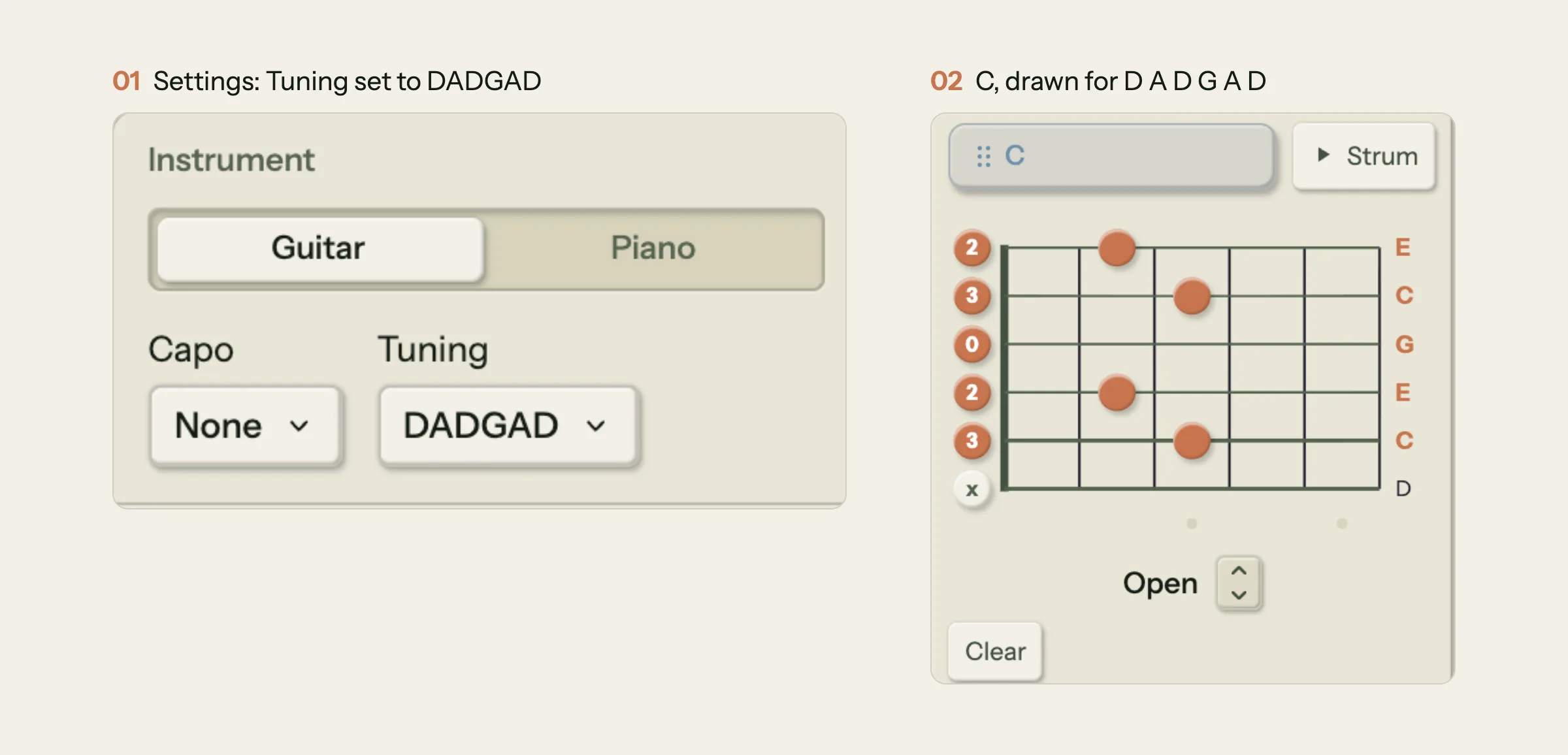
Press play and the chords sound as they would on a guitar in DADGAD, with the capo on top if you set one. The guitar tab dock writes the frets for the tuning and shows its name in the header. On the phone, the same choice sits in Song settings under Tuning, and the chord diagrams there follow it too.
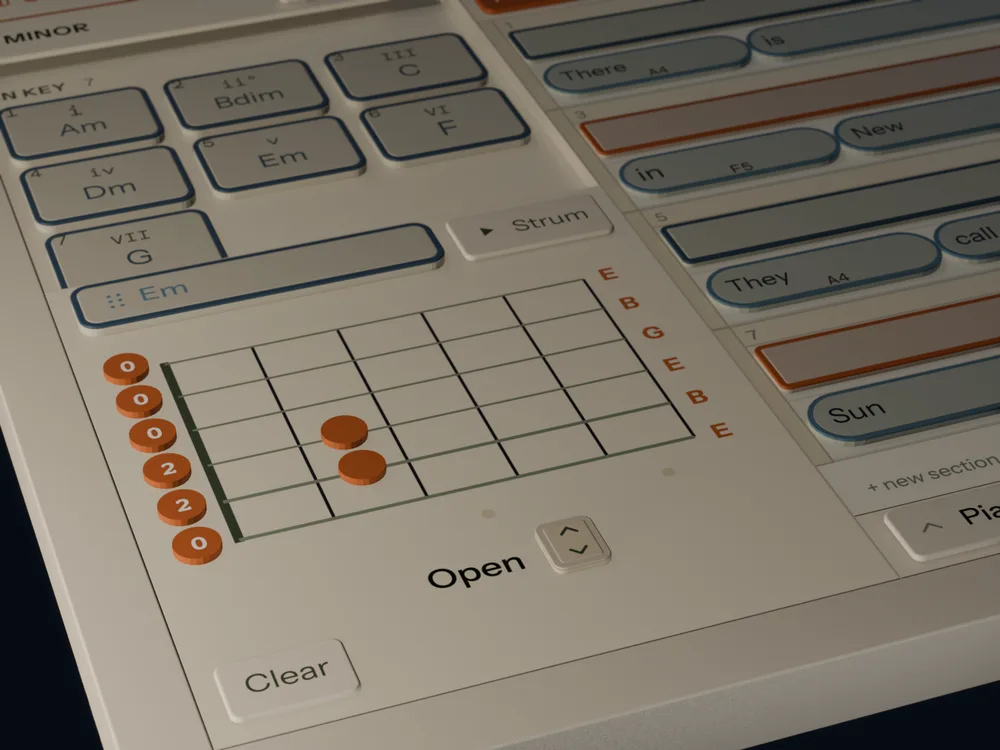
Keep the tuning with the song
Song Cage saves the tuning and capo with every song and draws each chord as a shape for the strings as they're tuned. Pick DADGAD once, and every chord, the playback and the tab follow it.
Frequently Asked Questions
What are the notes of DADGAD tuning?
D A D G A D, from the 6th string (lowest) to the 1st (highest). Three strings are D, two are A and one is G. From standard tuning you lower the 6th, 2nd and 1st strings a whole step each and leave the 5th, 4th and 3rd alone.
What chord is DADGAD tuned to?
Dsus4. The open strings hold D (the root), A (the fifth) and G (the fourth), with no third. That's why the tuning can sound major or minor: the third comes from the note you fret or sing, F# for D major or F for D minor.
How do you play a D major chord in DADGAD?
Play 0 0 4 2 0 0: the 4th string at the 4th fret gives F#, the major third, and the 3rd string at the 2nd fret turns its G into A. Another shape, 0 0 0 2 0 4, puts the F# on top. The standard-tuning D fingering, x x 0 2 3 2, doesn't work here: on DADGAD strings it plays D, A, C and E.
Is DADGAD good for beginners?
For writing, yes: the open strum already sounds finished, and power chords and sus chords take one or two fingers. For learning songs written in standard tuning, no. Almost none of the standard chord shapes carry over, so a beginner working through a songbook is better off staying in standard.
Why is DADGAD called Celtic tuning?
Because it became the standard guitar tuning for Irish and Scottish traditional music. Mícheál Ó Domhnaill and Dáithí Sproule brought it into Irish music in the early 1970s, and its open strings ring as a drone under the tune, much like the drones of the pipes. It came to the British Isles from Davey Graham, who worked it out in Morocco.
What key is DADGAD in?
D is home, and it works in D major and D minor alike, because the open strings have no third. G major and E minor fit too, since D, G and A are in both scales. With a capo you can move any of those keys up: capo 2 for E, capo 5 for G.