Table of Contents
- What Separates the Best Rhyme Tools for Songwriters
- The 10 Best Rhyme Generators for Songwriters
- 1. Song Cage
- 2. RhymeZone
- 3. MasterWriter
- 4. RHYMEBOOK
- 5. RhymeHamster
- 6. B-Rhymes
- 7. Rhymer.com
- 8. WordHippo
- 9. Power Thesaurus
- 10. RapPad
- Understanding Rhyme Types for Songwriting
- Full Feature Comparison
- Why does workflow integration beat a bigger rhyme database?
- Should you use a paid rhyme tool or stay free?
- Frequently Asked Questions
Verified May 2026
Pricing and feature data verified May 2026 from official vendor sources: songcage.com (free web app and license), rhymezone.com (free; history from rhymezone.com help pages, owned by Merriam-Webster, launched January 1996), masterwriter.com ($9.95/mo, $99.95/yr; 4.5/5 from 1,322 Trustpilot reviews), the Apple App Store listing (DailyRapFacts LLC, Premium $4.99/mo or $49.99/yr), rhymehamster.com (free, 115,000+ words, no account or ads; verified September 2026), b-rhymes.com, rhymer.com, wordhippo.com, powerthesaurus.org (free to search without an account; PRO membership removes ads; Chrome extension 4.5/5 from 485 ratings), and rappad.co (Binary Hands LLC, copyright 2026).
Song Cage is the only rhyme finder here that lives inside the lyric sheet you are already writing in, so a suggestion arrives without you leaving the song. RhymeZone is the strongest free standalone rhyme dictionary. MasterWriter is the deepest paid word reference for professional songwriters.
Every songwriter eventually hits the same wall: the right word is right there, you can almost feel it, but the word that rhymes with what you've already written isn't it. A good rhyme generator finds you three other options in two seconds, one of which is exactly right. A great rhyme generator does that without making you leave your lyric draft.
We tested 10 rhyme tools used by working songwriters in 2026. The most important distinction isn't how many words any given database contains. It's whether the tool stays inside your writing process or forces you to break out of it every time you need a suggestion. That difference is what separates the top three from the rest. Companion guides: best lyric writing apps, how to write song lyrics, and best chord progression tools.
What Separates the Best Rhyme Tools for Songwriters
Most rhyme generator reviews focus on database size. We focused on workflow, because a 150,000-word rhyme dictionary is worthless if you have to leave your lyric draft to use it. The tools at the top of this list are there because they minimize the distance between needing a rhyme and getting one, inside the creative process rather than outside it.
How we ranked these tools
- Workflow integration — does the rhyme finder live inside your lyric workspace or in a separate tab?
- Rhyme depth — perfect rhymes, slant rhymes, near rhymes, phrase rhymes, syllable grouping
- Songwriter fit — built for lyric writers, not crossword puzzlers or academics
- Value — pricing relative to features and quality of the free tier
The 10 Best Rhyme Generators for Songwriters
1. Song Cage

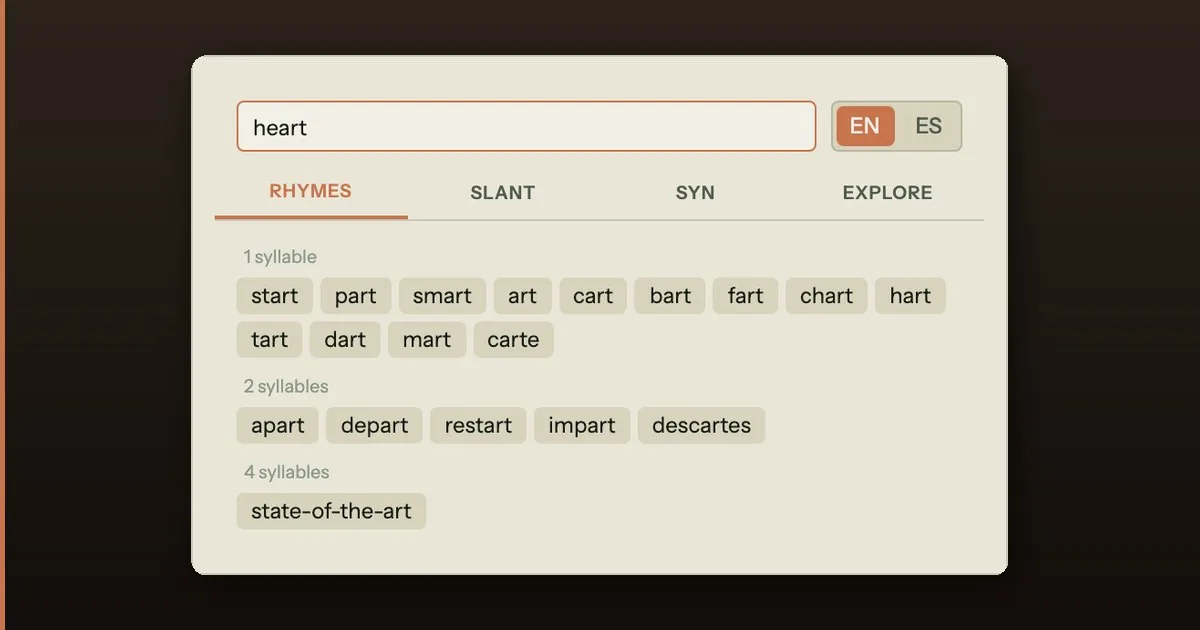
Song Cage is #1 because it is the only rhyme generator that lives inside your lyric draft rather than in a separate browser tab. Click any word in your lyrics and the rhyme panel opens instantly in context: perfect rhymes grouped by syllable count, slant rhyme suggestions, synonyms, and a semantic exploration panel that follows chains of thematically related words. All of this happens without leaving the song.
For most songwriters, the biggest problem with rhyme tools isn't finding rhymes. It's the constant context-switching that breaks creative flow. Song Cage solves this by being a complete lyric writing app with rhyme suggestions built into the workspace. You're not looking up a word in a dictionary; you're choosing from options that appear in the context of what you've already written. And because the chord palette, lyric lane, and rhyme tools share the same canvas, your harmonic decisions and lyric decisions stay connected throughout the writing process. Song Cage also lets you assign a melody note to each syllable of a lyric block on the timeline, so the rhymes you pick, the chord underneath, and the actual pitches the singer hits all stay attached to the words they belong to — something no other rhyme tool on this list does.
The Semantic Drift Chain is particularly powerful for breaking lyric writer's block: enter a starting word and the tool generates a chain of thematically related words, each connected to the next by meaning, tone, or association. It's not a rhyme dictionary in the traditional sense; it's a word exploration tool that surfaces unexpected language no standard rhyme finder would suggest. The Word Collider generates unexpected pairings from two entered concepts, a technique in the lineage of Jeff Tweedy's word ladders and the Burroughs cut-up method, applied to lyric writing.
Pricing verified September 2026 from songcage.com. Free includes the full rhyme finder, slant rhymes, synonyms, semantic tools, the chord palette, audio recording, and per-syllable melody on the timeline. The free web app is limited to one song. License: $79 for unlimited songs, MIDI/PDF export, and up to five co-editors; the license also covers the Mac and Windows desktop app plus the AU/VST3 plugin, and signing in once in the desktop app or plugin starts a 14-day trial of everything. Start free at app.songcage.com →
Key Features
- Rhyme finder embedded directly in the lyric workspace
- Perfect rhymes grouped by syllable count to keep meter intact
- Slant rhyme tab alongside perfect rhymes
- Synonym finder for direct word-swap options
- Semantic Drift Chain and Word Collider for lateral word exploration
- Chord palette and lyric workspace on the same canvas
- Per-syllable melody assignment on the timeline (one pitch per syllable, with guitar-string preferences)
- MIDI and PDF chord-sheet export (license)
- Full rhyme stack available on the free tier
- iOS, Android, and desktop with cloud sync
Pros & Cons
- No context switching between rhyme tool and lyric draft
- Rhymes grouped by syllable count maintain meter as you choose
- Slant rhyme, synonym, and semantic tools alongside perfect rhymes
- Chord progressions, melody notes, and rhyme tools share the same canvas
- Melody pitches bind to individual syllables, not just to whole lyric lines
- Free tier includes the full rhyme stack
- The free web app is limited to one song, with no PDF or MIDI export
- Not a standalone rhyme dictionary, chord/lyric context expected
- No advanced linguistic options (homophones, consonant matching) that RhymeZone has
2. RhymeZone

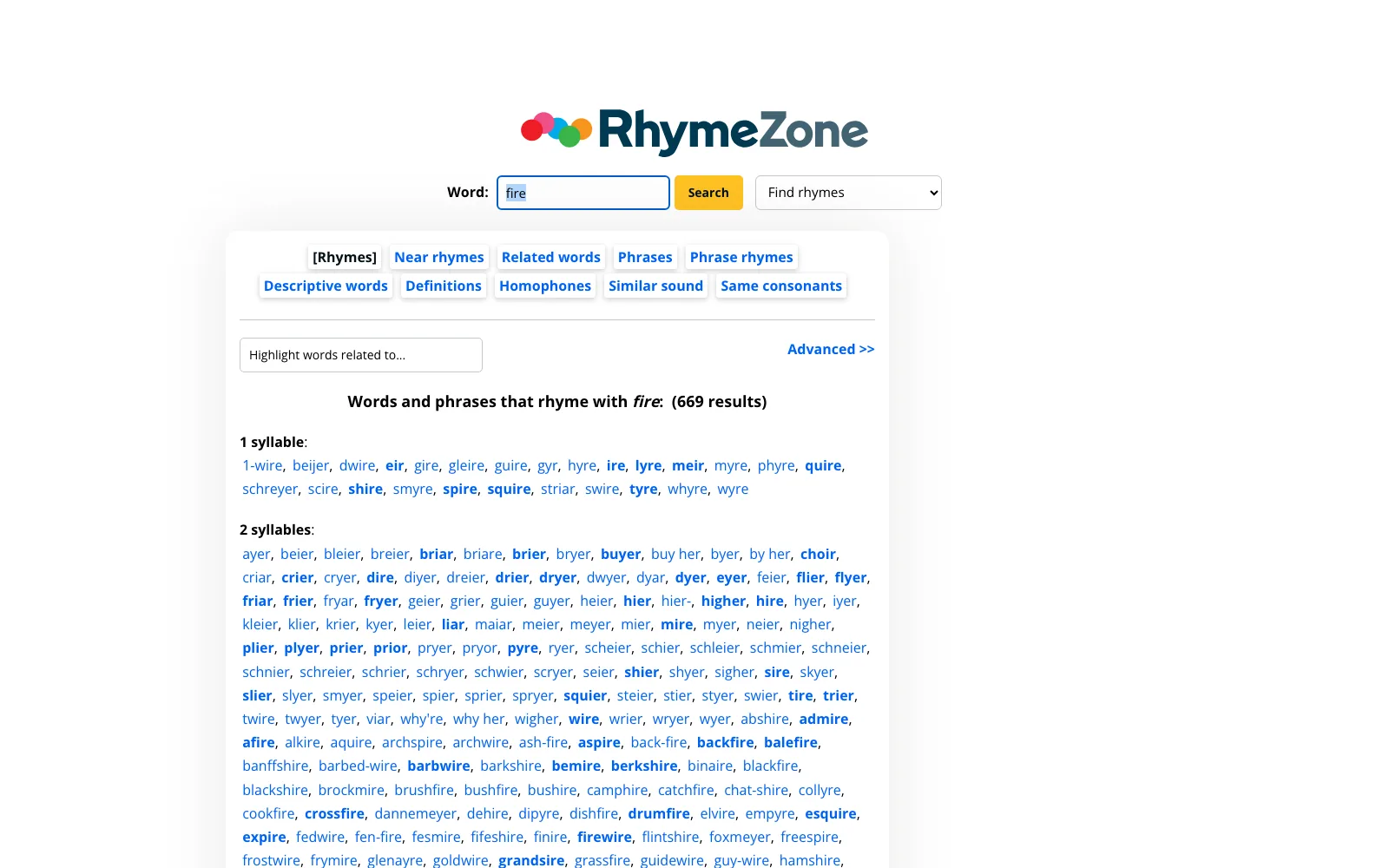
RhymeZone is the dominant free rhyme finder on the internet and has been for nearly three decades. Created by Doug Beeferman, launched in January 1996 as the Semantic Rhyming Dictionary, renamed in April 2000, and now owned by Merriam-Webster, it draws pronunciation data from the CMU Pronouncing Dictionary. The mobile apps include a database of more than 150,000 words. Completely free, no account required.
The feature set is genuinely comprehensive for a free tool. You can search for exact rhymes, near rhymes (slant rhymes), synonyms, antonyms, homophones, similar-sounding words, related words, phrase rhymes (multi-word slant rhyme phrases, particularly useful for hip-hop and contemporary pop), and similar spellings. The advanced search interface lets you filter by rhyme quality, syllable count, popularity, and meter. The Poet Maker tool combines multiple constraints in a single search. For pure rhyme-finding depth, nothing free comes close.
The limitation that keeps it at #2: RhymeZone exists in a browser tab separate from wherever you're actually writing. Every time you need a rhyme, you break out of your creative flow: open tab, search, scroll through results, find the word, return to your lyric draft. This context-switching is the primary reason songwriters look for a RhymeZone alternative embedded inside their writing app.
Key Features
- 150,000+ word database in the mobile apps
- Exact rhymes, near rhymes, phrase rhymes
- Synonyms, antonyms, homophones, related words
- Advanced search with syllable, quality, and meter filters
- Poet Maker for combining multiple constraints
- Free, ad-supported on web, no account required
Pros & Cons
- Deepest free rhyme database, no paywall
- Running since 1996, owned by Merriam-Webster
- Mobile apps available alongside web
- Advanced filters and Poet Maker for power users
- Standalone browser tool, requires constant tab-switching
- No lyric writing workspace
- No chord tools, recording, or song structure features
- Ad-supported web version
3. MasterWriter

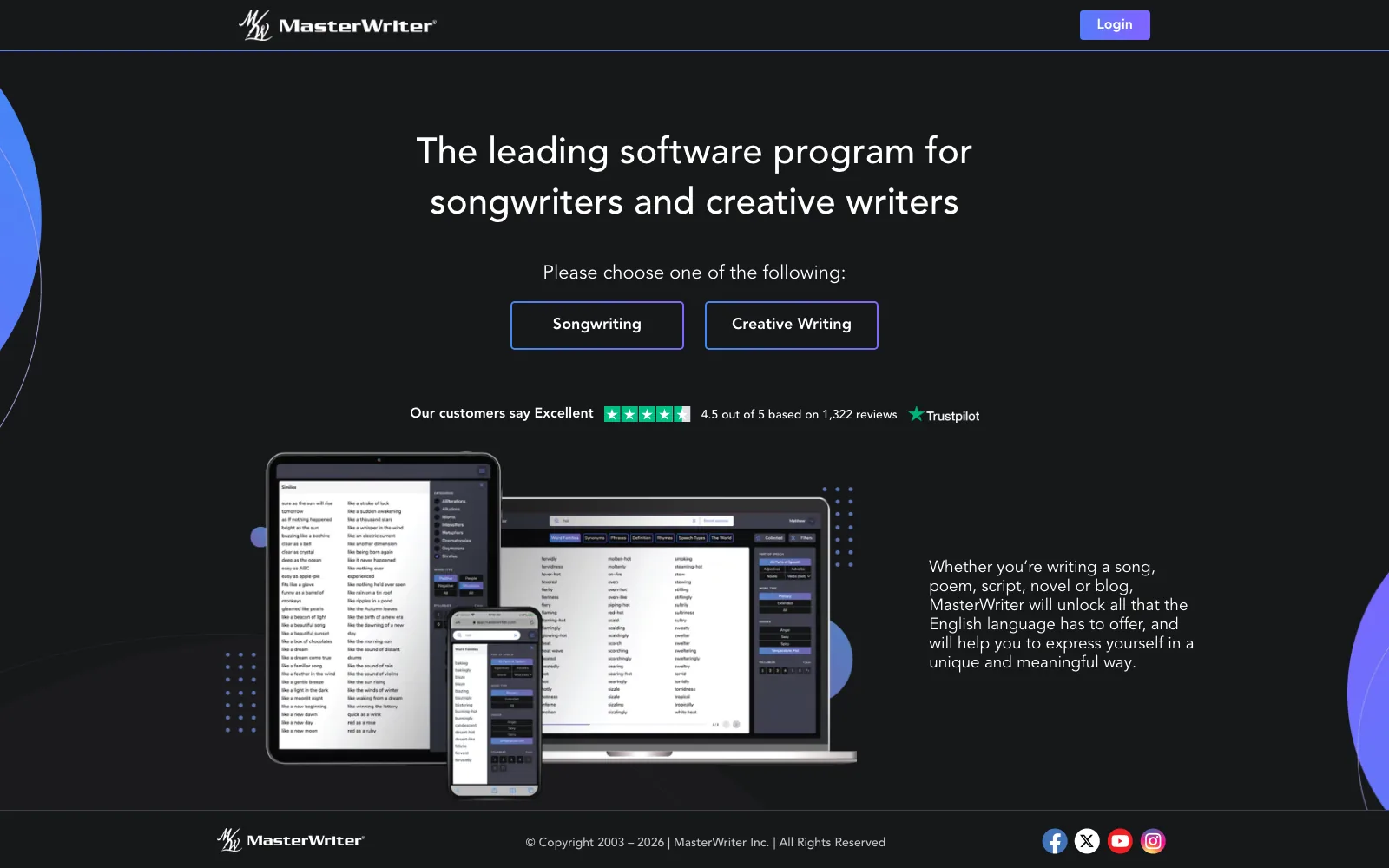
MasterWriter has been the professional songwriter's word toolkit since 2003. With a 4.5 out of 5 rating from 1,322 Trustpilot reviews, it is the most validated paid word tool in the space. Where RhymeZone gives you rhymes and where Song Cage gives you rhymes embedded in a chord+lyric workflow, MasterWriter gives you the full English language: organized, filtered, and ready to use.
The rhyming dictionary contains over 100,000 entries and 36,000 rhymed phrases, with filters for perfect rhymes, close rhymes, and wide rhymes, a meaningful distinction that lets you dial in how much phonetic similarity you need. But MasterWriter's real differentiator is everything beyond rhymes: a Phrases dictionary with over 33,000 phrases, sayings, and idioms; Word Families (a unique database of descriptive words that goes far beyond a standard thesaurus); Speech Types covering metaphors, similes, oxymorons, alliterations, allusions, and onomatopoeia; and a Pop Culture dictionary with 11,000 icons of American and world culture.
The workflow model is a double-click collection system: browse any dictionary, double-click words you like, and they stack in a collection panel. You review and pick from the collected options without constant back-and-forth. It's a thoughtful design for maintaining creative flow within the tool, though it still exists separately from your lyric draft if you're writing elsewhere.
Key Features
- 100,000+ rhyme entries and 36,000 rhymed phrases
- Perfect, close, and wide rhyme filters
- 33,000+ phrases, idioms, and sayings
- Word Families for descriptive language
- Speech Types: metaphors, similes, alliterations, oxymorons
- Pop Culture dictionary with 11,000 entries
- Double-click collection workflow
- 90-day money-back guarantee
Pros & Cons
- Very deep rhyme database with quality filters
- Goes far beyond rhymes into figures of speech and idioms
- 4.5/5 from 1,322 Trustpilot reviews, highly validated
- Unique Word Families and Pop Culture dictionaries
- No free tier, paid only ($9.95/mo)
- Desktop-first, no dedicated mobile app
- No chord tools, recording, or song structure
- UI is functional but dated compared to modern apps
4. RHYMEBOOK
RHYMEBOOK, developed by DailyRapFacts LLC, takes a different approach from every other tool on this list: instead of searching for rhymes on demand, it suggests them in real time as you type, through a custom keyboard. The dictionary is built into the keyboard itself, so rhymes, near rhymes, and slant rhymes appear as you write without tapping a separate search button.
Filter results by syllable count, sort by relevance, and tap any word to insert it directly into your lyrics. The dictionary works completely offline. The free tier includes 25 notes and basic rhyme dictionary access, enough to evaluate the tool. Premium ($4.99/mo or $49.99/yr, verified from the Apple App Store listing) adds the full keyboard, unlimited notes, dark mode, and an ad-free experience. The tool is primarily mobile-native and works best on iOS and Android; there's no robust desktop version.
Key Features
- Real-time keyboard rhyme suggestions
- Works offline, full dictionary without internet
- Perfect, near, and slant rhymes
- Syllable-count filter
- iOS and Android native
Pros & Cons
- Rhymes appear as you type, no manual lookups
- Affordable premium tier ($4.99/mo)
- Offline support for travel and weak signal
- Built for hip-hop multi-syllabic schemes
- Mobile-only, no desktop web app
- Free tier limited to 25 notes
- No chord tools or song structure
- Rhyme database smaller than RhymeZone or MasterWriter
5. RhymeHamster

RhymeHamster is hand-edited rather than generated from a pronunciation database, and that is the whole point of it. RhymeZone and the free tools built the same way derive their lists from the CMU Pronouncing Dictionary, which is why they will hand you sure/sore, on/yawn, or satisfy/my and call all three perfect rhymes. RhymeHamster rejects those by name and keeps the perfect list strict.
It covers more than 115,000 words. Slant rhymes sit on a dial you widen or tighten yourself instead of arriving as one fixed list, and there are separate tools for stretch, internal and wildcard rhymes, which is the set you want when the rhyme has to land mid-line rather than at the end of it. The wildcard tool is not a crossword-style letter search: free up part of a word and it fills the gap with every sound that fits rather than every spelling, so freeing the "ca" in candle turns up scandal, dwindle, Handel and trundle. Filters let you drop names, places and brands out of the results, include or exclude phrases, and include or exclude words ending in -in', which matters more in sung lyrics than in written verse. Words you never want to see again can be hidden, and words it does not know can be added by hand.
The dictionary downloads into the browser on first load, so every lookup after that is instant with no server round trip. There is no account, no ads, and nothing to pay for. It was built by Jeremy Desmon, a musical theatre bookwriter and lyricist who has taught a songwriting and musicals workshop at Princeton for twenty years, and the editorial judgment shows in what the tool refuses to call a rhyme. Like RhymeZone it lives in its own tab, so it is a reference you consult rather than a place you write.
Key Features
- 115,000+ words, curated by hand rather than generated
- Strict perfect rhymes that reject near-misses other tools accept
- Slant rhyme on an adjustable dial, not a fixed list
- Stretch, internal and wildcard rhyme tools
- Filters for names, brands, phrases and -in' endings
- Hide words you don't want, add words it lacks
- Instant lookups after the first load, no account, no ads
- Wildcard search by sound, not spelling
Pros & Cons
- Editorial curation means the perfect list needs no double-checking
- You set how loose the slant rhymes are
- Internal and wildcard rhymes, rare in free tools
- Free with no account and no advertising
- Separate browser tab, not inside a lyric workspace
- Smaller database than RhymeZone's 150,000+
- No synonyms, semantic tools or chord tools
- No dedicated mobile app
- First load downloads the full dictionary
6. B-Rhymes

B-Rhymes has one job: finding near rhymes. The site describes itself as a rhyming dictionary that's not stuck up about what does and doesn't rhyme, finding words that sound good together phonetically even when they don't share the same ending sound. This is a genuinely different approach from RhymeZone, which groups exact and near rhymes in separate sections.
For songwriters, this is practically valuable. Perfect rhymes are easy to find. The harder, more rewarding challenge is finding near-rhymes that sound natural, that carry the right meaning, and that don't feel forced. B-Rhymes is useful as a specialized tool alongside a broader rhyme finder: RhymeZone for exact rhymes, B-Rhymes when you want to cast a wider net for phonetically satisfying options without the constraint of a perfect match. Free, no account required, web-only.
Key Features
- Specializes exclusively in slant and near rhymes
- Single-purpose interface, no clutter
- Free, no account required
- Good complement to exact-rhyme-first tools
Pros & Cons
- Unique slant-rhyme focus, treats near rhyme as primary output
- Fast and simple
- Free with no signup
- Web-only, no mobile app
- No syllable grouping or filter
- No synonyms, semantic tools, or lyric workspace
- Database smaller than RhymeZone
7. Rhymer.com

Rhymer.com offers six distinct types of rhyme in a single interface: end rhymes (the standard, same final vowel and consonant sounds), last-syllable rhymes (similar but broader), double rhymes (feminine rhymes, same sounds in the final two syllables), triple rhymes (same sounds in the final three syllables), beginning rhymes (alliteration and front rhyme), and first-syllable rhymes. Each type returns a different list for the same query.
This multi-type structure is genuinely useful for certain songwriting challenges. If you need a triple rhyme for a complex lyric line, or beginning rhymes for an alliterative passage, Rhymer.com surfaces these where RhymeZone buries them in search filters. It's a specialist tool for writers who think carefully about rhyme type; most casual users will find RhymeZone's interface more practical. Free, no account required, web-only.
Key Features
- Six distinct rhyme types in one tool
- Double and triple rhymes for complex lyric lines
- Beginning rhymes for alliteration
- Free, no account required
Pros & Cons
- Most rhyme-type variety of any free tool
- Useful for writers who care about rhyme classification
- Clean separation of types in the result view
- Web-only, no mobile app
- No slant rhyme suggestions
- No lyric workspace, synonyms, or semantic tools
- Interface is plain and dated
8. WordHippo

WordHippo is a broad, free word tool covering rhymes, synonyms, antonyms, translations, sentences using a word, pronunciations, and several other word-related lookups. It's a generalist rather than a specialist: useful when you need multiple types of word information about a single word without switching between separate tools.
The rhyme finder is competent but not as deep as RhymeZone's database. The synonym finder is more straightforward than MasterWriter's Word Families approach. For songwriters, WordHippo is most useful as a lightweight reference, a thesaurus with a built-in rhyme checker, available without any account or cost. It doesn't have a lyric workspace, chord tools, or anything songwriting-specific. But when you need to check synonyms, antonyms, and rhymes for the same word in one place, it covers that efficiently.
Key Features
- Rhymes, synonyms, antonyms in one place
- Example sentences using a word
- Translation tool for multilingual writers
- Free, no account required
Pros & Cons
- Covers many word-related lookups in one tool
- Clean, fast interface
- Useful translation support
- Rhyme database less comprehensive than RhymeZone
- No slant rhyme section
- No lyric workspace or chord tools
- Web-only, no dedicated mobile app
9. Power Thesaurus

Power Thesaurus is a synonym and antonym reference where results are ranked by user votes rather than alphabetically, and it earns a place on a rhyme list for one specific reason: you can sort results by syllable count and filter them by part of speech. That is the exact problem a lyric writer has when a line already sings and only one word is wrong.
Alongside synonyms and antonyms it returns definitions, idioms and phrases, which matters when the fix for a clumsy line is a three-word phrase rather than a single word. Searching is free and needs no account; a free registered account and a paid PRO membership reduce or remove ads and add filtering. There are mobile apps and browser extensions, and the Chrome extension holds 4.5 out of 5 from 485 ratings. It finds no rhymes at all, so it sits beside a rhyme tool rather than replacing one. Inside Song Cage the same job is done by the synonym tab next to the rhyme tab, without the round trip to a browser.
Key Features
- Sort results by syllable count, length or rating
- Filter by part of speech
- Idioms and phrases, not just single words
- Free to search with no account
- Browser extension for lookups in place
Pros & Cons
- Syllable sorting is rare and genuinely useful for lyrics
- Community ranking surfaces words people actually use
- Free without an account
- Idiom and phrase results
- No rhyme finder of any kind
- Ads unless you register or pay
- No lyric workspace, chord tools or song structure
- Online only, no offline mode
10. RapPad

RapPad (Binary Hands LLC, copyright 2026) is primarily a hip-hop community platform, but its writing tools make it genuinely useful for rap-focused lyric writers. The built-in rhyming dictionary pairs with a syllable counter, thesaurus, and line generator in a single editor interface. You can attach an instrumental or recording to your lyrics and control playback from the same screen.
The standout feature is the Blueprint, a lyric analysis tool that breaks your text into syllables and calculates metrics like rhyme density, rhyme complexity, and average syllables per word, then gives your rap an overall grade. For songwriters who work with complex multi-syllabic rhyme schemes (particularly in hip-hop, R&B, and pop-rap), this analytical feedback is genuinely distinctive: no other tool on this list grades your lyric by rhyme density. Free to use, community-supported, web-based.
Key Features
- Blueprint rhyme density and complexity analysis
- Syllable counter built into the editor
- Beat sync with highlighted lyrics
- Hip-hop community and feedback
- Free with no paywall on core features
Pros & Cons
- Unique rhyme density and complexity metrics
- Syllable counter and beat sync built in
- Free with no paywall
- Community feedback loop
- Hip-hop community focus, less suited to pop or folk
- Web-only, no mobile app
- No chord tools, melody, or music theory
- Rhyme dictionary less deep than RhymeZone
Understanding Rhyme Types for Songwriting
Not all rhymes are the same, and knowing which type you need changes which tool you should reach for. Perfect rhymes (cat/hat, stone/phone) share the same final vowel and consonant sounds. Slant rhymes (room/storm, fire/liar) are phonetically similar but not identical: they sound more natural in contemporary lyrics and give writers more word choices. Double rhymes (walking/talking) match the final two syllables, common in hip-hop and complex pop. Phrase rhymes match a single word with a multi-word phrase (poetry/boba tea), increasingly common in R&B and contemporary pop. Song Cage covers perfect, slant, synonym, and semantic; RhymeZone covers exact, near, and phrase; Rhymer.com covers six distinct types; B-Rhymes specializes in slant only.
Full Feature Comparison
| Tool | Rhyme Finder | Slant | Synonyms | Semantic Tools | Chord Tools | Mobile | Lyric Workspace | Price |
|---|---|---|---|---|---|---|---|---|
| Song Cage | Syllable-grouped | Dedicated tab | Yes | Drift + Collider | Full palette | iOS + Android | Embedded | Free / $79 |
| RhymeZone | 150,000+ words | Near rhymes | Yes | Related words | No | iOS + Android | Browser only | Free |
| MasterWriter | 100K+ entries | Close/wide | Word Families | Metaphors + idioms | No | Desktop only | Built-in editor | $9.95/mo |
| RHYMEBOOK | Real-time keyboard | Yes | No | No | No | iOS + Android | Notes only | Free / $4.99/mo |
| RhymeHamster | 115,000+ curated | Adjustable dial | No | Internal + wildcard | No | Web only | Browser only | Free |
| B-Rhymes | Slant only | Specializes | No | No | No | Web only | No | Free |
| Rhymer.com | 6 rhyme types | No | No | No | No | Web only | No | Free |
| WordHippo | Basic | No | Yes | No | No | Web only | No | Free |
| Power Thesaurus | None | No | Community-ranked | Idioms + phrases | No | iOS + Android | Browser only | Free / PRO optional |
| RapPad | + syllable count | No | Thesaurus | Blueprint analysis | No | Web only | Rap-focused editor | Free |
Why does workflow integration beat a bigger rhyme database?
Most songwriters never run out of rhyme options. A 50,000-word database surfaces more candidates than any single lyric needs. The real cost in lyric writing is the friction between needing a rhyme and getting one back: open a new tab, type the word, scroll the result list, find the candidate, switch back, retype it into the draft. That round trip costs ten to fifteen seconds and breaks the flow that produced the line in the first place. Embedded rhyme tools (Song Cage, RHYMEBOOK) collapse that loop. RhymeZone and MasterWriter have deeper databases but live outside the lyric draft. For most working songwriters, three good options inside the workspace beat three hundred good options in another tab.
Should you use a paid rhyme tool or stay free?
For pure rhyme-finding, the free tools cover almost everything. RhymeZone's 150,000-word database, B-Rhymes for slant rhymes, Rhymer.com for rhyme-type variety, and Song Cage's free tier (full rhyme finder, slant rhymes, synonyms, semantic tools; limited to one song in the free web app) cover the rhyme half of lyric writing without paying anything. The case for paid tools is the workflow around the rhyme. MasterWriter ($9.95/mo) adds 33,000 phrases, figures of speech, and a Pop Culture dictionary that no free tool matches. Song Cage's license unlocks unlimited songs, MIDI/PDF export, and collaborator invites on top of the embedded rhyme stack. RHYMEBOOK Premium ($4.99/mo) is the cheapest way to get rhymes that appear as you type on mobile. Decide on the workflow first; the rhyme database differences are usually a secondary factor.
The Rhyme Finder That Lives Inside Your Song
Song Cage is the only rhyme generator built into a chord and lyric writing workspace. Click any word: perfect rhymes, slant rhymes, synonyms, and semantic tools appear instantly without leaving your draft.
Frequently Asked Questions
What is the best rhyme generator for songwriters in 2026?
Song Cage is the best rhyme generator for songwriters because it is the only tool that embeds the rhyme finder directly inside the chord and lyric writing workspace. Click any word in your lyrics and instantly see perfect rhymes (grouped by syllable count), slant rhymes, synonyms, and the Semantic Drift Chain, without switching apps or browser tabs. For a free standalone rhyme dictionary, RhymeZone (running since January 1996, owned by Merriam-Webster, 150,000+ word database) is the strongest option. For professional-level word tools beyond rhymes, MasterWriter ($9.95/mo, 4.5/5 from 1,322 Trustpilot reviews) is the industry standard.
What is a slant rhyme and which tools find them?
A slant rhyme (near rhyme, imperfect rhyme) is a rhyme where the sounds are similar but not identical: vowels match but consonant endings differ, or vice versa. Examples: room/storm, home/foam, fire/liar. Most contemporary songwriters use a mix of perfect and slant rhymes to avoid the sing-songy quality of constant perfect rhyming. Tools with slant rhyme support: Song Cage (dedicated slant rhyme tab, syllable-grouped), RhymeZone (near rhymes section), B-Rhymes (specializes exclusively in near rhymes), RHYMEBOOK (slant rhymes in real-time keyboard), and MasterWriter (close and wide rhyme filters).
Is RhymeZone free and how long has it existed?
Yes, RhymeZone is completely free with no account required. It was created by Doug Beeferman and launched in January 1996 as the Semantic Rhyming Dictionary, renamed RhymeZone in April 2000, and is now owned by Merriam-Webster. It uses pronunciation data derived from the CMU Pronouncing Dictionary. The mobile apps include a database of more than 150,000 words. It offers exact rhymes, near rhymes, synonyms, antonyms, homophones, phrase rhymes, and a Poet Maker tool for advanced searches, all free.
How much does MasterWriter cost?
MasterWriter pricing (verified from masterwriter.com, May 2026): $9.95/month, $99.95/year ($8.33/mo), or $149.95 for two years ($6.25/mo). MasterWriter has been running since 2003 and holds a 4.5 out of 5 rating from 1,322 Trustpilot reviews. It includes a rhyming dictionary with 100,000+ entries and 36,000 rhymed phrases, a phrases dictionary with 33,000+ entries, Word Families, Speech Types (metaphors, similes, alliterations, oxymorons, idioms), a Pop Culture dictionary with 11,000 entries, and full word processing. There is a 90-day money-back guarantee.
What makes Song Cage different from RhymeZone?
The key difference is workflow integration. RhymeZone is a standalone browser tool that requires you to leave your lyric draft, open a new tab, search, and return, breaking creative flow every time you need a rhyme. Song Cage is a lyric writing app with rhyme suggestions built directly into the lyric workspace. Click any word and the rhyme panel opens in context, no tab switching. Song Cage also adds slant rhymes, synonyms, and the Semantic Drift Chain (semantic exploration tool) that RhymeZone doesn't have. And Song Cage integrates chord progressions alongside lyrics, so harmonic and lyric decisions develop together. For pure rhyme database depth, RhymeZone is larger (150,000+ words). For a complete songwriting workflow, Song Cage covers everything in one place.
What is RHYMEBOOK and how much does it cost?
RHYMEBOOK, developed by DailyRapFacts LLC, is a mobile rhyme generator that suggests rhymes in real time as you type, through a custom keyboard. The dictionary is built into the keyboard, so perfect rhymes, near rhymes, and slant rhymes appear as you write. Filter by syllable count. Works offline. Pricing (verified from the Apple App Store listing): free tier (25 notes, basic rhyme dictionary, community access). Premium: $4.99/month or $49.99/year, adds the full keyboard, unlimited notes, dark mode, and ad-free. Available on iOS and Android.
What rhyme types does Rhymer.com offer?
Rhymer.com offers six distinct rhyme types, more type variety than any other free tool on this list: (1) end rhymes, same final vowel and consonant sounds (hat/cat); (2) last-syllable rhymes, broader than end rhymes (humanity/zesty); (3) double rhymes (feminine rhymes), same sounds in the final two syllables (walking/talking); (4) triple rhymes, same sounds in the final three syllables (combination/dissertation); (5) beginning rhymes, same initial sounds (scenery/cedar); (6) first-syllable rhymes, same sounds preceding the first syllable break (carrot/caring). Free, no account required, web-only.
What is B-Rhymes and how is it different from RhymeZone?
B-Rhymes is a free web-based rhyming dictionary that specializes exclusively in near rhymes and slant rhymes: words that sound good together even if they don't technically rhyme. Unlike RhymeZone, which separates exact and near rhymes into different sections, B-Rhymes treats slant rhyme as the primary and only output. This makes it particularly useful when you want to avoid forced-feeling perfect rhymes and find phonetically satisfying alternatives with more semantic freedom. It has no syllable grouping, no lyric workspace, and no chord tools. It is a single-purpose slant rhyme finder, and it does that job well as a free companion to a broader rhyme tool.
What is RapPad's Blueprint feature?
The Blueprint is RapPad's lyric analysis tool. It breaks your lyrics into syllables and calculates metrics including rhyme density (how frequently rhyming words occur relative to total words), rhyme complexity, and average syllables per word, then generates an overall grade for the rap. It can analyze any lyrics, including non-RapPad content like Eminem's "Rap God." For hip-hop and rap songwriters interested in the technical craft of rhyme density and syllabic structure, this analytical feedback is genuinely unique: no other tool on this list quantifies the rhyme density of a lyric draft. RapPad is by Binary Hands LLC (copyright 2026) and is free to use.
Which rhyme generator tools work on mobile?
Mobile-available rhyme tools: Song Cage (iOS and Android native apps, full rhyme tools and chord palette on mobile, see best apps for capturing song ideas fast); RhymeZone (iOS and Android apps, 150,000+ word database); RHYMEBOOK (iOS and Android, real-time keyboard, works offline). Web-only tools that work in mobile browsers but don't have native apps: RhymeHamster, B-Rhymes, Rhymer.com, WordHippo, RapPad. Power Thesaurus is web-first with iOS and Android apps and a browser extension. MasterWriter is desktop-first with no dedicated mobile app.
What is the best free rhyme finder for songwriters?
For a standalone free rhyme finder: RhymeZone (running since 1996, owned by Merriam-Webster, 150,000+ word database, completely free, no account required). For a free embedded rhyme tool inside a lyric writing app: Song Cage's free tier includes the full rhyme finder, slant rhyme tab, and synonym tools (limited to one song). For free slant-rhyme-only: B-Rhymes is the best free specialist. For hip-hop focused free rhyme plus analysis: RapPad with the Blueprint lyric grading system is free.
Do I need a paid rhyme tool or is free enough?
For most songwriters, the free tools are sufficient for rhyme-finding specifically. RhymeZone's free database of 150,000+ words covers more rhyme options than you'll ever need. The case for paid rhyme tools: (1) MasterWriter ($9.95/mo) if you need professional-level word tools beyond rhymes (figures of speech, metaphors, idioms, pop culture references, 33,000+ phrases); (2) the Song Cage license if you want rhyme tools embedded in a chord+lyric workspace with mobile capture, unlimited songs, and music theory; (3) RHYMEBOOK Premium ($4.99/mo) if you primarily work on mobile and want the full real-time keyboard experience. Power Thesaurus and RapPad are free to use without an account.
What is RhymeHamster and what makes it different?
RhymeHamster is a free web rhyming dictionary of more than 115,000 words, built by musical theatre lyricist Jeremy Desmon. Its difference is editorial: the word lists are hand-edited rather than generated from a pronunciation database, so the perfect-rhyme list stays strict and rejects the near-misses that mechanically built tools accept (sure/sore, on/yawn, satisfy/my). Slant rhyme sits on a dial you tighten or loosen yourself, and there are separate stretch, internal and wildcard rhyme tools for rhymes that land mid-line. You can filter out names and brands, include or exclude phrases and -in' endings, hide words you never want to see, and add words it does not know. There is no account and no advertising. It lives in its own browser tab rather than inside a lyric workspace.
Which rhyme tool is best for hip-hop and rap songwriters?
RapPad is the most rap-specific tool: rhyming dictionary, syllable counter, thesaurus, Blueprint rhyme density analysis, beat sync for playback, and a hip-hop community. For real-time rhyme suggestions as you write, RHYMEBOOK (DailyRapFacts LLC) is optimized for hip-hop flows with multi-syllabic patterns and a keyboard that suggests rhymes as you type. Song Cage is also strong for rap and hip-hop because the slant rhyme finder is organized by syllable count (critical for multi-syllabic rhyme schemes), and the Semantic Drift Chain can surface unexpected word chains for lyrics. All three work together: RapPad for analysis, RHYMEBOOK for real-time mobile flow, Song Cage for connecting rhymes to chord progressions and melody.