Table of Contents
- Two Types of Music Theory Tools for Songwriters
- 1. Song Cage
- 2. Hookpad (by Hooktheory)
- 3. Scaler 3 (by Plugin Boutique)
- 4. Piano Companion (by Songtive)
- 5. Chordify
- 6. Hooktheory Books (I & II)
- 7. Chord Crush (by Hooktheory)
- 8. musictheory.net
- 9. Tonaly
- 10. teoria.com
- 11. FaChords
- Full Feature Comparison
- How to Choose the Right Music Theory Tool for Your Songwriting
- Frequently Asked Questions
Two Types of Music Theory Tools for Songwriters
Music theory tools for songwriters fall into two fundamentally different categories, and the distinction shapes which tool is right for your workflow. The first type teaches theory as academic content: lessons, exercises, intervals, scale degrees. The second type applies theory in practice, showing you which chord comes next in your specific song, explaining why a borrowed chord adds color, mapping the pivot route to a new key. Most songwriters need both, but the applied tools matter most day to day.
Used while writing. They show chord functions, suggest progressions, and explain borrowed chords in context. Theory appears inside your song, not in a textbook. Song Cage, Hookpad, Scaler 3.
Quick lookups for chord shapes, scale patterns, and key relationships. Most useful when you have a specific question. Piano Companion, Chordify.
Train your ability to recognize chord progressions, intervals, and harmonic relationships by ear. Chord Crush, musictheory.net, teoria.com.
Structured learning from first principles, for songwriters who want to understand the theory behind what they already do. Hooktheory Books, musictheory.net.
The most important distinction
Academic music theory asks: "What are the rules?" Applied music theory for songwriters asks: "What chord comes next in this song?" The best music theory tools for songwriters are built around the second question. They meet you in the creative moment rather than requiring you to step out of it to look something up.
If you are just starting out, our companion guide to the best music theory apps for beginners covers the gentlest on-ramps. This list is ranked for working songwriters, by how directly each tool feeds the writing.
1. Song Cage
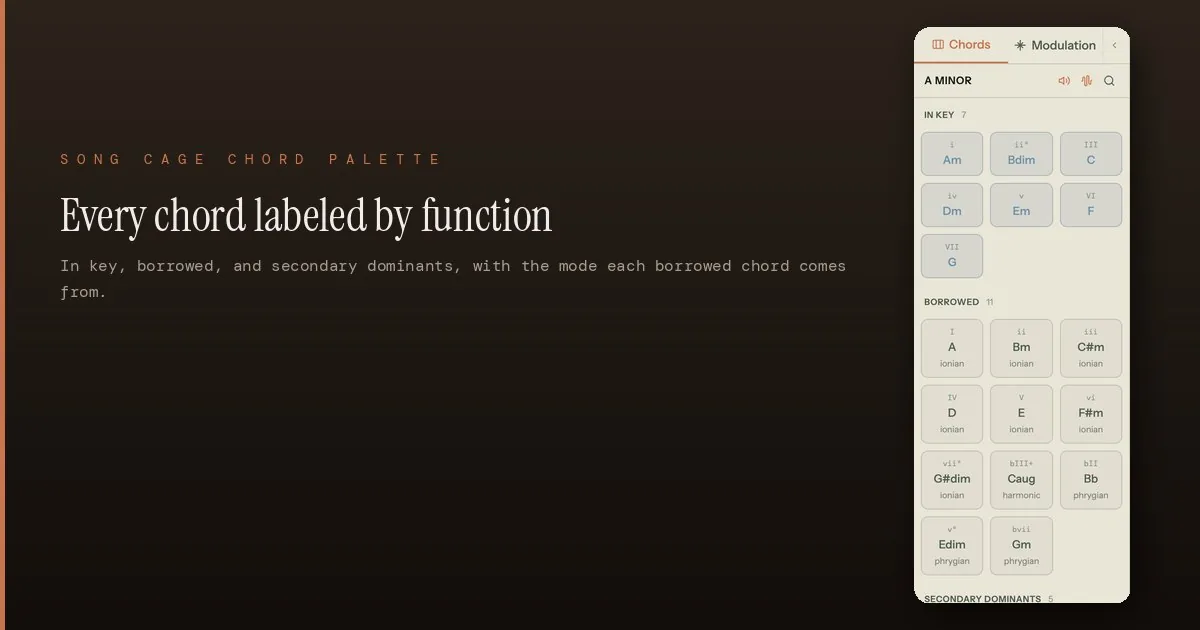

Song Cage tops this list because it delivers music theory for songwriters without reading music in the most natural way: by embedding theory into the act of writing. Every chord in the palette carries a Roman numeral label (I, IV, V, vi), so you always know the harmonic function of what you are playing. Hover or tap any chord and a tooltip explains why it works at that position, with notes like "Classic ii–V–I cadence," "borrowed from Aeolian mode," or "part of the I–V–vi–IV pop progression," alongside voice-leading smoothness and how many melody notes are chord tones. You absorb theory by seeing it applied to your own music.
The chord palette organizes three categories per key: diatonic chords (the seven naturally in your key), borrowed chords from parallel modes (each labeled by its source: Dorian, Mixolydian, Aeolian, Phrygian), and secondary dominants with resolution arrows showing where each wants to resolve. That is the working language of contemporary pop and rock harmony, available without any prior theory knowledge, from beginner I–IV–V progressions to modal interchange and secondary-dominant chains.
The modulation panel, a feature no other app on this list has, maps pivot-chord routes between any two keys, from a simple V→I pivot to a full ii–V–I with voice-leading-optimized extensions. Context-aware suggestions factor in the chord before, the chord after, and the melody notes at that beat, so you choose from what fits the specific moment rather than a generic list. With guitar fretboard and piano voicing diagrams for every chord plus a full lyric workspace with a rhyme finder, it is the most complete single tool for the whole songwriting process, with theory running through every decision.
Pros
- Every chord labeled by harmonic function, so theory is visible in your song
- Borrowed chords labeled by source mode, so you understand modal interchange
- Secondary dominants with resolution arrows
- Context-aware chord suggestions with explanations of why each works
- Modulation panel with pivot-chord routes between any two keys
- Guitar fretboard and piano voicing diagrams for every chord
- Full lyric workspace with rhyme suggestions alongside the chord tools
- Free tier includes the full chord palette and every theory tool
Cons
- No formal theory curriculum or structured lessons
- No ear-training module (for that, see Chord Crush)
- No song analysis from audio (for that, see Chordify)
- The free web app is limited to one song; unlimited songs need the license
Pricing (verified September 2026 from songcage.com)
Free: $0, no card required. You get the full chord palette (diatonic, borrowed, secondary dominants), the modulation panel, all Word Tools, playback, and audio recording in the web app, limited to one song. License: $79. It covers the Mac and Windows desktop app plus the AU/VST3 plugin, and adds unlimited songs, PDF chord-sheet and MIDI export, and collaboration with up to 5 editors. Signing in once in the desktop app or plugin starts a 14-day trial of everything.
2. Hookpad (by Hooktheory)

Hookpad is the most research-oriented music theory tool for songwriters. Its TheoryTab database of 70,000+ popular songs, analyzed in Roman numeral notation, is the most comprehensive chord research library available, and the Magic Chord AI trained on it shows which chords are statistically most likely to follow what you have already placed. Search "what songs use IV–I–V–vi" and see hundreds of examples. Copy any hit song's chord track directly into your project, transposed to your key.
Pricing (verified from hooktheory.com/hookpad/pricing): Free is basic, with a limited chord palette, no MIDI export, and one melody voicing. Standard is $7.99/month or $199 one-time lifetime, adding full chord palettes, MIDI export, sheet music, up to four melody voicings, and 500+ instruments. The Aria AI add-on is +$14.99/month. One important limitation: Hookpad's landing page states it is "designed for larger screens," and there is no iOS or Android app. As a Hookpad alternative with lyric writing, Song Cage covers comparable chord depth and adds the lyric workspace, guitar voicings, and modulation panel that Hookpad lacks. For a wider look at this category, see our roundup of the best chord progression tools.
Pros
- 70,000+ TheoryTab songs, the deepest chord research database available
- Magic Chord AI backed by real song statistics, not abstract theory
- Copy any song's chord progression into your project
- MIDI export to any DAW (Standard)
- Melody composition with real-time consonance and dissonance highlighting
- $199 lifetime option, with no recurring cost for Standard features
Cons
- No lyric tools: no rhyme finder, no lyric workspace
- No guitar voicing diagrams or guitar-specific features
- Web only, with no iOS or Android app
- No modulation panel or pivot-chord visualization
- Aria AI raises the all-in cost (+$14.99/mo)
- Steeper learning curve for the melody-entry interface
3. Scaler 3 (by Plugin Boutique)
Scaler 3 (by Plugin Boutique) is a music theory workstation that runs as a standalone app or as a VST, VST3, AU, or AAX plugin inside any DAW. Unlike the other tools here, the chord progressions you build can directly trigger virtual instruments on your DAW's timeline. At $99 (currently around $79 on sale), it is a one-time purchase with free updates. It launched in March 2025 as the successor to Scaler 2, which existing owners were upgraded to for free.
The content is deep: over 1,000 chord sets, keys, and modes, plus artist-curated sets from producers including Carl Cox and MJ Cole. Audio and MIDI detection analyzes what key and scale you are already in from existing tracks and suggests compatible chords. Five modulation methods (including Secondary Scale, Modal Interchange, and Neo-Riemannian approaches) map routes between keys, while the Motion library generates melodies, arpeggios, and basslines from your current chords. Keys Lock gives one-finger chord control from a MIDI keyboard, and a timeline Arrange page, 50 internal sounds, and VST/AU hosting round it out. For producers who already live in a DAW and want applied theory without leaving it, Scaler 3 is the strongest option.
Pros
- Runs standalone and as a plugin in any DAW
- 1,000+ chord sets, keys, and modes, plus artist sets across genres
- Audio and MIDI detection identifies the key you are already in
- Five modulation methods for moving between keys
- Motion library for melodies, arpeggios, and basslines
- Keys Lock one-finger chord performance from a MIDI keyboard
- One-time purchase with free updates, no subscription
Cons
- Heavier and more producer-focused than a songwriting canvas
- No lyric workspace or word tools
- No mobile version
- Learning curve to navigate the interface
- Theory labels are less explanatory than Song Cage or Hookpad
4. Piano Companion (by Songtive)

Piano Companion (by Songtive) is the most comprehensive music theory reference app for mobile. Its database covers 1,500+ chords with up to six inversions and 10,000+ scales, from standard major and minor through chromatic, pentatonic, blues, and exotic modes, with a reverse chord lookup that names whatever notes you tap. Tap keys on screen or connect a MIDI keyboard over Bluetooth or USB, and it identifies every chord or scale those notes form.
The interactive circle of fifths shows compatible chords and key relationships visually. The chord progression builder suggests chords from scale patterns and exports to MIDI. Grand-staff notation with treble and bass clef, fingering for both hands, and secondary-dominant and leading-tone labels make it a genuinely deep reference rather than a simple chord dictionary. It runs on iOS, Android, and macOS in 40+ languages. The free version covers core chord and scale lookups; Pro unlocks all inversions, the full scale library, the progression builder, and the circle of fifths.
Pros
- 1,500+ chords (six inversions) and 10,000+ scales, the most complete mobile reference
- Reverse chord lookup: tap keys to identify what you are playing
- MIDI keyboard support for live chord and scale identification
- iOS, Android, and macOS, in 40+ languages
- Circle of fifths with compatible chords visualized
- Grand-staff notation with fingering for both hands
- Secondary-dominant and leading-tone labels
- Free core features
Cons
- Reference tool only: no lyric workspace, no recording
- No songwriting canvas or chord progression timeline
- Progression builder is less contextual than Song Cage or Hookpad
- Pro features require in-app purchase
5. Chordify

Chordify is the music theory tool for songwriters who learn from real songs, by seeing how their favorites are harmonically built. Its AI, combining deep neural networks with human music researchers, analyzes any audio and displays the chord progression synchronized with playback, across a library of 36 million+ songs (confirmed from chordify.net). Paste a YouTube or Deezer link, or upload your own audio, and see exactly which chords play in what order.
Pricing (verified from chordify.net/premium): a free tier is available. Basic is €2/month (€24/year) for unlimited song access. Premium is €3/month (€36/year), adding key transposition, tempo change, MIDI download, PDF chord sheets, setlists, and loop sections. Premium Plus is €8/month for the first year (introductory €24/year), then €48/year, adding a Toolkit with tuner, metronome, chord practice, and chord detection. Guitar, piano, ukulele, and mandolin diagrams appear on every tier, with a 14-day money-back guarantee.
Pros
- 36 million+ songs: analyze any song by link or upload
- AI plus human researchers for chord accuracy
- Chord diagrams for guitar, piano, ukulele, and mandolin
- iOS, Android, and web, on any device
- Key transposition, tempo adjustment, and loop sections (Premium)
- MIDI download and PDF chord sheets (Premium)
- 14-day money-back guarantee
Cons
- Analysis tool only: no palette for creating progressions
- No lyric workspace, no rhyme finder
- AI detection occasionally misreads complex chords
- Premium Plus (€48/year after the first year) can be steep for occasional use
- Cannot create original progressions, only analyze existing music
6. Hooktheory Books (I & II)

Hooktheory I ($14.99) and Hooktheory II ($19.99) are the most recommended music theory books written for songwriters and producers rather than classical musicians. Book I covers melody and chord creation with 88 audiovisual examples and 41 exercises from artists including Avicii, Beyoncé, Journey, and Taylor Swift, all in relative notation so it applies across every key. Book II extends into advanced harmony: voice leading, secondary dominants, borrowed chords, and modulation.
The books are interactive. Click any audiovisual example and it plays, so you hear the concept applied to a real song immediately. Readers consistently praise the "aha" moments the Roman numeral approach creates, suddenly hearing how progressions relate across all the songs they know. The wider Hooktheory platform also includes the Hookpad composition tool and Chord Crush ear training, though both are separate purchases. Reading Book I takes about five hours on average, a small investment for the understanding gained.
Pros
- Built for songwriters and producers, with pop and rock examples, not classical
- Roman numeral and relative notation that works across all keys
- 88 interactive audiovisual examples in Book I, plus 41 exercises
- Very affordable ($14.99 and $19.99) for full theory education
- Integrates with Hookpad for immediate application
- Widely praised as the best theory resource for non-classical musicians
Cons
- Books only: no chord composition tool included in the price
- Hookpad access is a separate subscription ($7.99/mo)
- Some advanced musicians find Book I too basic
- Book II is more advanced and may need rereading
- No audio recording, no lyric tools, no mobile songwriting app
7. Chord Crush (by Hooktheory)

Chord Crush (by Hooktheory) trains the skill that separates intuitive songwriters from theoretical ones: hearing a chord progression and knowing what it is. Every exercise is drawn from a real song in the Hooktheory TheoryTab database, so you train on actual progressions from popular music rather than synthetic MIDI drills. You hear the harmony in context, the way it appears in songs you already know.
The adaptive ELO system (the same statistical idea used in chess rankings) tracks your accuracy with each chord and combination and serves exercises at your current level. As you improve, difficulty rises; where you struggle, the system focuses. The free tier gives 5 puzzles per day. Standard ($49/year) unlocks unlimited exercises at all levels. Premium ($79/year) adds customizable training sets that target the chord types you consistently miss. Pricing verified from hooktheory.com/chordCrush/pricing.
Pros
- Real songs from the TheoryTab database, not synthetic exercises
- Adaptive ELO system that targets your weak spots
- Hooktheory's relative, functional-harmony notation
- Premium adds customizable sets for targeted practice
- 5 free puzzles per day to try before subscribing
- $49/year Standard is affordable for the depth
Cons
- Web only, with no dedicated mobile app
- Ear training only, not a chord composition tool
- Free tier limited to 5 puzzles per day
- Separate subscription from Hookpad, with no bundle discount
8. musictheory.net
musictheory.net is the most accessible free structured music theory resource online. Its lessons cover the full curriculum: staff basics, note duration, time signatures, scales and key signatures, intervals, triads, seventh chords, diatonic chords, Roman numeral analysis, chord progressions, and cadences, all as interactive animated lessons. The exercises section adds drills across staff, keyboard, and fretboard identification, plus ear training, with customizable difficulty.
For songwriters specifically, the chord progressions section on common patterns, cadences, and circle progressions is immediately applicable. The fretboard exercises for guitarists and keyboard exercises for pianists cover theory in the instrument-specific context where it is most useful. The Tenuto iOS and Android app provides enhanced offline versions of all the exercises. Everything on the website itself is free.
Pros
- Completely free: all lessons and exercises on the web
- Comprehensive curriculum: staff, keyboard, fretboard, ear training
- Interactive animated lessons, more engaging than textbooks
- Fretboard exercises for guitarists in a theory context
- Chord progression section directly applicable to songwriting
- Tenuto mobile app for offline exercises (paid)
Cons
- Classical, academic approach: exercises use notation, not Roman numerals
- No chord progression creation tool or applied canvas
- No pop or rock examples; lessons use classical references
- Less practical for immediate songwriting than Song Cage or Hookpad
- Offline exercises require the paid Tenuto app
9. Tonaly

Tonaly is a songwriting and music theory app built around the circle of fifths as its primary interface. Related chords within a key light up on the circle, making it visually intuitive to see which chords belong together and which are more distant, with borrowed chords from parallel modes accessible right alongside the diatonic ones. Chord extensions like maj7, sus, and add9 are one tap away.
The intelligent chord suggestion system recommends next chords from harmonic context, and scales for any key sit alongside the palette. Tonaly also supports melody finding for hooks, basslines, and solos with a scale overlay on the chord view. Export options include MIDI, PDF chord sheets, and shareable song links, and a macOS version mirrors the iOS app with cross-device sync. The app has drawn strong reviews in the music press, noted by gigmit as "an ideal tool for music creators" with a "beautifully designed" interface that clearly differentiates major, minor, and diminished chords.
Pros
- Circle of fifths interface that makes harmony immediately intuitive
- Borrowed chords and extensions alongside the diatonic chords
- Melody finding for hooks, solos, and basslines
- MIDI and PDF export plus shareable song links
- iOS and macOS with cross-device sync
- Praised for clean design and clear chord-type differentiation
Cons
- iOS and macOS only: no Android, no web browser
- No lyric workspace or rhyme tools
- Less context-aware suggestion depth than Song Cage or Hookpad
- No ear training features
10. teoria.com

teoria.com has offered free music theory education for 29 years. The site covers tutorials, interactive exercises, a complete reference section, and harmonic analysis articles, and it is actively maintained: an April 2026 update posted an analysis of Bach's Prelude from Suite in E major (BWV 1006a). A January 2026 update added a new category on secondary dominants in instrumental music.
For songwriters, the harmonic progressions section (secondary dominants, cadences, and circle progressions) provides the conceptual foundation that makes applied tools like Song Cage and Hookpad more understandable. The ear training exercises cover intervals, scales, chords, and now harmonic progressions using patterns, added in December 2025 and revised in April 2026. The site won a MERLOT 2006 Classic Award and remains free with no account required.
Pros
- Completely free, with no account or subscription
- 29 years of continuous development and updates
- Harmonic progression exercises including secondary dominants (2026 update)
- Comprehensive reference: intervals, scales, chords, progressions, analysis
- Regularly updated, confirming active maintenance
- MERLOT award-winning, peer-reviewed educational resource
Cons
- Web only, with no mobile app
- Classical, academic approach, less immediately applicable to songwriting
- No chord composition canvas or applied songwriting tools
- Interface is functional but dated
- No pop song examples in the exercises
11. FaChords
FaChords is a free interactive platform for guitarists covering fretboard notes, chords, scales, chord progressions and ear training, with nothing behind a login. The chord tool works in both directions: click notes on a fretboard and it names the chord, or look a chord up and browse voicings by key, type and position. Move a capo to any fret and it recalculates the note names to match, and it handles drop D and open tunings as well as standard.
Where musictheory.net and teoria.com teach theory in the abstract, FaChords teaches it in the place a guitarist actually looks. It plays a selection back in a loop with a countdown, an adjustable tempo and an optional drum pattern, so a scale or a change can be drilled rather than just read. The site has been running since 2012.
It is a learning and reference site rather than a place to keep work, so nothing you do in it is saved as a song. Song Cage is where the chords you learn here turn into a progression with lyrics and structure attached. Our free guitar chord charts roundup covers nine more references in the same vein.
Pros
- Theory shown on the fretboard, not just on a stave
- Chord identification and chord lookup in one tool
- Scales, progressions and ear training included
- Capo on any fret, plus drop D and open tunings
- Completely free with no account
Cons
- Guitar only, so no help for piano writers
- Nothing is saved: no song file or project
- Web only, with no mobile app
- No borrowed chord library organized by mode
- Reference and practice, not a writing tool
Full Feature Comparison
| Tool | Applied while writing | Chord research | Ear training | Lyric tools | Mobile | Free tier | Price from |
|---|---|---|---|---|---|---|---|
| Song Cage | ✓ Best, theory in your song | ~ Full palette | × | ✓ Rhyme + semantic | ✓ iOS + Android (free) | ✓ Full tools, one song | Free / $79 |
| Hookpad | ✓ 70K+ song data | ✓ TheoryTab 70K+ | × | × | × Web only | ~ Limited | $7.99/mo |
| Scaler 3 | ✓ In DAW | ✓ 1,000+ chord sets | × | × | × Plugin/standalone | × Trial | $79 |
| Piano Companion | ~ Reference use | ✓ 1,500+ chords | × | × | ✓ iOS+Android | ✓ Core | Free + Pro |
| Chordify | ~ Analysis only | ✓ 36M+ songs | × | × | ✓ iOS+Android | ✓ | €2/mo |
| Hooktheory Books | × Separate study | ~ Song examples | × | × | ~ e-book | × Purchase | $14.99 |
| Chord Crush | × | ~ Exercise content | ✓ Best, chords by ear | × | × Web only | ✓ 5/day | $49/yr |
| musictheory.net | × | ~ Reference | ✓ Exercises | × | ~ Tenuto (paid) | ✓ Fully free | Free |
| Tonaly | ✓ Circle of fifths | ~ In-key chords | × | × | ✓ iOS only | ~ See site | See site |
| teoria.com | × | ✓ Harmonic analysis | ✓ Exercises | × | × Web only | ✓ Fully free | Free |
| FaChords | × | ~ Fretboard lookup | ✓ Ear training | × | × Web only | ✓ Fully free | Free |
✓ full support · ~ partial or limited · × not available. Prices verified from each vendor's official pages in 2026; Song Cage runs in any modern browser and also ships free native iOS and Android apps: dedicated idea-capture companions that sync your captures to the full editor on web and desktop.
How to Choose the Right Music Theory Tool for Your Songwriting
The right tool depends on where theory fits in your process. A quick map:
- You want theory embedded in your writing process: Song Cage, the only tool that delivers chord suggestions, borrowed-chord explanations, and modulation routes inside your songwriting canvas as you write, alongside a lyric workspace.
- You want to research how real songs are built: Hookpad (70,000+ TheoryTab songs, copy any progression into your project) or Chordify (36 million+ songs analyzed from audio).
- You work in a DAW and want theory as a plugin: Song Cage now ships its own AU/VST3 plugin ($79), putting its labeled chord palette and lyric tools inside your DAW and streaming chord and melody MIDI to your own instruments. Scaler 3 ($99, often ~$79) is a deeper music theory workstation with 1,000+ chord sets, audio and MIDI detection, and five modulation methods.
- You want a mobile chord and scale reference: Piano Companion, with 1,500+ chords, 10,000+ scales, reverse lookup, and MIDI keyboard support on iOS, Android, and macOS.
- You want to develop your ear: Chord Crush ($49/year) for chord progression recognition from real songs, or musictheory.net and teoria.com for free ear training.
- You want to study theory systematically: Hooktheory Books ($14.99 and $19.99), the most praised theory resource written specifically for songwriters using pop examples.
Music theory that works inside your song
Song Cage embeds theory in the songwriting process: every chord labeled, every suggestion explained, borrowed chords visible, modulation routes mapped. Learn by writing, not by studying. Free to start.
Frequently Asked Questions
What is the best music theory tool for songwriters in 2026?
Song Cage is the best music theory tool for songwriters because it delivers music theory for songwriters without reading music, embedded in the act of writing. Every chord is labeled by harmonic function (I, IV, V, vi), borrowed chords are identified by source mode (Aeolian, Dorian, Mixolydian), secondary dominants show resolution arrows, and context-aware suggestions explain why each chord works in your specific progression. The modulation panel maps pivot-chord routes between any two keys. You absorb theory by seeing it applied to your own song in real time. For chord research backed by real song data, Hookpad has the deepest database, with 70,000+ analyzed songs. For song analysis from audio, Chordify covers 36 million+ songs.
Do songwriters really need to learn music theory?
Songwriters do not need to formally study music theory, but understanding chord functions (why the V chord creates tension that resolves to the I) and basic harmonic vocabulary (diatonic chords, borrowed chords, secondary dominants) makes writing significantly faster and more intentional. The most effective approach for songwriters is applied: instead of studying rules in isolation, you learn by seeing which chords work in context and why. Song Cage is built around this approach, so theory is visible in your song as you write without requiring separate study. The Hooktheory books (I at $14.99, II at $19.99) are also widely praised for teaching theory through real pop examples rather than classical exercises.
What is the difference between Hookpad and the Hooktheory books?
Hookpad is Hooktheory's chord and melody composition tool, a browser-based sketchpad with a chord palette, TheoryTab database access, MIDI export, and the Magic Chord AI. Standard is $7.99/month or $199 lifetime. The Hooktheory books (I and II) are separate interactive e-books teaching theory through real song examples: Hooktheory I costs $14.99 and covers melody and chord creation with 88 audiovisual examples and 41 exercises; Hooktheory II costs $19.99 and covers advanced harmony. The books integrate with Hookpad for practice, but you can read them without a Hookpad subscription. Chord Crush (Standard $49/year, Premium $79/year) is a third separate Hooktheory product, for ear training.
What is Scaler 3 and how does it help with music theory?
Scaler 3 (by Plugin Boutique) is a music theory workstation that runs as a standalone app or as a VST, VST3, AU, or AAX plugin inside any DAW on Windows and Mac. It launched in March 2025 as the successor to Scaler 2. Regular price is $99, frequently on sale around $79. Features include over 1,000 chord sets, keys, and modes, plus artist-curated sets from producers including Carl Cox and MJ Cole; audio and MIDI detection to identify the key and scale of existing tracks; five modulation methods (including Secondary Scale, Modal Interchange, and Neo-Riemannian); a Motion library for melodies, arpeggios, and basslines; and Keys Lock for one-finger chord control from a MIDI keyboard. Because it runs inside your DAW, the progressions you build can directly trigger virtual instruments in your session.
What is Chordify and how many songs does it analyze?
Chordify is a chord detection service that analyzes any song, by URL (YouTube, Deezer) or file upload, and displays the chord progression synchronized with playback. It has over 36 million songs (confirmed from chordify.net). The AI combines deep neural networks with human music researchers. Pricing (verified from chordify.net/premium): a free tier; Basic at €2/month (€24/year) for unlimited song access; Premium at €3/month (€36/year), adding key transposition, tempo change, MIDI download, PDF chord sheets, and loop sections; and Premium Plus at €8/month for the first year (€24 introductory), then €48/year, adding a Toolkit with tuner, metronome, and chord practice. Guitar, piano, ukulele, and mandolin diagrams are included, with a 14-day money-back guarantee.
What is Chord Crush and how does it train ear recognition?
Chord Crush (by Hooktheory) is an ear training app that teaches you to recognize chord progressions by ear. Every exercise uses a real song from the Hooktheory TheoryTab database, so you hear progressions from actual popular music rather than synthetic MIDI exercises. The adaptive ELO system serves exercises at your current level and targets the chord types you most often miss. Pricing (verified from hooktheory.com/chordCrush/pricing): free (5 puzzles per day); Standard $49/year for unlimited exercises at all levels; Premium $79/year, adding customizable training sets targeting your specific blind spots. The training uses Hooktheory's functional-harmony and relative notation system (colored chords, Roman numerals), which many users find faster for developing practical songwriting ear skills than traditional solfege.
What is Piano Companion and what does it include?
Piano Companion (by Songtive) is a music theory reference app for iOS, Android, and macOS with 1,500+ chords (up to six inversions) and 10,000+ scales (from major and minor through chromatic, pentatonic, blues, and exotic modes). It supports 40+ languages. The reverse chord lookup identifies what you play: tap keys on screen or connect a MIDI keyboard, and it names every matching chord and scale in real time. Features include an interactive circle of fifths, grand-staff notation with fingering for both hands, secondary-dominant and leading-tone labels, and a chord progression builder with MIDI export. Core chord and scale lookups are free; the Pro upgrade unlocks all inversions, the full scale library, the progression builder, and the circle of fifths.
What is the Hooktheory TheoryTab database?
The Hooktheory TheoryTab database is a community-built, searchable library of chord progressions and melody data from popular songs, analyzed in Roman numeral notation. As of 2026 it contains 70,000+ songs. From Hookpad (a Standard subscription is required for full access), you can search by chord progression, key, and genre, and copy any song's chord track directly into your project, transposed to your key and tempo. The Chord Crush ear training app also draws all its exercises from TheoryTab data, so you train on the same real song progressions that are available for composition research.
What is the best music theory app for songwriters who don't read music?
Song Cage is designed specifically for music theory for songwriters without reading music. It uses Roman numeral function labels (I, IV, V, vi) rather than staff notation, so you understand chord relationships without reading notes. Every chord suggestion comes with a plain-English explanation, such as "borrowed from Aeolian," "Classic ii–V–I cadence," or "part of the I–V–vi–IV pop progression," so you develop harmonic intuition naturally as you write. No sheet music is required at any point. The Hooktheory books (I and II) also use relative notation rather than classical staff notation and are widely praised as the first theory resource non-readers find fully accessible.
What is teoria.com and is it still active in 2026?
teoria.com is a free music theory website that has been running for 29 years. It covers tutorials, interactive exercises, a comprehensive reference, and musical analyses. The site is actively maintained: an April 2026 update posted an analysis of Bach's Prelude from Suite in E major (BWV 1006a), and a January 2026 update added a new harmonic analysis category for secondary dominants in instrumental music. A December 2025 update added harmonic progressions using patterns exercises, revised in April 2026. All content is free with no account required, and the site won a MERLOT 2006 Classic Award. It is particularly strong on harmonic analysis and is a peer-reviewed academic resource.
How is music theory different for guitar vs piano songwriters?
The underlying principles are identical: diatonic chords, borrowed chords, secondary dominants, and key relationships are the same for both instruments. What differs is how theory looks on the instrument. Piano shows notes linearly (left to right, low to high), so chord structures and intervals are visible as physical distances. Guitar shows the same notes in multiple positions across the fretboard in patterns that do not follow that linear logic; a C major chord has several standard voicings up the neck. That is why guitarists benefit from fretboard chord diagrams (Song Cage's guitar view) rather than only a keyboard layout. Song Cage shows both guitar fretboard diagrams and piano voicings for every chord, so it serves both instrument types. Piano Companion defaults to keyboard visualization, and Scaler 3 includes both fretboard and keyboard views.
Can I learn music theory for free for songwriting?
Yes. Several free resources on this list cover music theory for songwriters thoroughly. Song Cage's free tier includes the full chord palette with Roman numeral labels, borrowed-chord explanations, secondary dominants, and the modulation panel; the free web app is limited to one song, and signing in once in the desktop app or plugin starts a 14-day trial of everything. musictheory.net is entirely free on the web, with interactive lessons across the full curriculum. teoria.com is free, with 29 years of tutorials, exercises, and harmonic analysis, updated in 2026. Piano Companion's free tier covers core chord and scale lookups, Chordify has a free tier for basic song analysis, and Chord Crush offers 5 free ear training puzzles per day.
What is the difference between diatonic chords and borrowed chords?
Diatonic chords are built entirely from the notes of the current key. In G major that is G (I), Am (ii), Bm (iii), C (IV), D (V), Em (vi), and F#° (vii°); all seven share the key's notes and sound naturally "in key." Borrowed chords (also called modal interchange) come from the parallel mode of the same root, for example using Gm (i), B♭ (♭III), or F (♭VII) while writing in G major, borrowed from G minor. They add color and emotional complexity by introducing notes outside the key while still sounding intentional. Song Cage labels every borrowed chord by its source mode ("borrowed from Aeolian," "borrowed from Mixolydian"), so you understand where each comes from as you use it. That is the fastest way to learn modal interchange, the harmonic language behind most emotionally complex pop and rock.
What is the best chord progression builder for songwriters?
Song Cage has the best chord progression builder for songwriters because it is context-aware: it reads the chords before and after any empty slot, plus the melody notes at that beat, and ranks suggestions by how well each fits the specific moment rather than returning a generic list. Hover any suggestion to see why it works: voice-leading score, melody-note compatibility, and harmonic function. The palette covers diatonic, borrowed, and secondary-dominant chords per key. Hookpad's builder is database-backed, with suggestions statistically ranked from 70,000+ real song analyses. Scaler 3 ($99) is the strongest builder inside a DAW, and Piano Companion's builder suggests scale-compatible patterns with MIDI export. For a deeper comparison, see our guide to the best chord progression tools.