Table of Contents
- Hookpad's three gaps for songwriters
- Chord suggestions: scored by data, or explained by theory?
- Lyric and rhyme tools: which app actually helps you write words?
- Modulation: how do you change keys, and find your way back?
- Mobile and idea capture: which app is with you away from the desk?
- TheoryTab: Hookpad's real-song database
- Melody: capture a tune first, or arrange and export?
- Pricing: how much does each cost?
- Full feature comparison
- Who should use Hookpad vs Song Cage?
- Frequently asked questions
Our verdict
For most songwriters, Song Cage is the better tool. For chord-and-melody research, Hookpad is. Hookpad is excellent at what it does: popularity-scored chord suggestions and a dedicated melody track backed by a database of 70,000+ analyzed songs. But for writing a whole song it has three gaps. No rhyme tools. No modulation panel. No way to work on your phone. Song Cage covers all three while matching Hookpad's chord depth.
Hookpad has been a go-to chord tool for years, and for good reason. Its TheoryTab database, popularity-scored chord suggestions, and dedicated melody track are genuinely strong. This is not a hit piece.
But when you sit down to write a song, not just sketch chords but build words, melody, and harmonic structure together, three gaps in Hookpad become hard to ignore: no rhyme finder, no modulation panel, and no mobile experience. Those are the features songwriters reach for most. Song Cage was built to fill exactly those gaps while keeping pace with Hookpad on chord depth.
Best for capturing melody, chords, and lyrics together. Sing a melody and it detects the notes. Free tier includes the full chord palette, all five word tools, and the modulation panel. The paid option is a license.
Best for chord and melody research. Free tier is limited. Standard is $7.99/month or $199 one-time lifetime; the Aria AI add-on is an extra $14.99/month.
Hookpad's three gaps for songwriters
Before going category by category, it helps to name the gaps directly. These are not edge cases. They are features most songwriters use every writing session.
What Hookpad doesn't have
- No lyric workspace with rhyme tools. Hookpad has a lyrics editor that places words above notes and counts syllables. It has no rhyme finder, no slant-rhyme suggestions, no synonyms, no word-association tools. When you need a rhyme, you leave Hookpad and open RhymeZone in another tab, every time.
- No modulation panel. Hookpad has no pivot-chord tool and no key-transition guidance. If you want to modulate for a bridge or a final-chorus key lift, you are on your own.
- No mobile experience. Hookpad is web-only and designed for larger screens. Every idea you capture on your phone between sessions lives in a separate, disconnected app.
Song Cage was built to fill all three of these gaps without giving up chord-palette depth. It covers diatonic chords, borrowed chords labeled by source mode, secondary dominants, and context-aware suggestions comparable to Hookpad's chord theory, while adding the lyric workspace, modulation panel, and phone-based capture that Hookpad doesn't have. That is the case for Song Cage in one paragraph.
Chord suggestions: scored by data, or explained by theory?
Both tools generate good chord suggestions; the difference is what sits behind each one. Hookpad scores every chord by how often it appears in that spot across real songs. Song Cage suggests chords from music-theory reasoning and then tells you, in plain English, why each one works. One shows you what is common; the other teaches you why it is common.
Hookpad's approach is database scoring. Each suggestion carries a 1 to 100 score based on how frequently that move shows up across 70,000+ analyzed songs. It is a useful signal, but it tells you what real songs do without explaining why. You can copy patterns without absorbing the reasoning, which limits how far your harmonic writing grows.
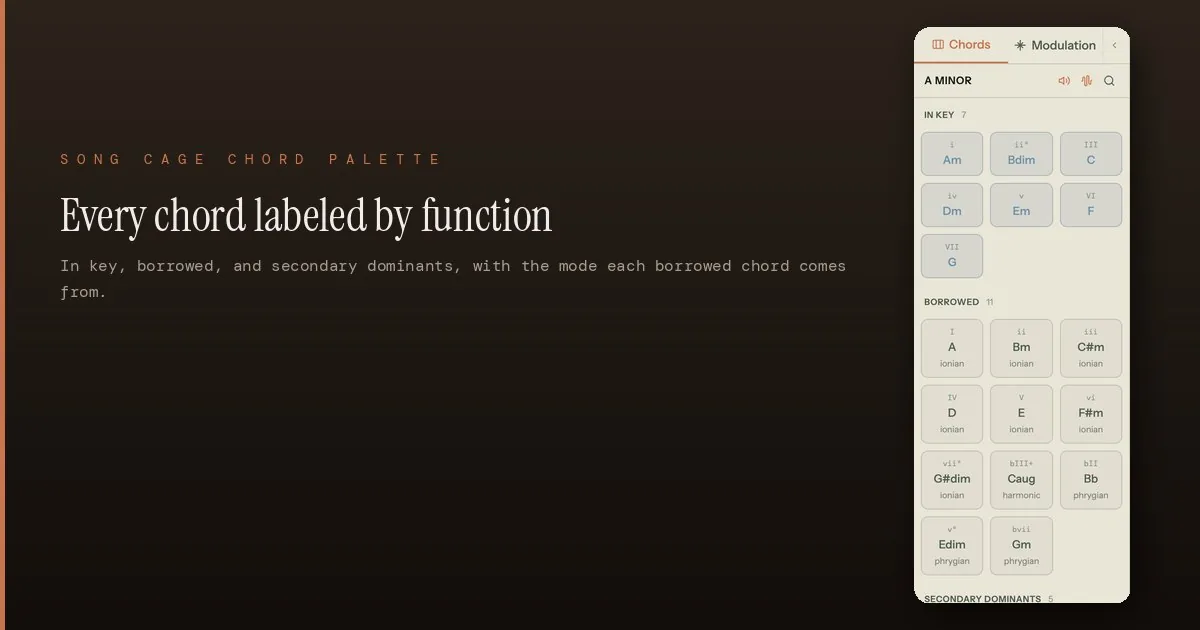
Song Cage's approach is harmonic function, voice leading, cadence, and modal interchange. Hover any chord and it explains the move: "classic ii-V-I cadence," "borrowed from Aeolian," "part of the I-V-vi-IV pop progression." The chord palette covers diatonic chords, borrowed chords labeled by source mode, and secondary dominants with resolution arrows. Change a melody note and the rankings reshuffle to fit it, so harmony responds to melody in real time.
Song Cage
- Suggestions from theory: harmonic function and voice leading
- Diatonic, borrowed (labeled by mode), and secondary dominants
- Every chord explained: "borrowed from Aeolian," "ii-V-I cadence"
- Melody-aware: rankings reshuffle when melody notes change
- Builds harmonic intuition over time, not just pattern-copying
Hookpad
- Database-scored from 70,000+ real-song analyses
- 1 to 100 popularity score per suggestion in context
- Magic Chord updates in real time as you build
- Tells you frequency, not harmonic reasoning
- No plain-English explanation of why a chord works
Verdict: Song Cage for understanding
For developing harmonic intuition, Song Cage's theory-labeled approach wins. Hookpad's popularity scores are useful for grounding choices in real music, but Song Cage's explanations teach the reasoning that makes you a better writer. For pure chord research, Hookpad has the edge, covered below.
Lyric and rhyme tools: which app actually helps you write words?
This is the biggest difference between the two, and the one that matters most day to day. Hookpad has a lyrics editor; Song Cage has a lyric-writing workspace with rhyme tools built in. In Hookpad you place words over a melody and count syllables. In Song Cage you click any word and five word tools open beside your lyrics, with no tab-switching and no leaving the song.
Hookpad's 2024 redesign improved its lyrics editor: you can type words above the chord and melody tracks, see a syllable count per line, group lyrics by section, and export a PDF lyric sheet. Those are useful structural features. But there is zero rhyme assistance. When you are stuck on a word, Hookpad has nothing for you, so you open RhymeZone in another tab, find a word, come back, and break your flow.
Song Cage's lyric workspace puts the writing help where you write. Click a word and you get:
- Perfect rhymes grouped by syllable count, so you never force a line to fit the wrong rhythm
- Slant rhymes for natural-sounding near-rhymes
- Synonyms for direct swaps that preserve meaning
- Explore, which follows word associations into thematically related territory
- Word Collider, a cut-up engine that throws unexpected pairings at writer's block
The lyric lane stays in sync with the chord timeline and melody. Sheet view is a free-form notepad; Timeline view places each word on a beat grid alongside chord blocks. Every word carries its own melody note, and the scissors tool splits a syllable so each piece gets its own pitch and beat. (Song Cage's word features hold up against dedicated rhyme generator tools while living inside the song.)
Song Cage
- Rhyme finder with perfect rhymes by syllable count
- Slant rhymes for natural near-rhymes
- Synonym finder for direct swaps
- Explore for thematic word-association chains
- Word Collider for writer's block
- Sheet view (notepad) plus Timeline (beat grid)
- Words, chords, and melody on one canvas
Hookpad
- Lyrics text field above chord and melody tracks
- Syllable count per line (2024 update)
- Section grouping and PDF lyric export (2024 update)
- No rhyme finder
- No slant-rhyme, synonym, or word-association tools
- Stuck on a word? Open RhymeZone in another tab
Verdict: Song Cage, and it isn't close
This is not a feature gap, it is a category gap. Hookpad has a lyric-placement tool. Song Cage has a lyric-writing app with rhyme tools. For any songwriter who develops lyric language while composing, this round is no contest.
Modulation: how do you change keys, and find your way back?
Modulation is one of the most powerful tools in a songwriter's kit, and Hookpad has no support for it at all. A key lift for the final chorus, a bridge that steps into new tonal space, a verse that drifts and needs to come home: Song Cage maps the route for all of these. Hookpad lets you change a section's key manually but offers no harmonic guidance for getting there smoothly.
Song Cage's modulation panel maps pivot-chord routes between any two keys. Pick a destination and it shows every chord shared between your current key and the target, each one a potential pivot, ranked by harmonic strength. Full cadential routes lay out the path: current key, pivot chord, dominant preparation, new tonic. It also surfaces return routes, the paths back to your original key, so a harmonic detour does not have to be a one-way door.
Song Cage
- Pivot chords between any two keys, ranked by strength
- Full routes: current, pivot, dominant, new tonic
- Return routes to find the path back home
- Chord Exits: see every key where a chord is diatonic
- Preview a route before placing it on the timeline
Hookpad
- No modulation panel
- No pivot-chord tool
- No key-transition guidance
- No return-route suggestions
- Manual key change per section, with no harmonic map
Verdict: Song Cage, no contest
Hookpad has nothing in this category. If modulation is part of your writing, and in any song with a memorable key change it is, Song Cage is the only option between these two.
Mobile and idea capture: which app is with you away from the desk?
Great ideas don't wait until you are at a desk, and only one of these tools is ready when one arrives. Hookpad is web-only and built for larger screens, with no mobile-optimized experience. Song Cage meets you on your phone with free native iOS and Android apps: pick a key, tap chords, and record a voice memo with the chord context attached, then pick it up on desktop with the harmonic foundation already in place. The web app runs in your phone's browser too if you'd rather not install.
Hookpad has nothing here. Every idea you capture between sessions lives in Voice Memos, a notes app, or some other tool that never connects to your Hookpad project. When you sit back down at the desktop, you are starting that fragment over.
Song Cage closes the loop without a separate app to learn. Capture in your phone's browser and your work syncs to the desktop workspace, so you don't return to a mystery waveform, you return to the chords you were hearing when the idea hit. Free native iOS and Android apps are live on the App Store and Google Play (Song Cage: Capture Song Ideas): capture a hummed melody, a lyric line, or a chord shape on your phone and sync it to the full editor on web or desktop. Prefer not to install? The web app runs in your phone's browser too.
Song Cage
- Free native iOS & Android capture apps (or the web app in your phone's browser, no install required)
- Voice-memo capture with chord context attached
- Ideas sync automatically to the desktop workspace
- Free native iPhone and Android capture apps, plus the web app in any phone browser
- Full editor on web and on the native Mac and Windows desktop app
Hookpad
- No mobile-optimized experience
- Designed for larger screens
- Ideas captured on a phone live in separate, disconnected apps
- No connected capture-to-desktop pipeline
Verdict: Song Cage
Hookpad has no mobile story. For any songwriter who captures ideas away from a desk, which is most of them, Hookpad forces a separate workflow. Song Cage gives you a connected phone-to-desktop pipeline today, with free native iOS and Android apps already on the App Store and Google Play.
TheoryTab: Hookpad's real-song database
To be fair, Hookpad's TheoryTab is its strongest feature, and Song Cage has no equivalent. TheoryTab is a searchable library of chord and melody data from 70,000+ popular songs, analyzed in Roman-numeral notation. From inside Hookpad you can search by chord progression or genre, find the harmony behind a specific song, and copy its chord track into your project, transposed to your key and tempo.
For songwriters who learn by studying real music, that is a powerful research tool, and it is the one round where Hookpad wins cleanly. Song Cage's suggestions come from music-theory principles, not a song database, so if your workflow starts with researching how specific hits are built, Hookpad gives you something Song Cage can't. If you are weighing the broader category, our roundup of chord progression tools covers where database-driven and theory-driven approaches each fit.
Verdict: Hookpad
TheoryTab is Hookpad's most distinctive feature and Song Cage has nothing comparable. For real-song chord research, Hookpad wins. For writing original songs with lyric tools alongside, Song Cage's three-round lead above matters far more day to day.
Melody: capture a tune first, or arrange and export?
For melody-first writing, Song Cage is the stronger tool, because you can sing or play a melody and it detects the notes for you. Song Cage runs melody detection in the browser (nothing uploaded) that turns a sung or played take into editable notes, snaps them to the detected key, and lets you drag them onto the timeline. From there, Auto Chords builds a progression that fits the melody, with a Held, Steady, or Active control for harmonic rhythm. Hookpad has no audio-to-melody detection at all.
Song Cage gives you several ways in: hold M and sing one note straight onto a syllable, or use the inline piano, Musical Typing on the QWERTY home row, a guitar-tab fret lane, and Follow Chord mode, where every note you enter snaps to a chord tone. Notes live on the timeline as melody-only blocks or attached to lyric syllables, and the chord palette reshuffles its rankings around whatever melody you put down. This is a genuine melody-first canvas, not an afterthought to the lyrics.
Where Hookpad pulls ahead is arrangement and output. Its dedicated melody track adds scale-degree notation and real-time highlighting of stable versus dissonant notes against the current chord, virtual-instrument bands that auto-arrange playback, MP3 and WAV plus stem export, sheet music and tabs, and the optional Aria AI add-on ($14.99/month) for generated ideas. Song Cage plays back through a built-in synth but does not render or export MP3 or WAV audio.
Verdict: a split, by what "melody-first" means
For capturing a melody and turning it into notes and chords, Song Cage is the stronger melody-first tool: its pitch detection and Auto Chords have no Hookpad equivalent. For arranging a melody with full instrumentation and exporting audio, Hookpad wins. Choose by whether you start from a tune in your head or finish with a produced sketch.
Pricing: how much does each cost?
Song Cage's free tier is the more generous of the two, and its paid option is a license. The free tier is what most songwriters judge a chord tool by, and Song Cage gives you the full chord palette, every word tool, the modulation panel, and audio recording before asking for a cent.
Song Cage free tier: the full chord palette (diatonic, borrowed, and secondary dominants), all five word tools (rhyme finder, slant rhymes, synonyms, Explore, Word Collider), the modulation panel, playback, and audio recording, with no credit card, limited to one song. A $79 license adds unlimited songs, PDF chord-sheet export, MIDI export, and up to five editors per song with collaborative editing, and covers the Mac and Windows desktop app and the AU/VST3 plugin; signing in once in the desktop app or plugin starts a 14-day trial of everything.
Hookpad free tier: a basic chord palette, limited melody entry, limited TheoryTab access, and 10 Aria AI uses per day. The features most people want, the full TheoryTab library, full melody tools, and MIDI drag-and-drop, require Standard at $7.99/month ($95.88/year) or $199 one-time lifetime. Aria AI is a separate $14.99/month add-on, and the interactive Hooktheory theory books are sold separately on top of that.
| Plan | Song Cage | Hookpad |
|---|---|---|
| Free tier | Full palette, all word tools, modulation, recording | Basic palette, limited melody and TheoryTab |
| Paid monthly | None | $7.99/mo (Standard) |
| Paid annual | None | $95.88/yr (Standard) |
| One-time | $79: full web app, desktop app (Mac and Windows) + AU/VST3 plugin | $199 lifetime (Standard) |
| AI add-on | None (no AI) | Aria AI +$14.99/mo |
Prices verified June 2026 from songcage.com and hooktheory.com.
Verdict: Song Cage on value
Song Cage's free tier already includes the lyric tools and modulation panel that Hookpad's paid plan still doesn't have. Hookpad's $199 lifetime is good value if you are certain it will stay in your workflow, but it still leaves the lyric, modulation, and mobile gaps unaddressed; Song Cage's $79 license for the full web app, the Mac and Windows desktop app, and the AU/VST3 plugin is less than half that price.
Full feature comparison
| Feature | Song Cage | Hookpad | Winner |
|---|---|---|---|
| Chord suggestions with explanations | Plain-English reasons | Popularity scores only | Song Cage |
| Borrowed chords labeled by mode | Source mode labeled | Shown, less explained | Song Cage |
| Lyric workspace with rhyme finder | Full word-tool suite | Basic text editor | Song Cage |
| Slant rhymes, synonyms, Explore | Five word modes | None | Song Cage |
| Modulation panel + pivot chords | Pivot + return routes | None | Song Cage |
| Works on your phone | Native iOS & Android apps + browser, syncs to desktop | Desktop only | Song Cage |
| Guitar fretboard voicings | All chords, positions + capo | Playback reference | Song Cage |
| Built-in voice recording | With chord context | No mic recording | Song Cage |
| Collaborative editing | Up to 5 editors (license) | No co-editing | Song Cage |
| Free tier depth | Full palette + all word tools | Limited features | Song Cage |
| TheoryTab real-song database | No equivalent | 70,000+ songs | Hookpad |
| Pitch detection (sing or play to notes) | In-browser, nothing uploaded. Sing a whole take, or hold M and sing one note onto a syllable | No audio-to-melody | Song Cage |
| Melody track: scale degrees + instruments | Melody lane, synth playback | Scale-degree highlighting + Aria AI | Hookpad |
| MP3 / WAV audio export | No | Full render + stems | Hookpad |
| Sheet music / tab export | No | Lead sheets, tabs, PDF | Hookpad |
| MIDI export | License | Standard tier | Tie (both paid) |
| Price | $79 | $95.88/yr or $199 lifetime | Song Cage |
Song Cage leads 12 of 17 rows; Hookpad leads 4, with one tie. For writers who build chords and lyrics together, the gap is wider than the count suggests.
Who should use Hookpad vs Song Cage?
The honest split: Song Cage is the better songwriting tool, and Hookpad is the better chord-research tool. Most songwriters live in the first group.
Write chords and lyrics in the same session; start from a melody you sing or play and let Song Cage detect the notes; want a rhyme finder without leaving the song; want chord suggestions explained, not just scored; want to modulate keys and find your way back home; capture ideas on your phone; use Android or Windows; want a full chord palette plus word tools for free; or co-write with others.
Compose chord and melody lines without lyric writing; want to research how 70,000+ real songs are built; need MP3 or WAV export of full sketches; want a dedicated melody track with scale-degree highlighting; want Aria AI generation (+$14.99/mo); need sheet music or tab export; or work only on desktop with no mobile capture needs.
Bottom line
If you write songs, chords and lyrics, with ideas that arrive on your phone and develop at your desk, Song Cage covers the full workflow. If you mostly analyze real songs and build chord-and-melody structures without lyric work, Hookpad's TheoryTab advantage is real. Most songwriters belong in the first category.
Everything Hookpad does for chords, plus lyrics and modulation
The chord depth you came for, plus the rhyme finder, modulation panel, and phone capture Hookpad doesn't have. Free to start, no credit card, and 14 days of everything in the desktop app or plugin.
Frequently asked questions
Is Song Cage better than Hookpad?
For most songwriters, yes. Song Cage covers comparable chord depth (diatonic chords, borrowed chords, secondary dominants) while adding three things Hookpad doesn't have: a lyric workspace with a rhyme finder and word tools, a modulation panel with pivot and return routes, and phone-based capture that syncs to desktop. Hookpad wins on chord research from real songs (its TheoryTab database of 70,000+ analyzed songs is unique) and on melody composition and audio export. For the complete writing workflow, Song Cage is the stronger tool.
What are the biggest weaknesses of Hookpad for songwriters?
Three gaps. First, no lyric tools: the 2024 lyrics editor adds syllable counting and section grouping but has no rhyme finder, slant rhymes, synonyms, or word-association tools, so you leave for RhymeZone every time. Second, no modulation panel: Hookpad has no pivot-chord tool and no key-transition guidance. Third, no mobile experience: Hookpad is web-only and built for larger screens, so ideas captured on a phone live in a disconnected app. Song Cage addresses all three.
Does Hookpad have a rhyme finder?
No. Hookpad's lyrics editor (redesigned in 2024) lets you type words above the chord and melody tracks, counts syllables, groups lyrics by section, and exports a PDF lyric sheet, but none of that helps you find rhymes. When you need a rhyming word you open RhymeZone or another tool in a separate tab. Song Cage has a rhyme finder built into the lyric workspace: click any word to see perfect rhymes by syllable count, slant rhymes, synonyms, and word-association chains, without leaving the song.
Does Hookpad have a mobile app?
No. Hookpad is web-only and built for larger screens, with no mobile-optimized experience. Any idea you capture on a phone, a melody hum into Voice Memos, a lyric line in a notes app, lives in a tool that never connects to your Hookpad project. Song Cage has free native iOS and Android apps today (Song Cage: Capture Song Ideas, on the App Store and Google Play): pick a key, tap chords, record a voice memo with chord context attached, and it syncs to the full editor on web and desktop. No account is needed to start, and it also runs in your phone's browser if you prefer.
What does Hookpad have that Song Cage doesn't?
Three real advantages. First, TheoryTab: a searchable library of 70,000+ real-song chord progressions you can copy straight into a project. Second, a melody track with relative notation, scale-degree highlighting, and Aria AI generation ($14.99/mo add-on). Third, audio export: MP3, WAV, and individual stems from the virtual-instrument arrangement. Song Cage has its own melody workflow (pitch detection from a sung take, a melody lane, and Auto Chords) but does not have TheoryTab, AI generation, or rendered MP3/WAV export. If real-song research, scale-degree melody arrangement, or audio-demo export are your priorities, Hookpad has meaningful advantages there.
How much does Song Cage cost vs Hookpad?
Song Cage's free tier includes the full chord palette, all five word tools, the modulation panel, and audio recording, with no credit card, limited to one song. A $79 license adds unlimited songs, export, and collaboration with up to five editors per song, and covers the Mac and Windows desktop app plus the AU/VST3 plugin. There are no add-ons and no AI upsell. Hookpad's free tier is limited; the features most people want require Standard at $7.99/month ($95.88/year) or $199 lifetime, with Aria AI a separate $14.99/month and the Hooktheory books sold separately. Song Cage's free tier already includes more songwriter-specific features.
Can Song Cage turn a melody I sing into chords?
Yes. Sing or play a melody and Song Cage detects the notes in the browser, with nothing uploaded, snaps them to the detected key, and lets you drag them onto the timeline. From there, Auto Chords builds a progression that fits the melody, with a Held, Steady, or Active control for harmonic rhythm, and the chord palette keeps ranking suggestions against your notes. Hookpad has no audio-to-melody detection: you enter melody notes by hand or generate them with the Aria AI add-on. For a melody-first workflow that starts from a tune in your head, Song Cage captures it end to end.
How does Song Cage's chord palette compare to Hookpad's?
Both cover the same categories: diatonic chords with Roman-numeral labels, borrowed chords from parallel modes, and secondary dominants. The difference is the explanation. Song Cage labels borrowed chords by source mode (Aeolian, Dorian, Mixolydian, Phrygian) and explains every suggestion in plain English: why it works here, how it voice-leads from the previous chord, what function it serves. Hookpad uses a 1-to-100 popularity score from its song database instead of theory reasoning. Both produce good progressions; Song Cage teaches harmonic understanding, Hookpad shows statistical frequency.
What is the best Hookpad alternative with lyric writing?
Song Cage. It is built to fill Hookpad's lyric gap while matching its chord depth: diatonic chords, borrowed chords labeled by source mode, secondary dominants, and context-aware suggestions comparable to Hookpad, plus a lyric workspace with a rhyme finder (syllable-grouped perfect rhymes), slant rhymes, synonyms, the Explore word-association tool, and Word Collider for writer's block. It also adds a modulation panel with pivot and return routes that Hookpad lacks. Free to start with no credit card, with the full chord palette and all word tools on the free tier.
Can Song Cage and Hookpad be used together?
Yes, and some songwriters do. One workflow: use Hookpad's TheoryTab to research chord progressions from real songs and sketch melody structure, export MIDI from Hookpad, then bring the ideas into Song Cage for lyric writing, rhyme tools, and modulation. The tools don't overlap much: Hookpad's real-song database and melody track are unique to it, and Song Cage's lyric workspace and modulation panel are unique to it. For most people who want one tool that covers the whole workflow, Song Cage is the more practical single choice.
Is Song Cage good for beginners learning chord progressions?
Yes. Song Cage teaches music theory through use rather than study. The chord palette shows which chords work in any key with Roman-numeral labels, and hovering any suggestion explains why in plain English ("classic I-V-vi-IV pop progression," "borrowed from Aeolian") without requiring you to already know the terms. You build harmonic intuition as you write instead of memorizing rules from a book. Hookpad's popularity scores are also useful for beginners, but they show frequency rather than reasoning, which limits how much theory you actually absorb.
What guitar features does Song Cage have compared to Hookpad?
Song Cage shows guitar voicings for every chord in the palette: multiple positions up the neck, open shapes, barre versions, and capo-adjusted voicings. Every diatonic, borrowed, and secondary-dominant chord has a playable diagram on screen, so you see which chord comes next (theory) and how to play it (instrument) at once. Hookpad added a guitar instrument in 2024 that shows chord shapes during playback, but it is primarily a playback reference rather than a guitarist's practice tool. For guitarists who write at the instrument, Song Cage's fretboard integration is more practical.
Can I capture song ideas on Android with Song Cage?
Yes. Song Cage has a free native Android app on Google Play (Song Cage: Capture Song Ideas, Android 6+) built for exactly this: capture voice memos, lyric drafts, and chord sketches on your phone and they sync to the full editor on web and desktop. It also runs in any modern browser, including Chrome on Android, if you'd rather not install. Hookpad has no Android option at all, as it is web-only and built for larger screens. For Android songwriters who want a chord tool with mobile capture, Song Cage is the only option in this comparison.
Is Hookpad's $199 lifetime worth it compared to Song Cage?
Hookpad's $199 lifetime license pays for itself in about two years versus $7.99/month, and it is good value if you are confident Hookpad will stay in your workflow. By comparison, the Song Cage desktop app for Mac and Windows plus the AU/VST3 plugin is a single $79 license, less than half Hookpad's lifetime price, and it works fully offline. A few caveats on the Hookpad side: Aria AI ($14.99/month) is not included and stays a monthly add-on, the Hooktheory books are sold separately, and the license still leaves the lyric tools, modulation panel, and mobile gaps that bring many users to Song Cage. Song Cage's $79 license includes the chord palette, all lyric tools, the modulation panel, and MIDI export with no add-ons. For pure chord research the lifetime deal is compelling; for complete songwriting, Song Cage offers more at a lower cost.
What makes Song Cage songwriting software with music theory built in?
Song Cage is built on the idea that theory should live in your song, not a textbook. Every chord is labeled by Roman-numeral function. Every suggestion explains itself in plain English, not just a score but a reason. Borrowed chords name their source mode, secondary dominants show where they resolve, and the modulation panel maps how to move between keys and back. The lyric workspace ties word choices to chord and melody context. You absorb the theory by writing rather than studying it. Hookpad's popularity-scored approach is powerful but passive: it shows what works without explaining why.