An AI music detector reads a finished audio file and estimates how likely it is that a generator such as Suno or Udio made it. On a file downloaded straight from a generator, the best ones are close to perfect. Change the file a little and they start guessing, and human songs get caught in the guessing.
AI music detection is everywhere now because the uploads are. Deezer said in July 2026 that it receives about 90,000 fully AI-generated tracks a day, more than half of its new uploads on peak days in June. Distributors screen releases, pitching services block submissions that score as AI, and a song that fails a check can lose its release date over a number nobody can explain.
What does an AI music detector check?
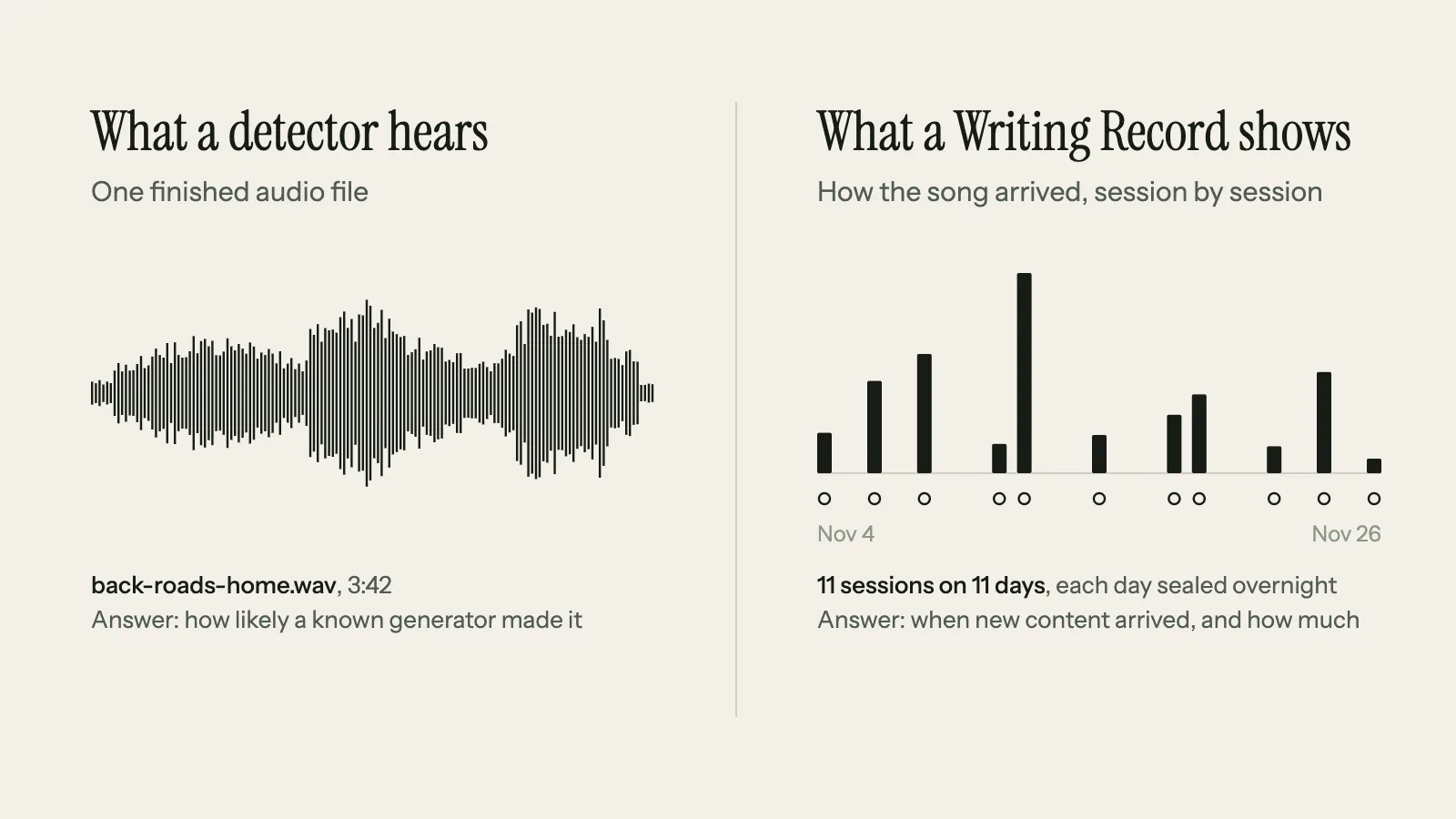
A detector checks the sound of the file, not the song. It turns the audio into a spectrogram, a picture of its frequencies over time, and looks for traces that a generator's audio decoder leaves behind. What comes back is a probability that the file came from a generator it knows.
Deezer describes its own tool this way: generative models leave "specific artifacts" in the audio they create, artifacts "usually inaudible to humans", and because they differ from model to model, the tool can often say which generator made a track.
SubmitHub's free AI Song Checker runs two models side by side. One reads the spectrogram for the textures generators tend to leave. The other follows how the melody, harmony and rhythm move over time. Since version 4.3 in September 2026 it also splits a suspect song into stems and checks the vocal and the instrumental separately, which helps it tell a "hybrid" track from pure AI.
What none of them look at is how the song came to exist. They hear the bounced file. The session, the notebook and the voice memo from the morning the chorus arrived never reach a detector.
How accurate are AI music detectors?
AI music detectors are very accurate on raw generator output, by their makers' own numbers. Deezer reports 99.8% accuracy and fewer than one false flag per 10,000 human tracks. A peer-reviewed independent test of a commercial detector, published in 2025, found it flagged 4.7% of human songs as AI, and that simple file changes fooled it.
Deezer's figures come from its own detection FAQ: it may miss about two AI tracks in every 1,000 and wrongly flag fewer than one human track in every 10,000. Deezer applies its visible tag at album level "to reduce the risk of incorrect classifications", and it says the system "focuses on fully AI-generated music and does not typically tag AI-assisted tracks."
SubmitHub tested its version 4.0 on songs its models had never seen and got 499 of 500 human songs right; the one miss was an ASMR track that scored about 55% AI. Its own summary of where that number holds: "It's pretty much 100% accurate when looking at a song downloaded directly from one of the AI platforms. But as soon as you start fiddling with stems, production, and more, it gets a lot muddier."
The independent test is the TISMIR study by Laura Cros Vila, Bob L. T. Sturm, Luca Casini and David Dalmazzo. On a sample of 150 human songs from the Million Song Dataset, the commercial IRCAM Amplify detector labelled 4.7% as AI-generated, a rate the authors note "could result in millions of errors when scaled to music catalogs exceeding 22 million items." It caught every Suno and Udio track in the sample, then caught only 3 of 50 songs from Boomy, a generator that, as far as the authors knew, it had not been trained on. IRCAM now claims under 0.02% false positives, and its current detector checks for Boomy only when a customer switches it on: since October 2026 it leaves older generators out by default because they "contribute disproportionately to false-positive detections," as its release notes put it (via the AI Detector Index).
| Check | What it reads | What it says about accuracy | What it misses |
|---|---|---|---|
| Deezer AI detection | Generator artifacts in the audio | 99.8% accuracy, under 1 in 10,000 human tracks flagged (Deezer's figures) | AI-assisted tracks; it tags fully generated music |
| SubmitHub AI Song Checker | The spectrogram, how the music moves, and separated stems | 499 of 500 human songs right in its own hold-out test | AI that has been mastered, re-sung or blended with human parts (its own list) |
| IRCAM Amplify | The audio | Claimed 98.5% on human music in 2025 (now claims under 0.02% false positives); flagged 4.7% of human songs in the TISMIR test | Generators it hadn't been trained on (3 of 50 Boomy songs caught in the test); older generators such as Boomy are now off by default |
| Suno's credential check | A C2PA content credential Suno attaches at download | Not a detector: it reads a label | Older Suno downloads, stripped files, every other generator |
| ElevenLabs provenance check | A watermark inside the audio samples | Not a detector: it reads a watermark | Other generators; details can be lost on short or heavily changed audio |
The first three guess from the sound. The last two only read a mark one company put there.
Why do small changes fool them?
Deezer's own researchers asked this before the company shipped its tool. In a 2024 paper, Darius Afchar, Gabriel Meseguer-Brocal and Romain Hennequin trained a detector that scored 99.8% on its test set, then applied edits anyone might make: a pitch shift of up to two semitones, time stretching, EQ, reverb, added noise, and re-encoding to 64 kbps MP3, AAC or Opus. Accuracy on the fake tracks dropped drastically under pitch shifts, added noise and re-encoding, and a detector trained on one family of audio decoders failed almost completely on the others. The authors wrote that "a good test score is not the end of the story" and called the paper "a caveat to a flourishing market of fake content checkers."
The TISMIR team found a stranger weakness. When they resampled a handful of test files to 22.05 kHz, IRCAM Amplify misread all five Suno samples, three of the five Udio samples and two of the five human ones. Their conclusion about the detectors they built is, I think, the most useful sentence written about these tools: what such a detector shows is "whether a given audio file has characteristics consistent with the production pipeline of Suno, Udio, or something else," not that it is reliably detecting AI music.
Can a human-made song be flagged as AI?
Yes. Human-made songs by working musicians have been flagged as AI this year. Tracks built on synths, drum machines, tight sequencing and processed vocals are especially likely to be misread, Digital Music News reported. The artist then has to prove a negative, usually through a distributor's support queue.
In April 2026 the distributor TuneCore flagged unreleased songs by the metalcore band Zao as generative AI. The band posted footage of its DAW session and wrote: "There isn't even technically a click track or drum samples on this. If we were using AI it did its job poorly." TuneCore reversed the flag after the post spread, and the band said the release was back on track for June 26.
The Hamburg musician André Grafert, who records as Coloured Tears, released a handmade double album of 23 covers of the 1980s band Twice a Man in June 2026 and was publicly accused of using AI. As Digital Music News reported, Ines Weidemann of International Artist Marketing ran all 23 tracks through SubmitHub, and every one was rated as potentially AI. She then tested Twice a Man's original recordings, made about four decades earlier. SubmitHub rated seven of them "possible AI/hybrid," and named a specific AI platform for two.
If a streaming tag is the problem, Deezer's creator support page says to start with your distributor, and to open a ticket with Deezer if the distributor hasn't answered within 5 business days.
Can a watermark prove a song is AI, or human?
A watermark or content credential can show that one company's generator made a file. A missing one shows almost nothing, because only some generators add them, older files never had them, and metadata disappears when a file is converted or shared.
Suno now attaches C2PA content credentials, an open provenance standard, to songs downloaded from it, and offers a public checker. Suno is clear about its limits: the check works only on songs downloaded after the credentials were introduced, and it is "not a general purpose AI detector." ElevenLabs embeds an inaudible watermark in its generated audio and offers a provenance check that can name the model and generation date, though the details "might not be possible" to recover from short or heavily changed audio.
OpenAI's provenance documentation states the general rule plainly. Editing, converting or sharing a file "can remove its metadata," and a negative result "doesn't rule that out," since its tool doesn't detect content made by another company's model. A clean result means no label was found. It does not mean a person made the song.
What can't an AI music detector tell you?
An AI music detector can't tell you who wrote the song, or how. It judges a recording. A melody, a chord progression and a lyric leave no acoustic fingerprint of their own, so a machine-written verse sung by a person over their own guitar passes every check, and a song written by hand over three months can still fail one.
The music industry's own labels stop at the same line. The voluntary track labels that IFPI, the RIAA and others announced on July 10, 2026 sort recordings into "AI-Generated" and "AI-Assisted," and the announcement says the system "does not cover the use of generative AI in lyrics, composition, music videos or cover art at this point."
That is the gap I wrote about in the AI music labels stop at the recording. For a listener, the most useful evidence is still outside the audio: an artist's footprint, live shows, interviews. The listening guide to telling whether a song is AI covers those signs. For the person who wrote the song, the evidence is how it was written.
What counts as evidence of how a song was made?
The strongest evidence is material made while the song was being written, with its dates attached: session files, raw takes, dated drafts and voice memos. Music buyers increasingly ask for it, and a "human-made" certificate is only as strong as the evidence behind it. A statement written afterwards carries the least weight.
The people paying for music want that evidence. In a survey of 144 music supervisors, filmmakers, advertisers and editors by Cyanite, MediaTracks and Marmoset, published in December 2025, 97% said they want to know whether a track is AI-generated or human-made, and 49% said they will only license human-made music. One film editor put it this way: "Clients are increasingly asking us to prove music is human-made."
A handful of services now sell or give away "human-made" certificates. The certifier Proudly Human asks for evidence in three parts (song conception, recording and performance, mixing and mastering) and tells applicants: "The 40 second voice memo from the day the idea landed says more than a polished bounce." VERIMUSIC's October 2026 review of five other such services (Proudly Human was not among them) found that none publishes an audited method, and that no streaming platform or distributor recognises their certificates as grounds to reverse a decision.
When Zao made its case, the evidence it showed was the session itself: tracks, takes, mistakes left in. Evidence made while you write, and dated by someone other than you, carries more weight than a declaration made after the fact.
How Song Cage keeps a record of how a song was written
Song Cage keeps a Writing Record for each song in your account: every writing session with its date and how much new lyric, melody, chord and take content arrived, sealed each night by two independent timestamping authorities. It shows when and how much, not who typed it, so it can't prove a song is free of AI.
I build Song Cage, a songwriting app with no generative AI in it, so I'll be direct about why this section is here. Since November 27, 2026, Song Cage keeps a Writing Record for every song saved to your Song Cage account. Open a song in the desktop app or the web app and choose File > Writing Record…
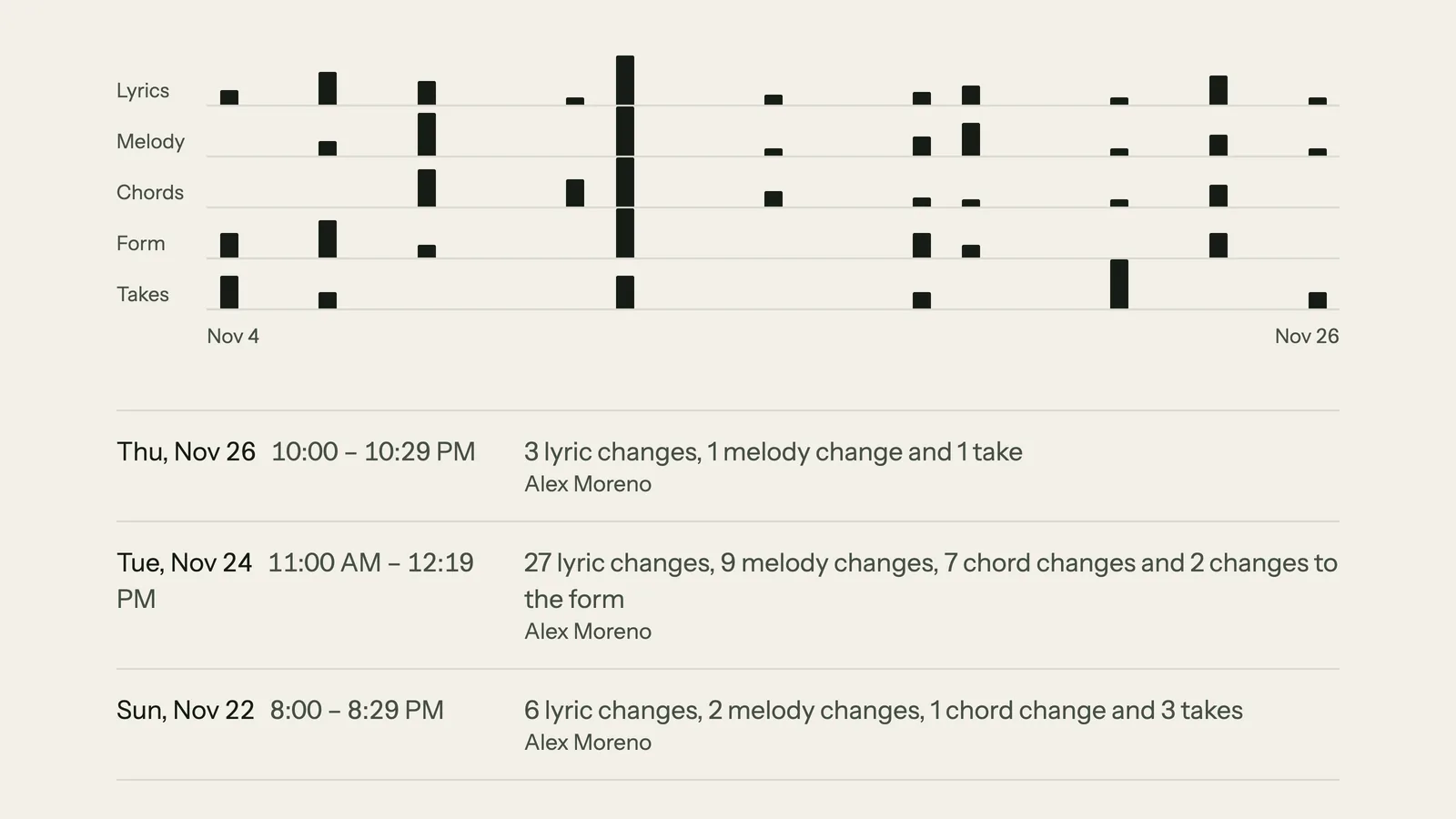
A made-up sample song, to show the layout: the calendar strip, and the three latest of its eleven sessions.
What does the Writing Record show?
The top of the record is a calendar strip, one slot per day, with a row for each part of the song that changed: Lyrics, Melody, Chords, Form and Takes. Under it, every writing session is listed with its date, its time and what arrived, in words: "12 lyric changes, 3 chord changes and 1 take." The counts are of new content only. Saving or syncing the same song again, undoing, or switching back to an earlier version of a section adds nothing.
Each night, that day's record is sealed and signed by two independent time-stamping authorities, using the RFC 3161 standard. If anyone changed a past day afterward, including me, its seal would no longer match the signed timestamp. The song's owner can make a link to a public page that shows the record, the song's title and the writer's name, and turn it off at any time. Anyone with the link can check every seal in their own browser and download the proof.
Songs that already existed when the record began say so at the top: "Song Cage began keeping this record on" the date it started, followed by what the song already had.
What can't the Writing Record prove?
What it leaves out matters as much. The record never contains the lyrics, the chords or the audio, only when and how much. It doesn't show who was at the keyboard or where the content came from: lines you paste or import count the same as lines you type. So it can't prove a song is free of AI, and I'd distrust anything that claimed it could. What it can do is answer the question a publisher, a library, a contest or a certifier actually asks, which is how and when this song was written, with dates nobody can quietly edit.
Write the song, and keep the record of writing it
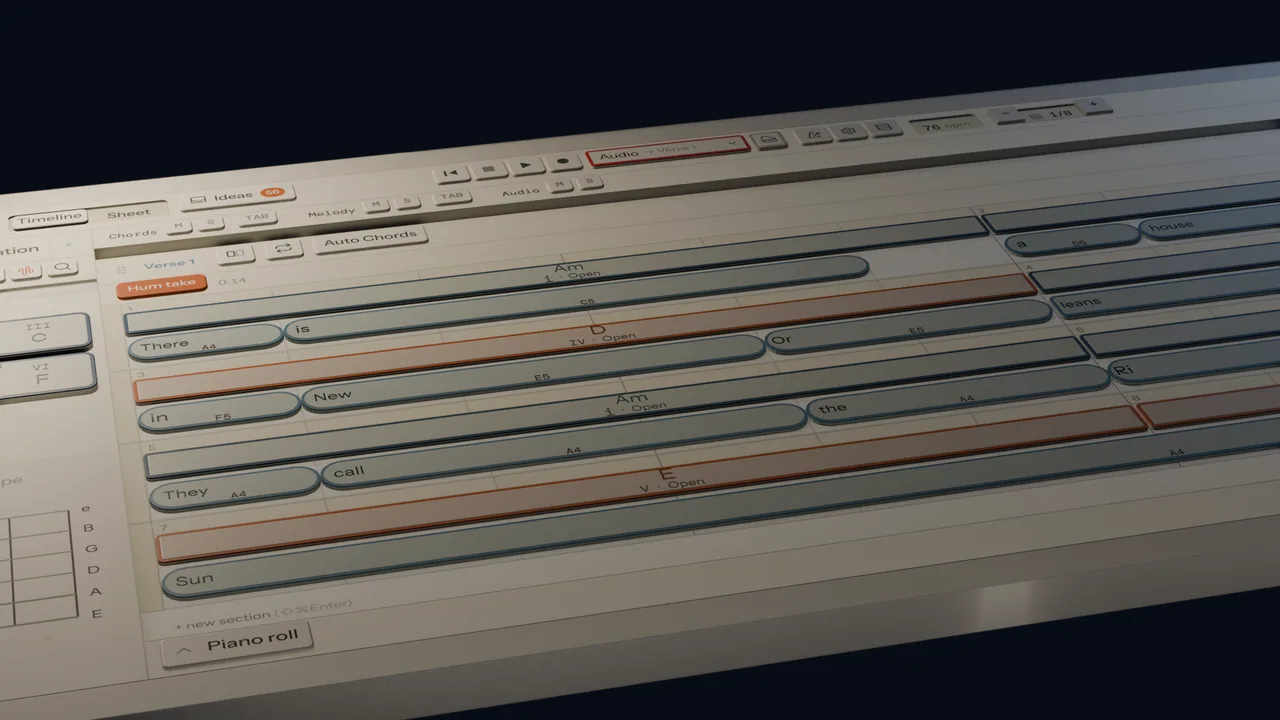
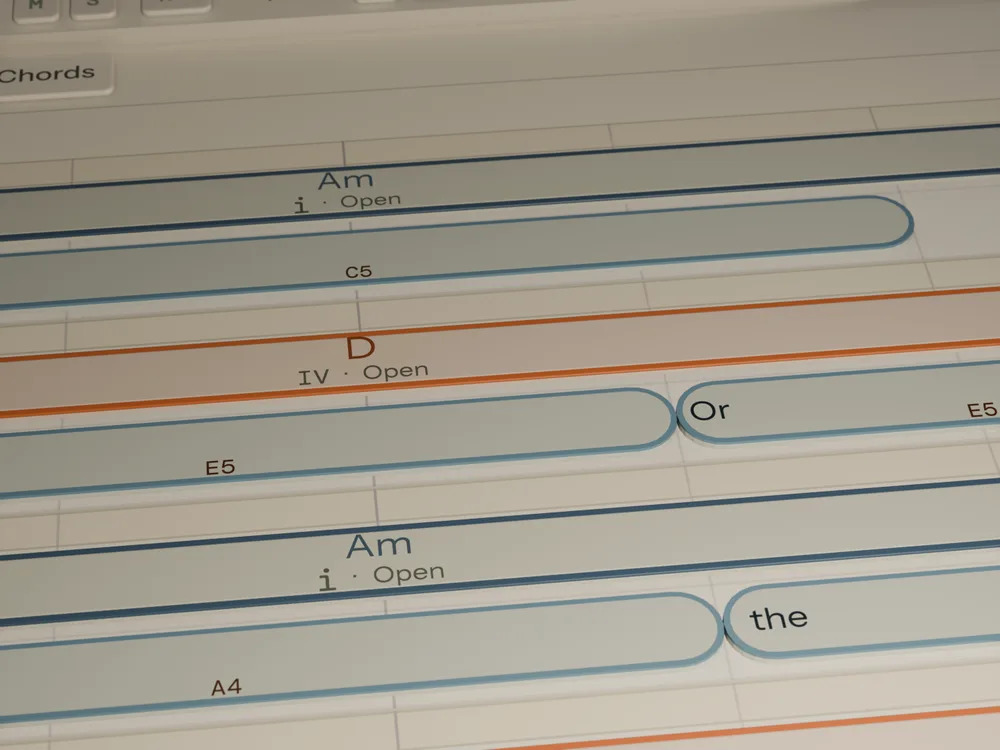
Song Cage puts your lyrics, melody and chords on one timeline, ranks chords against the melody you sang, and keeps a dated Writing Record of every song. Nothing in it writes the song for you.
Frequently Asked Questions
How accurate are AI music detectors?
On files downloaded straight from a generator, close to perfect: Deezer reports 99.8% accuracy and fewer than one false flag per 10,000 human tracks, and SubmitHub got 499 of 500 human songs right in its own hold-out test. Independent testing is less kind. A 2025 peer-reviewed study found the commercial IRCAM Amplify detector flagged 4.7% of human songs as AI, and that resampling a file could flip its answer.
Can AI music detectors detect Suno and Udio?
Yes, when the file is unaltered. Deezer and SubmitHub both train on Suno and Udio output and catch raw downloads reliably. Accuracy drops when a track has been mastered, pitch-shifted, re-encoded or blended with human parts, and detectors miss generators they were not trained on: in one independent test, a detector caught 3 of 50 songs from Boomy.
Is there a free AI song checker?
SubmitHub's AI Song Checker is free: guests get 2 runs, and a free account gets 10 a day. It accepts a Spotify, YouTube, SoundCloud or Disco link, or an MP3, WAV or FLAC file of at least 30 seconds, and SubmitHub says accuracy improves past 90 seconds. Deezer's AI music detector, launched June 11, 2026, is also free: connect an account on one of 20 streaming services, including Spotify, Apple Music and YouTube Music, and it scans up to 100 of your playlists for AI-generated tracks. Suno offers a free check for its own content credentials, which only identifies songs downloaded from Suno.
How do I check if a song is AI?
Run the track through a detector such as SubmitHub's AI Song Checker, or scan your playlists with Deezer's free AI music detector, and treat the score as a reason to look further rather than a verdict: detectors are reliable on raw generator output and weaker on edited or partly human tracks. Then look outside the audio, at the artist's live shows, interviews and history, which the guide to telling if a song is AI covers.
Can a detector tell if the lyrics or melody were written by AI?
No. Detectors analyse the recording, and a composition leaves no acoustic fingerprint. A machine-written lyric sung by a person sounds like a person singing. The voluntary AI labels announced by IFPI, the RIAA and others in July 2026 say they do not cover "the use of generative AI in lyrics, composition, music videos or cover art at this point."
What should I do if my song is wrongly flagged as AI?
Find out who flagged it, because each company has its own appeal. For a Deezer tag, Deezer says to contact your distributor first and to open a ticket with Deezer if there is no answer within 5 business days. Send evidence of the making: the DAW project, raw stems and takes, dated demos and drafts. When TuneCore flagged the band Zao in April 2026, the band posted footage of the session publicly, and TuneCore cleared the release soon after.
Does a "human-made" certificate prove a song isn't AI?
Not on its own. A review of five such services by VERIMUSIC in October 2026 found that none publishes an audited method and that no streaming platform or distributor recognises their certificates as grounds to reverse a decision. They are most useful when built on evidence of how the song was made, such as dated drafts, voice memos and session files.