Table of Contents
- Standard Tuning and Fretboard Logic
- Guitar-Friendly Keys and Their Diatonic Chords
- Why do these keys feel natural on guitar?
- What does each chord function do emotionally?
- The Relative Minor Relationship
- Roman Numerals and the Nashville Number System
- What are the most common progressions in number notation?
- The CAGED System
- How does CAGED apply to songwriting?
- The Circle of Fifths for Guitarists
- How do you use the circle for song structure?
- Power Chords
- When should you reach for power chords?
- Borrowed Chords for Emotional Color
- The Pentatonic Scale for Melody Writing
- How do you use the pentatonic for melody in your songs?
- Capo Use for Songwriting
- What are common capo songwriting techniques?
- Putting It All Together: A Guitar Songwriting Workflow
- Frequently Asked Questions
Most music theory was written for classically trained musicians who read notation. Guitarists — particularly those who learned by ear, by watching YouTube videos, by listening to records — tend to learn theory backwards: first the sounds, then the names for the sounds. That is not a deficit. It is a different pathway to the same knowledge, and in many ways a more durable one.
This guide covers the music theory that guitarists who write songs actually need, organized around the guitar's physical logic rather than the piano's. You do not need to read standard notation. You do not need to know what a quaver is. You need to understand why certain chords work together, how the fretboard is organized, how to move ideas between keys, and how to add harmonic color. For deeper reading on the patterns themselves, see our companion guide to the 10 most useful chord progressions for songwriters.
What this guide covers
Standard tuning and fretboard logic · Guitar-friendly keys and their diatonic chords · The relative minor relationship · The CAGED system for fretboard navigation · The Nashville Number System · The circle of fifths · Power chords and borrowed chords · The minor pentatonic scale for melody · Capo use for transposition and songwriting · How to put it all together.
Standard Tuning and Fretboard Logic
Standard guitar tuning is E A D G B E from lowest to highest, with the lowest and highest strings two octaves apart. The interval between adjacent strings is a perfect fourth (5 semitones), except between the G (3rd) and B (2nd) strings, which sit a major third apart (4 semitones). This single irregular interval is the source of most confusion when guitarists try to apply piano-based theory to the fretboard.
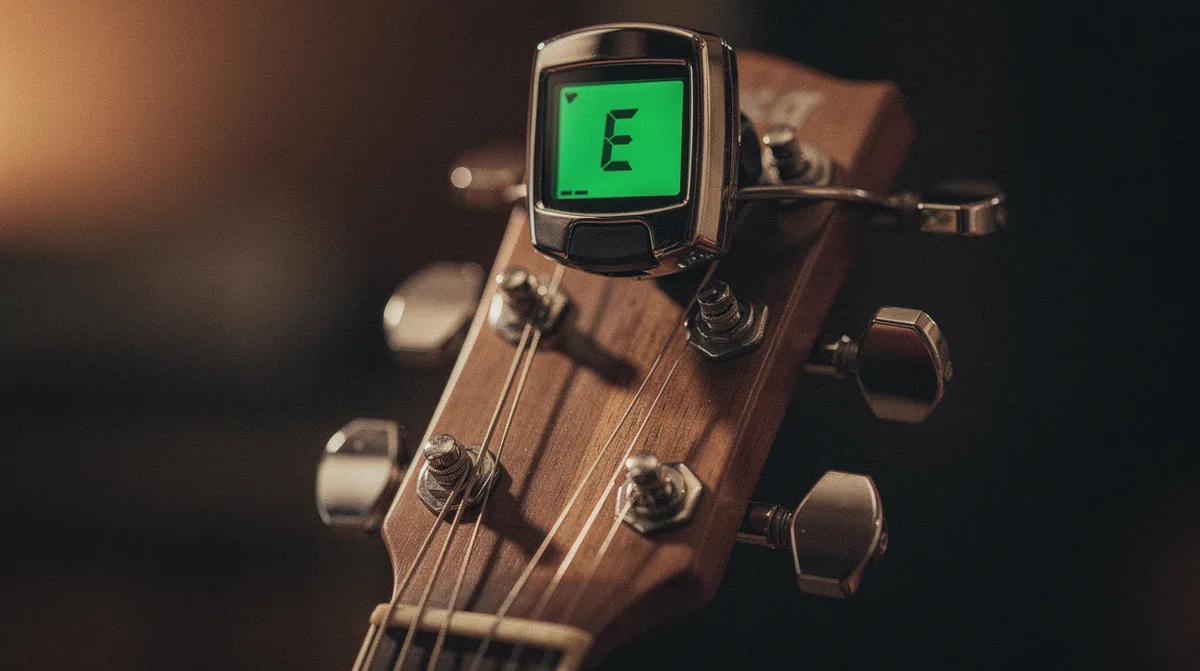
Frequencies in standard tuning: E2 (82.41 Hz), A2 (110 Hz), D3 (146.83 Hz), G3 (196 Hz), B3 (246.94 Hz), E4 (329.63 Hz). Every fret raises pitch by one semitone (one half step). Move five frets up any string and you have risen a perfect fourth, the same note as the open string above (except across the G–B transition, where you only need four frets). This relationship is how guitarists tune by ear without an external reference pitch.
Why this matters for songwriting
Because of the all-fourths-except-one structure of standard tuning, chord shapes that work in one part of the neck mostly work everywhere else, with minor adjustments for the G–B string gap. This is the physical basis of the CAGED system covered later, and the reason barre chords are possible. A shape that works on the low strings can be moved up the neck while keeping the same harmonic relationships intact.
Guitar-Friendly Keys and Their Diatonic Chords
The five most guitar-friendly keys are G, D, A, E, and C major. In any major key there are seven diatonic chords built from the scale, and the pattern is always I major, ii minor, iii minor, IV major, V major, vi minor, vii° diminished. The I, IV, V, and vi chords carry most of the harmonic weight in popular songwriting. Guitar-friendly keys are friendly precisely because those four chords fall in open positions where the strings ring naturally.
| Key | I (home) | IV (lift) | V (tension) | vi (depth) | Full diatonic set |
|---|---|---|---|---|---|
| G major | G | C | D | Em | G · Am · Bm · C · D · Em · F#° |
| D major | D | G | A | Bm | D · Em · F#m · G · A · Bm · C#° |
| A major | A | D | E | F#m | A · Bm · C#m · D · E · F#m · G#° |
| E major | E | A | B | C#m | E · F#m · G#m · A · B · C#m · D#° |
| C major | C | F | G | Am | C · Dm · Em · F · G · Am · B° |

Why do these keys feel natural on guitar?
G major gives you G, C, D, and Em as open chords, all four of your most-used diatonic chords in open position with no barre chord required to access the full harmonic palette. D major gives you D, G, and A as open chords (Bm needs a barre at the 2nd fret). A major gives you A, D, and E open. E major gives you E and A open (B is typically a barre). C major gives you C and G open. Among these, G is the most guitar-natural key. Many songwriters default to it instinctively and discover later that most of their songs gravitate there for structural reasons, not habit.
What does each chord function do emotionally?
The most important thing to learn is not the specific chord names but the functions. What each chord position does to a listener's ear stays consistent across every key:
The chord that sounds resolved and stable. Everything else in the key is heard in relation to I. Starting and ending a section on I gives a sense of arrival.
Moves away from home gently. Less tense than the V. The I–IV–V progression underlies most blues and rock songwriting.
Creates the strongest pull back to I. The V–I move is the most common resolution in tonal music. A V7 chord amplifies this tension further.
The emotional anchor of most pop music. Adds melancholy and depth inside a major-key song. Forms the basis of the I–V–vi–IV progression.
Once you understand that the function (I, IV, V, vi) stays the same across keys and only the chord names change, you can write a song in any guitar-friendly key by finding the four chords that fill those roles.
The Relative Minor Relationship
Every major key has a relative minor: a minor key that shares all the same chords. The relative minor is always built on the sixth degree of the major scale. E minor is the relative minor of G major; A minor is the relative minor of C major; B minor is the relative minor of D major. They share all seven diatonic chords. Only the tonal center, the chord that sounds like home, changes.
| Major Key | Relative Minor | Shared Chords |
|---|---|---|
| G major | E minor | G · Am · Bm · C · D · Em · F#° |
| D major | B minor | D · Em · F#m · G · A · Bm · C#° |
| A major | F# minor | A · Bm · C#m · D · E · F#m · G#° |
| E major | C# minor | E · F#m · G#m · A · B · C#m · D#° |
| C major | A minor | C · Dm · Em · F · G · Am · B° |
The practical meaning: you can write a song using the same four guitar shapes that work in G major, and depending on which chord you treat as home (G or Em), the song feels major-key bright or minor-key melancholic. Em–C–G–D and G–D–Em–C use the same four chords. One starts on the minor; one starts on the major. This is why so many songs feel ambiguous about whether they sit in a major or minor key: they draw on the shared palette of a major/minor pair.
Identifying relative minors instantly on guitar
Find the root of your major key on the low E string and count back three frets (three semitones) toward the nut. That fret gives you the root of the relative minor. In G major (G is at the 3rd fret of the low E), counting back three frets lands on the open E string — E minor. In A major (A is at the 5th fret), counting back three lands on the 2nd fret — F# minor. The 3-fret relationship works anywhere on the neck.
Roman Numerals and the Nashville Number System
The most important music theory concept for any songwriter is thinking in chord functions rather than chord names. Roman numeral notation (I, ii, iii, IV, V, vi, vii°) labels every chord by its function: uppercase for major, lowercase for minor. The Nashville Number System replaces Roman numerals with Arabic numbers (1, 4, 5, 6m) and was designed by Neal Matthews Jr. of the Jordanaires in the late 1950s — and further developed by Charlie McCoy — so session musicians could transpose songs instantly for different vocalists.
The number 1 is always the tonic (home), 4 is always the subdominant, 5 is always the dominant, 6m is always the relative minor, regardless of which key the song is actually in. Roman numerals and Nashville numbers are functionally identical for most songwriting purposes. The practical value: write a song as "1–5–6m–4" and you can play it in any key. In G major that is G–D–Em–C. In A major it is A–E–F#m–D. In D major it is D–A–Bm–G. Same four chords, same emotional arc, three different sounds on the guitar — all from a capo position change or a hand position shift.
What are the most common progressions in number notation?
The most common in pop. G–D–Em–C in G. The Axis progression. "With or Without You," "Someone Like You," and hundreds more.
Blues and rock foundation. G–C–D in G. "La Bamba," "Twist and Shout." Three chords, maximum simplicity.
Relative minor opening. Em–C–G–D in G. Darker and more introspective than 1–5–6m–4.
The 50s progression. G–Em–C–D in G. "Stand By Me," "Heart and Soul," smooth and rolling.
Jazz cadence. Am–D–G in G. The strongest resolution in tonal music. The basis of most jazz standards.
Classic rock. G–F–C in G. Borrowed flat-seven from Mixolydian. The "Sweet Home Alabama" sound.
The CAGED System
The CAGED system is the most practical framework for understanding the guitar fretboard. It is named for the five open chord shapes every guitarist learns first: C, A, G, E, and D. Each of these shapes can be moved up the neck as a barre chord, creating five overlapping positions that together cover the entire fretboard. Understanding CAGED means you can play any chord anywhere on the neck, not just in one open position.

Each shape contains the same three chord tones (root, major third, perfect fifth) regardless of where on the neck it appears. Each CAGED shape also comes with a corresponding scale pattern — the major scale notes that surround the chord at that position — and an arpeggio pattern outlining the chord tones alone. This is what makes CAGED valuable for melody writing: once you know which CAGED shape your chord is built from, you immediately know which notes are available for melody nearby on the neck.
How does CAGED apply to songwriting?
When you play a chord progression in open position (G–D–Em–C in G major), you are using the open G shape for G, the open D shape for D, the open E shape for Em, and the open C shape for C. All four shapes are part of the CAGED system. You are already using it without naming it.
For rhythm-guitar variety, the same progression can be played higher up the neck using different CAGED shapes — an E-shape barre at the 3rd fret for G, an A-shape barre at the 5th fret for D. Different voicing, same chord function, different tonal character.
For lead guitar and melody writing over a progression, the scale pattern attached to each CAGED shape tells you exactly which notes to use at that position. The five minor pentatonic positions correspond directly to the five CAGED shapes, which is why pentatonic licks travel cleanly between chord positions. The Song Cage chord palette shows multiple voicings for every chord across the neck so you can switch between CAGED positions while you write.
The Circle of Fifths for Guitarists
The circle of fifths is a visual map of how the 12 musical keys relate to each other. Moving clockwise, each key is a perfect fifth (7 semitones, or 7 frets) higher than the previous: C → G → D → A → E → B → F#. Moving counter-clockwise, each key is a perfect fourth higher. Keys adjacent on the circle share the most chords in common, which is why modulating to a neighboring key sounds smooth.
Guitar-friendly keys on the circle
The five most guitar-friendly keys (G, D, A, E, and C) cluster together on the right-hand side of the circle. G and D are adjacent and share five chords. D and A are adjacent and share five chords. A and E are adjacent. This is why moving between these keys feels natural on guitar — you barely change what your hands are doing. A capo shift or one new barre chord position and you are in a neighboring key.
How do you use the circle for song structure?
The most practical use of the circle for guitarists is pivot chord modulation — moving from one key to another using a chord that exists diatonically in both. Adjacent keys share five of seven chords, making pivot modulation seamless. From G major to D major, the shared chords include G (I in G, IV in D), D (V in G, I in D), A (II in G, V in D), Em (vi in G, ii in D), and Bm (iii in G, vi in D). Any of these can serve as a pivot.
The chord D itself, V in G and I in D, is the most direct pivot. You land on a D chord, let it sit, and the listener's ear reorients to hear it as a tonic rather than a dominant. That is all modulation is. Song Cage's modulation panel finds every pivot chord between any two keys and shows the routes ranked by smoothness.
Power Chords
A power chord is a two-note chord made of a root and a perfect fifth — nothing else. In notation it is written with a "5" suffix: G5, A5, E5. Because it contains no third, a power chord is tonally neutral: neither major nor minor. It can sit inside a progression without committing to either emotional color. This is not a simplification. It is a deliberate harmonic choice.

The shape is always index finger on the root, ring finger two frets higher on the adjacent string. Move the shape up or down the neck to play any root. Move it from the low E string to the A string to access different roots in the same hand position. Power chords appeared in rock recordings as early as the 1950s — Willie Johnson's playing on Howlin' Wolf's "How Many More Years" (1951) and Pat Hare on James Cotton's "Cotton Crop Blues" (1954) — were popularized by Link Wray's 1958 instrumental "Rumble" and the Kinks' 1964 "You Really Got Me," and became central to heavy rock and early metal in the 1970s through Deep Purple, Led Zeppelin, and Black Sabbath. By the 1980s they were the backbone of heavy metal; by the 1990s they defined punk and grunge.
When should you reach for power chords?
Because they carry no major/minor quality, power chords let you write a riff or progression where the mood is ambiguous — the melody or vocal line determines the emotional character rather than the chords.
Power chords also work particularly well with distortion, where the extra harmonics of a full major or minor chord create unpleasant intermodulation. The root-fifth structure stays clean through heavy gain. A common songwriting technique: write the verse with full open chords (harmonically transparent), the chorus with power chords and distortion (driving and aggressive), then the bridge with arpeggiated open chords (reflective). The power chords create maximum contrast with the surrounding sections.
Borrowed Chords for Emotional Color
Borrowed chords are taken from the parallel minor key and used inside a major-key song. A parallel minor shares the same root note but uses a different scale: G major and G minor are parallel keys (both start on G, neither shares the same chords). Borrowing chords from the parallel minor inside a major-key song creates emotional depth that purely diatonic chords cannot produce.
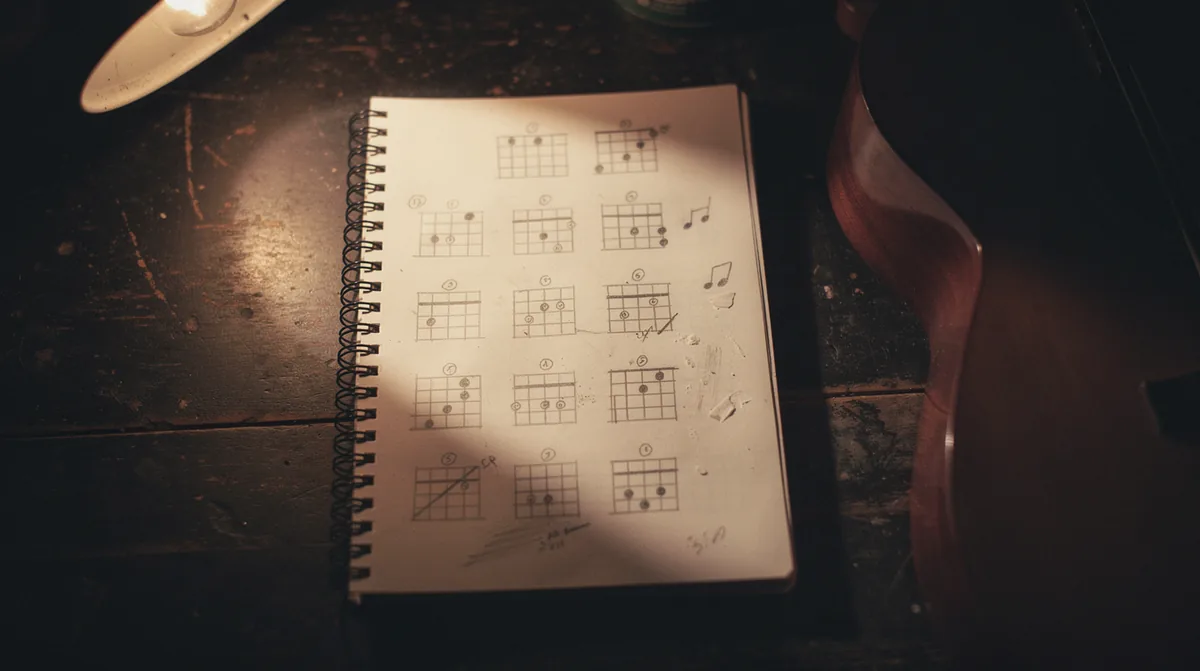
The three most useful borrowed chords for guitarists, ordered by how easy they are to reach in guitar-friendly keys:
In G major: F major. The most guitar-friendly borrowed chord. F major sits at a first-fret barre, a shape guitarists use constantly. Adds rock energy and an anthemic quality. The I–♭VII–IV progression (G–F–C in G) is the sound of classic rock; "Sweet Home Alabama" is D Mixolydian — D–C–G — the same harmonic pattern.
In G major: E♭ major. Borrowed from the parallel minor's sixth scale degree. Adds cinematic weight and emotional grandeur. Requires a barre chord in most guitar-friendly keys, but the emotional payoff is significant. Often appears as IV–♭VI–I, a dramatic resolution pattern.
In G major: Cm. The diatonic IV chord made minor. Adds profound melancholy to a major-key song. The move from a major IV to a minor iv (C to Cm in G major) is one of the most emotionally powerful single-chord changes in popular music. Requires a barre chord, but the effect is immediate.
A practical note on borrowed chords and guitar keys
In guitar-friendly keys, the ♭VII is often the most accessible borrowed chord because it sits in a position your hand already knows. In G major, F major is a first-fret barre. In D major, C major is a natural open chord. In A major, G major is fully open. The ♭VII in guitar-friendly keys almost always lands in a comfortable position, which is part of why it is used so heavily in rock music written on guitar.
The Pentatonic Scale for Melody Writing
The minor pentatonic scale is the most widely used scale for melody and improvisation in rock, blues, and pop guitar. It contains five notes: the root, minor third, perfect fourth, perfect fifth, and minor seventh. It is a five-note subset of the natural minor scale — specifically, the natural minor with the second and sixth degrees removed, leaving only the five notes that carry the strongest melodic character.
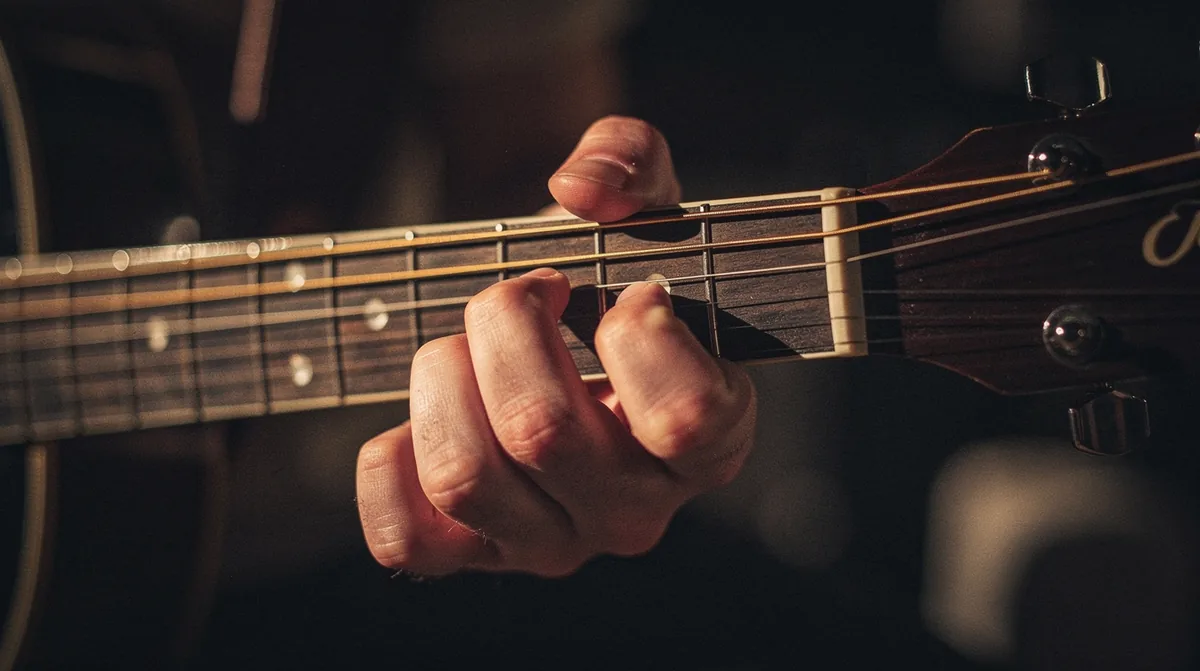
A minor pentatonic contains A, C, D, E, G (root, ♭3, P4, P5, ♭7). The minor pentatonic has five positions on the fretboard, one for each CAGED shape. Pattern 1 (the "box pattern" most guitarists learn first) sits at the 5th fret for A minor pentatonic. Pattern 2 sits at the 8th fret. Each pattern connects to the next, so the entire fretboard is navigable using only these five shapes. The practical advice: learn Pattern 1 first, learn to make music with it before moving to Pattern 2. Five scales learned as music-making tools beat five scales memorized as finger exercises.
How do you use the pentatonic for melody in your songs?
The minor pentatonic of the relative minor shares the same notes as the major pentatonic of the relative major. E minor pentatonic and G major pentatonic both contain E, G, A, B, D. Write a melody using E minor pentatonic over a G major chord progression and it will work naturally.
The pentatonic avoids the two "tension" notes of the full scale (the 2nd and 6th degrees), which is why melodies built from it tend to sound resolved and singable rather than dissonant. This is ideal for vocal melodies in pop and folk songwriting. Adding the "blue note" — the flattened fifth (♭5, also called the tritone) — between the 4th and 5th of the pentatonic creates the blues scale (six notes). That one extra note adds the characteristic blues tension and expressiveness that the pure pentatonic does not carry.
Capo Use for Songwriting
A capo is a clamp that attaches across all six strings at a specific fret, raising the pitch of every string equally by one semitone per fret. It creates a new "nut" at that fret position, allowing guitarists to use open-chord shapes in any key. The core principle: the capo makes pitch go up, so count down from your target key to find which open-chord shapes to use.
| Capo fret | G shape sounds like | D shape sounds like | A shape sounds like | C shape sounds like |
|---|---|---|---|---|
| No capo | G major | D major | A major | C major |
| Fret 1 | A♭ major | E♭ major | B♭ major | D♭ major |
| Fret 2 | A major | E major | B major | D major |
| Fret 3 | B♭ major | F major | C major | E♭ major |
| Fret 4 | B major | F# major | C# major | E major |
| Fret 5 | C major | G major | D major | F major |
| Fret 7 | D major | A major | E major | G major |
What are common capo songwriting techniques?
Vocal range matching. Write a song in G major (easy open chords) and experiment with capo positions to find the key that suits your voice. Capo 2 in G shapes sounds in A major. Capo 5 in G shapes sounds in C major. Same chord fingerings, different keys for different voices.
Timbre shift. A capo at the 5th or 7th fret shortens the vibrating string length, producing a brighter, more metallic tone. The change in timbre — not just key — is why artists use a capo even when they could play the same key without one. The open strings ring differently at higher positions.
Collaboration with other instruments. If a pianist is playing in B♭ major (natural for piano, awkward for guitar), a capo at the 3rd fret lets you play D shapes that sound in F, or a capo at the 1st fret with A shapes that sound in B♭. Use the transposition table above to find the most comfortable guitar shapes for any target key.
Open-tuning capo combinations. Combining a capo with alternate tunings (Open D, Open G) opens up extra tonal variation. Robert Johnson used Open G with a capo to access different resonances across his recordings. Song Cage's guitar mode updates every fretboard diagram automatically when you set a capo position, so you can hear the same song in every comfortable key.
Putting It All Together: A Guitar Songwriting Workflow
Start with a key. For most guitar-based songwriting, G major or D major is the easiest entry point — all your core I, IV, V, vi chords are available as open chords. Pick a progression using Roman numerals: I–V–vi–IV (the most common in pop), I–IV–V (blues and rock), or vi–IV–I–V (more melancholic and searching). Play the progression until it becomes familiar as sound rather than as chord names.
Then ask: what does this progression need? If it sounds too resolved and predictable, replace the IV with the borrowed minor iv — one chord change that adds immediate emotional depth. If the verse feels too bright for the lyrical content, start on the vi instead of the I — same four chords, different emotional opening. If the chorus needs more power than the verse, play the same chords using barre-chord CAGED shapes higher on the neck with more drive in the right hand. If the song needs a key change between sections, use the circle of fifths to find the nearest key that keeps your open-chord shapes accessible, and plan the pivot chord first.
For melody, start with the minor pentatonic that matches your key. In G major, E minor pentatonic (E, G, A, B, D) gives you all five melody notes that work over the G major chord family. Sing through the scale until you find the phrases that land. Then move beyond the pentatonic by adding the 2nd and 6th scale degrees of the full major scale — this is how you expand from a pentatonic vocabulary to a full diatonic melodic range while staying grounded in the shapes you already know.
Using Song Cage alongside this knowledge
Song Cage puts all of this music theory into a single working environment. Pick any key and the In Key tab shows all seven diatonic chords labeled with Roman numerals — I, ii, iii, IV, V, vi, vii° — with a guitar fretboard diagram for every chord including multiple voicings and capo-adjusted positions. The Borrowed tab shows the ♭VII, ♭VI, and minor iv labeled by source mode. The modulation panel finds every pivot chord between any two keys. The context-aware chord suggestion engine reads your melody and ranks every chord by how well it fits the notes you have already written. It is the theory from this guide applied to a real song in real time. For more side-by-side comparisons of music theory tools, see the best music theory apps for beginners and the best chord progression tools for songwriters.
Apply Guitar Theory While Writing Real Songs
Song Cage shows every diatonic chord, borrowed chord, and secondary dominant in any key, with guitar fretboard diagrams, capo support, and a modulation panel. Write the theory, hear it, play it.
Frequently Asked Questions
What music theory do guitarists need to write songs?
Guitarists who write songs need to understand: which keys are guitar-friendly (G, D, A, E, C major and their relative minors), the seven diatonic chords in any key and their Roman numeral labels (I, IV, V, vi), the relative minor relationship, how to use borrowed chords (especially the ♭VII) for emotional color, and how to use the pentatonic scale for melody. Notation reading is not required — chord function and harmonic relationships matter far more. The Nashville Number System is the most practical notation for guitarists: write progressions as numbers (1–5–6m–4) and they work in any key instantly.
What are guitar-friendly keys and which are best for songwriting?
Guitar-friendly keys are major keys where the most common diatonic chords (I, IV, V, vi) fall in comfortable open-chord positions on standard tuning. The five most guitar-friendly keys are: G major (G, C, D, Em all open), D major (D, G, A open — Bm requires a barre), A major (A, D, E open), E major (E, A open — B requires a barre), and C major (C, G open — F needs a barre or capo). G major is the most guitar-natural overall. Their relative minors (E minor, B minor, F# minor, C# minor, A minor) share the same open-chord shapes and are equally guitar-friendly.
What is the CAGED system and how does it help with songwriting?
The CAGED system is a framework for understanding the guitar fretboard using five open chord shapes: C, A, G, E, and D. These shapes, moved up the neck as barre chords, create five overlapping positions that cover the entire fretboard. Each CAGED shape is a reference point for chords, scales, and arpeggios in that area of the neck. For songwriting, CAGED means any chord progression you write in open position can also be played in multiple positions up the neck; the scale pattern surrounding each CAGED shape tells you which melody notes complement your chords at that position; and the five minor pentatonic patterns map directly to the five CAGED shapes.
What is the Nashville Number System and how do guitarists use it?
The Nashville Number System (NNS) was developed by Neal Matthews Jr. of the Jordanaires in the late 1950s and further developed by Charlie McCoy. It uses numbers (1–7) to represent chords by their scale degree rather than their name. The number 1 is always the tonic (home), 4 the subdominant, 5 the dominant, 6m the relative minor. A 1–5–6m–4 progression in G is G–D–Em–C; in A it is A–E–F#m–D; in D it is D–A–Bm–G. Same numbers, same emotional arc, different keys. Guitarists use NNS to write songs once and play them in any key by shifting the capo or starting position.
What is the relative minor and how do I find it on guitar?
The relative minor is the minor key that shares all the same chords as a given major key. It is always built on the sixth degree of the major scale. E minor is the relative minor of G major; A minor is the relative minor of C major; B minor is the relative minor of D major. The quick guitar method: find the root of your major key on the low E string, then count back three frets (three semitones) toward the nut — that fret gives you the root of the relative minor. G is at the 3rd fret; counting back three lands on the open E string — E minor. A is at the 5th fret; counting back three lands on the 2nd fret — F# minor.
How do I use the circle of fifths for guitar songwriting?
The circle of fifths maps how the 12 keys relate to each other — adjacent keys share the most chords. For guitarists, the five most guitar-friendly keys (G, D, A, E, C) sit adjacent to each other on the right side of the circle (the sharp keys). Practical uses: finding pivot chords for key modulation (a chord that exists in both the current key and the destination key), understanding why moving from G major to D major feels so natural (they share five chords), and planning key changes in songs so each section can be played in a guitar-comfortable key.
What are power chords and when should I use them?
Power chords are two-note chords consisting of a root and a perfect fifth — no third. Because they contain no third, they are tonally neutral: neither major nor minor. The shape is always index finger on the root, ring finger two frets higher on the adjacent string. Use power chords when writing rock, punk, or metal riffs where the neutral tonal quality works with distortion; when creating contrast between a verse (open chords, transparent harmony) and a chorus (power chords, driven sound); or when the melody line or vocal should carry the major/minor emotional quality rather than the rhythm guitar. Power chords go back to 1950s electric blues (Willie Johnson, Pat Hare) and were popularized by Link Wray's "Rumble" (1958) and the Kinks' "You Really Got Me" (1964) before becoming the backbone of 1970s heavy rock through Deep Purple, Led Zeppelin, and Black Sabbath.
What are borrowed chords and which ones work best on guitar?
Borrowed chords are taken from the parallel minor key and used inside a major-key song. The three most guitar-friendly borrowed chords in guitar-friendly keys: the ♭VII (flat-seven major — F major in G major, C major in D major — often an open or first-position barre chord) which adds rock energy; the ♭VI (flat-six major — requires a barre but adds cinematic weight); and the minor iv (the diatonic IV chord made minor — Cm in G major, Gm in D major — adds profound melancholy). The ♭VII is the most guitar-friendly borrowed chord because in G, D, and A major it falls in a comfortable barre or open position.
How does the minor pentatonic scale relate to chord progressions?
The minor pentatonic is a five-note scale (root, minor 3rd, perfect 4th, perfect 5th, minor 7th) with five fretboard positions that correspond directly to the five CAGED shapes. The minor pentatonic of the relative minor shares all five notes with the major pentatonic of the relative major: E minor pentatonic and G major pentatonic both contain E, G, A, B, D. A melody using E minor pentatonic works naturally over a G major chord progression. The pentatonic avoids the two "tension" scale degrees (2nd and 6th), which makes melodies built from it sound naturally resolved and singable.
How does a capo help with songwriting?
A capo clamps across all six strings at a specific fret, raising pitch by one semitone per fret and creating a new nut position. Songwriting uses: match your open-chord fingerings to your vocal range without changing hand positions (G shapes with capo 2 sound in A major; G shapes with capo 5 sound in C major); change the tonal character of open chords without changing key (higher capo = brighter, more metallic tone from shorter string length); match a collaborator's key when their instrument's natural keys differ from guitar's natural keys. Song Cage's capo-aware chord palette updates all fretboard diagrams automatically when you set a capo position.
What are diatonic chords and why do they matter for guitarists?
Diatonic chords are the seven chords built naturally from any major key — they all share the same scale notes, so they always sound harmonically correct together. The pattern in every major key is: I major, ii minor, iii minor, IV major, V major, vi minor, vii° diminished. In G major: G (I), Am (ii), Bm (iii), C (IV), D (V), Em (vi), F#° (vii°). Understanding diatonic chords tells you which chords are available in any key without harmonic conflict. For guitarists in guitar-friendly keys, the I, IV, V, and vi are all accessible as open chords, and these four diatonic chords underpin the vast majority of popular music.
How do I write a chord progression on guitar using music theory?
Start in a guitar-friendly key — G major is the easiest entry point. Using the Nashville Number System, pick a progression: 1–5–6m–4 (G–D–Em–C, the most common in pop), 1–4–5 (G–C–D, blues and rock foundation), or 6m–4–1–5 (Em–C–G–D, more melancholic). Play it until you know it as sound rather than chord names. Then ask: does this need more emotional depth? Replace the 4 with the borrowed minor iv (Cm instead of C). Does the chorus need more energy? Try the ♭7 borrowed chord (F major) before the 1. Does the verse need more darkness? Start on the 6m instead of the 1.
Do I need to read music to understand guitar music theory?
No. The music theory most useful for guitar songwriters — diatonic chords, chord function, Roman numerals, the Nashville Number System, CAGED positions, pentatonic patterns, capo transposition, borrowed chords, and relative minor relationships — can all be learned and applied entirely through ear, chord shapes, and the numerical notation systems built for exactly this purpose. The Nashville Number System was created so skilled musicians could work without reading standard notation. Reading notation matters if you need to communicate music to classical musicians, write orchestral arrangements, or study in a conservatory context — none of which are required to write great songs on guitar.
What is the difference between natural minor and harmonic minor for guitarists?
Natural minor uses the same notes as the relative major — E natural minor and G major share all seven notes. Its V chord is minor (Em in E minor), which creates gentle resolution. Harmonic minor raises the seventh degree by one semitone (G# in E minor instead of G), which makes the V chord major (E major instead of Em) — creating much stronger resolution toward the tonic. The harmonic minor's major V produces the intense tension-and-release quality heard in flamenco, classical music, and the Andalusian cadence (i–♭VII–♭VI–V). The practical guitarist consequence: using an E7 chord instead of Em in an A minor progression adds the harmonic minor pull toward Am.