Table of Contents
- The core difference: a songwriting tool or a free DAW?
- Chords and music theory: a guided palette or a blank canvas?
- Lyrics and rhymes: which tool helps you write the words?
- Melody: capture a tune, or play it in?
- Recording, mixing, and mastering: where BandLab pulls ahead
- AI or music theory: two different philosophies
- Collaboration and community: a network or a co-writing room?
- Offline and capture: which is with you when an idea hits?
- Pricing: how much does each cost?
- Full feature comparison
- Who should use Song Cage vs BandLab?
- Frequently asked questions
Our verdict
For writing songs (chords, lyrics, melody, and the theory behind them), Song Cage is the better tool. For recording, producing, mixing, and releasing finished tracks for free, BandLab is. They overlap less than the title suggests. Song Cage is a songwriting app for the ideas stage. BandLab is a free, cloud-based DAW and 100-million-creator social platform for the production stage. Most writers will get the most out of using both, at different points in the same song.
BandLab is one of the most impressive free products in music software. A full multitrack studio in your browser and your pocket, hundreds of instruments, a quarter-million royalty-free samples, free mastering, and a community of over 100 million creators, all at no cost. This is not a knock on BandLab.
But "better for songwriters" depends on what you mean by songwriting. If it means producing and releasing a finished recording, BandLab is built for that and Song Cage is not. If it means the craft of writing the song itself (finding the chords, shaping the words, capturing the melody before it fades), that is a different job, and it is the one Song Cage was built for. This comparison takes both meanings seriously.
Best for writing the song: chords with music theory built in, a lyric workspace with a rhyme finder, melody capture, and phone-to-desktop idea capture. Free to start, then a paid license. Not a DAW.
Best for recording, producing, and releasing music free: a cloud DAW, 370+ instruments, 250,000+ samples, free mastering, collaboration, and a huge community. Core tools are genuinely free. BandLab Pro is $14.99/month (or $99 the first year, then $149/year).
The core difference: a songwriting tool or a free DAW?
Song Cage and BandLab sit at opposite ends of the same song. Song Cage is a songwriting tool for everything that happens before you hit record: the chord progression, the lyric, the melody, and the music theory that ties them together. BandLab is a digital audio workstation, the kind of tool you reach for once you know roughly how the song goes and you want to record, arrange, mix, and release it.
That difference shapes everything below. BandLab gives you tracks, instruments, samples, effects, and a mastering engine. Song Cage gives you a chord palette that explains itself, a lyric lane with rhymes built in, and a melody canvas, with no audio mixing in sight. If you are weighing free studios in general, our roundup of GarageBand alternatives for songwriters covers BandLab and its DAW peers in more depth.
Chords and music theory: a guided palette or a blank canvas?
This is where the two tools diverge most for writers. Song Cage hands you a chord palette built on music theory; BandLab hands you instruments and gets out of the way. Pick a key in Song Cage and you instantly see every chord available to you, with the reasoning attached.
Song Cage's chord palette covers diatonic chords with Roman-numeral function labels, borrowed chords labeled by their source mode, and secondary dominants with resolution arrows. Hover any chord and it explains the move in plain English. A modulation panel maps pivot-chord routes between any two keys, and the route back home. BandLab has on-key helpers, Smart Chords (play a full chord from one note) and Smart Scales (a key detector so anything you play stays in key), plus the AI-driven Smart Tools (Pro) that generate chord, bass, and drum parts. Useful for production, but none of it is a progression-building, theory-teaching workspace.
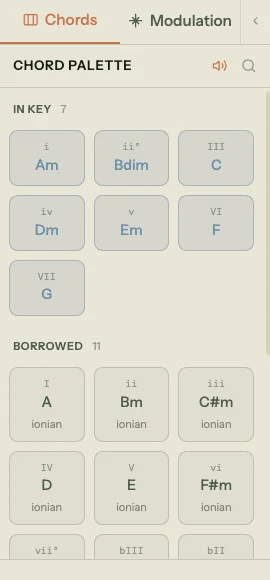
Song Cage
- Full chord palette: diatonic, borrowed, secondary dominants
- Roman-numeral function labels on every chord
- Plain-English reason for each suggestion
- Modulation panel with pivot and return routes
- Guitar and piano voicings for every chord
BandLab
- Smart Chords: one-note chord play on instruments
- Smart Scales: key detector keeps you in key
- Smart Tools (Pro): AI generates chords, bass, drums
- No diatonic palette, Roman numerals, or theory labels
- No modulation or pivot-chord guidance
Verdict: Song Cage for writing chords
If you want to understand and build progressions, Song Cage's theory-labeled palette is purpose-built and BandLab has no equivalent. BandLab's chord helpers are performance aids for playing instruments on key, not a tool for composing harmony. For the writing stage, this round is no contest.
Lyrics and rhymes: which tool helps you write the words?
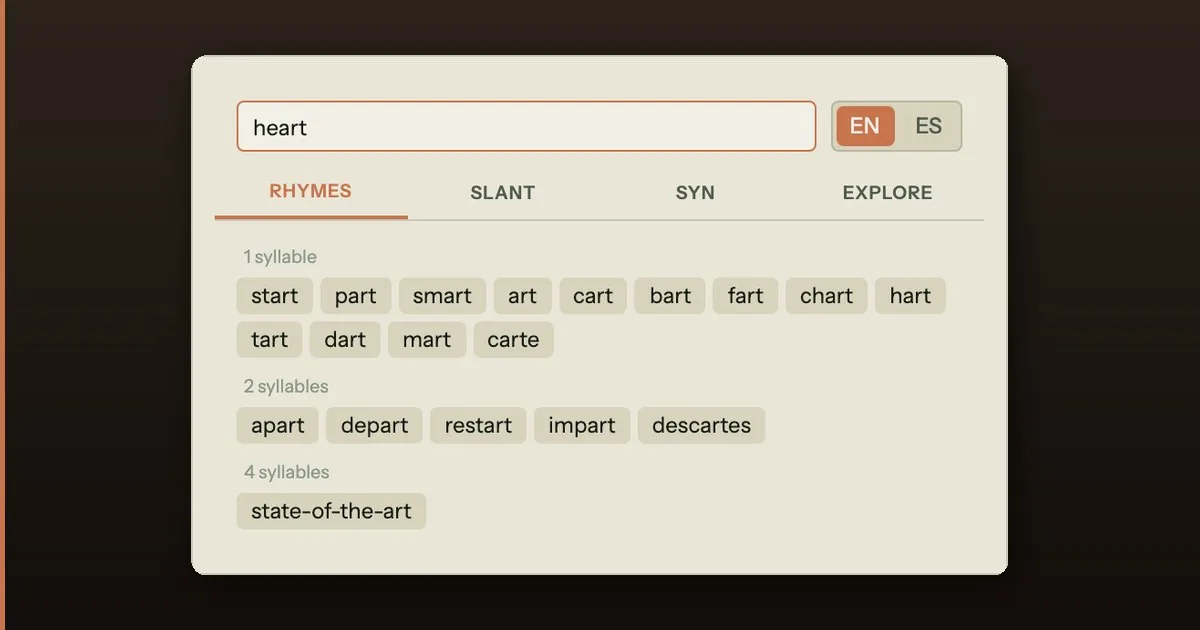
Only one of these tools helps you write lyrics at all. Song Cage has a lyric workspace with rhyme tools built in; BandLab Studio has no lyric editor. When the words are part of your songwriting, this is the single biggest gap between them.
In Song Cage, click any word and word tools open beside your lyrics: perfect rhymes grouped by syllable count, slant rhymes for natural near-rhymes, synonyms for direct swaps, an Explore panel that follows word associations into related territory, and Word Collider for breaking writer's block. The lyric lane stays in sync with the chord timeline and the melody, each word carrying its own note on the beat grid. BandLab is audio and MIDI: there is no lyrics view, no syllable counting, and no rhyme assistance. (SongStarter accepts a short lyric prompt, but it uses that to generate an instrumental idea, not to help you write words.) If lyric tooling is your priority, our guide to rhyme generator tools for songwriters shows where Song Cage's built-in approach fits.
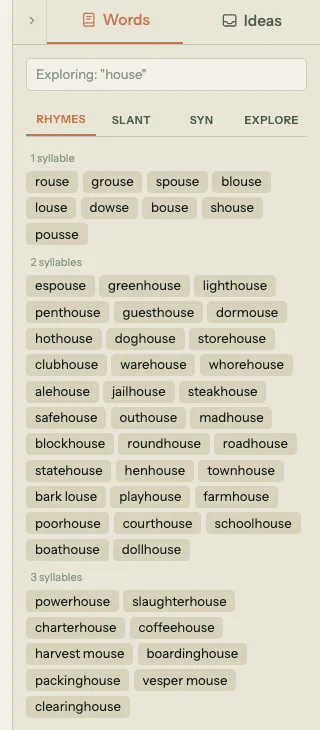
Song Cage
- Rhyme finder with perfect rhymes by syllable count
- Slant rhymes, synonyms, and word-association Explore
- Word Collider for writer's block
- Lyrics synced to chords and melody on one canvas
- Each word sits on a beat and carries a melody note
BandLab
- No lyric editor in Studio
- No rhyme finder or slant-rhyme tools
- No syllable counting or word-association tools
- SongStarter takes a lyric prompt only to generate audio
- Write words in a separate notes app
Verdict: Song Cage, and it isn't close
This is a category gap, not a feature gap. BandLab is not built to write words, and that is fine for its job. For any songwriter who develops lyrics while composing, Song Cage is the only one of the two with anything to offer here.
Melody: capture a tune, or play it in?
For melody-first writing, Song Cage lets you sing or play a melody and turns it into editable notes. BandLab is built around playing parts in and arranging them. If your songs start with a tune in your head, that distinction matters.
Song Cage runs melody detection in the browser, with nothing uploaded, that turns a sung or played take into notes, snaps them to the detected key, and lets you drag them onto the timeline. For a single note there is a shorter path: hold M, sing it, and it lands on the syllable you have selected. Auto Chords then builds a progression that fits the melody, with a Held, Steady, or Active control for harmonic rhythm. You can also enter notes on an inline piano, by Musical Typing, or on a guitar-tab lane. BandLab approaches melody as performance: record an instrument or vocal, play virtual instruments (Smart Scales keeps you in key), or generate a MIDI idea with SongStarter, then quantize and arrange. It does not transcribe a sung melody into notes, but it does render the result as audio, which Song Cage does not.
Verdict: Song Cage to capture, BandLab to produce
To capture a melody you are humming and turn it into notes and chords, Song Cage is the stronger tool, with no BandLab equivalent. To play parts in, arrange them with instruments, and export finished audio, BandLab wins. Choose by whether you start from a tune or finish with a recording.
Recording, mixing, and mastering: where BandLab pulls ahead
This is BandLab's home turf, and Song Cage does not compete here at all. Song Cage plays your song back through a built-in synth so you can hear the chords and melody, but it is not a DAW: there is no multitrack audio recording, no mixing, and no MP3 or WAV export. BandLab does all of it, for free.
BandLab gives you up to 16 audio and MIDI tracks per project (32 with Pro), projects up to 15 minutes long, 370+ virtual instruments, more than 250,000 royalty-free loops and samples, a Drum Machine, a Sampler, and a Looper. Free mastering offers four presets designed with Grammy-winning engineers; AutoPitch handles pitch correction. Pro adds AI mixing and cleanup tools (AutoMix, Voice Cleaner, Voice Changer), a 7-stem Splitter, and Audio-to-MIDI. If your idea of songwriting includes producing the recording, this is a real and large advantage for BandLab. Song Cage's role ends at the demo-ready idea; you would take that into a DAW like BandLab to record it.
BandLab
- Full cloud DAW: up to 16 tracks free, 32 on Pro
- 370+ instruments and 250,000+ royalty-free samples
- Free mastering with Grammy-engineer presets
- MP3 and WAV export, plus stem separation
- AI mixing tools (AutoMix, Voice Cleaner) on Pro
Song Cage
- Built-in synth playback, not a recording studio
- No multitrack audio recording or mixing
- No mastering
- No MP3 or WAV export (MIDI export with the license)
- No sample or loop library
Verdict: BandLab, decisively
For recording, mixing, and mastering, BandLab is in a different class because Song Cage does not try to be a DAW. If producing the track is part of your songwriting, BandLab covers it for free and Song Cage hands off to a tool like it.
AI or music theory: two different philosophies
BandLab leans into AI to generate and polish; Song Cage takes a deliberate no-AI, music-theory stance. Neither is wrong, but they suit different writers, and it is worth knowing which you are.
BandLab's free SongStarter generates three royalty-free musical ideas from a genre or lyric prompt, and Pro adds Smart Tools (Layer, Extend, Recompose) that generate and reshape MIDI parts, plus AI voice and mixing tools. The pitch is speed: get a starting point or a polished result without doing it by hand. Song Cage makes the opposite promise. Its chord suggestions, pitch detection, and Auto Chords all come from music-theory rules running on your device, not a generative model, and every suggestion is explained so you learn why it works. One approach hands you ideas; the other helps you build and understand your own. For writers who want to grow their craft, that explanation is the point; for writers who want a fast produced sketch, BandLab's generators do more.
Verdict: depends on how you want to work
Want generated ideas, AI mixing, and a fast path to a produced demo? BandLab. Want to build progressions yourself and understand the theory as you write, with no AI in the loop? Song Cage. This one is a genuine preference, not a winner.
Collaboration and community: a network or a co-writing room?
BandLab is also a social network; Song Cage is a private songwriting room for you and your bandmates. If reach and feedback matter to you, BandLab's scale is unmatched here. If you want to co-write the bones of a song with a small group, Song Cage's model fits that.
BandLab connects over 100 million creators. You can publish tracks to a feed, get feedback, follow other artists, fork any forkable project to remix it, invite up to 50 collaborators to a project, and even work together in a real-time Live Session in the web Mix Editor. Song Cage's collaboration is quieter and more focused: with a license, share a song with up to five editors by link or email, assign owner, editor, or viewer roles, and edit the same song from different devices. It syncs in the background within a few seconds rather than showing live cursors, so it is closer to a shared document than a live jam. Different goals: BandLab for audience and remix culture, Song Cage for writing a song together.
BandLab
- Community of 100M+ creators with a social feed
- Up to 50 collaborators per project
- Forking: remix any forkable public track
- Real-time Live Session in the web Mix Editor
- Publish and share tracks publicly
Song Cage
- License: up to 5 editors per song
- Owner, editor, and viewer roles
- Background sync within a few seconds
- Private co-writing, not a public network
- No live cursors or public feed
Verdict: BandLab for reach, Song Cage for co-writing
For an audience, feedback, and remixing at scale, BandLab's 100-million-creator network has no rival in this comparison. For privately co-writing a song's chords, words, and melody with bandmates, Song Cage's roles-and-sync model is the better fit.
Offline and capture: which is with you when an idea hits?
Ideas rarely wait for a desk and a Wi-Fi signal, and here the tools behave very differently. Song Cage is offline-first and capture-ready on its free native iOS and Android apps (and in your phone's browser); BandLab is cloud-based and wants a connection.
Song Cage runs in any modern browser and works offline, and it also has free native iOS and Android capture apps: capture a voice memo, a lyric line, or a chord sketch on your phone, with chord context attached, and it shows up on the desktop workspace later. The native desktop app for Mac and Windows works fully offline too. BandLab, by its own help center, lets you start a project offline but needs an internet connection to download instruments and sounds, save, or publish, and it recommends staying connected throughout. For capturing fragments on the move, that is the practical difference. (For more on the capture stage specifically, see our roundup of apps for capturing song ideas fast.)
Verdict: Song Cage for capture and offline
Song Cage is built to capture an idea wherever it lands and sync it later, online or off. BandLab's cloud model is excellent for production but assumes a connection. For the moment inspiration strikes away from the studio, Song Cage is readier.
Pricing: how much does each cost?
BandLab has the more generous free tier in raw capability; Song Cage's paid option is a license with no AI add-ons. They price differently because they sell different things.
Song Cage is free to start, with no credit card. The free tier keeps the songwriting toolset on one song: the full chord palette, all word tools, the modulation panel, melody capture, and playback. One $79 license adds unlimited songs, export, and up to five editors per song, and covers the native desktop app (Mac and Windows) and the AU/VST3 plugin; signing in once in the desktop app or plugin starts a 14-day trial of everything. BandLab keeps its core DAW genuinely free with no time limit, capped at 16 tracks and 15-minute projects, with claim limits on samples (20/month) and beats (2/week). BandLab Pro is $14.99/month, or $99 the first year then $149/year; BandLab Max is $199 the first year then $299/year. Membership adds 32 tracks, AI tools, distribution, and more.
| Plan | Song Cage | BandLab |
|---|---|---|
| Free tier | Full songwriting toolset on one song | Full DAW, no time limit; 16 tracks, 15-min projects, sample claim limits |
| Entry paid (monthly) | None | $14.99/mo (Pro) |
| Entry paid (annual) | None | $99 first year, then $149/yr (Pro) |
| Top paid tier | $79 (license, 5 editors) | $199 first year, then $299/yr (Max) |
| One-time option | $79, full web app, desktop app (Mac and Windows) plus AU/VST3 plugin | None |
| AI add-on | None (no AI) | AI tools bundled into Pro/Max |
Prices verified June 2026 from songcage.com and bandlab.com / the BandLab Help Center.
Verdict: BandLab for free, Song Cage for paid value
If "free forever" is the deciding factor, BandLab's free DAW gives you more raw capability than any free songwriting tool. If you are paying, Song Cage's license bundles every songwriting feature with no AI upsell. They are priced for different jobs.
Full feature comparison
| Feature | Song Cage | BandLab | Better for songwriters |
|---|---|---|---|
| Chord palette with theory labels | Diatonic, borrowed, secondary dominants | No theory palette | Song Cage |
| Modulation / pivot-chord guidance | Pivot + return routes | None | Song Cage |
| Lyric workspace + rhyme finder | Full word-tool suite | No lyric editor | Song Cage |
| Sing-to-notes pitch detection | In-browser, nothing uploaded. Sing a whole take, or hold M and sing one note onto a syllable | No audio-to-melody | Song Cage |
| Guitar fretboard voicings | All chords, positions + capo | Instruments, not a chord reference | Song Cage |
| Offline capture + phone-to-desktop sync | Offline-first, syncs later | Cloud-based, needs internet | Song Cage |
| Multitrack audio recording | No | 16 tracks free, 32 on Pro | BandLab |
| Instruments and sample library | No | 370+ instruments, 250,000+ samples | BandLab |
| Mixing and mastering | No | Free mastering, AI mixing on Pro | BandLab |
| MP3 / WAV audio export | No | MP3, WAV, and stems | BandLab |
| AI idea generation | None by design | SongStarter + Smart Tools | BandLab |
| Community and distribution | No public network | 100M+ creators, distribution on Pro | BandLab |
| Collaborative co-writing | Up to 5 editors (license) | Up to 50, plus Live Session | Tie |
| Genuinely free, no time limit | Free web app, capped at one song | Free core DAW, no time limit | BandLab |
| Paid price | $79 (license) | $99, then $149/yr (Pro) | Song Cage |
Song Cage leads on the writing craft (chords, lyrics, melody, theory, offline capture); BandLab leads on production, community, and free-tier breadth. The "best" tool is the one that matches the stage you are in.
Who should use Song Cage vs BandLab?
The honest split: Song Cage is the better tool for writing the song, and BandLab is the better tool for producing and releasing it. Many songwriters move between the two.
Want a chord palette that explains the theory; write lyrics and want a rhyme finder in the same window; start from a melody you sing or hum and want it turned into notes and chords; need to modulate keys and find your way home; capture ideas on your phone and finish at a desk, online or off; prefer a no-AI, learn-as-you-write approach; or co-write a song's chords and words with a small group.
Want to record audio, build beats, and produce a full track for free; need instruments, samples, mixing, and mastering in one place; want to export MP3 or WAV and distribute to streaming; like AI generators and one-tap mixing tools; want a 100-million-creator community to share with and remix from; or need a capable free DAW with no time limit and no install.
Bottom line
If "songwriting" means writing the song (the chords, the words, the melody, and the theory under them), Song Cage is purpose-built and BandLab barely touches it. If it means recording and releasing the music, BandLab is a free studio Song Cage doesn't try to be. The most productive answer for many writers is both: shape the idea in Song Cage, then produce it in BandLab.
Write the song, then take it anywhere
Song Cage gives you the chord theory, rhyme tools, and melody capture that a DAW like BandLab leaves out. Shape the idea here, then produce it wherever you like. Free to start, no credit card, and 14 days of everything in the desktop app or plugin.
Frequently asked questions
Is Song Cage or BandLab better for songwriters?
It depends on what part of songwriting you mean. For writing the song itself (chords, lyrics, and melody, with music theory built in), Song Cage is purpose-built: it has a theory-labeled chord palette, a lyric workspace with a rhyme finder, a modulation panel, and sing-to-notes melody capture, none of which BandLab has. For recording, producing, mixing, and releasing a finished track, BandLab is a full free DAW and Song Cage is not. Many writers use Song Cage to shape the idea and BandLab to produce it.
Is BandLab really free?
Yes. BandLab's core cloud DAW is genuinely free with no time limit: unlimited projects, free cloud storage, 370+ instruments, access to 250,000+ royalty-free samples (with monthly and weekly claim limits), up to 16 tracks per project, and free mastering. The optional BandLab Pro membership ($14.99/month, or $99 the first year then $149/year) adds 32 tracks, AI tools, music distribution, and more, and BandLab Max runs $199 the first year then $299/year. You can make and share complete tracks without paying anything.
Does BandLab have a chord or lyric tool for songwriters?
Not in the songwriting sense. BandLab Studio has Smart Chords (play a full chord from one note) and Smart Scales (a key detector that keeps your playing in key), which are performance aids for virtual instruments rather than a progression-building palette. It has no diatonic chord palette, Roman-numeral labels, borrowed-chord or modulation guidance, and no lyric editor or rhyme finder at all. Song Cage is built around exactly those: a chord palette that explains each chord and a lyric workspace with rhymes, slant rhymes, synonyms, and word-association tools.
Is Song Cage a DAW like BandLab?
No, and it does not try to be. Song Cage is a songwriting tool for the ideas stage: chords, lyrics, melody, and the theory that links them. It plays your song back through a built-in synth, but it has no multitrack audio recording, no mixing or mastering, no instrument or sample library, and no MP3 or WAV export. BandLab is a full digital audio workstation that does all of that. A common workflow is to write and arrange the idea in Song Cage, then take it into a DAW like BandLab to record and produce.
Can Song Cage turn a melody I sing into chords?
Yes. Sing or play a melody and Song Cage detects the notes in the browser, with nothing uploaded, snaps them to the detected key, and lets you drag them onto the timeline. Auto Chords then builds a progression that fits the melody, with a Held, Steady, or Active control for harmonic rhythm. BandLab has no audio-to-melody detection: you record audio, play parts in on virtual instruments, or generate a MIDI idea with SongStarter. For a melody-first writing workflow, Song Cage captures the tune end to end.
Which has better AI tools, Song Cage or BandLab?
BandLab, if AI is what you want. It includes the free SongStarter idea generator and, on Pro, Smart Tools (Layer, Extend, Recompose) that generate and reshape MIDI, plus AI mixing and voice tools like AutoMix and Voice Cleaner. Song Cage takes the opposite stance on purpose: it generates no music for you. Its chord suggestions and Auto Chords run on music-theory rules on your device, and every suggestion is explained so you learn the reasoning. Melody detection transcribes what you sang rather than inventing anything, and it runs on your device too. If you want generated ideas and one-tap polish, BandLab; if you want to build and understand your own writing, Song Cage.
Does Song Cage work offline? Does BandLab?
Song Cage is offline-first: changes save to a local database in your browser and sync when you reconnect, and the native desktop app for Mac and Windows works fully offline. You can capture ideas with no connection and they appear on your other devices later. BandLab is cloud-based. By its own help center, you can start a project offline, but you need an internet connection to download instruments and sounds, save, or publish, and it recommends staying connected throughout. For capturing ideas away from Wi-Fi, Song Cage is the more reliable choice.
How much does Song Cage cost compared to BandLab?
Song Cage is free to start with no credit card, limited to one song. One $79 license adds unlimited songs, export, and up to five editors per song, and covers the native desktop app (Mac and Windows) and the AU/VST3 plugin; signing in once in the desktop app or plugin starts a 14-day trial of everything. BandLab's core DAW is free with no time limit; BandLab Pro is $14.99/month or $99 the first year (then $149/year), and BandLab Max is $199 the first year (then $299/year). Song Cage's license has no AI add-ons.
Can I use Song Cage and BandLab together?
Yes, and it is a natural pairing because they cover different stages. Write the song in Song Cage: build the chord progression with theory labels, write the lyric with the rhyme tools, capture the melody, and modulate where you need to. Export MIDI from Song Cage with the license, then open BandLab to record vocals and instruments, arrange with its sounds, mix, master, and distribute. Song Cage handles the writing; BandLab handles the production and release. Together they cover a song from first idea to finished recording.
Is BandLab good for writing lyrics or chord progressions?
BandLab is excellent for making beats and producing tracks, but it is not designed for writing lyrics or building chord progressions from theory. There is no lyric editor or rhyme finder in BandLab Studio, and its chord features (Smart Chords, Smart Scales) help you play instruments on key rather than compose harmony. If your writing centers on words and progressions, a dedicated songwriting tool like Song Cage will do far more, while you can still bring the result into BandLab to produce.
Does Song Cage have a mobile app like BandLab?
BandLab has mature native iOS and Android apps. Song Cage has free native iOS and Android apps, and it also runs in any modern phone browser, so you can capture voice memos, lyric drafts, and chord sketches on iPhone or Android and sync them to the full editor on web or desktop. Free native iOS and Android capture apps are live on the App Store and Google Play: record a hummed melody, jot a lyric line, or sketch a chord shape, then sign in to sync it to the full editor on web or desktop. There is also a native desktop app for Mac and Windows. So both let you work on a phone; BandLab's mobile experience is further along, while Song Cage's browser capture already syncs to your desktop.
What is the best BandLab alternative for songwriting?
It depends on which side of BandLab you want to replace. As a free DAW, the closest alternatives are GarageBand, Soundtrap, and similar studios. But if what you actually want is help writing the song (chords, lyrics, and melody), the better fit is a dedicated songwriting tool rather than another DAW. Song Cage covers the writing craft with a theory-driven chord palette, a rhyme-finding lyric workspace, melody capture, and a modulation panel, then hands a clean idea to whatever DAW you produce in.
Is Song Cage good for beginners?
Yes. Song Cage teaches music theory through use rather than study. Pick a key and the chord palette shows which chords work, labeled by Roman-numeral function, and hovering any suggestion explains why in plain English without requiring you to know the terms first. You build harmonic intuition as you write. BandLab is also beginner-friendly, but as a production tool: it is great for learning to record and make beats, less so for understanding why a progression works. For a beginner focused on writing songs, Song Cage's explanations are the gentler on-ramp.
Does BandLab support real-time collaboration?
Yes. BandLab supports up to 50 collaborators per project, lets anyone fork a forkable public track to remix it, and offers a real-time Live Session in the web Mix Editor where collaborators can work at the same time. It is also a social network of over 100 million creators. Song Cage's collaboration is more private and focused: with a license you share a song with up to five editors and roles, syncing in the background within a few seconds rather than with live cursors. BandLab is stronger for reach and remixing; Song Cage for quietly co-writing a song.